Harigi Castle (Susaki City, Kochi Prefecture) Complete Guide | History, Climbing Route, and Highlights Explained in Detail
Harigi Castle, located in Susaki City, Kochi Prefecture, is one of the important mountain castles of Tosa Province during the Sengoku period. Built on a mountain 228 meters above sea level, this castle still retains clear remains and is highly regarded by castle enthusiasts and history buffs. This article provides detailed information useful for mountain castle enthusiasts nationwide, from the history of Harigi Castle to the climbing route and highlights.
Basic Information on Harigi Castle
Location and Geographical Position
Harigi Castle is located in the Harigi (Harigi-jo) district of Susaki City, Kochi Prefecture. Susaki City is located almost in the center of Kochi Prefecture, about 30 kilometers west of Kochi City, the prefectural capital, and is known as a port town facing the Pacific Ocean. Harigi Castle is located relatively close to the Susaki East Interchange, making it easily accessible.
Common Name/Alternate Name
Hariki Castle is also written as “張城” and is called “Harigijō” locally. It is also referred to as “Harigi Castle” after the name of the settlement where it is located.
Former Province and Administrative Division
- Former Province: Tosa Province
- Current Administrative Division: Susaki City, Kochi Prefecture
- Elevation: 228 meters
- Relative Height: Approximately 200 meters
Classification and Structure
Hariki Castle is a typical mountain castle, and its structure has the following characteristics:
- Castle Classification: Mountain Castle
- Layout: Concentric Enclosures
- Main Defensive Structures: Moats, Vertical Moats, and Rows of Vertical Moats
- Keep Structure: None (Due to being a mountain castle from the Sengoku period)
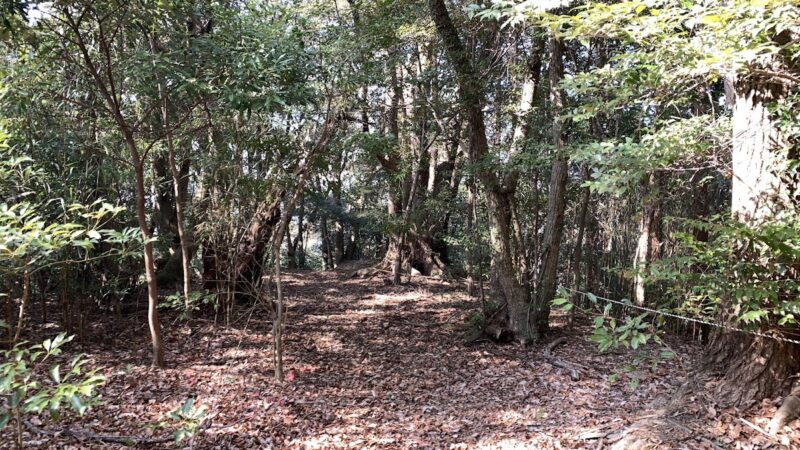
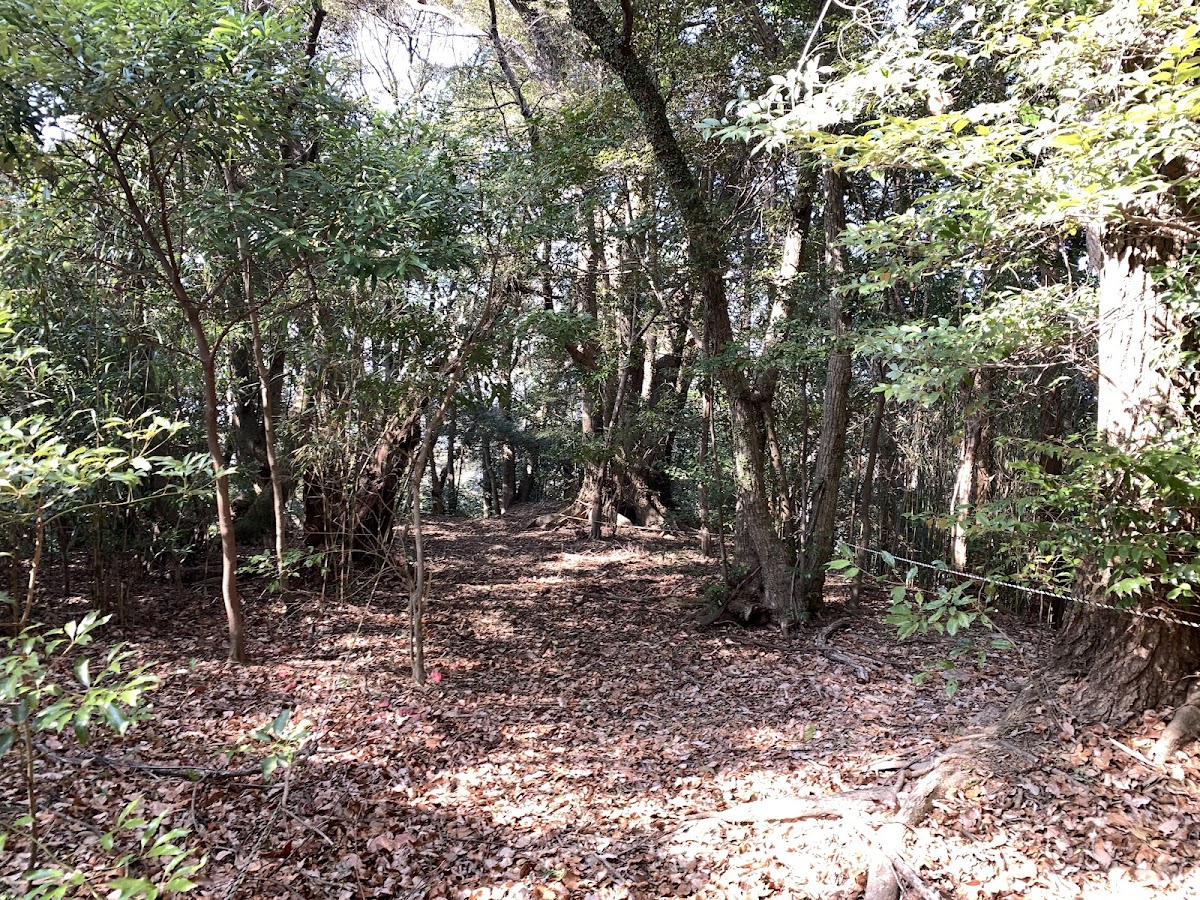
- Current Status: Forest (Well-preserved remains)
History of Hariki Castle
Builder and Construction Year
Detailed records regarding the construction of Hariki Castle are limited, but it is believed to have functioned as a base for regional control in Tosa Province during the Sengoku period. Before the rise of the Chosokabe clan in Tosa Province, many local lords built castles throughout the region, and Hariki Castle was one of them.
The construction period is estimated to be late 15th to early 16th century, and it is thought to have been built by a powerful local figure during the turbulent Sengoku period in Tosa.
Tosa Province and Hariki Castle in the Sengoku Period
During the Sengoku period, Tosa Province was a region where multiple local lords vied for power. The area around Susaki was no exception, and conflicts over regional control were frequent.
In the mid-16th century, the Chosokabe clan began to expand its power. Chosokabe Motochika aimed to unify Tosa, successively subjugating local lords. It is presumed that Hariki Castle played some role in the Chosokabe clan’s process of unifying Tosa, but no records of specific battles or sieges remain.
Date of Abandonment
The exact date of the abandonment of Hariki Castle is unclear, but it is thought to have been abandoned either after the Chosokabe clan’s unification of Tosa during the Tensho era (1573-1592) or after the Battle of Sekigahara during the Keicho era (1596-1615). During the Edo period, under the rule of the Tosa Domain (Kochi Domain), the “One Castle Per Province” decree was implemented, resulting in the abandonment of many mountain castles.
Layout and Remains of Hariki Castle
Features of the Main Enclosure (Honmaru)
The main enclosure of Hariki Castle is located on the mountaintop at an altitude of 228 meters. A triangulation point is installed in the main enclosure, and the layout utilizes the highest point on the ridge. While the main enclosure is relatively compact, traces of an earthen embankment surrounding it can be seen.
From the main enclosure, one can see a panoramic view of Susaki city and Tosa Bay, indicating its location was well-suited for military surveillance.
Moats and Large Moats
The greatest highlight of Hariki Castle is the moats carved into the bedrock. In particular, a large moat is located to the south of the main enclosure, and its scale is impressive.
Characteristics of the Moat:
- Bedrock Excavation: Created by excavating hard bedrock, requiring a massive amount of civil engineering work.
- Depth: A deep moat, several meters deep.
- Defensive Effect: A structure that effectively prevents enemy incursions along the ridge.
This large moat speaks to the high level of castle-building technology of the time and the strong will of the castle lord for defense. Compared to mountain castles throughout Japan, a moat excavated from bedrock is technically advanced and serves as evidence of the importance of Hariki Castle.
Ridge-shaped Vertical Moats
Ridge-shaped vertical moats can be seen on the northern slope of Hariki Castle. Ridge-shaped vertical moats are defensive structures in which multiple vertical moats are arranged parallel to the slope, making lateral movement of the enemy difficult and effectively dividing attacks.
Characteristics of the Ridge-Shaped Vertical Moats at Hariki Castle:
- Location: Slope on the north side of the main enclosure
- Number: Multiple vertical moats arranged in parallel
- Condition: Relatively good and clearly visible on site
Ridge-shaped vertical moats are a castle construction technique from the late Sengoku period, indicating that Hariki Castle was renovated and maintained to a certain level of technical skill.
Continuous Vertical Moats
Continuous vertical moats are also located south of the main enclosure. These moats served to block the ridgeline and limit enemy incursion routes. The arrangement of the vertical moats reveals the tactical thinking of the person who designed the castle layout.
Arrangement of Enclosures (Kuruwa)
It is believed that multiple enclosures were located around the main enclosure, but due to the increasing forestation, some enclosures are now unclear. Nevertheless, the existence of former enclosures can be inferred from the flat areas and elevation changes on the ridgeline. ## Route to Harigi Castle
Access Methods
Access by Car:
- Approximately 5 minutes from the Susaki East Interchange on the Kochi Expressway
- Approximately 10 minutes from Susaki city center via National Route 56
- Head towards the Harigi settlement
Public Transportation:
- Approximately 10 minutes by car from JR Dosan Line Susaki Station
- Taking a taxi from Susaki Station is convenient (walking is difficult)
Entrance to the Castle and Parking
The entrance to the castle is located on the south side of the Harigi settlement. There is no dedicated parking lot, but there are a few parking spaces along the roadside within the settlement. However, please be considerate of the local residents and park respectfully.
Detailed Route to the Castle
Estimated Time: Approximately 1 hour 30 minutes one way to the main enclosure (approximately 3 hours round trip)
Route Overview:
- From the Entrance to the Transmission Tower (approximately 40 minutes)
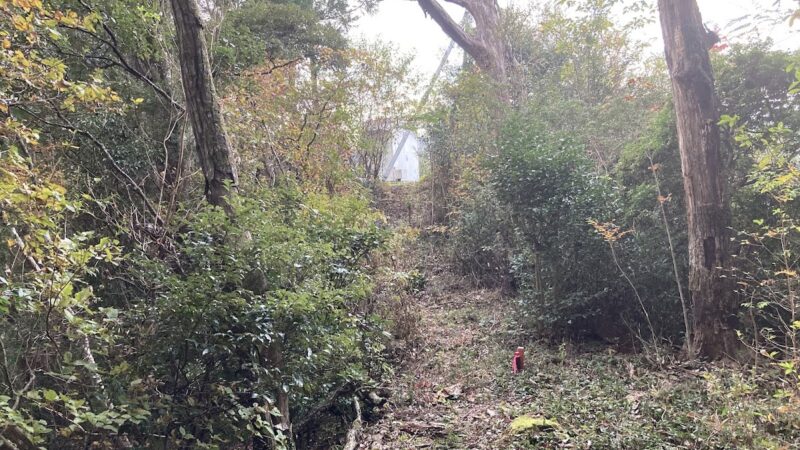
- Enter the mountain from the mountain path south of the settlement
- A relatively steep uphill climb continues
- There is a power transmission tower along the way, which serves as the first landmark
- From the Transmission Tower to the Ridge Path (approximately 20 minutes)
- After passing the transmission tower, you will reach the ridge path
- The route follows the ridge
- There are places where you can see the town of Susaki through the trees
- From the Ridge Path to the Main Enclosure (approximately 30 minutes)
- As you proceed along the ridge, you will encounter remains such as trenches and vertical moats
- After a final steep climb, you will arrive at the main enclosure
- The mountaintop with the triangulation point is the main enclosure
Precautions When Climbing the Castle
- Equipment: Hiking boots, long-sleeved shirt and long pants, gloves, and a hat are essential.
- Season: In summer, vegetation can be overgrown, making the route unclear.
- Safety: Avoid climbing alone; climbing in groups is recommended.
- Hydration: Bring plenty of drinking water.
- Time: Plan with ample time to descend before sunset.
- Weather: Avoid climbing in rainy weather or immediately after rain, as the ground can be slippery.
- Cell Phone: Be aware that there are areas in the mountains where cell phone signals do not reach.
Highlights of Hariki Castle
1. The Great Moat Carved into the Bedrock
The greatest highlight of Hariki Castle is undoubtedly the great moat carved into the bedrock. The work of carving out hard bedrock by hand must have required unimaginable effort by modern standards. Witnessing this moat allows you to truly appreciate the castle-building techniques of the Sengoku period and the hardships endured by the people of that time.
2. The Defensive System of Ridge-Shaped Vertical Moats
The ridge-shaped vertical moats positioned on the northern slope demonstrate advanced defensive techniques from the late Sengoku period. Castles with ridge-shaped vertical moats are rare throughout Japan, making this a testament to the military importance of Hariki Castle.
3. View from the Main Enclosure
From the main enclosure, at an altitude of 228 meters, you can enjoy a panoramic view of Susaki city, Tosa Bay, and the surrounding mountains. On clear days, you can even see the horizon of the Pacific Ocean, highlighting the castle’s excellent military location.
4. Excellent Preservation of Remains
Because Hariki Castle avoided large-scale development after its abandonment, its remains are remarkably well-preserved. The moats, vertical moats, and baileys remain clearly visible, conveying the appearance of a Sengoku period mountain castle.
History and Culture of Susaki City
Overview of Susaki City
Susaki City was formed on October 1, 1954 (Showa 29), through the merger of five towns and villages: Susaki Town, Tanogo Village, Uranouchi Village, Goso Village, and Kamibun Village. It flourished as one of Tosa’s leading port towns and is known nationwide as a fishing town, primarily for bonito fishing.
Climate and Nature of Susaki
Susaki City belongs to the Pacific coast climate zone, characterized by a warm climate and high rainfall. Influenced by the Kuroshio Current, it enjoys a relatively mild climate even in winter. This warm climate has supported people’s lives since ancient times.
Gourmet Culture of Susaki
Susaki City is nationally famous as the birthplace of Nabeyaki Ramen. It also boasts an abundance of fresh seafood, including bonito tataki, making it a representative gourmet town of Kochi Prefecture, attracting many tourists.
Tourist Attractions Around Hariki Castle
Susaki City Center
Located about a 10-minute drive from Hariki Castle, Susaki City Center offers the following tourist attractions:
- Susaki’s Nabeyaki Ramen Restaurants: Several famous restaurants in the city, making it fun to compare them.
- Susaki City Civic Culture Center: A local cultural facility.
- Susaki Fish Market: A market offering fresh seafood.
Uranouchi Bay
Uranouchi Bay, located in the northern part of Susaki City, is known for its beautiful ria coastline. Oyster farming is thriving in the calm bay, and there are facilities where you can enjoy fresh oysters.
Yokonami Kuroshio Line
A scenic drive along the Yokonami Peninsula, which separates Uranouchi Bay from the Pacific Ocean. Enjoy the magnificent view of the Pacific Ocean.
Best Season to Visit Hariki Castle
Spring (March-May)
The weather is mild, making it an ideal season for visiting the castle. The fresh greenery is beautiful, making for a pleasant mountain hike. However, since the vegetation starts to grow around Golden Week, it’s recommended to visit earlier.
Autumn (October-November)
This is the best season for climbing the castle. Temperatures drop, and there are fewer insects. During the autumn foliage season, the entire mountain is colored, offering a beautiful landscape to enjoy.
Summer (June-September)
High temperatures and dense vegetation increase the difficulty of climbing the castle. Heatstroke prevention is essential, and this season is best suited for experienced climbers.
Winter (December-February)
In the mild climate of Susaki City, climbing the castle is relatively easy even in winter, but the shorter daylight hours necessitate an early start.
Preservation and Future of Hariki Castle
The remains of Hariki Castle are currently being investigated and preserved by local castle enthusiasts and history researchers. To preserve the nationally rare bedrock-cut moats and ridged vertical trenches for future generations, proper preservation and management are essential.
In recent years, with the growing interest in mountain castles, Hariki Castle is gradually attracting attention. However, an excessive increase in visitors could lead to the destruction of the remains, so the manners of each visitor are crucial.
Summary
Hariki Castle in Susaki City, Kochi Prefecture, possesses valuable historical significance as a typical example of a mountain castle from Tosa Province during the Sengoku period. Built on a mountain 228 meters above sea level, its robust defensive structures, especially the large bedrock-cut moats and ridged vertical trenches, are must-see remains for castle enthusiasts nationwide.
The climb to the castle takes approximately 1 hour and 30 minutes one way and requires a certain level of physical fitness and equipment, but the rewards are well worth the effort. When visiting Susaki City, be sure to visit this historically romantic mountain castle along with enjoying local cuisine such as nabeyaki ramen.
Hariki Castle is a valuable cultural heritage site that conveys the history of Tosa to the present day. Let’s observe proper etiquette and preserve this magnificent historical site for future generations.