Iwaya Castle (Tsuyama City, Okayama Prefecture) Complete Guide | The Full Story of a Mountain Castle Where 148 Years of Battles Held as a Strategic Point in Mimasaka Province
Basic Information about Iwaya Castle
Iwaya Castle is a medieval mountain castle located in Nakakitakami (formerly Kume Town), Tsuyama City, Okayama Prefecture. Its main keep is situated on the summit of Mt. Iwaya, at an altitude of 483 meters, and it was built at a strategically important location near the border between Mimasaka Province and Bizen Province.
Location and Access Information
Location: Nakakitakami, Tsuyama City, Okayama Prefecture 709-4606
Transportation Access:
- Approximately 15 minutes by car from JR Kishin Line “Mimasaka-Ochiai Station”
- Approximately 20 minutes by car from Chugoku Expressway “Innosho IC”
- Access to the mountain trail is possible from the old Izumo Road along National Route 181
Inquiries: Tsuyama City Cultural Affairs Division (TEL: 0868-24-8413)
Castle Classification and Structure
Former Province Name: Mimasaka Province
Classification and Structure: Mountain castle, multi-bailey style
Builder: Yamana Norikiyo (legend)
Year of Construction: Kakitsu 1 (1441)
Year of Abandonment: Tensho 17 (1589)
Keep Structure: None (As it is a medieval mountain castle, there is no keep.)
Remains: Enclosures, earthworks, moats, ridged vertical moats, well remains, stone walls (partial)
Designated Cultural Property: Okayama Prefecture Designated Historic Site
History of Iwaya Castle
Iwaya Castle functioned as the base for the rule of Mimasaka Province for a remarkable 148 years, from 1441 to 1589. During this time, various daimyo representing the Sengoku period, such as the Yamana, Akamatsu, Urakami, Amago, Ukita, and Mori clans, engaged in fierce battles for control of this castle.
Yamana Clan Rule (1441-)
Construction of Iwaya Castle is said to have begun in 1441 when Yamana Norikiyo was appointed governor of Mimasaka Province. During the Ōnin War (1467-1477), the Yamana clan played a prominent role as a powerful daimyo of the Western Army, and Iwaya Castle was developed as a core base for their control of Mimasaka Province.
The Yamana clan skillfully utilized the natural terrain of Mount Iwaya, placing the main keep at the summit. Taking advantage of its geographical location on the border between Mimasaka and Bizen Provinces, the castle was positioned to monitor the old Izumo Road, a crucial transportation hub. From the summit, one could see as far east as the city of Tsuyama and as far west as the Katsuyama and Kuze districts of Maniwa City, making it an ideal location for military surveillance.
Rule by the Nakamura Clan
The Nakamura clan served as the actual lords of Iwaya Castle under the Yamana clan. Nakamura Yorimune, in particular, is known as a lord of Iwaya Castle and played a crucial role in maintaining the Yamana clan’s power in Mimasaka Province.
The Nakamura clan, as local powerful families, defended the castle while maintaining relations with surrounding local forces. Even after the decline of the Yamana clan’s power, they continued to maintain a certain level of influence in this region.
On the Border of Power Struggle (Sengoku Period)
With the arrival of the Sengoku period, Iwaya Castle became the stage for a complex power struggle over Mimasaka Province.
The Expansion of the Akamatsu Clan
The Akamatsu clan, based in Harima Province, sought to expand their influence into Mimasaka Province and positioned Iwaya Castle as a crucial base. The Akamatsu clan attempted to establish control over Mimasaka Province while strengthening ties with Bizen and Harima Provinces.
The Conflict Between the Urakami and Amago Clans
In the mid-16th century, the Urakami clan of Bizen Province and the Amago clan of Izumo Province clashed over Mimasaka Province. Iwaya Castle became the front line of this conflict. The Amago clan aimed for hegemony in the Chugoku region and sought to expand into Mimasaka Province, but the Urakami clan resisted, and fierce battles raged around Iwaya Castle.
The Rise of the Mori Clan
As the Amago clan declined, the Mori clan of Aki Province rose to power as the dominant force in the Chugoku region. The Mori clan strengthened their influence in Mimasaka Province, and Iwaya Castle was temporarily under their control. The Mori clan prioritized control of Mimasaka Province to secure the transportation route from the Iwami Silver Mine to the Seto Inland Sea.
The Ukita Clan’s Conquest and the Castle’s Demise
The most dramatic development in the history of Iwaya Castle was the conquest by the Ukita clan.
The Siege of 1584
The Ukita clan, based in Okayama, Bizen Province, aimed for complete control of Mimasaka Province and launched a large-scale attack on Iwaya Castle in 1584. To besiege Iwaya Castle, the Ukita clan constructed multiple fortified camps (outposts) in the surrounding mountains. Even today, remnants of the fortified camps from that time remain around the Iwaya River and Myotani River, which flow east and west of Iwaya Castle.
The Ukita clan’s siege was organized and large-scale, employing tactics to completely isolate Iwaya Castle. However, Iwaya Castle, utilizing its natural fortifications, was a strong defense and did not fall easily.
Destruction by Wildfire in 1589
After fierce fighting, in August 1589, Iwaya Castle was destroyed by a wildfire and abandoned. It is unclear whether this wildfire was accidental or intentionally set as part of the siege, but the 148-year history of Iwaya Castle came to an end.
After its abandonment, the Ukita clan ruled Mimasaka Province, and during the Edo period, the Mori clan built and ruled Tsuyama Castle, and Iwaya Castle disappeared from the stage of history.
The Castle Structure of Iwaya Castle
Iwaya Castle is a typical medieval mountain castle built on a high elevation of 483 meters. It features a defensive system that makes maximum use of the natural terrain, and valuable remains that convey the castle-building techniques of the Sengoku period (Warring States period) still exist today.
Arrangement of the Main Enclosure and Major Enclosures
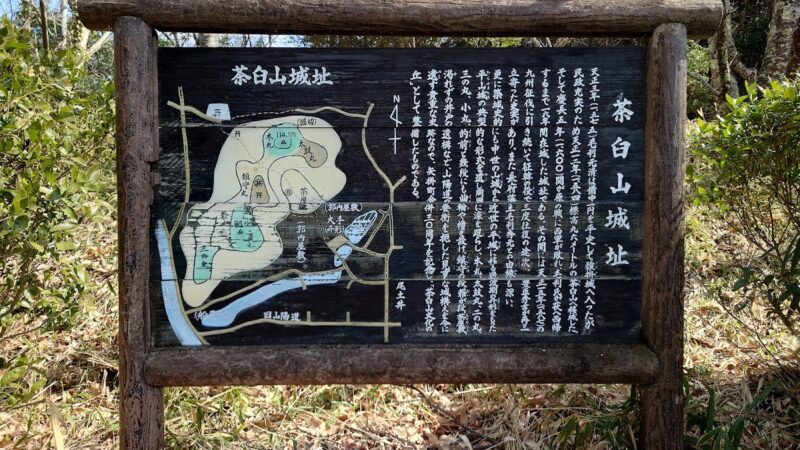
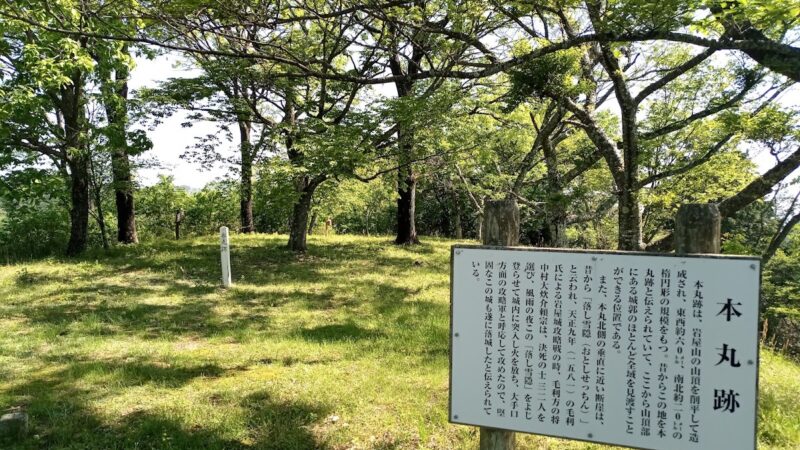
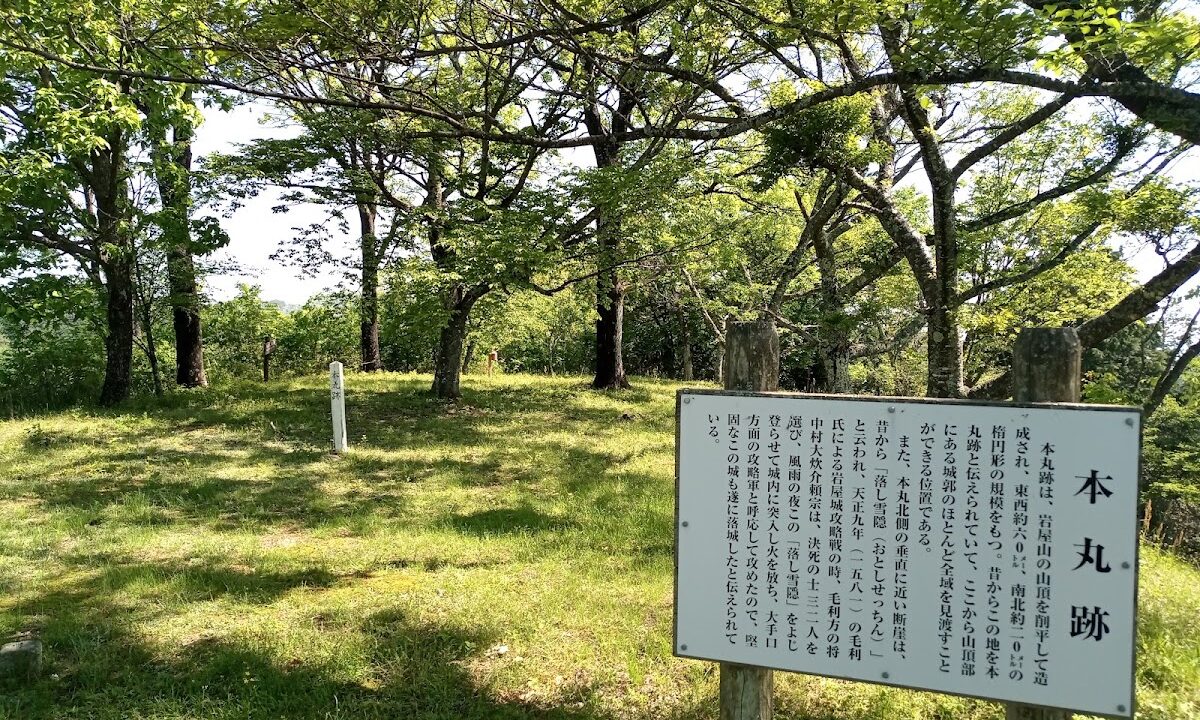
The main enclosure (honmaru) is located at the summit of Mount Iwaya, surrounded by multiple enclosures in a linear layout. The main enclosure measures approximately 40 meters east-west and 30 meters north-south, providing a relatively flat space.
To the north of the main enclosure is a steep cliff called “Otoshi-secchin,” which serves as a natural defensive wall. This cliff was extremely difficult for attackers to climb, effectively making attacks from the north impossible.
Enclosures are arranged in a stepped fashion on the east, south, and west sides. These enclosures function as a defensive line protecting the main enclosure, preventing enemy incursions in stages. Each enclosure was surrounded by earthen ramparts, enhancing its defensive capabilities.
Earthen Ramparts and Moats
The core of Iwaya Castle’s defensive system lies in its meticulously constructed earthen ramparts and moats.
Earthen ramparts, 1-2 meters high, surrounded the main enclosures, preventing enemy intrusion and protecting the interiors from outside views and projectiles. Parts of these ramparts are still clearly visible today, attesting to the advanced castle-building techniques of the time.
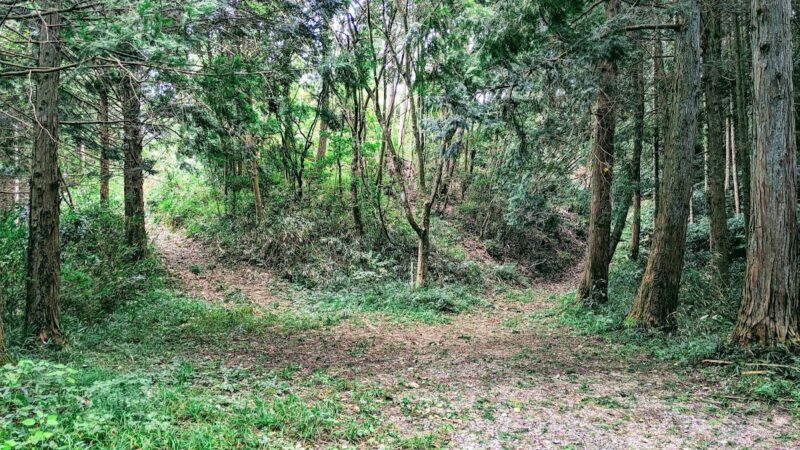
Moats blocking the ridgelines have also been identified in multiple locations. Moats are crucial defensive structures that limit enemy intrusion routes and artificially create terrain advantageous to the defenders. At Iwaya Castle, moats 3-5 meters deep were constructed along the main ridges, significantly hindering the advance of attackers.
The Defensive System of Ridge-Shaped Vertical Moats
One of the notable features of Iwaya Castle’s distinctive remains is the ridge-shaped vertical moat system. This system consists of multiple vertical moats dug parallel to the slope, making it difficult for enemy soldiers to climb the slope.
The ridge-shaped vertical moat system demonstrates the castle-building techniques of the late Sengoku period, indicating that Iwaya Castle’s defensive capabilities were strengthened over time. It is believed to have been particularly developed as part of the defensive reinforcement during the period of intense conflict with the Ukita clan.
The raised areas (ridges) between the vertical moats restrict the movement of climbing enemy soldiers, allowing the defenders to effectively intercept them. The ridge-shaped vertical moats that remain on the slope today are valuable historical remains that convey the tense battle situation of that time.
Wells and Water Source Securing
One of the most important challenges for mountain castles is securing a water source. At Iwaya Castle, well remains have been confirmed around the main keep, indicating that a water source was secured in preparation for a siege.
Digging wells at an altitude of 483 meters is technically difficult, but at Iwaya Castle, construction work was carried out to reach the underground water vein by excavating through the bedrock. This well continued to function as a lifeline for the castle’s soldiers throughout its 148-year history.
Use of Stone Walls
Iwaya Castle is basically an earthen mountain castle, but the use of stone walls has been confirmed in some areas. These were used at the main gates (entrances) and parts of important baileys, serving to strengthen defenses and as a symbol of authority.
The stone walls are built using the nozurazumi technique, stacking natural stones, and are valuable historical materials demonstrating stonework techniques of the Sengoku period. While not the neatly arranged stone walls of later early modern castles, they are important examples of stonework use in medieval mountain castles.
Current Status and Highlights of Iwaya Castle Ruins
Currently, Iwaya Castle Ruins are protected as a designated historical site of Okayama Prefecture, and are a valuable historical heritage site that conveys the appearance of a mountain castle from the Sengoku period.
View from the Summit
One of the greatest attractions of Iwaya Castle is the magnificent view from the summit. Standing on the site of the main keep at an altitude of 483 meters, a 360-degree panorama unfolds.
To the east, you can see the entire city of Tsuyama, and even locate Tsuyama Castle (Tsuruyama Castle). To the west, the view opens up to the Katsuyama and Kuze districts of Maniwa City, allowing you to see the vast territory of Mimasaka Province. To the south, the Chugoku Expressway, National Route 181, and the key point of the old Izumo Road, where the JR Kishin Line runs, spread out below, giving you a real sense of how strategically important this castle was.
To the north, the mountains of the Chugoku Mountains stretch out, allowing you to see the rugged terrain of the border region between Mimasaka Province and Bizen Province. This view eloquently explains why Iwaya Castle was the stage for 148 years of fierce battles.
Preservation of the Remains
Although more than 400 years have passed since the abandonment of Iwaya Castle, the main remains are preserved in relatively good condition.
The flat surface of the main keep is clearly visible, and the surrounding enclosures remain as stepped terrain. While some of the earthworks have collapsed, the main parts retain their height and shape, allowing us to imagine their appearance at the time.
Some of the moats are filled in, but the deep, sharply dug sections are still clearly visible, conveying their impressive defensive capabilities. The ridged vertical moats also leave clear traces on the slopes, making them valuable teaching materials for learning about castle construction techniques of the Sengoku period.
Surrounding Camp Fortifications
Around Iwaya Castle, there are several camp fortifications built during the siege by the Ukita clan in 1584. These are auxiliary forts built to surround Iwaya Castle, scattered throughout the mountains surrounding the Iwaya River and Myotani River.
Visiting both the fortified encampments and Iwaya Castle itself provides a comprehensive understanding of the realities of siege warfare during the Sengoku period. It’s a valuable field for experiencing Sengoku-era battles from both the perspectives of the besieger and the defended.
Ascent Route and Time Required
To reach Iwaya Castle, you will use a mountain trail. From the trailhead to the main keep, it takes approximately 40-60 minutes for someone in good physical condition.
While the trail is well-maintained, there are steep slopes typical of mountain castles, so appropriate clothing and footwear for hiking are necessary. Particular caution is needed after rain, as the trail can become slippery.
If you take your time observing the various enclosures and defensive structures along the way, the climb will take approximately 1 hour 30 minutes to 2 hours. Including breaks at the summit and time to view the ruins, allow 3-4 hours for the round trip.
Iwaya Castle Walk Rally
To promote awareness of the history and charm of Iwaya Castle, the “Iwaya Castle Walk Rally” is held annually. This event is organized by the Tsuyama Chamber of Commerce and Industry Youth Division, and co-sponsored by the Iwaya Castle Preservation Society and the Mimasaka Medieval Mountain Castle Liaison Council.
Participants walk the path to Iwaya Castle, visiting checkpoints at key locations. Explanations are provided by local history enthusiasts and experts, making it an excellent opportunity to learn about the history and structure of Iwaya Castle.
The event attracts many participants every year as an important initiative to protect local historical heritage and pass it on to future generations.
Historical Significance of Iwaya Castle
Iwaya Castle is not merely a local mountain castle; it is an extremely important historical site for understanding the political and military situation in the Chugoku region from the medieval period to the Sengoku period.
A Base for Controlling Mimasaka Province
Mimasaka Province was an inland province surrounded by other provinces such as Bizen, Bitchu, Harima, Inaba, and Hoki, and held a crucial position as a transportation hub. Iwaya Castle was located in the southwestern part of Mimasaka Province, on the border with Bizen Province, and functioned as a base for border defense and monitoring transportation routes.
The fact that powerful Sengoku-era daimyo such as the Yamana, Akamatsu, Amago, Mori, and Ukita clans fought over Iwaya Castle is due to its strategic importance; controlling this castle would lead to control of the entire Mimasaka Province.
A Typical Example of a Medieval Mountain Castle
Iwaya Castle is a valuable archaeological site that preserves the structure of a medieval mountain castle in excellent condition. With its layout that makes maximum use of the natural terrain, defensive systems using earthworks and moats, and sophisticated defensive facilities such as ridged vertical moats, it occupies an important position in the study of castle history as a castle that embodies the pinnacle of Sengoku-era castle construction technology.
In particular, the ridged vertical moats demonstrate technological innovation from the late Sengoku period, and the remains of Iwaya Castle are valuable resources for studying the development of castle construction techniques in the Chugoku region.
Witness to Local History
The 148-year history of Iwaya Castle directly reflects the medieval and Sengoku period history of Mimasaka Province. From the Ōnin War to the warring states of the Sengoku period and the unification of Japan under the Oda-Toyotomi regime, Iwaya Castle witnessed the turbulent times from the front lines.
Each remaining structure at the castle site conveys the memories of the lives and battles fought in this land, and is an important element in forming the historical identity of the region.
Related Historical Sites Around Iwaya Castle
When visiting Iwaya Castle, visiting the surrounding related historical sites will allow you to understand the history of Mimasaka Province more deeply.
Tsuyama Castle (Tsuruyama Castle)
Tsuyama Castle, built by the Mori clan during the Edo period, became the center of Mimasaka Province’s rule after the abandonment of Iwaya Castle. As a representative example of early modern castles, Iwaya Castle has a structure that is in stark contrast to medieval mountain castles, allowing us to learn about the changes in castle construction techniques over time.
Medieval Mountain Castles of Mimasaka
Numerous mountain castles from the same period remain around Iwaya Castle. These castles form a defense network centered on Iwaya Castle, and are a valuable group of ruins that show the reality of medieval territorial control in Mimasaka Province.
Old Izumo Road
The old Izumo Road, which passes below Iwaya Castle, functioned as an important transportation route from ancient times to the early modern period. Remains of post towns and milestones remain along this road, providing clues to understanding the location of Iwaya Castle from the perspective of transportation history.
Summary
Iwaya Castle in Tsuyama City, Okayama Prefecture, is a Sengoku period mountain castle built on the summit of Mt. Iwaya (483 meters above sea level). It functioned as a key point for the control of Mimasaka Province for 148 years, from 1441 to 1589. Iwaya Castle was the stage for fierce battles between powerful Sengoku-era daimyo such as the Yamana, Akamatsu, Amago, Mori, and Ukita clans. Its castle structure, which utilizes natural fortifications, and its well-preserved remains are invaluable resources for the study of medieval mountain castles.
Currently protected as a designated historical site of Okayama Prefecture, visitors can see the remains of the main keep, baileys, earthworks, moats, and ridged vertical trenches. From the mountaintop, a magnificent view unfolds, stretching from Tsuyama city to Maniwa city, allowing visitors to appreciate why this castle was considered a strategically important location.
Preservation efforts continue through events such as the Iwaya Castle Walk Rally, and it remains a valuable historical site where one can feel the romance of the Sengoku period, making it popular with many history enthusiasts and castle fans. Iwaya Castle, indispensable for understanding the history of Mimasaka Province, will undoubtedly continue to be a source of regional pride for future generations.