Taikomaru Castle (Wake District, Okayama Prefecture) Complete Guide | A Bizen Mountain Castle that Flourished as an Outpost of Tenjin-yama Castle
What is Taikomaru Castle?
Taikomaru Castle is a medieval mountain castle located on Tenjin-yama in Tado, Wake-cho, Wake-gun, Okayama Prefecture. Built as an outpost (branch castle) of Tenjin-yama Castle, a representative mountain castle of Bizen Province, it functioned as an important military base under the influence of Urakami Munekage during the Sengoku period.
The current Taikomaru Castle ruins retain well-preserved remains such as stone-walled gates, moats, and baileys, making it a valuable historical site for learning about the structure of medieval mountain castles. Its easy access, via a ridge climb from Wake Utsukushii Mori (Wake Utsukushii Mori Campsite), is also one of its attractions.
History of Taikomaru Castle
Background and Period of Construction
The exact construction period of Taikomaru Castle is unknown, but it is estimated to be around the 16th century, during the mid-Sengoku period. Taikomaru Castle is believed to be one of the outposts built by Urakami Munekage, who expanded his power as the deputy governor of Bizen Province, to enhance the defenses of his base, Tenjin-yama Castle.
Tenjin-yama Castle was a large mountain castle built on a mountaintop approximately 400 meters above sea level. Taikomaru Castle, located on the western ridge, was an important defensive stronghold against invasions from the west.
The Urakami Clan and Taikomaru Castle
Urakami Munekage was a powerful daimyo (feudal lord) who dominated Bizen Province, and at his peak, controlled Bizen, Mimasaka, and parts of Harima Province. He used Tenjin-yama Castle as his residence and constructed a strong defensive network by placing several subsidiary castles around it. Taikomaru Castle was a fortress that played a part in this defensive system.
The Urakami clan gradually lost power due to the rise of their vassal, Ukita Naoie, and eventually perished. It is believed that both Tenjin-yama Castle and Taikomaru Castle were abandoned.
Post-Abandonment Transformation
With the end of the Sengoku period, Taikomaru Castle ceased its military role and subsequently returned to nature. However, major remains such as stone walls and moats were well preserved, conveying its original appearance to the present day.
In recent years, local history enthusiasts and castle researchers have been conducting investigations, leading to a re-evaluation of its historical value. With the development of the beautiful Wake Forest, the access path to the castle has also been improved, making it a popular destination for history buffs.
Structure and Highlights of Taikomaru Castle
Overall Structure
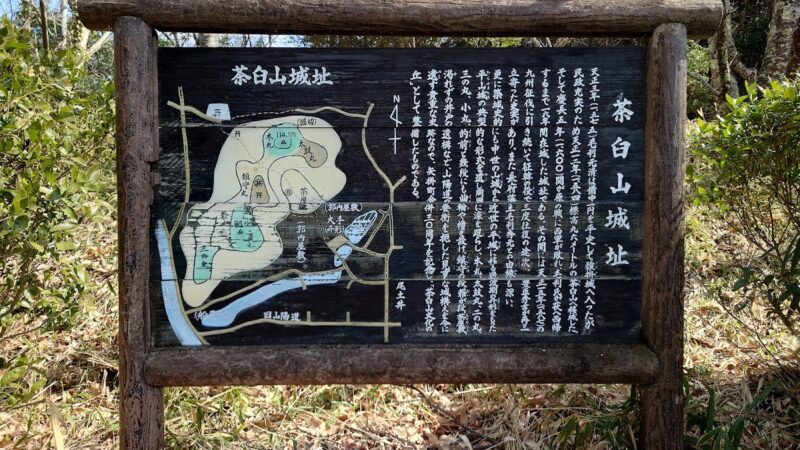
Taikomaru Castle is a multi-bailey mountain castle built on the western ridge of Tenjin-yama. Multiple baileys are arranged along the ridge, centered around the main bailey. The relative height is approximately 200 meters, and the castle’s layout utilizes the steep terrain for high defensive capabilities.
A mountain path continues along the ridge to the main bailey of Tenjin-yama Castle, demonstrating from the topography that the two castles functioned as an integrated defensive system.
Stone-Walled Entrance
The greatest highlight of Taikomaru Castle is the magnificent stone-walled entrance remaining on the east side of the main enclosure. This entrance is unusual for a medieval mountain castle, as the carefully constructed stone wall still exists.
The stone wall is built using the “nozurazumi” method, achieving a stable structure while utilizing natural stones. The entrance is approximately 2 meters wide, a narrow design intended to prevent enemy intrusion. This stone wall is an important historical site for understanding the stone-walling techniques of the Bizen region.
Military Stones (Group of Megaliths)
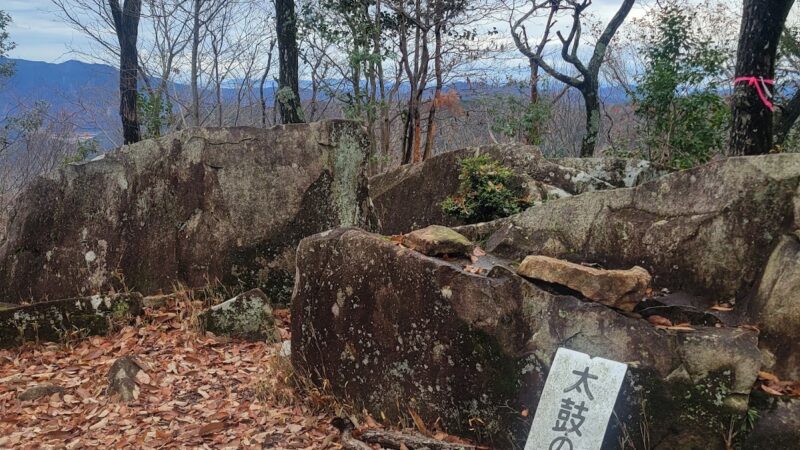
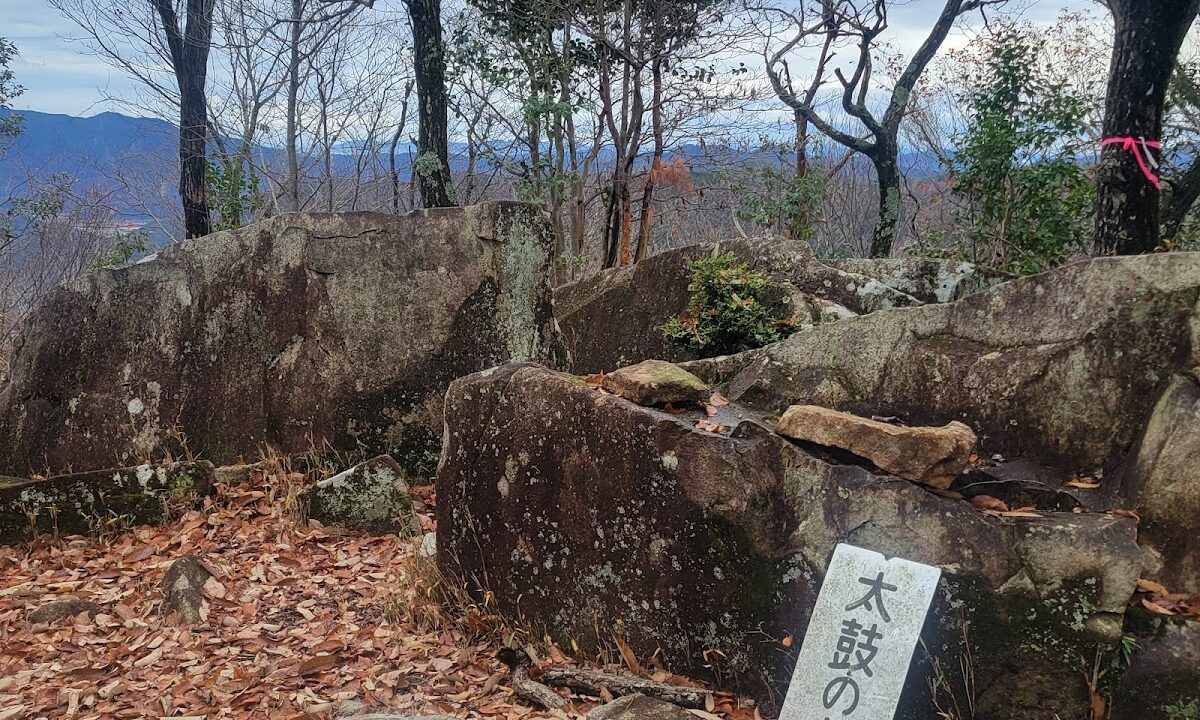
A group of megaliths known as “military stones” is positioned on the western ridge of the main enclosure. These megaliths were placed on the ridge to defend against enemy attacks, and it is believed that they were intended to be rolled down the slope to attack enemy soldiers in times of need.
Some of the military stones exceed 1 meter in diameter, and their placement suggests that they were planned and prepared. While such military stones are found as defensive structures in medieval mountain castles in various locations, the example at Taikomaru Castle is large in scale and well-preserved. ### Moat
The moat, which divides the ridge, is also an important defensive structure of Taikomaru Castle. The moat, which separates the main enclosure from the western ridge, is approximately 3 meters deep and 5 meters wide, and served to physically prevent enemy intrusion.
Earthworks were built on both sides of the moat, demonstrating an effort to further enhance its defensive capabilities. The moat, which can still be clearly seen today, is a valuable historical site that allows us to experience the layout techniques of medieval mountain castles.
Enclosures
Taikomaru Castle has multiple enclosures. The main enclosure is an oval shape, approximately 30 meters east-west and 20 meters north-south, and is built on a higher level than the surrounding area. From the main enclosure, one can overlook the town of Wake and the flow of the Yoshii River, indicating that it also served a surveillance function.
The second and third enclosures are arranged around the main enclosure, creating a structure that allows for tiered defense. The flat surfaces of each enclosure are relatively well-preserved, allowing visitors to appreciate the castle’s original scale.
Origin of Taikomaru
The name “Taikomaru,” which gives the castle its name, is said to be related to a drum platform that was located near the main enclosure. In mountain castles of the Sengoku period, drums were used for signaling and telling time, and it is presumed that a similar facility existed at Taikomaru Castle.
Access and Castle Visit Guide
Basic Information
- Location: Tado, Wake-cho, Wake-gun, Okayama Prefecture (Tenjin-yama)
- Castle Type: Mountain Castle (Outpost)
- Construction Period: Mid-Sengoku Period (Estimated)
- Main Lord: Urakami Clan
- Remains: Stone walls, moats, baileys, earthworks, military stones
- Designated Cultural Property: None
- Parking: Parking available at Wake Utsukushii Mori Campground parking lot
Transportation Access
Access by Train
- Get off at JR Sanyo Main Line “Wake Station”
- Approximately 10 minutes by car from Wake Station to Wake Utsukushii Mori (by taxi)
- Approximately 1 hour 30 minutes on foot from Wake Station
Access by Car
- Approximately 15 minutes from Sanyo Expressway “Wake IC”
- Head towards Wake Utsukushii Mori Campground
- Approximately 40 minutes from Okayama City via National Route 374
Parking
- Use the parking lot at Wake Utsukushii Mori Campground (free)
- Parking capacity: Approximately 50 cars
Castle Ascent Route
Route from Wake Utsukushii Mori (Recommended)
- Park in the Wake Utsukushii Mori Campground parking lot
- Enter the hiking trail from the back of the campground
- Head east along the ridge for approximately 20 minutes to reach the main enclosure of Taikomaru Castle
- Continue along the ridge to reach Tenjin-yama Castle (approximately 40 minutes)
The climbing route is relatively well-maintained, but since it is a mountain trail, athletic shoes or hiking boots are necessary. The distance is approximately 800 meters, and the elevation difference is approximately 200 meters.
Estimated Time Required
- From the parking lot to the main enclosure of Taikomaru Castle: Approximately 1 hour round trip
- Additional time from Taikomaru Castle to Tenjin-yama Castle: Approximately 1 hour 30 minutes round trip
- For a thorough visit: 2 to 3 hours
Precautions When Visiting the Castle
- Season: Spring to autumn is recommended. Snow is possible in winter.
- Clothing: Long-sleeved shirt and long pants, athletic shoes or hiking boots are essential.
- Items to Bring: Drinking water, towel, insect repellent (summer)
- Safety: Avoid visiting alone; visiting in groups is recommended.
- Weather: Avoid visiting in rainy weather as it can be slippery.
- Time: Plan to descend before sunset.
Relationship with Tenjin-yama Castle
Integrated Defense System
Taikomaru Castle functioned as an outpost protecting the western side of Tenjin-yama Castle. Tenjin-yama Castle was a large mountain castle with its main keep located on a mountaintop approximately 400 meters above sea level, and it was the political and military center of Bizen Province.
The distance from Taikomaru Castle to Tenjin-yama Castle is about 1.5 kilometers along the ridge, and a mountain path has been maintained. This ridge path was used as a military communication route, and in emergencies, the two castles could cooperate in defense.
Comparison with Tenjin-yama Castle
While Tenjin-yama Castle was a large main castle, Taikomaru Castle was a compact outpost. However, it had well-developed defensive facilities such as stone walls and moats, and was fully capable of functioning as an independent defensive base.
Visiting both castles allows for a three-dimensional understanding of the mountain castle defense system of the Sengoku period. Those with sufficient physical stamina are recommended to visit both Taikomaru Castle and Tenjin-yama Castle.
Nearby Tourist Attractions
Wake Shrine
A shrine dedicated to Wake no Kiyomaro, and a representative tourist attraction of Wake Town. The temple grounds feature a statue of Wake no Kiyomaro and a museum, where you can learn about the history of the Nara period. It’s about a 15-minute drive from Taikomaru Castle.
Wake Beautiful Forest
This campsite, which serves as the entrance to Taikomaru Castle, offers a chance to enjoy the outdoors in a rich natural environment. It’s equipped with campsites, bungalows, and cooking facilities, making it popular with families.
Wake Town Wisteria Park
Known as having the largest wisteria trellis in Japan, this park hosts a wisteria festival every year from late April to early May. The sight of approximately 100 varieties of wisteria in full bloom is breathtaking.
Yoshii River
One of Okayama’s three major rivers, it flows through the center of Wake Town. Historically, it was a ferry crossing called “Wake no Watashi,” which is the origin of the town’s name.
The Charm and Historical Value of Taikomaru Castle
Excellent State of Preservation
The greatest charm of Taikomaru Castle is the excellent state of preservation of its remains. The stone walls, moats, baileys, and military stones are well-preserved, making it easy to imagine the castle’s appearance at the time of its construction.
In particular, the stone-walled entrance gate is a valuable example of a medieval mountain castle and serves as important historical material for understanding the stonework techniques of the Bizen region.
Value for Medieval Mountain Castle Research
Taikomaru Castle provides a wealth of information for the study of medieval mountain castles, including its function as an outpost, the arrangement of defensive facilities, and its relationship with Tenjin-yama Castle.
Taikomaru Castle is indispensable for understanding the castle policies of the Urakami clan and the mountain castle defense system of the Sengoku period.
Ease of Access
Taikomaru Castle’s appeal lies in its relatively easy access from the beautiful forest of Wake. It’s accessible even for beginner hikers and enjoyable for families.
Walking along the well-maintained mountain path offers a valuable opportunity to experience a Sengoku period mountain castle.
Best Season for Visiting
Spring (March-May)
The season of fresh greenery and mild temperatures makes it ideal for visiting the castle. Especially from late April to early May, you can visit in conjunction with the Wisteria Festival at Wake Town Fuji Park.
Autumn (October-November)
The autumn foliage is beautiful, and the temperature is suitable for visiting the castle. It’s an excellent season to enjoy the autumn colors of Tenjin-yama while strolling through history.
Summer (June-September)
The greenery is lush, and you can fully enjoy nature, but the temperature is high and there are many insects, so sufficient preparation is necessary. Visiting early in the morning is recommended.
Winter (December-February)
The air is clear and the views are excellent during this season, but there is a possibility of snow and ice, so please check the weather carefully before visiting.
Points for Enjoying Taikomaru Castle
Pre-visit Study
Learning about the history of the Urakami clan and Tenjin-yama Castle before your visit will deepen your understanding at the site. Bringing a map or layout diagram will make it easier to understand the relative locations of the remains.
Photography
With many points of interest such as the stone wall gate, military stones, and moats, we recommend bringing a camera. The view from the main enclosure is also a great photo opportunity.
Consecutive Visits to Tenjin-yama Castle
If you are confident in your physical stamina, try the route from Taikomaru Castle to Tenjin-yama Castle along the ridge. Visiting both castles will give you a real sense of the relationship between the outpost and the main castle.
Utilizing Local Guides
The Wake Town Tourism Association sometimes offers guided tours depending on the season. Visiting while listening to explanations from experts will give you a deeper understanding.
Summary
Taikomaru Castle is a Sengoku period mountain castle located in Wake-cho, Wake-gun, Okayama Prefecture. It played an important role as an outpost protecting Urakami Munekage’s Tenjin-yama Castle. The remains of the medieval mountain castle, such as the stone wall gate, military stones, moats, and baileys, are well-preserved, making it a valuable historical site for learning about the Sengoku period mountain castle defense system.
Taikomaru Castle is easily accessible, allowing visitors to ascend along the ridge from the beautiful forest of Wake. It’s recommended not only for castle enthusiasts but also for history buffs and those who enjoy nature walks. Visiting it along with Tenjin-yama Castle will provide an even more enriching historical experience.
When visiting Okayama Prefecture, be sure to visit Taikomaru Castle and reflect on the Sengoku period in Bizen Province. The history etched into the stone walls, the military stones remaining on the ridge, and the view of Wake from the main enclosure will transport you to the Sengoku period.