Miyayama Castle (Tsu City, Mie Prefecture) Complete Guide | A Thorough Explanation of History, Remains, Access, and Surrounding Sightseeing
What is Miyayama Castle?
Miyayama Castle is a medieval mountain castle located in Toki-cho, Tsu City, Mie Prefecture. Currently, the castle ruins are on the hill behind the Minta Shrine. Built on a hill approximately 45 meters above sea level, it is a relatively low-lying castle with a relative height difference of about 25 meters. It is known as a historically valuable castle site, serving as an important military base during the Sengoku period in Ise Province, and the stage for battles between the Kizukuri clan and the Oda and Hashiba forces.
Miyayama Castle functioned as a branch castle (outpost) of Toki Castle, playing an important role in the defense of the northern region. Even today, remains such as earthworks, moats, and baileys remain in good condition near the summit, and it is designated as a city historical site, a valuable cultural asset of Tsu City, Mie Prefecture.
History of Miyayama Castle
Background of Construction and the Kizukuri Clan
Miyayama Castle was built by Kizukuri Tomomasa, who wielded considerable power in Ise Province during the Sengoku period. The Kizukuri clan, as local lords of Ise Province, maintained their power by building multiple castles in the region. Miyayama Castle was strategically positioned as an outpost protecting the northern part of Toki Castle, the Kizukuri clan’s base.
While under the influence of Oda Nobunaga during his period of power expansion, Kizukuri Tomomasa maintained a degree of independence. Miyayama Castle, playing a key role in the castle network centered around Toki Castle, was an important military facility supporting the Kizukuri clan’s rule in Ise Province.
The Battle of Komaki and Nagakute and the Fall of Miyayama Castle
The most important event in the history of Miyayama Castle is the battle for the castle during the “Battle of Komaki and Nagakute” in 1584. This battle was a large-scale conflict that arose after the death of Oda Nobunaga, pitting Hashiba Hideyoshi (later Toyotomi Hideyoshi) against the allied forces of Oda Nobuo and Tokugawa Ieyasu over the succession.
Kizuki Tomomasa sided with Oda Nobuo, showing his opposition to Hashiba Hideyoshi. In response, Hideyoshi’s forces ordered Gamo Ujisato, who had expanded his power from Omi Province into Ise Province, to subjugate Kizuki. Gamo Ujisato led a formidable army into Ise Province and attacked Miyayama Castle.
Under the fierce assault of Gamo’s army, Miyayama Castle fell. Gamo Ujisato, having captured the castle, renovated it to use it as a forward base for the attack on Toki Castle. This renovation allowed Miyayama Castle to function as a stronghold for Gamo’s army, ultimately leading to the fall of Toki Castle as well.
Miyayama Castle After its Fall
After the Battle of Komaki and Nagakute, Ise Province came under the control of Hashiba Hideyoshi, and the rule of the Kizuki clan came to an end. Miyayama Castle is believed to have completed its military role and been abandoned. During the Edo period, it came under the control of the Todo clan, whose base was Tsu Castle, but Miyayama Castle itself was never reused.
Currently, the castle ruins are part of the grounds of the Minta Shrine and are preserved as a local historical heritage. It has been designated a city historical site by Tsu City, Mie Prefecture, and is positioned as an important cultural property that conveys the history of the region.
Structure and Layout of Miyayama Castle
Overall Layout
Miyayama Castle is a flatland castle built on a hill approximately 45 meters above sea level. The relative height difference is about 25 meters, which is relatively low for a mountain castle. This is thought to reflect its character as a practical outpost that could be used daily, rather than a refuge in emergencies.
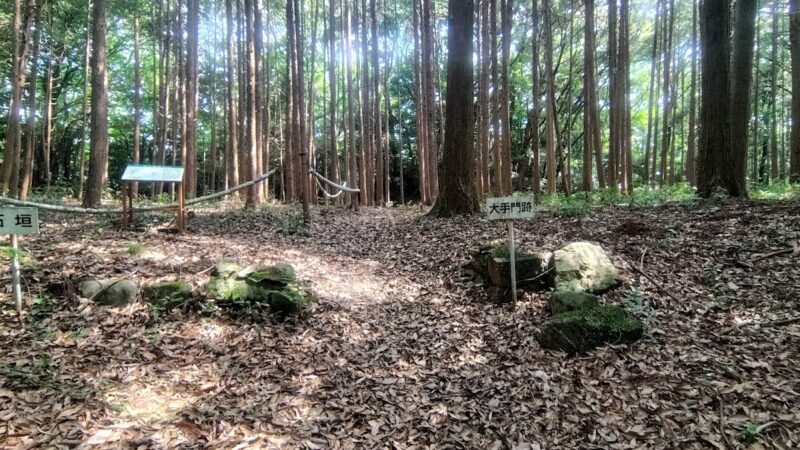
The castle’s layout consists of a main enclosure at the summit, with multiple enclosures (kuruwa) arranged around it. The entire hillside behind Minta Shrine constitutes the castle grounds, and the path leading from the shrine grounds to the mountaintop is thought to be a remnant of the former main approach road.
Main Enclosure and Earthworks
The main enclosure is located at the mountaintop, surrounded by earthworks. The earthworks, approximately 1-2 meters high, served to reinforce the enclosure’s defenses. The main enclosure was relatively small, suggesting a limited number of permanently stationed troops, but it is believed to have functioned as a base for receiving reinforcements from Toki Castle in emergencies.
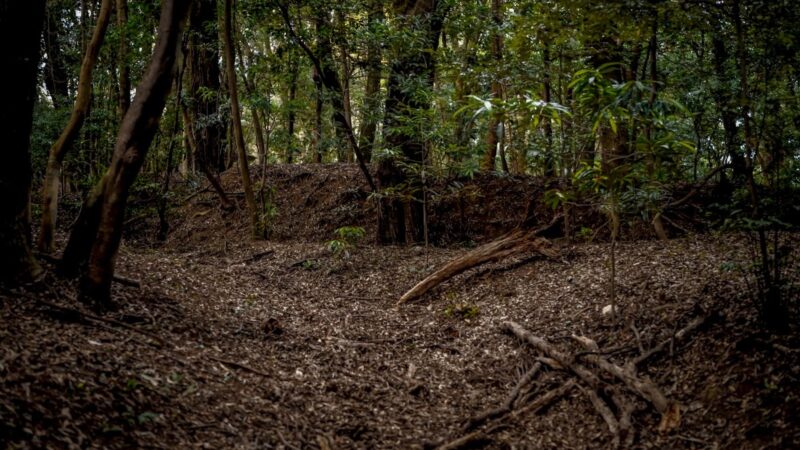
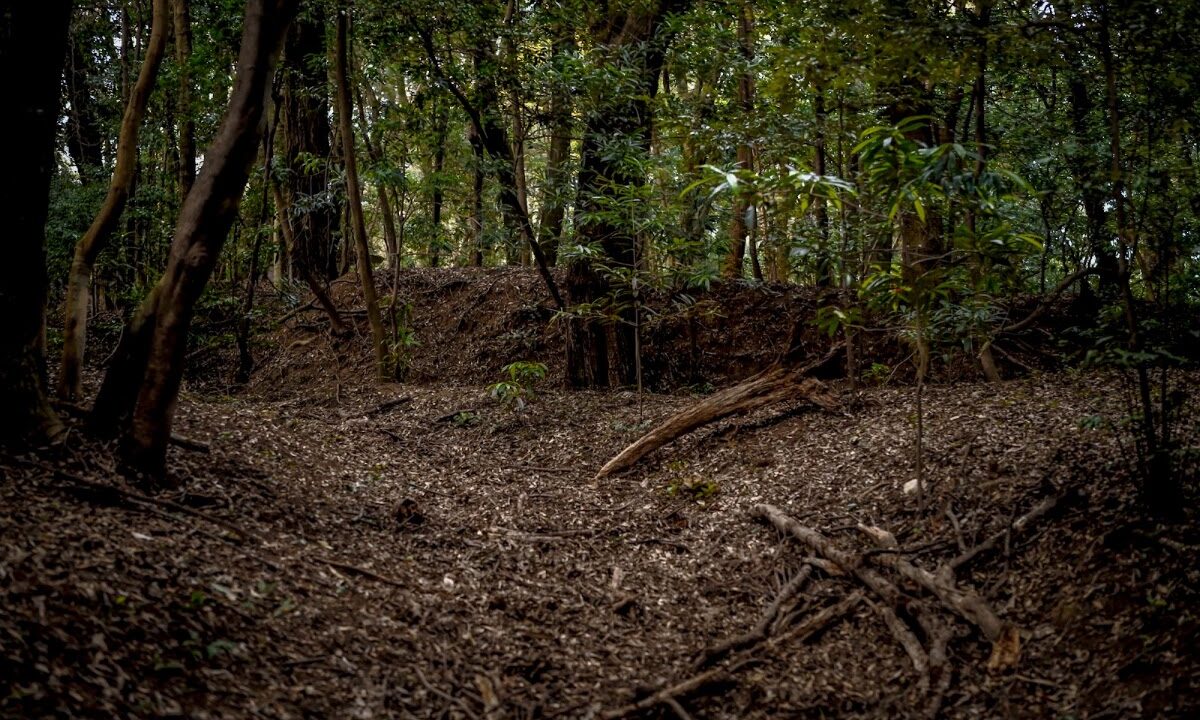
Parts of the earthworks are still clearly visible today, making them valuable remains for understanding the castle structure of the Sengoku period. A moat was positioned outside the earthworks, forming a double defensive line.
Moats and Enclosures
Miyayama Castle had multiple moats (horikiri). These moats were dry moats dug across the ridges, preventing enemy intrusion and separating enclosures. Even today, some of the moats can be seen as part of the terrain, measuring approximately 2-3 meters in depth.
Several enclosures are arranged in a stepped pattern around the main enclosure, each functioning as an independent defensive stronghold. These enclosures represent a structure designed to resist attacks on the castle in stages, exhibiting typical castle layout techniques of the medieval period.
Renovations by Gamo Ujisato
After Gamo Ujisato captured Miyayama Castle in 1584, the castle was renovated. It is believed that this renovation involved expanding the enclosures and adding moats to strengthen its function as a forward base during the siege of Toki Castle. Gamo Ujisato hailed from Hino Castle in Omi Province and was well-versed in Omi-style castle construction techniques; this influence may be reflected in the renovations of Miyayama Castle.
After the renovations, Miyayama Castle functioned as a supply base for the Gamo army and became an important strategic point during the siege of Toki Castle. However, after the end of the battle, the castle was abandoned and no further renovations or uses were undertaken.
Highlights of Miyayama Castle
Access to Minta Shrine and the Castle Ruins
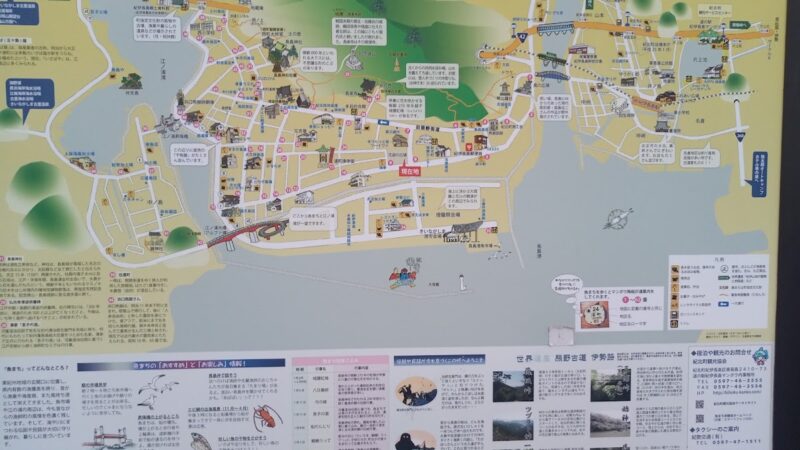
When visiting Miyayama Castle ruins, the first step is to head towards Minta Shrine. Minta Shrine is a local shrine revered as the guardian deity of the area, and its grounds serve as the entrance to the castle ruins. After passing through the shrine’s torii gate and leaving the grounds, you’ll see a path leading up the hillside.
The shrine grounds are well-maintained, and there is parking available for visitors. From here, it’s about a 10-15 minute walk to the castle ruins. The path is relatively gentle, but there are some steep sections, so comfortable shoes are recommended.
Remaining Earthworks and Moats
Upon reaching the mountaintop, you’ll see the earthworks surrounding the main enclosure. It’s surprising to see that these earthworks, built approximately 440 years ago during the Sengoku period, remain so clearly visible. The height of the earthworks varies depending on the location, but the best-preserved sections maintain a height of about 1.5-2 meters.
Outside the earthen rampart, traces of a moat can be seen, allowing us to understand the layout of the former defensive structures. While parts of the moat are filled in, others are clearly recognizable as part of the terrain’s undulations, fully demonstrating its value as a castle ruin.
Layout and Views of the Enclosures
From the main enclosure, you can overlook the surrounding terrain. To the north, you can see the direction of Toki Castle, giving a clear understanding of Miyayama Castle’s role in defending Toki Castle’s northern flank. The view is also open to the east and west, indicating a suitable location for monitoring enemy movements.
The arrangement of multiple enclosures in a stepped pattern can also be observed, providing a valuable opportunity to learn about the structure of medieval castles. The size and arrangement of each enclosure offer insights into the castle’s defensive strategy.
A Quiet Environment for a Sense of History
Miyayama Castle ruins maintain a simple atmosphere, unspoiled by tourism. With few visitors, it offers a quiet environment to reflect on the history of the Sengoku period. Surrounded by trees, the castle ruins also offer the opportunity to enjoy the beauty of nature throughout the seasons.
Especially during the fresh greenery of spring and the vibrant autumn foliage, you can enjoy both historical exploration and nature walks simultaneously. When visiting the castle ruins, we recommend bringing a camera to photograph the remains.
Access to Miyayama Castle
Location
Address: Minta, Toki-cho, Tsu City, Mie Prefecture
Landmark: Minta Shrine
Access by Car
Access by car is the most convenient. The following routes are common:
From the Ise Expressway:
- Exit at the Geino Interchange and head towards Tsu City on National Route 23
- Reach Toki-cho in approximately 15 minutes
- Follow the signs for Minta Shrine
From the center of Tsu City:
- Head south on National Route 23
- Head towards Toki-cho in approximately 20 minutes
- Take the prefectural road to Minta Shrine
Parking: There are several parking spaces within the grounds of Minta Shrine. However, priority is given to worshippers, so please be aware of potential crowds.
Access by Public Transportation
Access by public transportation is somewhat inconvenient.
Nearest Station: JR Kisei Main Line/Kintetsu Nagoya Line “Tsu Station”
Distance from Station: Approximately 8km
From Tsu Station, you will need to use a bus or taxi. Buses are infrequent, so it is recommended to check the timetable in advance. A taxi ride takes approximately 15-20 minutes and costs around 2,500-3,000 yen.
Points to Note When Visiting
- Since the castle ruins are located in a forest, please wear comfortable shoes and clothing suitable for walking.
- Bringing insect repellent is recommended during the summer months.
- Please prepare drinking water in advance (there are no vending machines on site).
- Be careful as the ground can be slippery during rainy weather or immediately after rain.
- In winter, the sun sets early, so please plan your visit for daylight hours.
Nearby Tourist Attractions
Toki Castle Ruins
The Toki Castle Ruins, the main castle of Miyayama Castle, are also a must-visit spot. Toki Castle was the residence of Kizuki Tomomasa and was a larger fortress than Miyayama Castle. Although some parts are now residential areas, some remains still exist. Visiting both Miyayama Castle and Toki Castle will allow you to gain a deeper understanding of the Kizuki clan’s castle network.
Location: Around Toki-cho, Tsu City, Mie Prefecture
Access: Approximately 5 minutes by car from Miyayama Castle
Tsu Castle Ruins (Castle Park)
Tsu Castle Ruins, located in the heart of Tsu City, Mie Prefecture, is a castle extensively renovated by Todo Takatora. Currently, it is maintained as “Castle Park,” and the remains such as stone walls and moats are well preserved. There are also reconstructed turrets, making it an essential spot for learning about the history of Tsu City.
Oda Nobukane (younger brother of Oda Nobunaga) founded the castle in 1580, and later, Todo Takatora carried out a large-scale renovation in 1611. It was a strong castle with a high stone wall on the north side and three-story turrets built at both the northeast and northwest corners.
Location: Marunouchi, Tsu City, Mie Prefecture
Access: Approximately 25 minutes by car from Miyayama Castle, approximately 15 minutes on foot from Tsu Station
Highlights: Stone walls, moat, turret (reconstructed), bronze statue of Todo Takatora
Kitabatake Shrine (Taki Kitabatake Clan Castle Site)
Kitabatake Shrine, located in Misugi-cho, Tsu City, Mie Prefecture, is the site of the residence of the Kitabatake clan, the provincial governors of Ise Province. The Kitabatake clan was a prestigious family that ruled southern Ise Province from the Nanboku-cho period to the Sengoku period, and their residence is designated as a national historical site. A beautiful garden remains, making it an important spot for learning about the medieval history of Ise Province.
Location: Kamitaki, Misugi-cho, Tsu City, Mie Prefecture
Access: Approximately 50 minutes by car from Miyayama Castle
Highlights: Castle ruins (National Historic Site), Kitabatake Clan Garden (National Scenic Spot), Kitabatake Shrine
Takada Honzan Senshuji Temple
Takada Honzan Senshuji Temple, located in Isshinden-cho, Tsu City, is the head temple of the Shinshu Takada sect. It is a temple that carries on the teachings of Shinran Shonin and houses many cultural assets, including the National Treasures, the Miei-do and Nyoraido halls. Its magnificent temple complex is well worth seeing and is a representative historical building of Tsu City.
Location: Isshinden-cho, Tsu City, Mie Prefecture
Access: Approximately 30 minutes by car from Miyayama Castle, approximately 10 minutes by car from Tsu Station
Highlights: National Treasure Mikage-do and Nyoraido halls, Important Cultural Property Sanmon gate
Mie Prefectural Art Museum
Located in the heart of Tsu City, the Mie Prefectural Art Museum boasts a wide collection of Japanese paintings, Western paintings, sculptures, and more. It is particularly rich in Western art collections, including works by Murillo and Dali. Enjoying art appreciation in between historical explorations is highly recommended.
Location: Otani-cho, Tsu City, Mie Prefecture
Access: Approximately 25 minutes by car from Miyayama Castle, approximately 10 minutes on foot from Tsu Station
To Enhance Your Visit to Miyayama Castle
Recommended Prior Study
Learning about the Battle of Komaki-Nagakute, the Kizuki clan, and Gamo Ujisato before visiting Miyayama Castle will make your visit to the castle ruins more fulfilling. It is especially helpful to keep the following points in mind.
- Overall Picture of the Battle of Komaki and Nagakute: The conflict between Hashiba Hideyoshi and Oda Nobuo/Tokugawa Ieyasu
- History of the Kizuki Clan: The Kizuki clan’s sphere of influence in Ise Province and their castle network centered around Toki Castle
- The Military Record of Gamo Ujisato: From his invasion of Ise Province from Omi Province to his subsequent transfer to Aizu
Photography Tips
At Miyayama Castle Ruins, there are several photography points, including:
- Cross-section of the earthwork: Take a photo from an angle that shows the height and thickness of the earthwork
- Moat Topography: Take a photo that shows the depth and shape of the moat
- View from the Main Enclosure: Take a photo of Toki Castle to the north and the surrounding topography
- Minta Shrine: A view of the shrine that serves as the entrance to the castle ruins
Comparative Viewing with Other Castle Ruins
Many other castle ruins remain in the vicinity of Tsu City, Mie Prefecture, besides Miyayama Castle. Visiting Toki Castle, Tsu Castle, Hase Fort, and the Kitabatake Clan Castle Ruins together will allow you to understand the changes in castles in Ise Province from the medieval to the early modern period.
In particular, comparing the relationship with Toki Castle, the difference in scale with Tsu Castle, and the difference in historical context with the Kitabatake Clan Castle Ruins will lead to a deeper understanding of history.
Local History Museums
There are also facilities in Tsu City that exhibit local history materials. By visiting them beforehand or after visiting the castle ruins, you can obtain detailed information about Miyayama Castle and the Kizuki clan.
Summary
Miyayama Castle is a valuable castle ruin from the Sengoku period remaining in Toki-cho, Tsu City, Mie Prefecture. It was built by Kizuki Tomomasa as a branch castle of Toki Castle and was captured by Gamo Ujisato in the Battle of Komaki-Nagakute in 1584. Currently, remains such as earthworks and moats remain on the hillside behind Minta Shrine and are protected as a city historical site of Tsu City, Mie Prefecture.
This flatland castle, built on a hill with a relative elevation difference of approximately 25 meters, is relatively easy to visit. It’s a valuable spot where you can quietly feel the history of the Sengoku period in a simple, unspoiled atmosphere.
When visiting Tsu City, be sure to also visit Miyayama Castle ruins, along with Tsu Castle ruins and Toki Castle ruins. It will be a valuable historical exploration where you can feel the history of Ise Province during the Sengoku period firsthand.