Nakagami Castle (Inabe District, Mie Prefecture) | Complete Guide to History, Remains, and Access
What is Nakagami Castle?
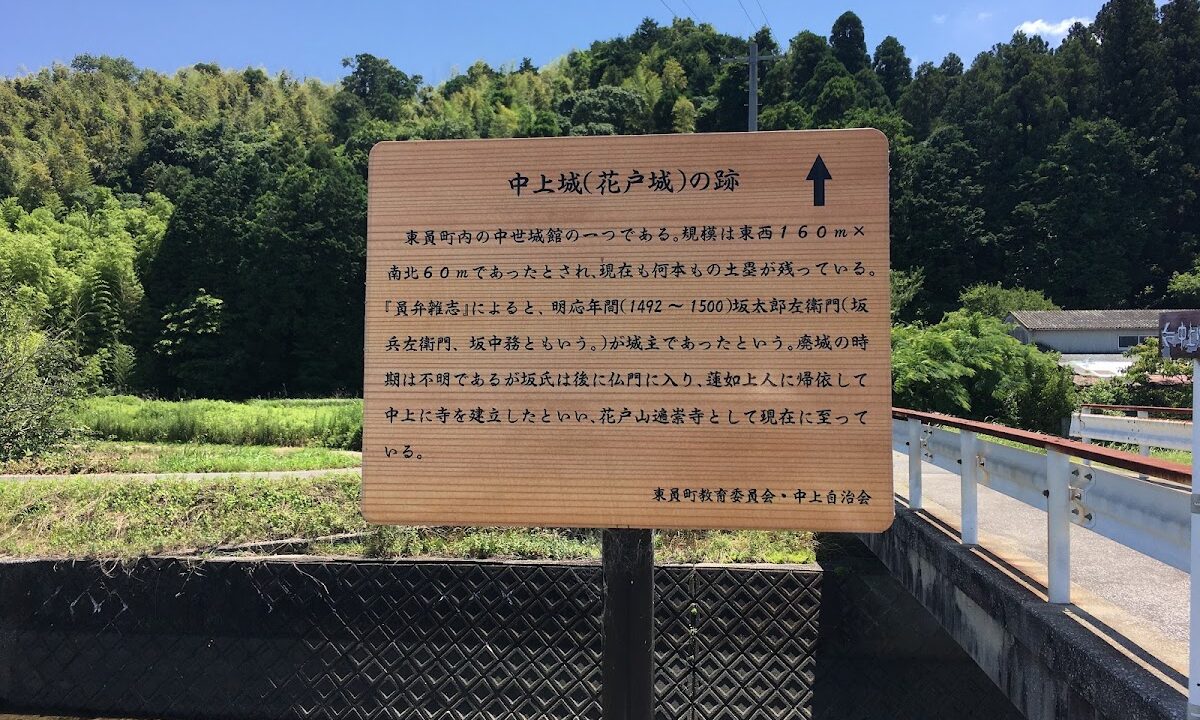
Nakagami Castle is a hilltop castle located in Nishiyama, Nakagami, Toin-cho, Inabe-gun, Mie Prefecture. Built on a hill approximately 50 meters above sea level, it has a relative height difference of about 40 meters. The remains, such as earthworks and baileys, are still well-preserved, making it a valuable historical site for understanding the characteristics of medieval castles in the Ise region.
Inabe-gun in northern Mie Prefecture has long flourished as a transportation hub connecting Ise, Omi, and Mino provinces. Nakagami Castle is thought to have functioned as a base of control for this region, and is an important legacy that tells the story of the regional history of the Sengoku period.
Location and Geographical Characteristics of the Castle
Nakagami Castle is located in the Nakagami area of Toin-cho, Inabe-gun, and the surrounding area is a mix of hills and plains. Built on the tip of a hill called Shiroyama, the castle faces a plain to the south and continues into mountains to the north. This location was not only advantageous defensively but also suitable for monitoring the surrounding area.
According to the Geographical Survey Institute’s Electronic National Land Map, the area around the castle ruins still retains its undulating terrain, allowing us to imagine the topography of the time. The location, Nakagami, Nishiyama, Toin-cho, Inabe-gun, Mie Prefecture, is important as a clue to understanding the region’s history.
History of Nakagami Castle
Construction Period and Background
While there are no clear records of the exact construction date of Nakagami Castle, its structure and the characteristics of its remains suggest it was built during the Sengoku period (Warring States period). In the Ise region, castle construction by local lords and kokujin (local samurai) was active from the 15th to the 16th centuries.
The Inabe-gun area was a region where local lords known as the “Forty-Eight Families of Hokusei” held sway, and Nakagami Castle is highly likely to have been one of the strongholds of these regional powers. Before Oda Nobunaga’s invasion, Ise Province was a complex mix of powers, including the Kitabatake, Kambe, and Seki clans.
Castle Lords and Changes
While there is a lack of reliable historical records regarding the lords of Nakagami Castle, and many details remain unclear, local traditions and connections to surrounding castles suggest that the castle lords were a family of local lords who controlled the Inabe region.
In the late Sengoku period, Oda Nobunaga’s invasion of Ise led to the destruction or forced submission of many local powers. It is presumed that Nakagami Castle was abandoned during this period, but the exact date of its abandonment is unknown.
Cultural Property Designation Status
Currently, Nakagami Castle is not designated as a cultural property by the national, prefectural, or municipal governments. However, it is attracting attention from castle researchers and history enthusiasts as a valuable historical site that conveys the region’s history. Even castle ruins without cultural property designation possess considerable historical value.
Layout and Remains of Nakagami Castle
Overall Structure
Nakagami Castle has a structure in which nearly square enclosures (kuruma) demarcated by earthworks are arranged in a series towards the end of the ridge. This arrangement is a typical form of medieval mountain castle that skillfully utilizes the terrain. The layout is a series of enclosures, starting from the main enclosure, followed by the second and third enclosures, and various defensive measures are evident throughout.
The main enclosure is located at the top of the castle mountain, and from there, multiple enclosures are arranged in a stepped fashion along the ridge. Each enclosure is clearly demarcated by earthworks, making it a good example of the importance of earthworks in medieval castles.
Characteristics of the Earthworks
The most distinctive feature of Nakagami Castle is its well-preserved earthworks. The earthworks were constructed to demarcate the enclosures and are built along the inside of each enclosure. Interestingly, there are almost no earthworks on the cliff sides. This is thought to be because the steep slopes of the natural terrain were used as cliffs to ensure defensive capabilities.
The height of the earthworks varies depending on the location, but some sections maintain a height of over 1.5 meters. It is presumed that the earthworks were constructed using a simple embankment method rather than the rammed earth technique.
Moats and Ditches
Ditches have been identified alongside some of the earthworks. These ditches are thought to have been excavated as soil extraction sites for the construction of the earthworks, and consequently functioned as defensive structures. However, no large-scale dry or water moats have been identified, indicating that Nakagami Castle’s defenses relied primarily on the earthworks and natural terrain.
Entrances and Exits
While no clear remains of entrances or exits are evident, several locations suggesting connecting routes between enclosures or access routes from outside the castle have been identified. Given the simple structure of the castle, it is unlikely that complex, square-shaped entrances or other fortified gates were constructed.
Highlights of Nakagami Castle
Well-Preserved Earthworks
The greatest highlight of Nakagami Castle is its well-preserved earthworks. Because it escaped later development, you can observe the earthworks that remain in their original form from when the castle was built. By examining the arrangement of the earthworks surrounding the baileys, you can understand the castle’s defensive strategy.
View
From near the main bailey, you can enjoy a panoramic view of the plains of Toin-cho, Inabe-gun. On clear days, you can even see as far as Ise Bay, giving you a real sense that this castle also functioned as a lookout post. The castle lords of the Sengoku period likely watched over the safety of their territories while gazing at the same view.
Layout Utilizing the Topography
The layout, which skillfully utilizes the natural terrain, is another highlight. The arrangement of baileys along the ridgeline and the technique of using steep slopes as fortifications are valuable learning materials for studying medieval castle construction techniques.
Location and Access
Detailed Location
Address: Nishiyama, Nakagami, Toin-cho, Inabe-gun, Mie Prefecture
Nakagami Castle is located in the Nakagami area of Toin-cho. Toin Town in Inabe District is located in the northernmost part of Mie Prefecture, bordering Gifu Prefecture to the north. Currently, Toin Town is the only town in Inabe District; the former towns of Inabe, Hokusei, Daian, and Fujiwara merged on December 1, 2003, to form Inabe City.
Access
Access by Car:
- Approximately 15 minutes from the Kuwana-Higashi Interchange on the Tomeihan Expressway
- Take National Route 421 towards Toin Town
- Parking is limited around the castle ruins, so be careful when parking on the road.
Access by Public Transportation:
- Approximately 30 minutes on foot from Toin Station on the Sangi Railway Hokusei Line
- Trains are infrequent, so check the timetable in advance.
Points to Note When Visiting
Nakagami Castle Ruins are not a developed tourist site; the remains are scattered within a forest. Please note the following points when visiting.
- Attire: Long sleeves, long pants, and comfortable walking shoes are essential.
- Season: Since the vegetation is lush from spring to autumn, winter visits are easier.
- Safety: Avoid traveling alone; visiting in groups is preferable.
- Manners: Since some areas may be private property, consideration for local residents is necessary.
- Equipment: Carry a map, compass, and drinking water.
History of Inabe District and Surrounding Areas
History of Inabe District
Inabe District is an ancient district that existed since ancient times and belonged to Ise Province under the Ritsuryo system. The place name “Inabe” has appeared in historical documents since ancient times, reflecting the deep history of the region. In the Middle Ages, the 48 local lords known as the Hokusei Forty-Eight Families vied for power, and many castles and residences were built.
Since the modern era, Inabe District consisted of several towns and villages. However, due to the large-scale municipal mergers of the Heisei era, Hokusei Town, Inabe Town, Daian Town, and Fujiwara Town merged on December 1, 2003, to form Inabe City. Currently, only Toin Town remains in Inabe District.
Characteristics of Toin Town
Toin Town is located in the northernmost part of Mie Prefecture and is a small town with an area of approximately 22.68 square kilometers. It has a long, narrow shape from north to south, with hilly terrain in the north and plains in the south. Agriculture has flourished there since ancient times, particularly rice cultivation, but in recent years it has also developed as a commuter town for the Nagoya area.
Within the town, in addition to Nakagami Castle, there are several castle ruins, burial mounds, temples, and shrines scattered throughout, making it an ideal area for historical walks.
Surrounding Castles
Besides Nakagami Castle, many other medieval castles exist in Inabe District and the surrounding area of Inabe City.
- Hokusei Castle: Castle ruins located in Hokusei-cho, Inabe City
- Inabe Castle: Castle that existed in the former Inabe town area
- Daian Castle: Castle ruins in the Daian town area
By visiting these castles, you can understand the distribution of power in northern Ise during the medieval period and the regional characteristics of castle construction techniques.
Castles of Ise Province and Nakagami Castle
Characteristics of Castles in Ise Province
Many flatland castles and mountain castles were built in Ise Province (present-day central and northern Mie Prefecture). Reflecting the complex topography of the Ise Plain and mountainous areas, many castles utilize hills and isolated mounds. Nakagami Castle is one such typical flatland castle of Ise.
Most castles in Ise are earthen castles, primarily using earthworks and moats rather than stone walls, and Nakagami Castle is no exception. This is thought to reflect the difficulty in obtaining building materials and the stage of development in castle construction technology.
The Positioning of Nakagami Castle
Nakagami Castle is a small to medium-sized castle, but it is believed to have functioned as a base for regional control. While there are no records of it being the site of large-scale battles, it likely played a role in daily territorial management, monitoring surrounding areas, and as a refuge in emergencies.
Many castle ruins exist in Mie Prefecture, but examples like Nakagami Castle, with relatively well-preserved remains, are rare. Further investigation and preservation are expected, as it will serve as material for castle research and history education.
Investigation and Research of Nakagami Castle
Previous Investigations
Nakagami Castle has been surveyed and measured by castle researchers. In particular, websites such as “Castle Wanderings” publish detailed layout maps and photographs, serving as basic research material.
However, archaeological excavations have not been conducted, and many aspects remain unclear regarding the dating of excavated artifacts and the detailed changes in the castle’s history.
Future Challenges
The following challenges exist in preserving and utilizing Nakagami Castle:
- Detailed Academic Research: Unraveling its history through archaeological excavations and documentary research
- Preservation Measures: Management to maintain the preservation state of the remains
- Utilization Methods: Examining strategies for utilizing it as a local historical resource
- Cultural Property Designation: Examining legal protection for preservation
It is crucial that local residents, government officials, and researchers cooperate to reaffirm the value of Nakagami Castle and pass it on to future generations.
Model Course for Visiting Nakagami Castle
Half-Day Course
This course explores the history of Toin Town, centering on Nakagami Castle.
- Toin Station (Start)
- Nakagami Castle Ruins (Visiting time: approx. 1 hour)
- Toin Town Local History Museum (Learn about the town’s history)
- Lunch (Local restaurant)
- Nearby Temples and Shrines (If time permits)
- Toin Station (Goal)
One-Day Course
This course tours castles in Inabe District and Inabe City.
- Nakagami Castle Ruins (Morning)
- Castle Ruins in Inabe City (Afternoon)
- Inabe City Tourist Facilities (If time permits)
Traveling by car is convenient, but if using public transportation, careful planning is necessary beforehand.
Summary
Nakagami Castle is a valuable medieval castle remaining in Toin Town, Inabe District, Mie Prefecture. The remains, such as earthworks and baileys, are well-preserved, making it an important example of a typical hilltop castle in the Ise region.
Located in Nishiyama, Nakagami, Toin-cho, Inabe-gun, Mie Prefecture, this is a flatland castle built on a hill approximately 50 meters above sea level. It can be seen on the Geographical Survey Institute’s Electronic National Land Basic Map and is affectionately known as “Shiroyama” (Castle Mountain) by the local community.
Although not designated as a cultural property, it is an important historical site for castle and regional history research, and further investigation and preservation are expected. Those interested in the history of Ise Province or medieval castles should definitely consider visiting.
When visiting, please take sufficient precautions for safety, be considerate of the local residents, and enjoy your time experiencing the romance of history.