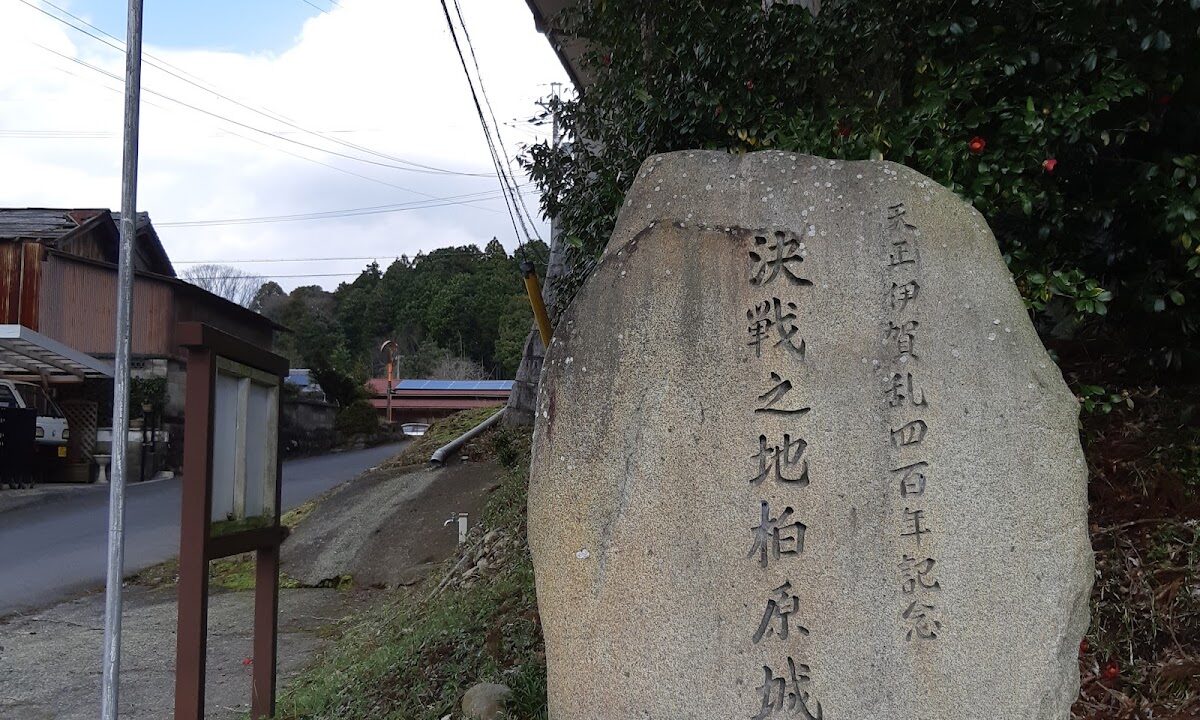
Kashiwabara Castle, Nabari City, Mie Prefecture | A thorough explanation of the castle ruins of the Takino clan, a local lord and the site of the end of the Tensho Iga Rebellion
Kashiwabara Castle is a Sengoku period mountain castle located in Kashiwabara, Akame-cho, Nabari City, Mie Prefecture. Also known as Takino Castle or Takino Juro Castle, it is known as the residence of Takino Sadakiyo, a local lord who resisted Oda Nobunaga’s invasion to the very end during the Tensho Iga Rebellion. Even today, the earthworks surrounding the main enclosure and the double dry moats remain well-preserved, making it a valuable historical site that conveys the characteristics of medieval castles in Iga Province.
Location and Geographical Features of Kashiwabara Castle
Geographical Location and Surrounding Environment
Kashiwabara Castle is built on a hill extending northeast from Mt. Takazen (Mt. Ryujin, approximately 400m above sea level) in Kashiwabara, Akame-cho, Nabari City. The castle is situated on a low hill approximately 10 meters above sea level, on the plains and foothills of the eastern bank of the Takigawa River, a tributary of the Uda River. This location was strategically important, controlling a crucial transportation hub connecting Iga Province and Yamato Province.
Nearby is the scenic Akame Forty-Eight Waterfalls, a well-known tourist attraction. The nearest station is Akameguchi Station on the Kintetsu Osaka Line, about a 20-minute walk away. Access to the castle ruins is relatively easy, and it continues to be visited by local residents and castle enthusiasts.
Strategic Value
The Kashiwabara area is located at the eastern edge of Iga Province, close to the border with Yamato Province (present-day Nara Prefecture). Due to this geographical location, Kashiwabara Castle played a vital role in monitoring and defending the routes of invasion into Iga Province. Its position overlooking the plains along the Takigawa River allowed for monitoring the flow of people and goods along the roads, functioning as a base supporting the power base of the local Takino clan.
Structure and Layout of Kashiwabara Castle
Structure of the Main Enclosure
Kashiwabara Castle is a castle with a structure based on a single enclosure surrounded by earthen ramparts on all four sides. The main enclosure is roughly square in shape, and is surrounded on all four sides by earthen ramparts about 2-3 meters high. These ramparts are a practical structure with a stone-dropping function, and are cleverly designed to prevent enemy intrusion.
The size of the main enclosure is estimated to be about 40 meters east-west and about 50 meters north-south, which is a standard size for a medieval local lord’s residence. The interior of the main enclosure is currently flat, and it is thought that buildings such as residences and warehouses were once built there.
The remains of a well remain in the southeastern corner of the main enclosure, indicating that water supply was considered during sieges. This well can still be seen as a historical remains and is important evidence of the castle’s living functions.
Dry Moats and Defensive Facilities
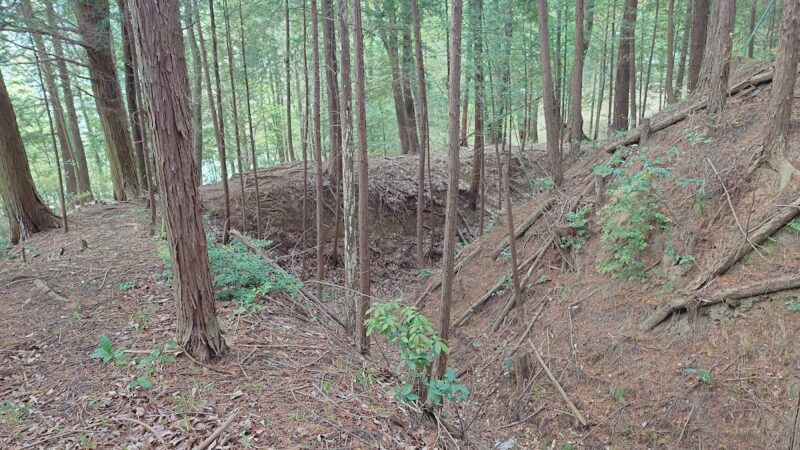
The most distinctive feature of Kashiwabara Castle is the multiple dry moats surrounding the main enclosure. The double-layered dry moats significantly enhanced the castle’s defensive capabilities. The inner dry moat ran along the main enclosure’s earthen rampart, while the outer dry moat further surrounded the outer perimeter.
These dry moats, approximately 3-5 meters deep and 5-8 meters wide, functioned as obstacles to hinder enemy approach. The bottoms of the dry moats are still clearly visible, and in some areas, a continuous structure leading to vertical moats (vertical moats) can be seen.
Partial traces of a surrounding moat (water moat) also remain, suggesting the possibility of a water-filled defensive structure in the past. These structures reflect the castle-building techniques of the late 16th century, demonstrating the process by which local lords of Iga Province strengthened their castles in preparation for actual battle.
Enclosures and Ancillary Facilities
Remnants of several small enclosures (kuruwa) remain around the main enclosure. These are presumed to have been used as residences for retainers, watchtowers, or armories. To the north and west of the castle, relatively gentle slopes extend, suggesting the possibility of samurai residences and townhouses being located there.
To the south of the castle lies a ridge leading to Mount Takayoshi, and the existence of a moat (a trench cutting across the ridge) designed to defend against attacks from the rear has been confirmed. This moat was an important defensive structure to prevent enemy incursions from the mountain side.
History of Kashiwabara Castle
Construction and the Takino Clan
Kashiwabara Castle is believed to have been built by Takino Sadakiyo during the Eiroku era (1558-1570). The Takino clan was a local lord based in Kashiwabara Village and a powerful family of local lords in Iga Province. In the Middle Ages, Iga Province adopted a system of “Sōkoku Ikki” (a system of collective uprisings), where numerous local lords exercised autonomy through a council system. The Takino clan was also a member of this Iga Sōkoku Ikki, participating in regional autonomy and defense.
Takino Sadakiyo is believed to have controlled the area around Kashiwabara as a local influential figure, deriving income from agricultural production and road tolls. The construction of Kashiwabara Castle was planned as a defensive stronghold to protect his territory during the turbulent Sengoku period.
The Tensho Iga Rebellion and Kashiwabara Castle
The most important event in the history of Kashiwabara Castle is the Tensho Iga Rebellion. In 1579, Oda Nobuo, the second son of Oda Nobunaga, launched an invasion of Iga Province (the First Tensho Iga Rebellion). At this time, the local lords of Iga united and succeeded in repelling the Oda army.
However, in 1581, Oda Nobunaga himself led a large army and launched a full-scale invasion of Iga Province (the Second Tensho Iga Rebellion). The Oda army attacked Iga Province simultaneously from six directions, capturing castles one after another. At this time, Kashiwabara Castle, defended by Takino Sadakiyo, became one of the castles in Iga Province that continued to resist until the very end.
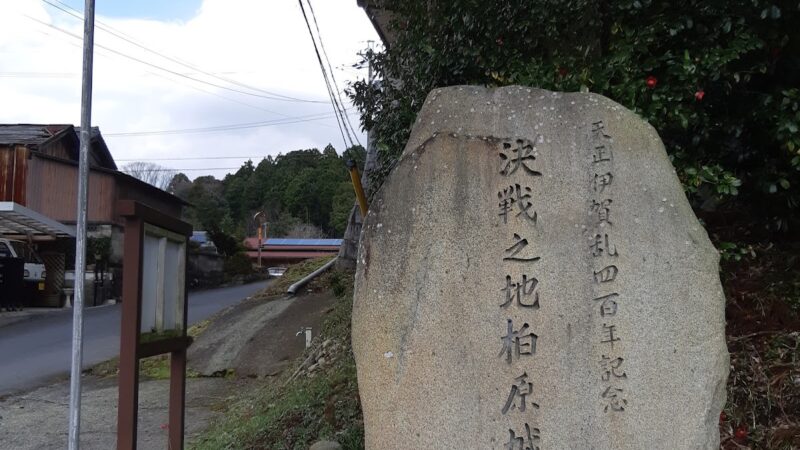
According to historical records such as the “Seishu Gunki,” Kashiwabara Castle fiercely resisted the Oda army’s onslaught, but ultimately fell. It is believed that the castle lord, Takino Sadakiyo, either died in battle or committed suicide, marking the end of the Tensho Iga Rebellion. For this reason, Kashiwabara Castle is also known as the “Castle of the End of the Tensho Iga Rebellion.”
Kashiwabara Castle After its Fall
After the Tensho Iga Rebellion, Iga Province came under the control of Oda Nobunaga, and subsequently, rulers changed hands to Toyotomi Hideyoshi and Tokugawa Ieyasu. Kashiwabara Castle was abandoned and never used again. During the Edo period, the castle site became farmland and forest, and was remembered locally as “Shiroyama” (Castle Mountain).
Even after the Meiji era, the castle site remained privately owned and escaped development, resulting in the excellent preservation of remains such as earthworks and dry moats. Currently, its value is being re-evaluated by local history enthusiasts and castle researchers.
Attractions around Kashiwabara Castle
Akame Forty-Eight Waterfalls
Located about 2 kilometers south of Kashiwabara Castle are the Akame Forty-Eight Waterfalls, selected as one of Japan’s Top 100 Waterfalls. The various waterfalls, large and small, scattered throughout the valley in the upper reaches of the Takigawa River, have long been known as a sacred site for Shugendo (mountain asceticism) and have attracted many pilgrims. Currently, walking trails have been developed, making it a tourist destination where visitors can enjoy the beauty of nature throughout the seasons.
By visiting the Akame Forty-Eight Waterfalls in conjunction with a visit to the castle ruins, you can fully appreciate both the nature and history of the Kashiwabara region.
Takazen-yama (Ryujin-yama)
Takazen-yama (Ryujin-yama), towering behind Kashiwabara Castle, is a mountain approximately 400 meters high and is popular as a hiking course. From the summit, you can enjoy a panoramic view of Nabari city and the Iga Basin. Perhaps Takino Sadakiyo once contemplated the defense of his territory while gazing at this view. The route from Takazenyama to the Kashiwabara Castle ruins is an ideal course for understanding the castle’s location and defensive structure.
Historical and Cultural Facilities in Nabari City
Nabari City has several facilities where you can learn about the history and culture of the Iga region. The Nabari City Local History Museum displays materials related to the Tensho Iga Rebellion and exhibits on the region’s medieval history. Nearby, there are also facilities where you can comprehensively learn about the history of Iga Province, such as Iga Ueno Castle and the Iga-ryu Ninja Museum.
Access and Visiting Information for Kashiwara Castle
Transportation Access
Access by Train
- Get off at Akameguchi Station on the Kintetsu Osaka Line, approximately 20 minutes on foot.
- Head towards Akame 48 Waterfalls from Akameguchi Station, and follow the signs to the castle ruins along the way.
Access by Car
- Approximately 30 minutes from Hari IC on the Meihan Expressway via National Route 165.
- There is no specially maintained parking area, so it is recommended to use nearby public parking lots or the Akame 48 Waterfalls parking lot and access the castle on foot.
Notes for Visitors
Kashiwara Castle Ruins are preserved as a historical site, but they remain in their natural state without extensive maintenance. Please note the following points when visiting:
- Clothing: Wear comfortable clothing and non-slip shoes (such as trekking shoes).
- Season: Spring to autumn is the best time to visit. In winter, there is a possibility of snow and ice.
- Insect repellent: In summer, there are many insects such as mosquitoes and horseflies, so we recommend using insect repellent spray and wearing long sleeves.
- Private property: Some parts of the castle ruins are private property. Please do not enter areas marked as “No Entry.”
- Safety management: There are unstable areas around the dry moats and earthworks. Please be careful not to fall or slip.
Points to note when visiting
When visiting Kashiwabara Castle Ruins, paying attention to the following points will help you understand the castle’s structure and history more deeply.
- Main Enclosure Earthworks: Observe the height and thickness of the earthworks surrounding the enclosure on all four sides, and observe the structure of the stone drop.
- Double Dry Moat: Compare the arrangement and depth of the inner and outer dry moats to understand the defensive system.
- Well Remains: Consider the function of the castle in a siege, based on the well remains in the southeastern corner of the main enclosure.
- View: Observe the surrounding terrain from the castle ruins and consider why the castle was built in this location.
- Vertical Moat: The vertical moats carved into the slope are a design to prevent lateral movement of the enemy.
Historical Significance of Kashiwabara Castle
Role in the Tensho Iga Rebellion
Kashiwabara Castle played a crucial historical role as the “last stronghold” in the Tensho Iga Rebellion. While the local lords of Iga fiercely resisted Oda Nobunaga’s overwhelming military power in various locations, and castles fell one after another, Kashiwabara Castle continued to fight to the end.
This resistance demonstrates the strong will of the people of Iga Province to protect their autonomy and independence, and is regarded as an event symbolizing the spirit of “Sōkoku Ikki” (national uprisings) in Japanese medieval history. The battle fought by Takino Sadakiyo and the defenders of Kashiwabara Castle is still recounted today as a source of regional pride.
Position in the History of Castles in Iga Province
Kashiwabara Castle occupies an important position in the history of castles in Iga Province, as a typical castle of a local lord. Unlike the early modern castles with large stone walls and keeps, Iga castles are characterized by practical structures primarily consisting of earthworks and dry moats.
The layout of Kashiwabara Castle is a fine example of the technological level of medieval castles, showcasing ingenuity to achieve maximum defensive effectiveness with limited resources and personnel. In particular, the double dry moat system is noteworthy as an example of the development of castle construction technology in the late 16th century.
Importance in Regional History
For Nabari City and the Iga region, Kashiwabara Castle is an important historical heritage site that forms the regional identity. The Tensho Iga Rebellion holds an important place in local history education as a historical event in which local people united to resist an external enemy.
The Kashiwabara Castle ruins are a concrete example of this history and are the target of local cultural property preservation activities. In recent years, local history enthusiast groups have been engaged in preservation activities of the castle ruins and the installation of information boards, utilizing it as a local historical resource.
Preservation of Kashiwabara Castle and Future Challenges
Current State of Preservation
The Kashiwabara Castle ruins have been spared from development, resulting in relatively well-preserved remains such as earthworks and dry moats. However, because it has not received official historical site designation, full-scale excavation and restoration work have not been carried out. Currently, cleaning activities by local volunteers and visits by castle enthusiasts continue.
Some parts of the remains are covered with trees and weeds, making it difficult to grasp the overall structure. Furthermore, some parts of the earthworks show signs of collapse, and some kind of measure is needed for long-term preservation.
Expectations for Future Preservation and Utilization
Considering the historical value of Kashiwabara Castle, the following initiatives are expected in the future:
- Promotion of Historic Site Designation: Formal designation as a cultural property by the city and prefecture will provide budgets and legal protection for preservation.
- Implementation of Archaeological Excavations: Academic investigations will allow for a more accurate understanding of the castle’s detailed structure and history.
- Development of Remains: Establishing viewing paths and improving information boards will create an environment where visitors can safely explore the site.
- Collaboration with Local Tourism: Utilizing the castle as part of a historical tourism course in conjunction with other tourist resources such as Akame Forty-Eight Waterfalls.
- Utilization for Educational Activities: Utilizing the castle for local school education and lifelong learning, including for studying local history.
Summary
Located in Kashiwabara, Akame-cho, Nabari City, Mie Prefecture, Kashiwabara Castle is a castle that holds an important position in Japanese medieval history as the residence of Takino Sadakiyo, a local lord who resisted to the end during the Tensho Iga Rebellion. The castle retains well-preserved practical structures such as double dry moats and earthen ramparts on all four sides, conveying the characteristics of castle architecture in Iga Province during the late 16th century.
The history of Kashiwabara Castle, which continued to fight against Oda Nobunaga’s large army until the very end, symbolizes the spirit of the people of Iga who sought to protect their local autonomy and independence. Even today, remnants of the castle remain, allowing visitors to feel the tension of the Sengoku period and the lives of the local lords firsthand.
Visiting Kashiwabara Castle in conjunction with the natural scenery of Akame Forty-Eight Waterfalls and Takazenyama Mountain allows you to enjoy both the history and nature of the Kashiwabara region. It’s a recommended historical site not only for castle enthusiasts but also for history buffs and hikers.
By visiting Kashiwabara Castle ruins, you can experience local history not found in textbooks, the lives of the people who lived during the Sengoku period, and the traces of history that still remain today. When visiting Nabari City, be sure to visit this valuable historical heritage site.