Kameo Castle (Kikuchi City, Kumamoto Prefecture) Complete Guide | A Thorough Explanation of the History and Highlights of the Eighteen Outer Castles of Kikuchi
What is Kameo Castle?
Kameo Castle is a medieval mountain castle located in Kameo, Shichijo-machi, Kikuchi City, Kumamoto Prefecture. Built on the tip of a hill on the south bank of the Kikuchi River, this castle served as an important defensive base to the south, as one of the “Eighteen Outer Castles of Kikuchi” protecting Kikuchi Castle (Kumafu Castle), the base of the Kikuchi clan.
Currently, the castle site is maintained as the grounds of Itai Kumanoza Shrine and Kameo Castle Ruins Park, where visitors can see reconstructed remains such as baileys, earthworks, and dry moats based on the results of archaeological excavations. Located right next to the source of the Maekawa River, it is a valuable spot where you can enjoy both the history and nature of Kumamoto.
History of Kameo Castle
Construction and Lords
The exact construction date of Kameo Castle is not clearly known, but it is believed to have existed since the Kamakura period. The castle lord was the Itai clan, a branch of the Sagara clan, and was subordinate to the Kikuchi clan. Although a branch of the Sagara clan, the Itai clan played an important role in the Kikuchi clan’s sphere of influence in northern Higo Province.
Records also show that during the time of Kikuchi Shigeaki, the 21st head of the Kikuchi clan, the Sekibe clan served as the castle lord. Thus, while Kameo Castle was managed by different warlords throughout history, it consistently remained an important base, playing a vital role in the Kikuchi clan’s defense network.
The Battle of Itaihara and Imagawa Ryōshun
The most important event in Kameo Castle’s history is the Battle of Itaihara, which erupted in 1379 (Kōryaku 1). This battle was a crucial struggle for supremacy in Kyushu during the Nanboku-chō period.
Imagawa Ryōshun, who was entrusted with governing Kyushu as the Kyushu Tandai (governor of Kyushu), and his younger brother, Imagawa Nakaaki, established their headquarters at Kameo Castle in order to conquer the Kikuchi clan, a powerful warlord of the Southern Court. The Imagawa army fought fierce battles against the Kikuchi clan from Kameo Castle, a protracted conflict lasting approximately two years.
In this battle, Kameo Castle functioned not merely as a defensive stronghold, but as a crucial forward base for the attacking side, highlighting its high strategic value. Its geographical location overlooking the Kikuchi River provided ideal conditions for controlling the surrounding area.
Role as one of the Eighteen Outer Castles of the Kikuchi Clan
The Eighteen Outer Castles of the Kikuchi Clan refer to the 18 branch castles positioned to protect Kikuchi Castle (Kumafu Castle), the main castle of the Kikuchi clan. Among them, Kameo Castle played a crucial role as a key point in the southwest, protecting the Kikuchi clan’s sphere of influence.
The Kikuchi clan was a prominent family that ruled northern Higo Province for approximately 450 years, from the Heian period to the Sengoku period. To maintain their power, a network of outer castles surrounding the main castle was essential. Kameo Castle, located on the south bank of the Kikuchi River, is believed to have functioned as the first line of defense against invasions from the south.
This defense system is a typical form of regional control in medieval Japan and demonstrates the Kikuchi clan’s excellent military strategy.
Structure and Characteristics of Kameo Castle
Location and Layout
Kameo Castle is built on the hilly area on the south bank of the Kikuchi River, at the tip of a tongue-shaped plateau extending northward. This location is militarily advantageous, offering a panoramic view of the Kikuchi River basin to the north. The layout, skillfully utilizing the natural terrain, exhibits typical characteristics of a medieval mountain castle.
Although the castle grounds are relatively compact, defensive functions are efficiently arranged, making it easy to defend even with a small number of personnel. The current location of Kumanoza Shrine corresponds to the central part of the castle, with the main fortifications located on the wooded plateau north of the shrine.
Restored Enclosures and Earthworks
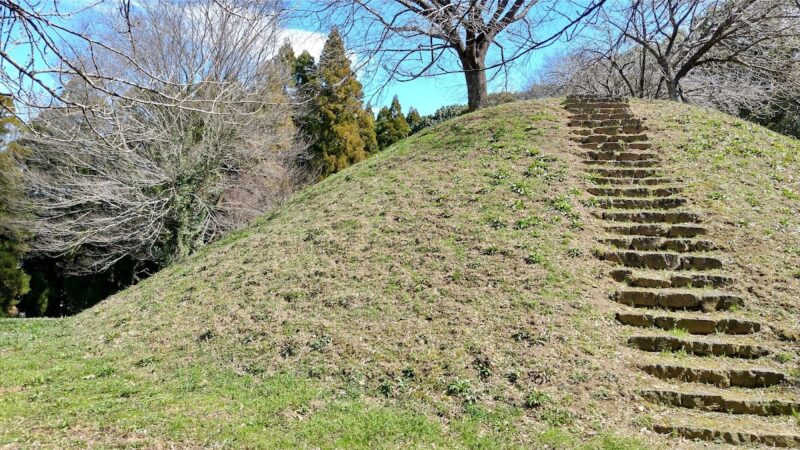
Following archaeological excavations by Kumamoto Prefecture, the Kameo Castle site was developed into a park, and the original structures were restored. The most distinctive feature is the main enclosure (honmaru), which has a unique shape resembling a keyhole-shaped burial mound.
The enclosures surrounding the main enclosure form a tiered defensive line. Earthworks surround each enclosure, creating a structure designed to prevent enemy intrusion. The height of the earthworks varies depending on the location, but the highest points exceed 2 meters, demonstrating the advanced castle-building techniques of the time.
The restoration work faithfully reflects the results of the archaeological excavations, allowing visitors to experience the actual appearance of a medieval mountain castle. A major attraction is the opportunity to observe the layout of each enclosure and the structure of the earthworks while walking along the well-maintained walking paths.
Features of the Buzen Moat (Dry Moat)
One of the greatest highlights of Kameo Castle is the Buzen Moat, a dry moat that beautifully surrounds the main enclosure. A Buzen Moat is a moat that does not hold water, and together with the earthworks, it was an important structure that enhanced defensive capabilities.
The restored dry moat surrounds almost the entire perimeter of the main enclosure, and its scale and excellent state of preservation leave a strong impression on visitors. The moat is up to about 3 meters deep, and the difference in elevation from the bottom to the top of the earthworks is even greater.
This dry moat was not merely an obstacle, but a calculated defensive structure that restricted enemy movement and gave an advantage to attacks from within the castle. In some parts, earthworks were built on both the inside and outside of the moat, forming a double line of defense.
Currently, a walking path has been constructed, allowing visitors to actually walk along the bottom of the dry moat. The view of the earthworks from within the moat is impressive, allowing visitors to experience firsthand the reality of medieval castle defense.
Visibility and Preservation of the Remains
A major characteristic of the Kameo Castle site is the exceptionally high visibility of its remains. While many medieval mountain castles have their remains obscured by overgrown trees and sediment accumulation, at Kameo Castle, archaeological excavations and park development have allowed for the clear identification of structures such as baileys, earthworks, and dry moats.
In particular, the area around the main bailey is meticulously maintained, with clear mowing and other maintenance, allowing for the distinct lines of the earthworks and the shape of the dry moats. This is highly valuable from the perspective of castle research and history education, making it an ideal field for learning about the structure of medieval mountain castles.
Stairs and information boards are appropriately placed, ensuring that even visitors unfamiliar with history can understand the castle’s structure while exploring.
Highlights of Kameo Castle
Main Bailey (Honmaru Site) and Keyhole-Shaped Burial Mound
The greatest highlight of Kameo Castle is its uniquely shaped main bailey. Viewed from above, it resembles a keyhole-shaped burial mound, a shape believed to be the result of utilizing the natural terrain while shaping it for defense.
The main enclosure covers approximately 1,000 square meters, a standard size for a medieval mountain castle. It is presumed that the lord’s residence and soldiers’ quarters were located within this space. Currently, the area is leveled, allowing visitors to stroll around and imagine the original building layout.
The combination of earthworks and dry moats surrounding the main enclosure is a textbook example of a medieval mountain castle structure, making it a must-see for castle enthusiasts.
Itai Kumanoza Shrine
At the center of the castle site stands the Itai Kumanoza Shrine. This shrine has deep ties to the history of Kameo Castle and may have functioned as the castle’s guardian deity. The shrine grounds themselves are part of the castle, demonstrating the medieval characteristic of integrating sacred spaces with military facilities.
The path and stairs leading to the shrine may have utilized the former castle’s access route, giving a sense of historical continuity. From the shrine grounds, you can enjoy views of the surrounding landscape, realizing the strategic importance of this location.
Maekawa Spring
Immediately next to Kameo Castle Ruins Park is the Maekawa Spring, selected as one of Kumamoto’s 100 Famous Waters. This spring is believed to have been an important water source even during the time the castle was operational, and must have been a major factor in the castle’s location selection.
In medieval castles, securing water was a matter of life and death. When considering siege warfare, a stable water source within or near the castle was essential. The existence of the Maekawa Spring indicates that Kameo Castle was designed to withstand prolonged defenses.
Even today, abundant water springs forth, and its pure water is enjoyed by visitors. We recommend visiting this beautiful spring in conjunction with your castle ruins tour.
Views and Surrounding Landscape
From the Kameo Castle ruins, you can overlook the plains of the Kikuchi River basin. This view is not only beautiful, but also crucial for understanding the castle’s military function. This excellent vantage point was essential for fulfilling the role of an outer castle: early detection of enemy movements and relaying that information to the main Kikuchi Castle.
The view to the north is particularly open, offering a vantage point to monitor the roads and settlements along the Kikuchi River. On clear days, you can see the distant mountains, allowing you to relive the scenery that medieval castle soldiers must have seen.
Access and Visiting Information
Location
Address: 1885 Kameo, Shichijo-machi, Kikuchi City, Kumamoto Prefecture 861-1342 (Itai Kumanoza Shrine)
Access by Car
- From Ueki IC on the Kyushu Expressway: Approximately 10 minutes (approx. 8 km)
- From Kikusui IC on the Kyushu Expressway: Approximately 20 minutes
- From central Kumamoto City: Approximately 40 minutes via National Route 387
Kameo Castle Ruins Park has a parking lot that is free to use. However, parking space is limited, so early arrival is recommended, especially on holidays.
Access by Public Transportation
- From JR Hohi Main Line, Higo-Ozu Station: Approximately 40 minutes by taxi
- Local Bus: There are bus routes running within Kikuchi City, but a walk is required from the bus stop closest to the castle ruins.
Public transportation access is somewhat inconvenient, so using a rental car or taxi is more practical. Planning a visit in conjunction with sightseeing in Kikuchi City is efficient.
Visiting Information
- Visiting Hours: Always open (however, avoiding nighttime visits is recommended)
- Admission Fee: Free
- Estimated Time Required: Approximately 30 minutes to 1 hour
- Restrooms: Located near the parking lot
- Accessibility: Due to numerous stairs, wheelchair access is difficult
Points to Note When Visiting
- Clothing: Comfortable shoes and clothing are recommended. There are stairs and slopes. 2. Season: Insect repellent is necessary in summer, and warm clothing is needed in winter.
- Weather: Be careful as the ground can be slippery in rainy weather.
- Drinking Water: Please prepare water for hydration, especially in summer.
- Photography: Please observe proper photography etiquette within the shrine grounds.
Visiting Route
The standard visiting route for Kameo Castle Ruins is as follows:
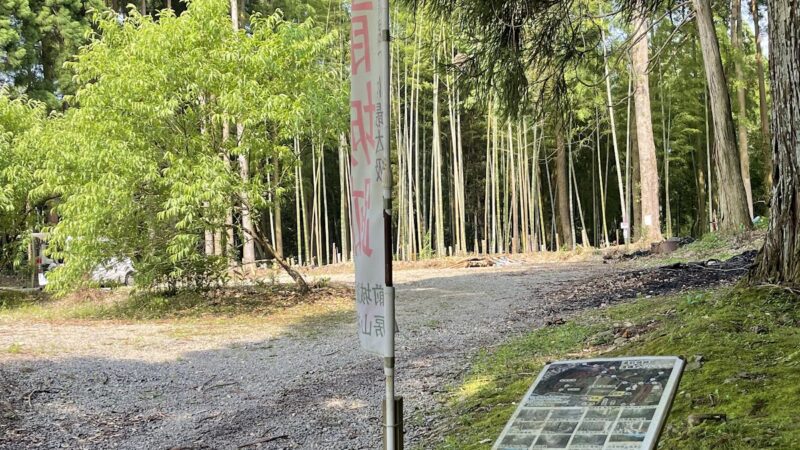
- Use the walking path from the parking lot: Head to the castle ruins via the Maekawa spring.
- Climb the stairs to the main enclosure: Climb the stairs that also serve as the approach to Itai Kumanoza Shrine.
- Visit the shrine: Pay your respects at Kumanoza Shrine, located in the center of the castle ruins.
- Stroll around the main enclosure: Observe the restored baileys, earthworks, and dry moats.
- Explore the inside of the dry moat: You can walk inside the moat using the walking path.
- Observation point: Enjoy the view to the north.
Please allow 30 minutes to 1 hour for the entire visit. For those who want to observe carefully or enjoy taking photos, we recommend allocating more than 1 hour.
Nearby Tourist Attractions
Kikuchi Castle (Kumafu Castle)
Kikuchi Castle, the main castle of Kameo Castle, is located in the center of Kikuchi City. This important castle served as the base of the Kikuchi clan for approximately 450 years, and Kikuchi Shrine now stands on the site. Visiting it together with Kameo Castle will give you a deeper understanding of the Kikuchi clan’s castle network.
Kikuchi Valley
Kikuchi Valley, a representative tourist spot in Kikuchi City, is about a 30-minute drive from Kameo Castle. This beautiful valley, selected as one of Japan’s Top 100 Waterfalls and Top 100 Famous Waters, attracts many tourists, especially during the summer and autumn foliage seasons.
Kikuchi Onsen (Hot Springs)
Kikuchi City boasts the Kikuchi Onsenkyo (hot spring resort area), with numerous day-trip bathing facilities and accommodations. After visiting the castle ruins, you can relax and unwind in the hot springs.
Shichijo Melon Dome
The roadside station “Shichijo Melon Dome” is about a 10-minute drive from Kameo Castle. Here you can purchase local fresh produce and processed goods, including melons, a specialty of Shichijo Town. A restaurant is also located on-site, where you can enjoy local cuisine.
Other Kikuchi Eighteen Outer Castles
For history buffs, we recommend visiting other castle sites within the Kikuchi Eighteen Outer Castles. Each castle has different characteristics, allowing you to understand the entire Kikuchi clan’s defense system. However, many of the castle sites are not as well-maintained as Kameo Castle, so prior research is necessary.
The Value and Appeal of Kameo Castle
Historical Value
Kameo Castle is an important historical site for understanding the political and military history of medieval Kyushu. In particular, the fact that Imagawa Ryōshun established his headquarters here during the Battle of Itaihara in the Nanboku-chō period demonstrates the strategic importance of this castle.
The Kikuchi Eighteen Outer Castles system is a typical example of regional control in medieval Japan, and Kameo Castle was an important part of that network. Archaeological excavations and restoration work have made it a valuable field for concretely understanding the castle structure of the time.
Educational Value
Kameo Castle is an ideal teaching material for learning about the structure of medieval mountain castles. Basic castle elements such as baileys, earthworks, and dry moats are clearly visible, allowing visitors to understand their respective defensive functions firsthand.
It is also used as a site for school education and lifelong learning, contributing to local history education. The site is well-equipped with information boards and explanatory panels, making it possible to learn about the castle’s structure and history even without specialized knowledge.
Attractiveness as a Tourist Resource
Kameo Castle Ruins is a spot where visitors can enjoy both historical and natural sightseeing simultaneously. The pure spring water of the Maekawa River source, the rich natural environment of the surrounding area, and the historical castle remains combine to offer visitors diverse attractions.
The compact castle ruins allow for a fulfilling visit even in a short time, making it an important element of Kikuchi City tourism. The site is well-maintained and safe for visitors, which is also highly valued.
Summary
Kameo Castle is a medieval mountain castle located in Shichijo-machi, Kikuchi City, Kumamoto Prefecture. As one of the eighteen outer castles of Kikuchi, it was an important base for the defense of the Kikuchi clan. Originally the residence of the Itai clan, Kameo Castle played a significant role in Kyushu history, including serving as the headquarters of Imagawa Ryōshun during the Battle of Itaihara in 1379.
Currently, the remains of the castle, such as baileys, earthworks, and dry moats, have been clearly observed based on archaeological excavations, making it a highly valuable historical site for learning about the structure of medieval mountain castles. The main bailey, with its unique shape resembling a keyhole-shaped burial mound, and the beautifully surrounding Buzen-bori (dry moat) are must-sees.
Kameo Castle ruins, maintaining a sacred atmosphere as part of the grounds of Itai Kumanoza Shrine and blessed with the pristine water source of the adjacent Maekawa spring, is an attractive tourist spot where history and nature harmonize. Its convenient access, approximately 10 minutes from the Ueki Interchange on the Kyushu Expressway, and the fact that admission is free are major draws.
When visiting Kikuchi City, be sure to visit Kameo Castle ruins and reflect on the history of medieval Kyushu. Walking along the well-maintained promenade will provide a valuable opportunity to experience the scenery seen by samurai warriors over 450 years ago.