Ichiba Castle (Yokkaichi City, Mie Prefecture) Complete Guide | History, Remains, and Access Information
Ichiba Castle, located in Ichiba-cho, Yokkaichi City, Mie Prefecture, is a medieval castle that played an important role in the Hokusei region from the Muromachi period to the Sengoku period. Also known as “Asakura Castle,” this castle, built on a river terrace on the left bank of the Asake River, is a cliffside castle that still conveys the castle-building techniques and strategic layout of the time. This article comprehensively introduces information useful for castle fans and history enthusiasts, from the historical background of Ichiba Castle to existing remains, points of interest for visitors, and access methods.
History and Origins of Ichiba Castle
Construction and Asakura Akizane
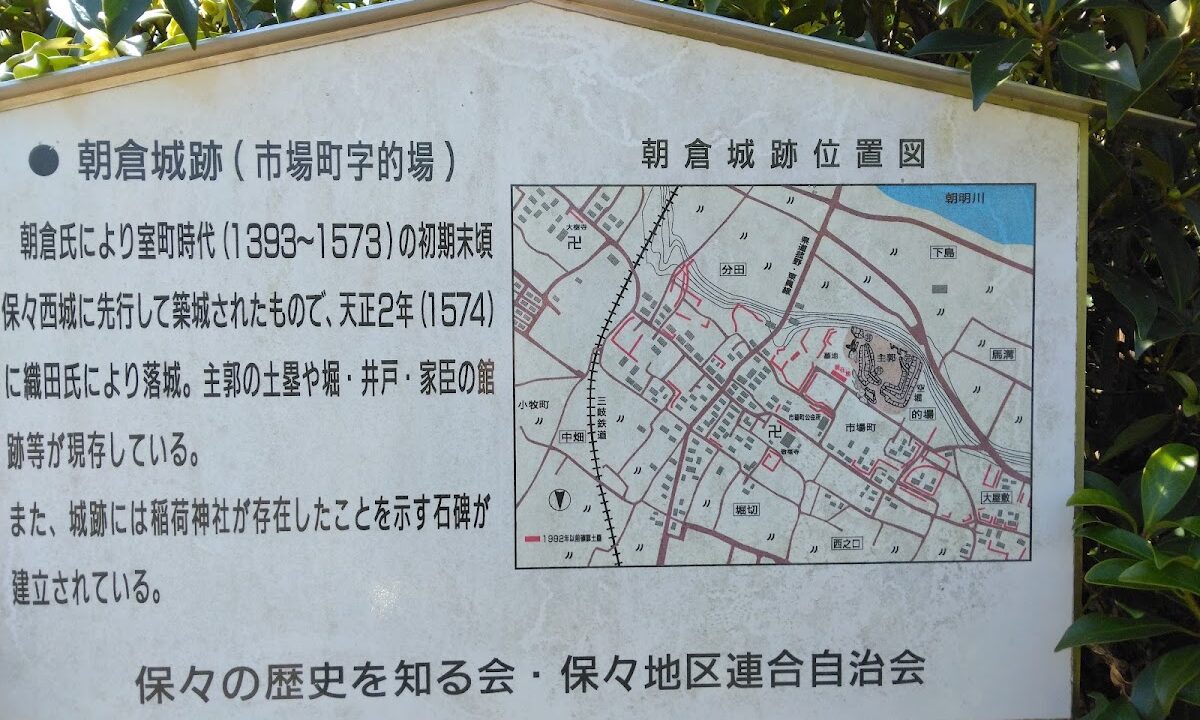
Ichiba Castle is believed to have been built by Asakura Akizane, who held an important position as a magistrate of the Muromachi Shogunate. Asakura Akizane was a member of the Echizen Asakura clan and a key figure in the central government of the Muromachi Shogunate. To solidify the Asakura clan’s power base in the Hokusei region, Akimasa built a castle in this location, skillfully utilizing the natural topography of the Asake River.
While there are various theories regarding the exact construction date, it is generally believed to have been built sometime between the mid-to-late 15th century. At that time, the Hokusei region was a strategic point where multiple powers, including the Kitabatake clan (governors of Ise Province), the Rokkaku clan of Omi Province, and the Oda clan of Owari Province, vied for influence. Ichiba Castle functioned as the Asakura clan’s base in Hokusei within this political and military environment.
Relationship with Hobonishi Castle
An essential aspect of understanding Ichiba Castle’s history is its relationship with Hobonishi Castle. After Hobonishi Castle was built, Ichiba Castle came to be positioned as its subsidiary castle. Hobonishi Castle is thought to have functioned as a larger base for the Asakura clan, while Ichiba Castle played a forward base role in monitoring and defending the Asake River basin.
The relationship between this main castle and its subsidiary castles is a classic example of a castle network during the Sengoku period. The strategy involved coordinating multiple castles to enable broader territorial control and defense. Ichiba Castle and Hoho-Nishi Castle were only a few kilometers apart, allowing for visual communication and rapid military support.
Oda Nobunaga’s Invasion of Ise and the Fall of Ichiba Castle
The history of Ichiba Castle came to an end with Oda Nobunaga’s invasion of Ise in 1568 (Eiroku 11). That year, Nobunaga, aiming to march to Kyoto with Ashikaga Yoshiaki, sought to expand his power into Ise Province. Many castles in the northern Ise region either surrendered to Nobunaga’s army or were captured one after another.
Ichiba Castle, along with Hoho-Nishi Castle, is believed to have fallen after being attacked by the Oda army. While detailed records of the battle are not available, given that many castles in northern Ise fell quickly during this period, it’s possible that Ichiba Castle also fell without putting up much resistance. After its fall, Ichiba Castle was abandoned and its military role ended.
Location and Geographical Characteristics of Ichiba Castle
Topography of the Asake River and River Terrace
Ichiba Castle was built in Ichiba-cho, Yokkaichi City, Mie Prefecture, on a river terrace on the left bank of the Asake River. This topographical feature was the source of Ichiba Castle’s defensive strength. River terraces are stepped landforms created by river erosion, consisting of terrace surfaces and terrace cliffs.
Ichiba Castle was a “cliffside castle” that utilized this terrace cliff as a natural defensive wall. One side of the castle was a steep cliff, making it extremely difficult for enemies to approach. The relative height was approximately 20 meters, providing sufficient defensive height for the time. The flow of the Asake River further strengthened the castle’s defenses and is thought to have enabled the use of water transport.
Strategic Positioning
The location of Ichiba Castle was not simply suitable for defense. Its location at a crucial transportation hub in the Hokusei region was also significant. The Asake River basin had long been a busy area for people, serving as one of the important routes leading from Yokkaichi inland.
By controlling this area, the Asakura clan could monitor and control the region’s logistics and movement of people. Furthermore, its location facilitated expansion towards Tsu City and the Ise Bay area, making it a strategically and economically valuable base. The name “Ichiba” (market) itself reflects the central economic activity of this region.
Structure and Layout of Ichiba Castle
Main Enclosure and Enclosure Arrangement
The layout of Ichiba Castle maximized the use of the river terrace topography. The main enclosure, the heart of the castle, was located at the highest point of the plateau and surrounded by earthen ramparts. From the main enclosure, one could overlook the Asake River and the surrounding plains, suggesting it served as both a surveillance and command post.
Multiple enclosures were arranged around the main enclosure, forming a multi-layered defensive structure. Each enclosure was demarcated by dry moats and earthen ramparts, designed to progressively prevent enemy incursions. While a typical structure for medieval castles, it is characterized by its skillful arrangement adapted to the terrain.
Remains of Dry Moats and Earthen Ramparts
Even today, traces of the defensive structures from that time remain at the Ichiba Castle site. Of particular note are the remains of the dry moats. These moats not only separated the enclosures but also served as a crucial defensive line to hinder enemy advances. Parts of the Ichiba Castle dry moats are well-preserved, allowing us to estimate their defensive strength based on their depth and width.
Earthen ramparts are also important remains. Walking along them provides a more concrete understanding of the castle’s scale and structure. These ramparts were not simply mounds of earth, but rather had calculated heights and widths, and it is believed that fences or walls were built on top of them. While the remaining ramparts are lower than they were originally due to weathering and development, their presence still conveys the appearance of a medieval castle to visitors.
Koguchi (gate entrance) and earthen bridge
The koguchi (gate entrance) is an important structural element of Ichiba Castle. It was not merely a gate, but a crucial defensive structure. It was designed to lure enemies into narrow passages, allowing for attacks from above and the flanks.
At Ichiba Castle, traces of earthen bridges crossing dry moats have also been found. These earthen bridges crossed dry moats and were usually built narrowly to prevent the simultaneous invasion of large armies. In times of emergency, destroying the earthen bridges could isolate the castle and strengthen its defenses.
Well remains and living facilities
Well remains also exist within the castle grounds, providing clues to the castle’s daily functions. Wells were essential for daily life within the castle and for securing water during sieges. The wells at Ichiba Castle were dug to a depth sufficient to secure groundwater even on a terrace, demonstrating the advanced civil engineering technology of the time.
In addition, the discovery of building foundations and daily life tools indicates that living facilities and warehouses were located within the castle. Ichiba Castle was not merely a military facility, but also a place where the lord and his retainers lived their daily lives.
Ichiba Castle Highlights and Visitor Guide
Castle Site Monument and Information Board
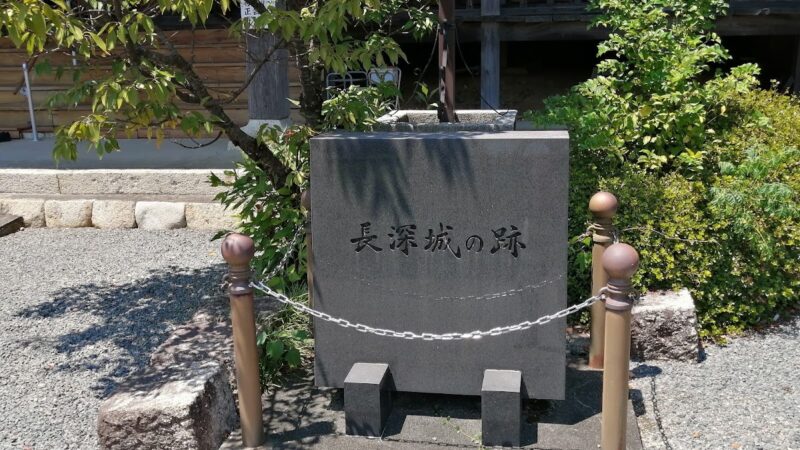
When visiting Ichiba Castle, the first thing you’ll see is the castle site monument. The stone monument is inscribed with “Ichiba Castle Ruins” or “Asakura Castle Ruins,” indicating that this is a historical castle site. Information boards are sometimes located near the monument, providing basic information about the castle’s history and structure.
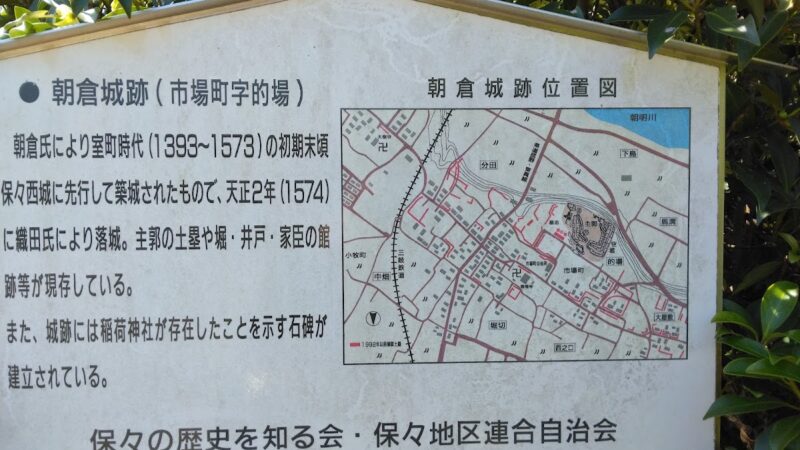
The information boards include a layout map and historical context, making it easy for first-time visitors to grasp the overall picture of the castle. Checking this information before your visit will allow you to view the remains with a deeper understanding.
Keifuku-ji Temple and Surrounding Environment
Keifuku-ji Temple is located near the Ichiba Castle ruins, and this temple can be used as a landmark to approach the castle site. The castle ruins are located approximately 300 meters southwest of Keifuku-ji Temple. The area surrounding the temple is a quiet residential neighborhood, and strolling around while imagining the former castle town is an interesting experience.
To the south of Keifuku-ji Temple is a community center where visitors can park their cars (prior permission is recommended). The castle ruins are accessible on foot from the community center, and the scenery along the way can be enjoyed.
Observation Points for the Ruins
When visiting the Ichiba Castle ruins, we recommend paying attention to the following points when observing the ruins:
Observation of the Dry Moat Cross Section: By observing the depth and slope angle of the dry moat, you can understand its defensive function. The difference in elevation from the bottom of the moat to the top of the earthworks, in particular, gives a real sense of the defensive strength of the time.
View from the Top of the Earthworks: Climbing to the top of the earthworks allows you to experience the view from the castle. Looking out over the Asake River and the surrounding terrain helps to understand why the castle was built in this location.
Division of the Enclosures: Walking around while imagining how each enclosure was arranged and what function it had will reveal the overall structure of the castle.
Cliff Edge Topography: By observing the cliffs of the river terrace, you can appreciate the skillful use of natural terrain for defense.
Cemetery and Stone Monuments
Part of the castle ruins is currently used as a cemetery. Stone monuments and old tombstones related to the castle remain within the cemetery, allowing you to feel the history of the region. When visiting the cemetery, it is important to be considerate and respectful of other visitors and to observe quietly.
Some of the stone monuments commemorate the Asakura clan and those involved with the castle, making the castle’s history feel more intimate.
Access Information and Visiting Precautions
Location and Map
The location of Ichiba Castle is near 2121-2 Ichiba-cho, Yokkaichi City, Mie Prefecture. Searching for “Keifuku-ji Yokkaichi City” or “Ichiba-cho, Yokkaichi City” on a map app or car navigation system will take you to the area around the castle ruins.
Access by Public Transportation
When using public transportation, the nearest stations are Kintetsu Yokkaichi Station on the Kintetsu Nagoya Line or Yokkaichi Station on the JR Kansai Main Line. From the station, you will need to take a bus or taxi.
Taking the Mie Kotsu bus and getting off at the “Ichiba-cho” bus stop is convenient, but since the number of buses is limited, it is recommended to check the timetable in advance. From the bus stop, it is about a 10-minute walk to the castle ruins.
Access and Parking by Car
Access by car is the most convenient. It is about 15 minutes from the Yokkaichi IC on the Tomeihan Expressway, and is also accessible from National Route 1.
Regarding parking, as mentioned above, you may be able to use the community center near Keifuku-ji Temple, but there is no official parking lot. Please avoid street parking and be considerate of the neighbors. If possible, please consider parking your car in a public parking lot in Yokkaichi City and visiting by taxi or bus.
Precautions When Visiting
When visiting Ichiba Castle Ruins, please note the following points:
- Respect for Private Property: Part of the castle ruins is private property. Please do not enter areas marked as “No Entry.”
- Safety Precautions: The footing can be unstable around cliff edges and dry moats. Wear comfortable shoes, and be especially careful during and after rain.
- Season and Time of Day: In summer, vegetation can be overgrown, making it difficult to see the remains. Visiting in spring or autumn is recommended. Also, it gets dark after sunset, so visit during daylight hours.
- Insect Repellent: As this is a place rich in nature, insect repellent spray is especially recommended during summer.
- Take Your Trash Home: There are no trash cans around the castle ruins. Please be sure to take your trash home with you.
Nearby Castles and Historical Spots
Hoho-Nishi Castle
If you visit Ichiba Castle, be sure to also visit Hoho-Nishi Castle. This castle, which functioned as the main castle of Ichiba Castle, has more extensive remains. Comparing these two castles allows for a deeper understanding of the medieval castle network.
Hoho-Nishi Castle is located a few kilometers northwest of Ichiba Castle and is accessible in about 15 minutes by car. This castle also utilizes a river terrace, and exhibits construction techniques similar to those of Ichiba Castle.
Uneme Castle
Other medieval castles are scattered throughout Yokkaichi City. Uneme Castle is located south of Ichiba Castle and is a historical site that tells the story of the complex power dynamics in the Hokusei region.
Yokkaichi Jinya
During the Edo period, a jinya (fortified residence) was established in Yokkaichi. While the Yokkaichi Jinya site is from a different era than Ichiba Castle, it is an important spot for understanding Yokkaichi’s history from a holistic perspective. It is located in the city center and is easily accessible.
Isaka Castle
Isaka Castle is located in Isaka-cho, Yokkaichi City, and functioned during the same period as Ichiba Castle. This is another castle that fell during Oda Nobunaga’s invasion of Ise Province, and it is relevant to understanding the historical context of Ichiba Castle.
Ichiba Castle and the Local History and Culture
Origin and Development of Ichiba-machi
The place name Ichiba-machi, where Ichiba Castle is located, indicates that this area has been a center of commercial activity since ancient times. Regular markets were held here, and people gathered from surrounding areas. The existence of the castle is thought to have played a role in protecting and simultaneously controlling these economic activities.
While present-day Yokkaichi City is known as an industrial city, tracing its history reveals that commercial centers like Ichiba-machi existed in various locations, supporting the regional economy. Ichiba Castle was a fortress closely linked to such economic activities.
The Asakura Clan and the Hokusei Region
The background to the expansion of the Echizen Asakura clan into the Hokusei region lies in the political structure of the Muromachi Shogunate. Why did Asakura Akimasa, who was active in the central government as a shogunate official, build a castle in the distant Ise Province? This was part of a strategy to extend the shogunate’s authority to the provinces while simultaneously expanding the clan’s power base.
Although the Asakura clan’s rule over northern Ise did not last long, Ichiba Castle is a valuable legacy that conveys the history of that short period. While smaller in scale compared to Ichijōdani, the main base of the Echizen Asakura clan, it provides important evidence of the clan’s widespread activities.
Oda Nobunaga’s Invasion of Ise and the Transformation of Northern Ise
Oda Nobunaga’s invasion of Ise in 1568 drastically altered the history of the northern Ise region. The fall of Ichiba Castle is one of the symbolic events. After Nobunaga’s invasion, the northern Ise region came under the control of the Oda clan, and eventually the rulers changed to Toyotomi Hideyoshi and then Tokugawa Ieyasu.
Even after Ichiba Castle was abandoned, the area remained important as a transportation hub. During the Edo period, it developed as a post town on the Tōkaidō road, and from the Meiji era onward, it developed as an industrial city. The history of Ichiba Castle forms one chapter in this long regional history. ## Preservation of Ichiba Castle and Future Challenges
Current State of Preservation
While some remains of Ichiba Castle have been lost due to development and agricultural conversion, the main parts are preserved in relatively good condition. Remains such as dry moats and earthworks remain to the extent that visitors can imagine the appearance of a medieval castle, and it continues to hold value as a regional historical heritage site.
However, compared to castle ruins developed as parks, the guidance facilities and preservation management system are not sufficient. The challenge is to raise awareness of Ichiba Castle’s value among more people and to ensure its proper preservation.
Connection with the Community
Ichiba Castle is located within the living area of local residents and is a space used daily. Its use as a cemetery is one example. Balancing such modern land use with the preservation of historical heritage is a common challenge faced by many castle ruins.
A balanced approach to preservation and utilization is needed, one that promotes local historical education and tourism resources while also considering the lives of residents.
Future Prospects
In recent years, interest in castles has been growing nationwide, and medieval castles like Ichiba Castle are attracting increasing attention. In communities such as the “Castle Enthusiasts Group,” visitors to Ichiba Castle share their impressions and photos, facilitating information exchange.
Against this backdrop, it is hoped that the value of Ichiba Castle will be re-evaluated and appropriate preservation and utilization will be promoted. Detailed surveys and archaeological excavations would yield even more information, further clarifying the castle’s history.
Summary
Ichiba Castle in Yokkaichi City, Mie Prefecture, is a medieval castle that played an important role in the Hokusei region from the Muromachi period to the Sengoku period. Built by Asakura Akimasa, it functioned as a branch castle of Hoho-Nishi Castle and disappeared from the historical stage during Oda Nobunaga’s invasion of Ise.
Its location as a cliffside castle utilizing the river terrace of the Asake River, the remains of dry moats and earthworks, and its deep connection to the region’s history are major attractions of Ichiba Castle. As a castle site that is still accessible today, it offers a valuable experience to history buffs and castle enthusiasts. When you visit Yokkaichi City, be sure to stop by the Ichiba Castle ruins. Learn about history from the stone monuments and information boards, imagine what it was like in its heyday by walking through the remains, and understand its strategic location from the surrounding landscape. Through these experiences, you can encounter living history that you can’t learn from textbooks.
Ichiba Castle is not a famous castle, but that’s precisely why it’s a place where you can quietly contemplate history. Why not visit this little-known medieval castle as part of your castle tour of Mie Prefecture or your sightseeing in Yokkaichi?