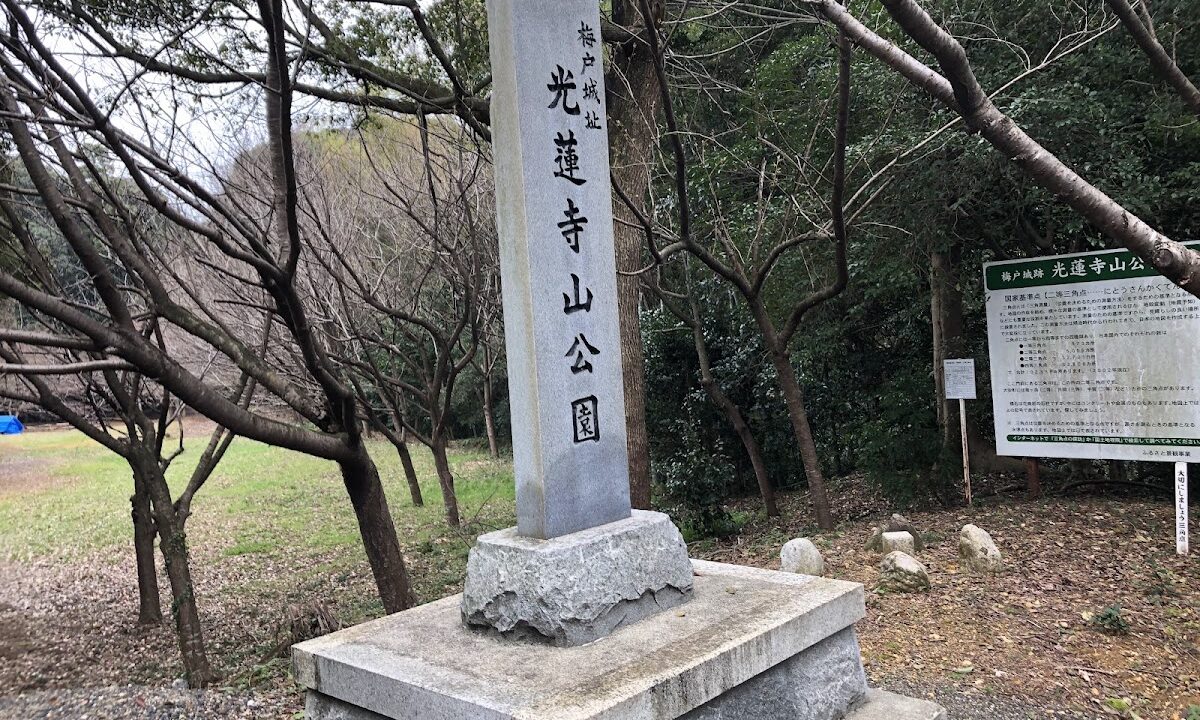
Umedo Castle (Inabe City, Mie Prefecture) Complete Guide | History, Remains, and Access Information
Umedo Castle, located in Daian-cho, Inabe City, Mie Prefecture, is a flatland castle that functioned as an important base controlling a key point on the Happo Highway during the Sengoku period. Built by Umedo Takazane, a descendant of the prestigious Rokkaku clan of Omi Province, the castle is now maintained as Korenji-yama Park, with well-preserved remains such as earthworks and dry moats. This article comprehensively explains the detailed history of Umedo Castle, its notable remains, and access information, providing useful information for castle enthusiasts and history buffs.
Basic Information on Umedo Castle
Umedo Castle is a Sengoku period mountain castle located in Monzen Tensui, Daian-cho, Inabe City, Mie Prefecture. Built on a hill approximately 84 meters above sea level, it measures approximately 80 meters east-west and 100 meters north-south.
Basic Data
- Location: Monzen Tensui, Daian-cho, Inabe City, Mie Prefecture
- Castle Structure: Hilltop Castle
- Construction Period: Sengoku period (estimated to be the first half of the 16th century)
- Builder: Umedo Takazane
- Main Remains: Enclosures, earthworks, dry moats
- Elevation: Approximately 84 meters
- Current Status: Developed as Korenji-yama Park
Inabe City is located at the northernmost tip of Mie Prefecture, bordering Gifu and Shiga Prefectures. It was formed in 2003 through the merger of four towns in Inabe District, and Umedo Castle is located within the Daian-cho area.
History of Umedo Castle
Background of Construction and the Roots of the Umedo Clan
Umedo Takazane, who built Umedo Castle, was from the Rokkaku clan, known as the shugo daimyo of Omi (present-day Shiga Prefecture). Specifically, he was born the fourth son of Rokkaku Takayori and was adopted into the Umedo family, inheriting the family headship. The Rokkaku family was a prestigious samurai family that served as the shugo (military governor) of Omi Province and was a powerful daimyo that ruled southern Omi from the Muromachi period to the Sengoku period.
After being adopted into the Umedo family, Umedo Takazane became the lord of Tabika Castle and later built Umedo Castle. The purpose of this castle’s construction was to control the Happo Road, which connected Ise (Kuwana area) to Omi (Hachiman area).
Role as a Strategic Point on the Happo Road
The primary reason for the construction of Umedo Castle was the management of the Happo Road, an important transportation route. The Happo Road was a major highway connecting Ise Province and Omi Province, and was an economically and militarily important location with a bustling flow of goods and people.
The Umedo clan controlled this entire highway area and built their economic base by collecting tolls (sekisen). In the medieval period, control of highways was a major source of income, and Umedo Castle functioned precisely as a tax collection center. This location indicates that Umedo Castle was not merely a military base, but also an economically important location.
As the ancestral residence of the Umedo clan
Umedo Castle served as the ancestral residence of the Umedo clan from its construction by Umedo Takazane. While related by blood to the Rokkaku clan of Omi Province, the Umedo clan maintained their own independent power in northern Ise.
The northern Ise region during the Sengoku period was a complex area where local lords (jigo) maintained a balance of power, influenced by surrounding major powers such as the Oda, Saito, and Rokkaku clans. The Umedo clan also occupied a corner of this balance, and it is believed that they maintained a certain degree of independence through their control of the Happo Highway.
Oda Nobunaga’s Invasion of Northern Ise and the End of Umedo Castle
The history of Umedo Castle reached a major turning point in 1568 (Eiroku 11). In that year, Oda Nobunaga invaded northern Ise, and the Umedo clan was destroyed.
After defeating Imagawa Yoshimoto at the Battle of Okehazama in 1560, Oda Nobunaga embarked on the conquest of Mino and, in his quest to march on Kyoto, began pacifying northern Ise. During his invasion of northern Ise, Nobunaga successively captured strongholds such as Kuwana and Nagashima, subjugating the local lords.
The Umedo clan also fell victim to this invasion, and it is believed that Umedo Castle was either captured or surrendered after giving up resistance. In any case, it is presumed that the Umedo clan’s rule ended at this point, and Umedo Castle was abandoned.
Oda Nobunaga’s pacification of northern Ise was a crucial step in his subsequent unification of Japan. The fall of Umedo Castle is a classic example of the Sengoku period, where a small local force was swallowed up by a larger one.
Umedo Castle’s Layout and Remains
Castle Structure
Umedo Castle was a flatland castle built on a hill approximately 84 meters above sea level, measuring approximately 80 meters east-west and 100 meters north-south. Although relatively small, it features a defensive layout that skillfully utilizes the terrain.
The main enclosure (honmaru) was located in the center of the castle, surrounded by earthen ramparts. Several smaller enclosures (kuruma) were arranged in a stepped pattern around the main enclosure, and dry moats were dug between each enclosure to enhance its defensive capabilities.
Remains of Earthen Ramparts
One of the best-preserved remains of Umedo Castle is the earthen ramparts. The ramparts surrounding the main enclosure are still clearly visible today, consisting of continuous mounds of earth about 1-2 meters high.
Earthen ramparts are earthen walls designed to prevent enemy intrusion and were a standard defensive feature in mountain castles during the Sengoku period. The earthen ramparts of Umedo Castle are arranged in a curved pattern, following the terrain of the hills, showcasing castle construction techniques that utilized the natural landscape.
The top of the ramparts is flat, suggesting the possibility of fences or walls being installed there in the past. Although currently overgrown with trees, careful observation allows the lines of the ramparts to be traced.
Traces of Dry Moats
Umedo Castle had multiple dry moats. Dry moats are moats that do not hold water and are a common defensive feature in mountain castles. They served to hinder enemy advances and demarcate different enclosures.
Even today, traces of the dry moats remain around the main enclosure, visible as depressions with V-shaped or U-shaped cross-sections. While some are obscured by burial or collapse, they provide important clues to understanding the castle’s structure.
Arrangement of Enclosures (Kuruwa)
Umedo Castle is composed of multiple enclosures. The castle grounds were arranged with the main enclosure at the center, surrounded by secondary enclosures such as the second and third enclosures, each functioning as an independent defensive unit.
Each enclosure was a leveled, flat area, where buildings and watchtowers are thought to have been constructed. The main enclosure was the largest, while the surrounding enclosures were relatively small. This structure is typical of mountain castles, with the lord’s residence and important facilities located in the center, and defensive structures surrounding it.
Koguchi (Entrance)
The koguchi, the entrance to the castle, was also an important defensive structure. While the exact location of the koguchi at Umedo Castle has not been clearly confirmed, it is likely that it was located on the east or south side, based on the topography.
To prevent enemy intrusion, koguchi were generally designed with curves rather than straight lines, or surrounded by earthen ramparts. It is possible that Umedo Castle also had such features, but the details are currently unknown.
Current Status as Kōrenji-yama Park
Park Development
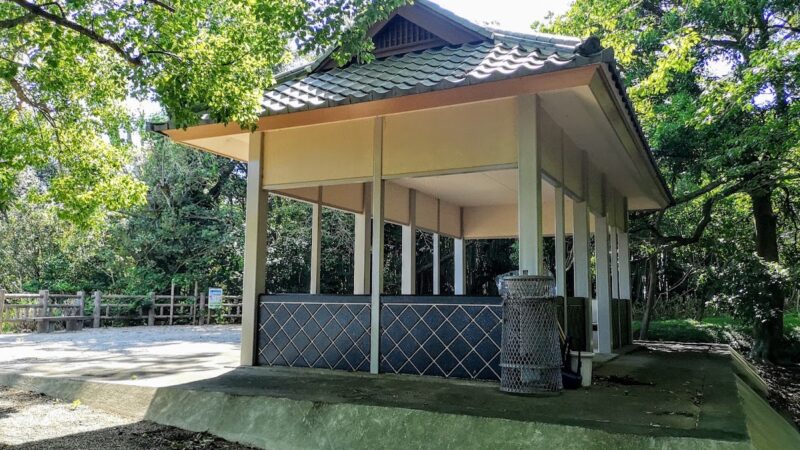
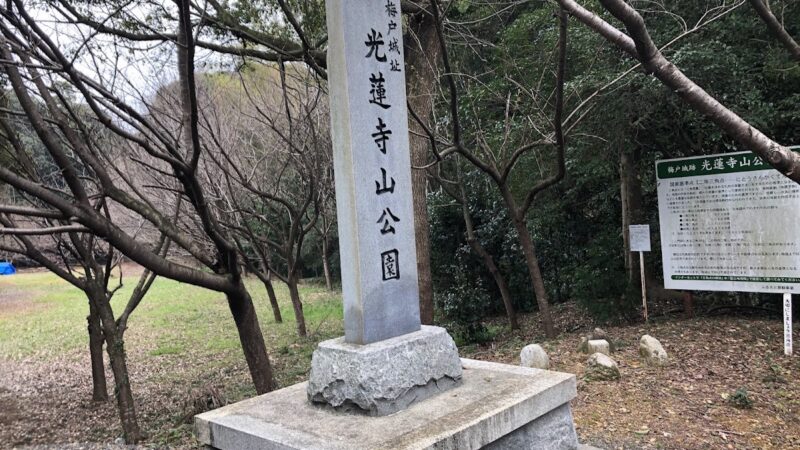
The Umedo Castle ruins are now developed as “Kōrenji-yama Park,” serving as a place of relaxation for local residents. Walking paths have been established within the park, allowing visitors to stroll through the castle ruins and observe the remains.
While the park’s development has partially diminished the atmosphere of the former castle, the main remains have been preserved, making it a historical site worth visiting for castle enthusiasts.
Kōrenji Temple and the Grave of Umedo Takazane
Near the castle ruins is Kōrenji Temple, which is said to house the grave of Umedo Takazane, the builder of Umedo Castle. Visiting Kōrenji Temple will allow for a deeper understanding of the history of the Umedo clan.
The grave of Umedo Takazane is a valuable historical site that conveys the memory of a local lord from the Sengoku period. Visiting it along with the castle ruins will allow for a more comprehensive understanding of Umedo Castle’s history.
Information Boards and Explanations
Within Kōrenji-yama Park, there are information boards explaining the history and structure of Umedo Castle. These boards are an important source of information for first-time visitors to help them understand the castle ruins.
The information boards include a map of Umedo Castle’s layout and historical background, allowing visitors to learn while observing the remains on-site.
How to Access Umedo Castle
Access by Car
The most convenient way to access Umedo Castle (Kōrenji-yama Park) is by car.
Main Route
- Approximately 15 minutes from the Kuwana-Higashi Interchange on the Tomeihan Expressway
- Head north on National Route 365 towards Daian-cho, Inabe City
- Follow the signs from near the “Umedo” intersection
There is parking space around the park, but the number of spaces is limited, so it may be crowded on holidays. There are also convenience stores such as FamilyMart nearby, which are convenient for preparations before your visit.
Access by Public Transportation
The nearest train line is the Sangi Railway Hokusei Line.
Public Transportation Route
- Get off at “Daian Station” on the Sangi Railway Hokusei Line
- Approximately 30-40 minutes on foot from the station, or by taxi.
However, the castle ruins are quite a distance from the station, making walking somewhat difficult. Consider using a taxi or renting a bicycle.
Nearby Tourist Attractions
Inabe City has other attractions besides Umedo Castle.
- Nature of the Inabe River: Clear stream and rich natural environment
- Inabe City Plum Blossom Park: A famous spot where approximately 4,500 plum trees bloom in early spring
- Mt. Fujiwara: A mountain where you can enjoy climbing and hiking
It is recommended to enjoy the nature and culture of Inabe City in conjunction with your visit to Umedo Castle.
Points to Note When Visiting Umedo Castle
Clothing and Equipment
Umedo Castle is a mountain castle, and some areas have slopes and uneven terrain. The following equipment is recommended when visiting:
- Comfortable walking shoes: Trekking shoes or athletic shoes
- Long-sleeved shirt and long pants: To protect your skin from plants and insects
- Hat: To protect your head from the sun and branches
- Drinking water: Especially in summer, heatstroke prevention is necessary
Visitor Etiquette
Umedo Castle is maintained as a park, but it is also a valuable historical site.
- Be careful not to damage the remains
- Always take your trash with you
- Pay attention to the boundaries of private property
- Respect the signs and fences
Suitable Season for Visiting
Umedo Castle is accessible year-round, but the viewing environment differs depending on the season.
- Spring (March-May): Beautiful fresh greenery and mild weather.
- Summer (June-August): Overgrown vegetation makes the ruins difficult to see; be careful of heatstroke.
- Autumn (September-November): Enjoy the autumn foliage; stable weather.
- Winter (December-February): Withered vegetation makes the ruins easier to see; warm clothing is necessary.
Spring and autumn are the most suitable seasons for visiting.
Historical Significance of Umedo Castle
Happo Road and Medieval Transportation Network
The most distinctive feature of Umedo Castle is its position as a base controlling the Happo Road, an important transportation route. From the medieval to the early modern period, roads were arteries for transporting goods and transmitting information, and control over them held great political and economic value.
The Happo Road, connecting Ise and Omi, was frequently used by merchants and travelers. The fact that the Umedo clan collected tolls on this road is an important example for understanding medieval traffic control and economic systems.
Relationship with the Rokkaku Clan of Omi
The fact that the Umedo clan was a branch of the Rokkaku clan, a prestigious family in Omi Province, further enhances the historical significance of this castle. The Rokkaku clan were powerful daimyo under the Muromachi Shogunate, wielding extensive influence from their base in Omi Province.
The fact that Umedo Takazane, born as the son of Rokkaku Takayori, was adopted into the Umedo clan of Ise Province illustrates the kinship networks and power expansion strategies in the samurai society of the Sengoku period. By adopting a person with the bloodline of a prestigious family, the Umedo clan enhanced their own authority and strengthened their relationship with Omi Province.
Position in Oda Nobunaga’s Unification of Japan
The destruction of Umedo Castle during Oda Nobunaga’s invasion of northern Ise in 1568 symbolizes the end of the Sengoku period and the path to national unification.
Nobunaga’s pacification of northern Ise was a crucial step towards his march to Kyoto and his ambition to unify Japan. By successively subjugating smaller local forces, Nobunaga built a strong base of control. The fall of Umedo Castle was precisely part of this larger historical flow.
Related Castles in Mie Prefecture
Several castles from the same period as Umedo Castle exist around Inabe City and within Mie Prefecture.
Takō Castle
Another castle where Umedo Takazane is said to have served as lord. Research continues regarding its relationship with Umedo Castle and the division of roles between the two castles.
Kuwana Castle
A central castle in northern Ise Province, it was an important base during Oda Nobunaga’s invasion of northern Ise. It was connected to Umedo Castle via the Happō Kaidō road.
Nagashima Castle
Known as a base for the Ikkō-ikki rebellion, it was the site of fierce battles fought by Oda Nobunaga. This is important for understanding the situation in northern Ise at the same time as the fall of Umedo Castle.
Visiting these castles together will allow you to gain a deeper understanding of the history of the northern Ise region during the Sengoku period.
Summary
Umedo Castle in Inabe City, Mie Prefecture, is a valuable historical site for understanding regional control and transportation control during the Sengoku period. Built by Umedo Takazane, a descendant of the prestigious Rokkaku clan of Omi Province, this castle, which functioned as a key point on the Happo Highway, came to an end with Oda Nobunaga’s invasion of northern Ise.
Currently, it is maintained as Korenji-yama Park, and the remains such as earthworks and dry moats are well preserved. It is a recommended spot not only for castle enthusiasts and history lovers, but also for those who want to enjoy nature walks.
When visiting Inabe City, be sure to visit the Umedo Castle ruins and feel the spirit of the Sengoku period. Visiting Umedo Takazane’s grave at the nearby Korenji Temple and reflecting on the history of the Happo Highway will make your historical exploration even more fulfilling.