Gokasayama Castle (Taki District, Mie Prefecture) Complete Guide | History and Highlights of the Mountain Castle that Became the Stage for the Restoration of the Kitabatake Clan
What is Gokasayama Castle?
Gokasayama Castle is a mountain castle built on an isolated hill approximately 140 meters above sea level, located in Asagara, Taki-cho, Taki-gun, Mie Prefecture. Also known as “Gokajo,” it is situated in a strategic location overlooking the south bank of the Kushida River.
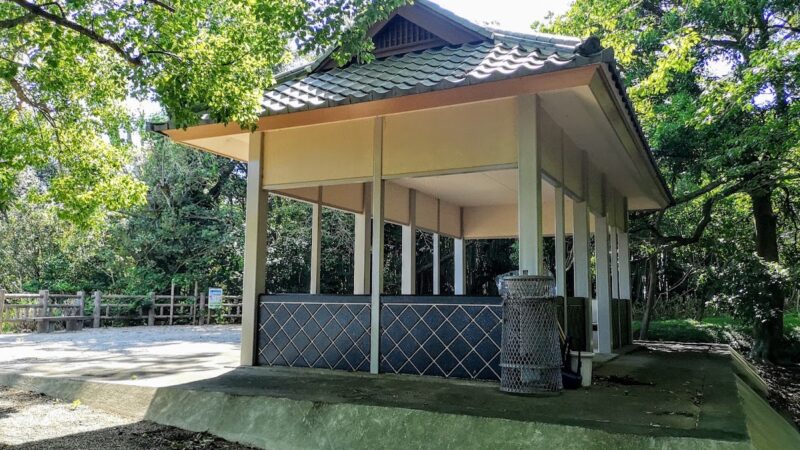
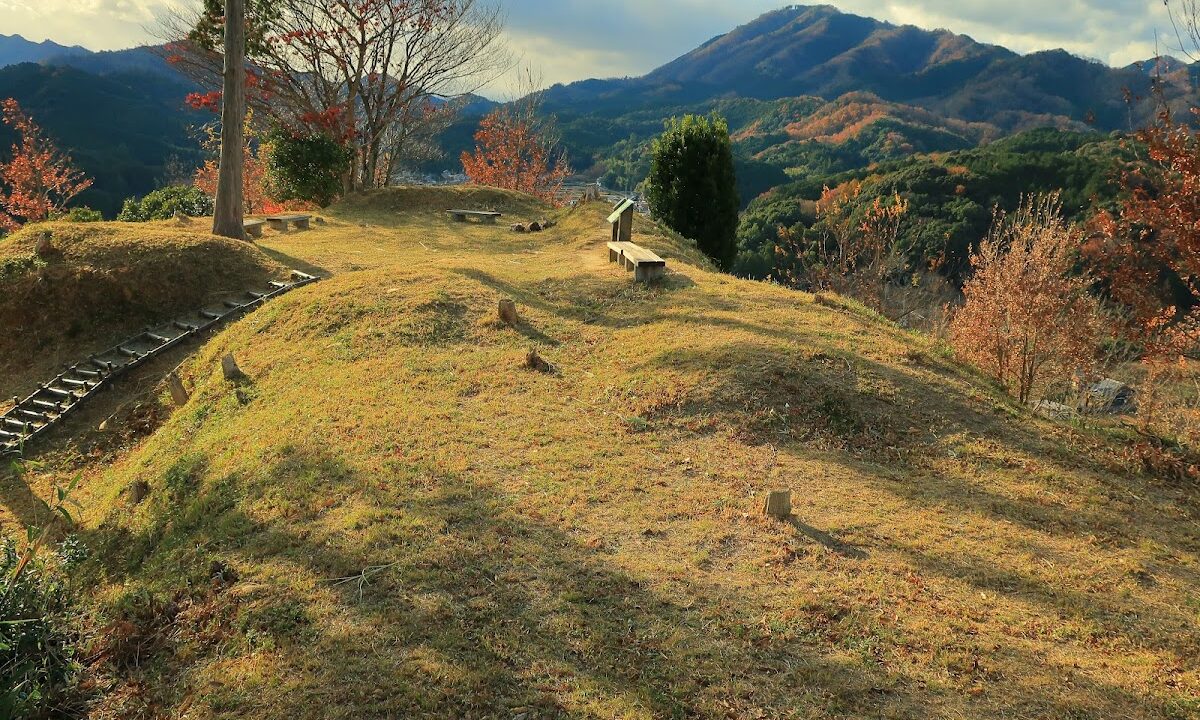
Known as one of the prefecture’s leading mountain castle ruins, its remains, such as earthworks, baileys, and moats, are well-preserved. Currently, it has been developed as “Yutori no Oka” (Hill of Relaxation), with walking paths, a lawn area, and a local community center, making it a popular place for relaxation not only for history buffs but also for local residents.
Castle Scale and Structure
Gokasayama Castle is a mountain castle that skillfully utilizes the terrain of an isolated peak, with a layout consisting of multiple baileys arranged around the main bailey. The main keep (honmaru) was located on the mountaintop at an elevation of 137 meters, and the steep terrain with a relative height difference of approximately 68 meters functioned as a natural defensive wall.
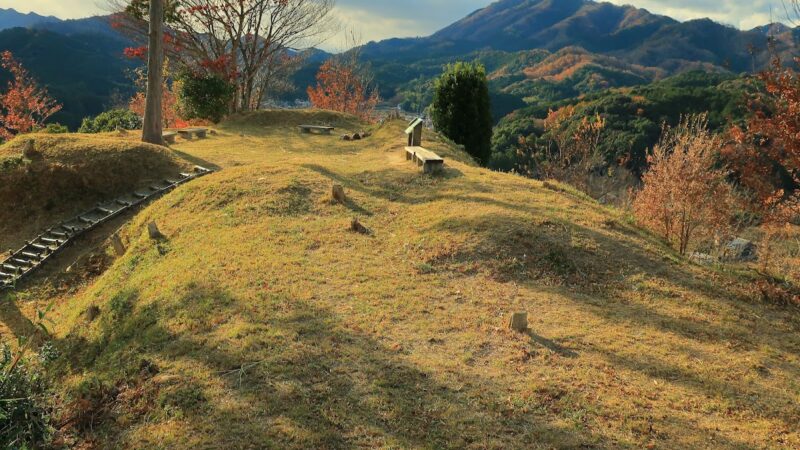
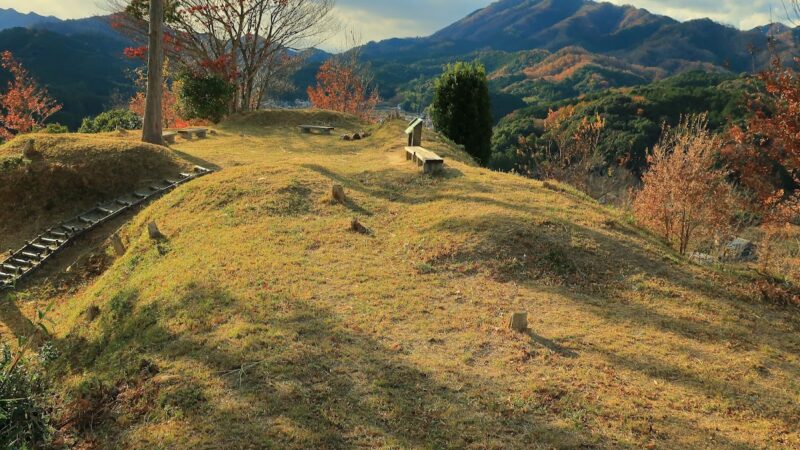
Clear earthworks surround the main keep, and moats separating each enclosure can also be seen. The design, which makes maximum use of the natural terrain, exhibits typical characteristics of medieval mountain castles and is an important historical site for castle research.
History of Goka-Sasayama Castle
Construction in the Mid-Kamakura Period and the Noro Clan
Goka-Sasayama Castle is believed to have been built in the mid-Kamakura period, between 1264 and 1273 (Bun’ei era). It is said that Noro Ujitaka, a descendant of Emperor Montoku, migrated from Kōzuke Province (present-day Gunma Prefecture) and built the castle in this area.
The Noro clan used this castle as their residence for generations and built their power as a powerful local lord serving the Kitabatake clan, the governors of Ise Province. The Noro clan’s base was in the Hatase region, and Goka-Sasayama Castle served as a ancestral stronghold for the Noro clan.
Battles during the Nanboku-cho Period
The earliest documented mention dates back to the Nanboku-cho period. Records indicate that in 1343 (Kōei 2 / Kōkoku 4), the castle was attacked by Niki Yoshinaga, the then governor of Ise Province. During this period, the Kitabatake clan was a powerful general on the Southern Court’s side, and Goka-Sasayama Castle, defended by the Noro clan (their vassals), also functioned as a Southern Court stronghold.
Niki Yoshinaga, as a general on the side of the Muromachi Shogunate (Northern Court), invaded Ise and attacked Southern Court strongholds. The attack on Goka-Sasayama Castle was part of a strategic move to increase pressure on Kiriyama Castle, the Kitabatake clan’s base. This battle became a symbolic event of the fierce fighting within Ise Province during the Nanboku-cho period.
From the Muromachi Period to the Sengoku Period
Throughout the Muromachi period, Goka-Sasayama Castle remained the residence of the Noro clan. While the Kitabatake clan maintained their power as governors of Ise Province, the Noro clan continued to support them as important vassals.
With the arrival of the Sengoku period, Ise Province became a target of Oda Nobunaga’s invasion. In 1569 (Eiroku 12), Oda Nobunaga launched a large-scale invasion of Ise, resulting in a fierce battle against the Kitabatake clan known as the “Battle of Okouchi.” In this battle, the Noro clan fought alongside the Kitabatake clan against the Oda army, but were killed in action.
After the fall of the Noro clan, Goka-Sasayama Castle became the domain of the Anbo clan, a senior retainer of the Kitabatake clan. However, the Kitabatake clan itself surrendered to Oda Nobunaga, effectively placing the castle under his control.
The Honnō-ji Incident and Kitabatake Tomochika’s Uprising
Goka-Sasayama Castle reappears on the historical stage after the Honnō-ji Incident in 1582 (Tenshō 10). When Oda Nobunaga was killed by Akechi Mitsuhide, Kitabatake Tomochika, the younger brother of Kitabatake Tomonori (who had been killed the previous year by Oda Nobuo), seized the opportunity to restore the Kitabatake clan and took action.
Although Kitabatake Tomochika had previously been a monk, he renounced his vows and gathered his former retainers, entering Goka-Sasayama Castle. It is believed that the castle was already in ruins at this time, but Tomochika raised the banner of the Kitabatake clan’s restoration and fought his final battle.
However, Goka-Sasayama Castle fell to an attack by the forces of Oda Nobuo (Kitabatake Tomonori’s adopted son and Oda Nobunaga’s second son). Kitabatake Tomochika’s uprising ended in failure, crushing the Kitabatake clan’s dream of restoration. This is believed to have been the last battle at Goka-Sasayama Castle, after which the castle was abandoned.
Highlights of Goka-Sasayama Castle
Main Enclosure (Honmaru) and Earthworks
The main enclosure, located on the mountaintop, is the central part of Goka-Sasayama Castle. A relatively large, flat area is secured, surrounded by clear earthworks. These earthworks, approximately 1 to 2 meters high, convey the appearance of the defensive facilities of the time.
From the main enclosure, one can enjoy a panoramic view of the Kushida River basin, highlighting its excellent location for monitoring a strategic transportation point. On clear days, one can even see as far as Ise Bay, demonstrating its strategic importance.
Enclosures and Moats
Several enclosures are arranged around the main enclosure. Each enclosure is arranged in a stepped pattern, utilizing the natural terrain, forming an efficient defensive line. Moats are constructed between the baileys, demonstrating ingenious methods to prevent enemy intrusion.
In particular, the moat separating the main bailey from the ridge is deep and clearly defined, making it an important historical site that confirms the techniques of medieval mountain castles. These remains are well-preserved, making them a worthwhile point of interest for castle enthusiasts.
Ascent Route and Layout
The current ascent route to the castle is a walking path developed as “Yutori no Oka” (Hill of Relaxation), accessible from near the Seiwa Library. The well-maintained path is easy to walk, making it a safe and enjoyable visit for families.
As you proceed along the ascent route, you can see traces of the castle’s former defensive lines and entrances. By observing the ingenious layout as you climb, you can experience the techniques and strategies of medieval castles.
Views and Surrounding Environment
The views from Gokasayama Castle are magnificent, offering a panoramic view of the Kushida River and the rural landscape of Taki Town. You can immerse yourself in the romance of history while imagining the scenery that the Noro clan and Kitabatake Tomochika once saw.
The area around the castle ruins has been developed into a park called “Yutori no Oka” (Hill of Relaxation), with facilities such as a lawn area and a local community center. It’s an environment where you can spend a leisurely time, combining a stroll around the castle ruins with a visit to the park.
Access and Visiting Information
Location
Address: Asagara, Taki-cho, Taki-gun, Mie Prefecture (formerly Asagara, Seiwa Village)
Goka Shinoyama Castle Ruins are located on an isolated hill on the border between Furue and Asagara in Taki-cho.
Access by Car
- From Matsusaka City: Approximately 40 minutes by car
- From Seiwa-Taki Interchange on the Ise Expressway: Approximately 10 minutes by car
After exiting the Seiwa-Taki Interchange, head south on National Route 368, and turn south at the intersection with Prefectural Roads 704 and 429. After crossing the bridge and climbing the slope on the right, you will find the Seiwa Library, which marks the entrance to the walking trail.
Parking
There is parking available around the Seiwa Library. Parking for users of the “Yutori no Oka” facility is also available.
Time to Visit
The walking trail is well-maintained, so you can reach the main enclosure in about 15 to 20 minutes on foot. If you want to take your time and carefully observe the remains, it’s best to allow 1 to 1.5 hours.
Points to Note When Visiting
- As this is a mountain castle, comfortable shoes and clothing are recommended.
- In summer, insect repellent and bringing drinking water are recommended.
- While the walking paths are well-maintained, some areas may be slippery after rain, so caution is advised.
- The castle ruins are protected as a historical site, so please be careful not to damage the remains.
Historical Significance of Gokashinayama Castle
History of the Kitabatake Clan and the Governor of Ise Province
The history of Gokashinayama Castle is closely intertwined with the rise and fall of the Kitabatake clan, the governors of Ise Province. The Kitabatake clan was a powerful daimyo who ruled southern Ise Province from the Nanboku-cho period to the Sengoku period, and their base was Kiriyama Castle.
The Noro clan, as important retainers of the Kitabatake clan, were responsible for the control and defense of the Kushida River basin. Gokashinayama Castle served as their base, playing a crucial role in supporting the Kitabatake clan’s sphere of influence.
The Final Stage of the Kitabatake Clan’s Restoration
Kitabatake Tomochika’s uprising after the Honnō-ji Incident was the last resistance in the history of the Kitabatake clan. The fact that Tomochika, who had renounced his monastic vows, gathered his former retainers and attempted to restore the clan at Gokashinayama Castle, several years after the clan’s de facto destruction by Oda Nobunaga, speaks volumes about the loyalty of the retainers to the Kitabatake clan and their longing for the lost prestigious family.
However, the tide of the times had already turned. Gokashinayama Castle, which fell to an attack by Oda Nobuo, became the stage for the final end of the Kitabatake clan’s history.
A Typical Example of a Medieval Mountain Castle
Gokashinayama Castle is a valuable historical site that conveys the techniques of medieval mountain castles. It retains many characteristics of medieval castles, including its layout that skillfully utilizes the natural terrain, defensive facilities such as earthworks and moats, and its strategic location controlling a key transportation hub.
The ruins, boasting one of the best preservation records in the prefecture, hold significant value for castle research and history education. Visiting the site allows you to experience medieval strategies and technologies that cannot be learned from textbooks.
Nearby Historical Spots
Kiriyama Castle Ruins
Kiriyama Castle, the base of the Kitabatake clan, is located approximately 15 kilometers southwest of Goka-Sasayama Castle. Built on a mountain 560 meters above sea level, this large-scale mountain castle retains magnificent ruins that attest to the power of the Kitabatake clan.
Kitabatake Shrine
Located at the foot of Kiriyama Castle, Kitabatake Shrine was built on the site of the Kitabatake clan’s residence. Designated a national historic site and place of scenic beauty, it offers beautiful gardens and historical buildings for visitors to admire.
Taki Kitabatake Clan Castle Ruins
Several castle ruins related to the Kitabatake clan exist around Taki Town, allowing visitors to trace the history of medieval Ise Province. Visiting Goka-Sasayama Castle in conjunction with this site will allow you to gain a deeper understanding of the Kitabatake clan’s history.
Significance of Visiting Goka-Sasayama Castle
Goka-Sasayama Castle is more than just a castle ruin; it is a historical witness of immense value. Beginning as the residence of the Noro clan, and after surviving the turmoil of the Nanboku-cho period, it became the final stage for the Kitabatake clan’s restoration. This castle encapsulates the history of Ise Province from the medieval period to the Sengoku period.
The well-preserved remains convey the castle’s technology and strategy of the time, making it a compelling spot for history and castle enthusiasts. Furthermore, the environment, developed as “Yutori no Oka” (Hill of Relaxation), is approachable and easily accessible even for those without a strong interest in history.
When visiting Taki District in Mie Prefecture, be sure to visit Goka-Sasayama Castle and reflect on its turbulent history. The view of the Kushida River and the surrounding countryside from the main enclosure will welcome visitors with a beauty unchanged from hundreds of years ago.
Summary
Goka-Sasayama Castle, located in Taki-cho, Taki-gun, Mie Prefecture, is one of the prefecture’s leading mountain castle ruins. Built in the mid-Kamakura period by Noro Ujitaka, it served as the residence of the Noro clan for generations. During the Nanboku-cho period, it was attacked by Niki Yoshinaga, and in the Sengoku period, the Noro clan was destroyed by Oda Nobunaga’s invasion of Ise Province.
After the Honnoji Incident, Kitabatake Tomochika renounced his monastic vows and entered Goka-Sasayama Castle with his former retainers, raising the banner of the Kitabatake clan’s restoration. However, the castle fell to an attack by Oda Nobuo, bringing the history of the Kitabatake clan to a complete end.
Currently, the site has been developed as “Yutori-no-Oka” (Hill of Relaxation), and the remains such as earthworks, baileys, and moats are well-preserved. The view from the isolated hilltop, approximately 140 meters above sea level, is magnificent, making it a spot where visitors can enjoy both historical and nature walks.
Located just a 10-minute drive from the Seiwa-Taki Interchange on the Ise Expressway, this historical site is easily accessible and highly recommended not only for castle enthusiasts but for anyone interested in history.