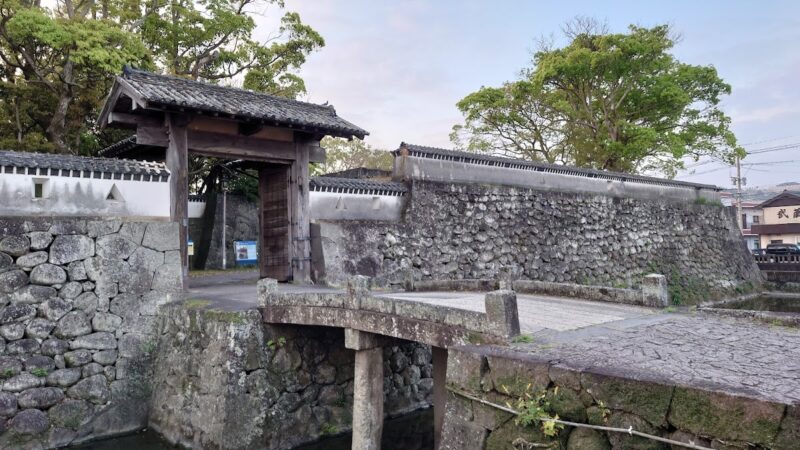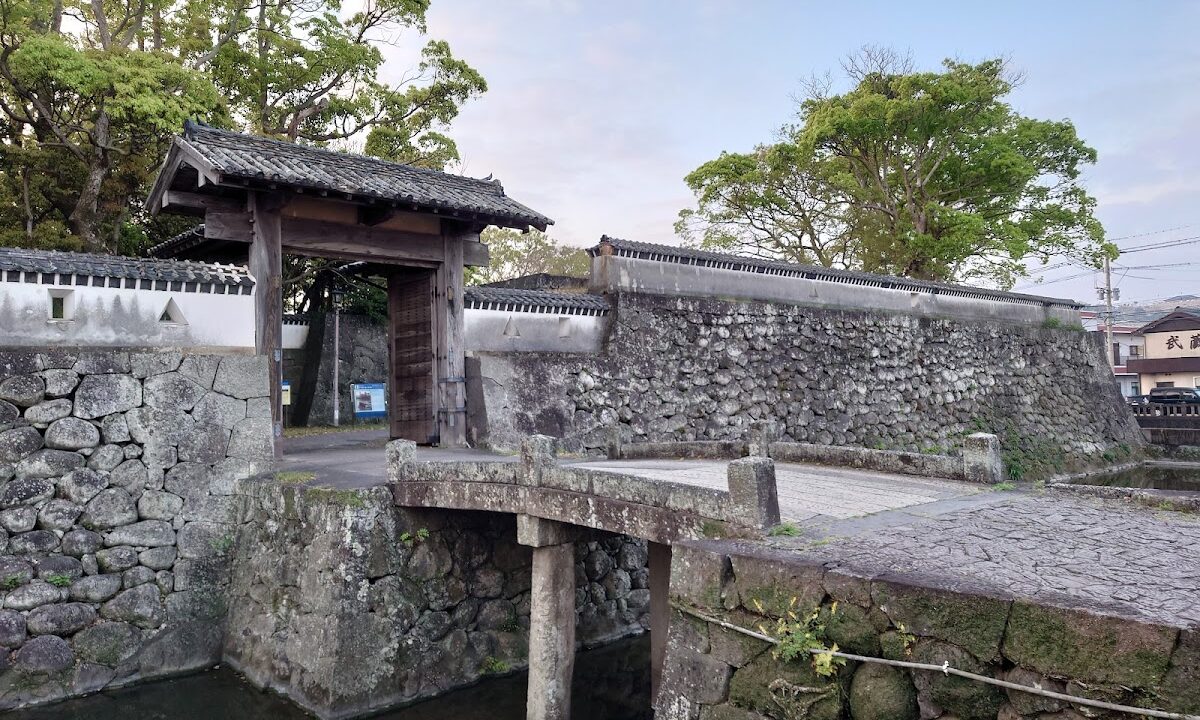
Egawa Castle, Goto City, Nagasaki Prefecture | Tracing the History of the Goto Clan’s Medieval Residence and the Fukue Domain
Egawa Castle, formerly located in Goto City, Nagasaki Prefecture, was a castle that played an important role from the medieval period to the early Edo period as the residence of the Goto clan, who ruled the Goto Islands. Located in the area of present-day Egawa-cho, Goto City, the castle disappeared from the historical stage after being destroyed by fire in 1614 (Keicho 19), but it had a significant impact on the subsequent history of the Fukue Domain and the establishment of Ishida Castle (Fukue Castle).
This article provides a detailed explanation of the history, structure, circumstances of its destruction by fire, and its current remains and historical significance in Goto City.
What is Egawa Castle? – The Goto Clan’s Base
Egawa Castle was a medieval castle located in the southwestern part of the Goto Islands, in the northeastern part of Fukue Island. The Goto clan was a powerful maritime force that ruled the Goto Islands from the Kamakura period through the Sengoku period, and Egawa Castle served as their base.
History of the Goto Clan and the Establishment of Egawa Castle
The Goto clan is believed to have branched off from the Uku clan and developed as a maritime lord ruling the Goto Islands during the medieval period. From the Muromachi period to the Sengoku period, the Goto clan acted as a branch of the Matsuura clan, expanding their power from the Goto Islands, a strategic point for maritime traffic.
While there are no clear records of when Egawa Castle was specifically built, it is confirmed that it functioned as the Goto clan’s residence at least during the Sengoku period. The castle was built in the Egawa district of Fukue Island and is thought to have had the characteristics of a maritime castle, taking advantage of its location near the sea.
Structure and Characteristics of Egawa Castle
Although many details of Egawa Castle’s structure remain unknown due to the loss of records after its destruction by fire, it is presumed to have had the following characteristics:
Location
- Located in the Egawa district in the northeastern part of Fukue Island
- A flatland castle or hilltop castle near the sea
- A strategic location allowing for monitoring and control of maritime traffic
Castle Structure
- A residence-type castle with a medieval layout
- Possibly equipped with moats and earthworks as defensive structures
- A structure that combined the living space of the Goto clan with administrative functions
Egawa Castle was an important base for the Goto clan’s activities as a maritime power and functioned as the center of their domain’s rule.
Historical Background of the Burning of Egawa Castle
The most important event in the history of Egawa Castle is the burning of the castle in 1614 (Keicho 19). This incident became a turning point that significantly changed the history of the Fukue Domain.
The Burning of Egawa Castle in 1614 (Keicho 19)
Egawa Castle was destroyed by fire in Keicho 19 (1614). There are various theories regarding the cause of the fire, but it is certain that the main part of the castle was lost due to the fire, rendering it unusable as a residence.
This period was shortly after the establishment of the Tokugawa shogunate, and it was a time when control over daimyo throughout the country was being strengthened. The Goto clan, as an outside daimyo, was under the shogunate’s supervision, and the reconstruction of the castle required the shogunate’s permission.
Castle Construction Restrictions and Relocation to Ishida Jinya
As part of its control over daimyo, the Edo shogunate implemented strict restrictions on castle construction, including the “One Castle Per Province” decree. After the burning of Egawa Castle, the Goto clan wished to rebuild the castle, but they were unable to obtain permission from the shogunate.
Therefore, the Goto clan (who had become the lords of the Fukue Domain at this time) constructed the Ishida Jinya in 1637 (Kanei 14) and relocated the domain’s administrative office there. The Ishida Jinya (fortified residence) was located in the Fukue district, the central part of present-day Goto City. It adopted the form of a “jinya” rather than a formal castle, thus circumventing the shogunate’s restrictions on castle construction.
The Ishida Jinya continued to function as the administrative center of the Fukue Domain for over 200 years.
The Relationship Between the Establishment of the Fukue Domain and Egawa Castle
Understanding the establishment of the Fukue Domain is essential to understanding the history of Egawa Castle.
From the Goto Clan to the Fukue Domain
The Goto clan sided with the Eastern Army (Tokugawa forces) in the Battle of Sekigahara (1600), and their territory was secured after the war. In the Edo period, the Goto clan was officially recognized as daimyo (feudal lords) and established the Fukue Domain.
The Fukue Domain had a rice yield of approximately 12,000 koku (later increasing to around 14,000 koku). Although a small tozama (outside) domain, it was an important domain controlling a key point for maritime traffic, governing the entire Goto Islands.
From Egawa Castle to Ishida Jinya, and then to Ishida Castle (Fukue Castle)
The changes in the Fukue Domain’s administrative center are as follows:
First Period: Egawa Castle Era (~1614)
- The traditional residence of the Goto clan
- Destroyed by fire in Keicho 19 (1614)
Second Period: Ishida Jinya Era (1637-1863)
- Temporary domain office after the burning of Egawa Castle
- Not a formal castle, but a “jinya” (fortified residence) style
- Functioned as the administrative office of the Fukue Domain for approximately 226 years
Third Period: Ishida Castle (Fukue Castle) Era (1863-1871)
- Finally received permission from the shogunate to build the castle in 1863 (Bunkyu 3), during the late Edo period
- One of the last castles built in Japan
- Ended its role just 8 years later with the abolition of the feudal domains and establishment of prefectures
Ishida Castle (Fukue Castle) was built a full 249 years after the burning of Egawa Castle. This period was a time of turmoil at the end of the Edo period, and the need to strengthen coastal defenses against the arrival of foreign ships forced the shogunate to allow the western domains to develop their castles.
The Current State of Egawa Castle Ruins – Remains and Historical Sites
More than 400 years have passed since Egawa Castle burned down, and almost no clear remains are left. However, in the area around present-day Egawa-cho, Goto City, there are still topographical features and place names that indicate the castle once stood.
Place Names and History of Egawa-cho
Present-day Egawa-cho, Goto City (postal code: 853-0006) is a place name derived from the area where Egawa Castle once stood. The name Egawa itself is evidence that a castle once stood in this area.
Egawa-cho is located in the northeastern part of Fukue Island and is now a quiet area with residential areas and farmland. However, careful observation of the topography reveals places where slight elevations and traces of waterways can be found, suggesting the possibility of a castle.
Status of Preservation of the Ruins
The status of the ruins of Egawa Castle is as follows:
Existing Ruins
- No clear remains of stone walls or moats have been confirmed.
- There is a possibility that traces of the castle remain in the terrain.
- Details are unknown as no archaeological excavations have been conducted.
Historical Site Designation
- Currently, it has not been designated as a historical site by the national, prefectural, or municipal government.
- There is local historical awareness.
A full-scale investigation and preservation activity of the Egawa Castle ruins remains a future challenge.
The History of Goto City and the Position of Egawa Castle
Egawa Castle is one of the important historical sites for understanding the history of Goto City. Let’s examine the role that Egawa Castle played in the historical development of Goto City.
Overview of Goto City’s History
Goto City was formed in 2004 (Heisei 16) through the merger of one city and five towns: Fukue City, Tomie Town, Tamanoura Town, Mitsuraku Town, Kishuku Town, and Naru Town. Located in the western part of Nagasaki Prefecture, in the southwestern part of the Goto Islands, the Goto Islands consist of 11 inhabited islands, centered around Fukue Island, and numerous uninhabited islands.
The Goto Islands have historically played an important role as a gateway for exchange with the continent and as a port of call for Japanese envoys to Tang China. During the medieval period, the Goto clan ruled the islands, and in the Edo period, the Fukue Domain developed its own unique culture.
Historical Significance of Egawa Castle
Egawa Castle holds an important position in the history of Goto City in the following respects:
1. Symbol of Goto Clan Rule
Egawa Castle was the center of the Goto clan’s rule over the Goto Islands from the medieval to the early modern period. As the Goto clan’s political and military base, it was the core of regional governance.
2. Strategic Point for Maritime Traffic
Taking advantage of its proximity to the sea, it played a role in monitoring and controlling maritime traffic around the Goto Islands. For the Goto clan, a powerful maritime force in the medieval period, Egawa Castle, with its maritime characteristics, was an ideal base.
3. The Starting Point of the Fukue Domain’s History
The burning of Egawa Castle and the subsequent relocation to the Ishida Jinya (fortified residence) marked a turning point in the history of the Fukue Domain. The development of the current central area of Goto City (the former Fukue city) began with the establishment of the Ishida Jinya, and the burning of Egawa Castle was the catalyst for this.
Comparison with Ishida Castle (Fukue Castle)
Comparing Egawa Castle with its successor, Ishida Castle (Fukue Castle), is beneficial for understanding Egawa Castle.
Overview of Ishida Castle (Fukue Castle)
Ishida Castle, built in 1863 (Bunkyu 3), is one of the last castles constructed in Japan. It was specially permitted by the shogunate to be built to strengthen coastal defenses against the arrival of foreign ships during the late Edo period.
Characteristics of Ishida Castle
- A modern castle designed as a coastal castle
- A unique location surrounded by the sea on three sides
- Used as the residence of the Goto clan for approximately 8 years
- Currently, parts of the stone walls and moats remain, making it an important historical site in Goto City
Differences between Egawa Castle and Ishida Castle
| Item | Egawa Castle | Ishida Castle (Fukue Castle) |
|——|——–|——————|
| Period | Medieval to early Edo period | Late Edo period |
| Year of Construction | Unknown (Medieval) | 1863 |
| Castle Style | Medieval Castle | Modern Castle (Coastal Castle) |
| Location | Northeast of Fukue Island (Egawa) | Central Fukue Island (Fukue) |
| Current Status | Remains almost completely gone | Stone walls and moats still exist |
| Historic Site Designation | None | City-designated Historic Site |
While Egawa Castle was a medieval-style residence-type castle, Ishida Castle was designed as a full-fledged castle with a modern layout. Furthermore, while Egawa Castle was used for several hundred years, Ishida Castle was used for a mere eight years.
Access to Egawa Castle and Surrounding Information
This section summarizes information for visiting the Egawa Castle ruins.
Access to Goto City
Goto City (Fukue Island) is generally accessed from Nagasaki City or Sasebo City.
Airplane
- Approximately 30 minutes from Nagasaki Airport to Fukue Airport
- Approximately 40 minutes from Fukuoka Airport to Fukue Airport (seasonal operation)
Ferry/High-Speed Boat
- Approximately 1 hour 25 minutes by high-speed boat or 3 hours by ferry from Nagasaki Port to Fukue Port
- Approximately 2 hours 20 minutes by ferry from Sasebo Port to Fukue Port
Attractions around Egawa Castle Ruins
While there are no clear remains at Egawa Castle itself, Goto City has many historical and cultural attractions.
Ishida Castle (Fukue Castle) Ruins
- A castle that succeeded Egawa Castle
- Well-preserved stone walls and moats
- Located in the center of Goto City, easily accessible
Goto City Historical Museum
- Exhibits the history of the Goto clan and the Fukue Domain
- Possibly houses materials related to Egawa Castle
World Cultural Heritage Related Facilities
- A component of the “Hidden Christian Sites in the Nagasaki Region”
- Includes the settlement of Kuga Island and the Egami Catholic Church on Naru Island
Information Sources for Goto City Tourism
When visiting Goto City, the following information sites will be helpful:
- Goto City Tourism Association: Provides comprehensive tourism information for Goto City
- Goto Island Travel (Nagasaki Prefecture Official): A travel information site for the Goto Islands
- Goto City Official Website: Basic city information, event information, etc.
These sites also allow you to search for accommodations, gourmet information, and event guides.
Current Status and Future Challenges of Egawa Castle Research
Unfortunately, research on Egawa Castle is not yet sufficiently advanced. Further progress is expected in this field.
Current Research Status
Information about Egawa Castle is mainly recorded fragmentarily in the following historical materials:
Documentary Materials
- Domain history materials such as the “History of the Goto Domain”
- Local history materials such as the “History of Nagasaki Prefecture”
- Ancient documents related to the Goto clan
However, there are almost no records of the castle’s detailed structure or daily use.
Future Research Challenges
To clarify the history of Egawa Castle, the following research is necessary:
Archaeological Investigation
- Excavation surveys in the vicinity of Egawa-cho
- Non-destructive investigations such as ground-penetrating radar surveys
- Collection and analysis of artifacts
Re-examination of Historical Documents
- Detailed analysis of documents related to the Goto clan
- Comparative study with historical documents from other regions
- Investigation of records of nearby temples and shrines
Topographical and Place Name Investigation
- Comparison of old maps with current topography
- Investigation of the origin of place names
- Analysis of aerial and old photographs
As these studies progress, the true nature of Egawa Castle will become clearer, and our understanding of Goto City’s history will deepen.
The Value of Egawa Castle as a Historical Heritage Site of Goto City
Although very few remains of Egawa Castle exist today, it holds significant value as a historical heritage site of Goto City.
Historical Value
Egawa Castle occupies an important position in regional history as the center of the Goto clan’s rule over the Goto Islands. It is also a valuable example showing the activities of local lords during the transition from the medieval to the early modern period.
Cultural Value
The series of events surrounding Egawa Castle, its destruction by fire, and its relocation to the Ishida Jinya (fortified residence) had a significant impact on the urban development of Goto City. The current central area of Goto City originated from the burning of Egawa Castle, making it important from an urban history perspective.
Potential as a Tourism Resource
Currently, Goto City is focusing on promoting tourism by leveraging its World Cultural Heritage site, “Hidden Christian Sites in the Nagasaki Region,” and its beautiful natural landscape. If properly maintained and utilized, the Egawa Castle ruins have the potential to become an important tourism resource that conveys the history of Goto City.
Summary – Historical Significance of Egawa Castle
Egawa Castle, formerly located in Goto City, Nagasaki Prefecture, was an important fortress used as the residence of the Goto clan from the medieval period to the early Edo period. Although it lost its function as a castle after being destroyed by fire in 1614 (Keicho 19), it had a significant impact on the subsequent history of the Fukue Domain.
The burning of Egawa Castle led to the construction of the Ishida Jinya (fortified residence) and the formation of the current central area of Goto City, creating a historical flow that continued to the construction of Ishida Castle (Fukue Castle) at the end of the Edo period. While almost no remains of Egawa Castle exist today, its name is preserved in the place name Egawa-cho.
When visiting Goto City, consider learning about the history of the Fukue Domain at the Ishida Castle ruins and the Goto City Historical Museum, and also visit the area around Egawa-cho to reflect on the former residence of the Goto clan.
Goto City offers many attractions beyond the history of Egawa Castle, including the World Heritage Site of Hidden Christian Sites, beautiful coastlines, and abundant nature. A trip to experience the history and culture of the Goto Islands, located at the westernmost tip of Nagasaki Prefecture, will surely be an unforgettable memory.
The history of Egawa Castle is the history of Goto City itself, conveying to visitors the depth and fascination of Japanese regional history. I hope that further research will reveal more about the true nature of Egawa Castle.
-680x450.png)