Tamanoura Castle (Goto City): A Complete Guide to its History and Highlights | A Hidden Mountain Castle Ruins in Nagasaki Prefecture
Tamanoura Castle, located in Tamanoura-cho, Goto City, Nagasaki Prefecture, is an important mountain castle ruin indispensable to understanding the history of the Goto Islands. This article comprehensively explains everything you need to know before visiting, from the historical background of Tamanoura Castle and the characteristics of its ruins to access methods and surrounding tourist information.
What is Tamanoura Castle?
Tamanoura Castle was a medieval mountain castle located in Tamanoura-cho, Goto City, Nagasaki Prefecture. It was built on a hill overlooking Tamanoura Bay, in the southwestern part of Fukue Island in the Goto Islands. While no castle structures remain today, traces of the terrain and earthworks allow us to imagine its former appearance.
The Goto Islands have long been a key point for trade with the continent and an important hub for maritime traffic. Tamanoura Castle, built in such a geopolitically important location, has played a significant role in the history of the region.
History of Tamanoura Castle
Background and Period of Construction
There are various theories regarding the construction period of Tamanoura Castle, but it is generally believed to have been built during the medieval period, particularly between the 14th and 15th centuries. During this time, the Goto Islands were under the control of the Uku clan, and Tamanoura Castle is believed to have been built by a member or vassal of the Uku clan.
The Goto Islands were a region where the Uku clan expanded its power from the late Heian period to the Kamakura period. As a branch of the Matsuura clan, the Uku clan controlled the Goto Islands, a key point for maritime traffic, and built its power through shipping and trade.
The Uku Clan and Tamanoura Castle
The Uku clan, as the largest power in the Goto Islands, governed its territory by building multiple castles. Tamanoura Castle likely functioned as a defensive base for the southwestern part of Fukue Island, playing a role in monitoring and controlling maritime traffic from Tamanoura Bay.
During the medieval period, the Goto Islands were a thriving center of trade with the Korean Peninsula and mainland China, and were also known as a base for Wokou (Japanese pirates). Tamanoura Castle may have also functioned as a base for these maritime activities.
From the Sengoku Period to the Edo Period
With the arrival of the Sengoku period, the rulers of the Goto Islands changed from the Uku clan to the Goto clan. When Goto Jungen, a member of the Uku clan, established Fukue Castle as his base, the military importance of Tamanoura Castle likely declined relatively.
During the Edo period, the Fukue Domain was established, and Fukue Castle became the domain’s center. It is presumed that by this time, Tamanoura Castle had already been abandoned, or had become merely a small guardhouse.
Connection to Christian History
The Goto Islands are an important region in the history of Christianity in Japan. In the late Edo period, many hidden Christians migrated to the Goto Islands from the Sotome region of Nagasaki. Christians also resided in the Tamanoura area, and a church was built there after religious freedom was restored in the Meiji era.
While there are no clear records indicating that Tamanoura Castle itself was directly involved in Christian history, Christian culture is an indispensable element in understanding the history of this region.
Structure and Remains of Tamanoura Castle
Location and Layout of the Castle
Tamanoura Castle is a typical medieval mountain castle built on a hilly area. Located on a high ground overlooking the sea, it offers a panoramic view of Tamanoura Bay and the surrounding waters. This location reflects the castle’s primary function of monitoring maritime traffic.
The castle’s layout (design) as a mountain castle is thought to have skillfully utilized the natural terrain. The typical structure involved using steep slopes as natural defensive walls and arranging baileys (kuruma) along the ridgeline.
Existing Remains
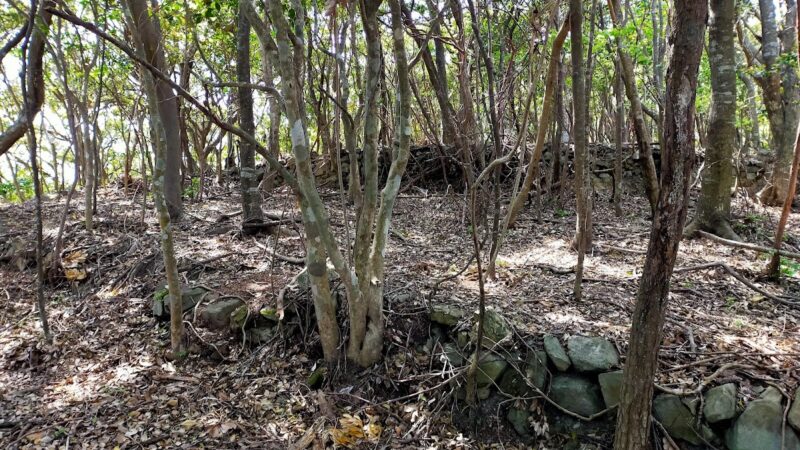
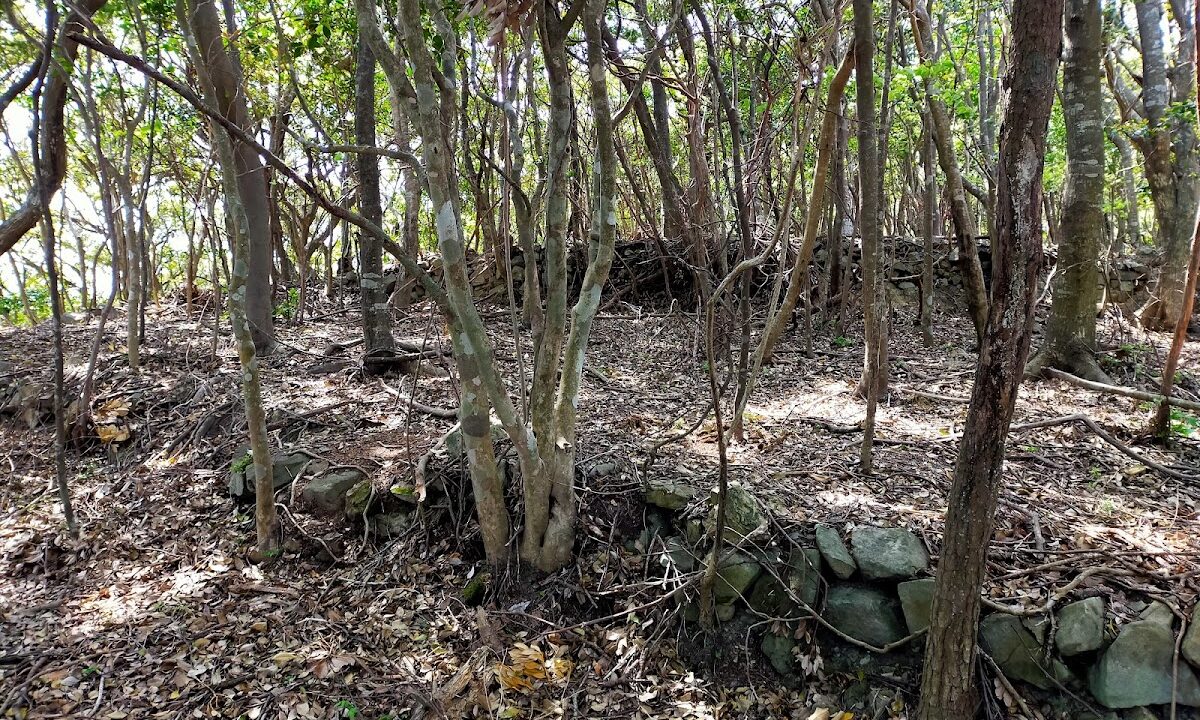
Currently, no clear stone walls or building remains remain at the Tamanoura Castle site. However, careful observation reveals the following traces:
Evidence of Topographical Alteration
Flat surfaces and steps differing from the natural terrain are visible, which are thought to be the remains of baileys or pathways.
Earthwork Traces
Some traces of earthworks may remain. While not clearly visible due to vegetation, they can be inferred from the subtle undulations of the terrain.
Possibility of a Moat
There is a possibility of remaining traces of a moat (a defensive ditch) cut across the ridgeline.
Characteristics of Medieval Mountain Castles
Medieval mountain castles like Tamanoura Castle have characteristics that differ from early modern castles that utilized stone walls.
- Earth-based structure: Defensive lines were mainly constructed using earthen ramparts and moats.
- Utilization of natural terrain: Mountain undulations and cliffs were used for defense.
- Simple structures: There were no magnificent buildings like castle towers; the structures were primarily practical.
- Temporary nature: It was not a castle for permanent residence, but functioned as a refuge during wartime.
How to access Tamanoura Castle
Access to Goto City
To visit Tamanoura Castle, you first need to access Goto City (Fukue Island).
Access by Air
- Approximately 30 minutes from Nagasaki Airport to Goto Tsubaki Airport (Fukue Airport)
- Approximately 40 minutes from Fukuoka Airport to Goto Tsubaki Airport
Access by Ferry
- Approximately 1 hour 25 minutes by high-speed boat or 3 hours 10 minutes by ferry from Nagasaki Port to Fukue Port
- Approximately 8 hours by ferry (overnight service) from Hakata Port to Fukue Port
From Fukue Port to Tamanoura Area
The distance from Fukue Port to Tamanoura area is approximately 30 km, about a 50-minute drive.
Rental Car
Renting a car at Fukue Port or Goto Tsubaki Airport is the most convenient option. A car is essential for getting around the island.
Local Bus
Goto Bus operates a route from Fukue to Tamanoura, but the number of buses is limited, so it is recommended to check the timetable in advance.
Taxi
While it is possible to take a taxi from Fukue city center, the fare will be expensive.
Specific Access to Tamanoura Castle Ruins
Upon arriving in the Tamanoura area, please note the following regarding access to the castle ruins:
- There may be no clear signposts.
- The path to the castle may not be well-maintained.
- You may need to pass through private property; confirmation with locals is recommended.
- You may need to walk on mountain paths; appropriate clothing and equipment are necessary.
It is recommended to contact the Goto City Tourism Association or the Tamanoura Branch Office in advance to obtain the latest information.
Points to Note When Visiting Tamanoura Castle
Clothing and Equipment
When visiting mountain castle ruins, please prepare the following equipment.
- Comfortable clothing: Long sleeves and long pants are recommended.
- Trekking shoes: Sturdy shoes with non-slip soles.
- Hat and sunscreen: Prepare for strong sunlight.
- Insect repellent: Especially important in summer.
- Drinking water: To prevent dehydration.
- Map and compass: Smartphone map apps are also useful.
Safety precautions
- Avoid traveling alone: Visit in groups if possible.
- Check the weather: The ground can become slippery in rainy weather.
- Allow plenty of time: Plan to descend before sunset.
- Cell phone signal: Signals may not reach in the mountains.
- Wildlife: Be aware of wild boars, venomous snakes, and other animals.
Manners and consideration
- Respect for private property: Remember that this is a residential area for local residents.
- Protection of historical remains: Be careful not to damage earthworks or the terrain.
- Take your trash with you: Let’s protect the natural environment.
- Be mindful of noise: Let’s maintain a quiet environment.
Highlights of Tamanoura Area
When visiting Tamanoura Castle Ruins, exploring the surrounding tourist spots will make your trip more fulfilling.
Tamanoura Church
Tamanoura Church is a wooden church built in 1912 (Meiji 45). It features a simple and warm exterior and is an important building that tells the history of Christianity in the Goto Islands. While it is possible to visit the interior, consideration is needed, such as avoiding mass times.
Daihoji Temple
Daihoji Temple, located in the Tamanoura area, is one of the 88 sacred sites of the Goto Islands. In its tranquil atmosphere, you can feel the history of local faith.
Natural Landscape of Tamanoura
The Tamanoura area is blessed with a beautiful coastline and abundant nature.
- Tamanoura Bay: A calm inlet that also functions as a fishing port.
- Natural Camellia Habitat: Known as the origin of the Tamanoura camellia.
- Coastal Drive: Enjoy the varied scenery of the coastline.
Tamanoura Camellia
Tamanoura is known as the birthplace of the “Tamanoura Camellia” variety. This beautiful variety, with its white petals edged in red, is highly valued among camellia enthusiasts. During its blooming season (February to April), you can enjoy camellias in the area.
Other Castle Ruins and Historical Sites in Goto City
Besides Tamanoura Castle, Goto City has several other castle ruins and historical sites.
Fukue Castle (Ishida Castle)
Fukue Castle is a castle built in the late Edo period in the center of Goto City. Known as one of the last castles built in Japan, its stone walls and moat remain today. The Goto Family Garden and the Goto Tourism and History Museum are also located there, allowing visitors to learn about the history of Goto.
Egawa Castle Ruins
Egawa Castle was one of the residences of the Uku clan and is located in Tomie-cho, Goto City. The remains of this medieval mountain castle are relatively well-preserved, making it an interesting spot for castle enthusiasts.
Uozugasaki Park
Uozugasaki Park is a scenic spot near the Tamanoura area, featuring an observation deck offering panoramic views of the East China Sea. On clear days, it is said that one can even see the distant Chinese mainland.
History and Culture of Goto City
From Ancient to Medieval Times
The Goto Islands have long played an important role as a gateway for exchange with the continent. Known as a port of call for Japanese envoys to Tang China, there is a legend that Kukai (Kobo Daishi) also visited Goto.
In the medieval period, the Uku clan, a branch of the Matsuura clan, ruled the Goto Islands and expanded their power through maritime traffic and trade. Connections with Wokou (Japanese pirates) have also been noted, indicating a region with a strong maritime character.
History of Christianity in the Goto Islands
The history of Christianity in the Goto Islands holds a significant place in the history of Christianity in Japan.
In the late Edo period, many hidden Christians migrated from the Sotome region of Nagasaki to the Goto Islands. While outwardly living as Buddhists, they secretly continued to practice their Christian faith.
With the recognition of religious freedom in the Meiji era, churches were built throughout the Goto Islands. Currently, there are over 50 churches in the Goto Islands, many of which stand amidst beautiful scenery. In 2018, the “Hidden Christian Sites in the Nagasaki Region” were registered as a World Cultural Heritage site (several settlements from the Goto Islands are component sites).
Industry and Culture of the Goto Islands
Fisheries
The Goto Islands are blessed with rich fishing grounds, and fishing has flourished there since ancient times. In particular, catches of horse mackerel, mackerel, and squid are abundant, and these are local specialties alongside Goto udon noodles.
Goto Udon
Goto Udon is a traditional noodle dish sometimes counted as one of Japan’s three greatest udon noodles. It features thin, firm noodles made using a unique method.
Camellia Oil
The Goto Islands are known as a natural habitat for camellias, and camellia oil production is a traditional industry. Camellia oil is used not only for cooking but also in cosmetics and hair products.
Accommodation when visiting Tamanoura Castle
Accommodation in the Tamanoura area
The Tamanoura area has small guesthouses and inns. A major attraction is the opportunity to enjoy dishes made with fresh local seafood.
Accommodation in Fukue City
For more options, staying in Fukue city is convenient. There are various types of accommodations, including hotels, business hotels, inns, and guesthouses.
Tamanoura is about a 50-minute drive from Fukue city, making a day trip possible.
Reservation Notes
Accommodations in the Goto Islands become crowded during peak tourist season (especially summer and the camellia blooming season). Early reservations are recommended.
Best Season to Visit Tamanoura Castle
Spring (March-May)
This coincides with the camellia blooming season, allowing you to enjoy the Tamanoura camellias. The weather is mild and pleasant, making it an ideal season for sightseeing.
Summer (June-August)
Tourism increases during the swimming season. While heat and insect repellent are necessary for visiting the mountain castle, the contrast between the blue sea and green mountains is beautiful.
Autumn (September-November)
After the typhoon season, the weather stabilizes and becomes more pleasant. There are relatively fewer tourists, allowing for a leisurely tour of the historical sites.
Winter (December-February)
Winter is windy and colder, but the rate of sunny days is high, allowing you to enjoy the scenery in crisp air. This is also the time of year with the fewest tourists.
Goto City Tourist Information
Tourist Information Centers
- Goto City Tourism Association: Located inside the Fukue Port Terminal, it provides tourist information and distributes brochures.
- Goto City Tourism and History Museum: A facility where you can learn about the history and culture of Goto.
Rental Cars and Bicycles
Renting a car is convenient for getting around the island, but electric-assist bicycles are also available for rent. However, the distance to the Tamanoura area is considerable, so visiting by bicycle is recommended for experienced cyclists.
Restaurants
There are many restaurants in Goto City that serve dishes made with fresh seafood. Goto udon, seafood bowls, and sashimi set meals are popular. There are also small restaurants in the Tamanoura area, but their operating hours may be limited, so it is recommended to check in advance.
Summary
Tamanoura Castle is the remains of a medieval mountain castle located in Tamanoura-cho, Goto City, Nagasaki Prefecture. Although no clear structures remain, Tamanoura Castle is an important historical site for understanding the history of the Goto Islands, and its location overlooking the sea gives a sense of its former strategic importance.
While prior preparation and information gathering are necessary for a visit, you can experience the beautiful natural scenery of the Tamanoura area, cultural assets such as Tamanoura Church, and the rich history and culture of the Goto Islands as a whole.
The Goto Islands are far from major cities like Tokyo and Osaka, but this distance makes them a fascinating region with a unique history and culture, and unspoiled nature. Visiting the Tamanoura Castle ruins will be more than just a historical site tour; it will be a valuable experience to touch upon the history and culture of Japan’s remote regions.
For history buffs, castle enthusiasts, and those interested in the culture of remote islands, Tamanoura Castle and the Goto Islands are worth visiting. Prepare appropriately and enjoy a safe and pleasant trip.
-680x450.png)