Complete Guide to Kanjigashiro Castle (Goto City, Nagasaki Prefecture): History, Highlights, and Access Explained in Detail
What is Kanjigashiro Castle?
Kanjigashiro Castle is a medieval mountain castle site located in Yamazaki, Tomie-cho, Goto City, Nagasaki Prefecture. Also known as “Yamazaki Stone Wall,” it is a valuable historical site of medieval castles in the Goto Islands. Built on a hill overlooking Tomie Bay in the southern part of Fukue Island, this castle played an important role as a defensive structure during the time of the Goto clan’s rule.
The remaining stone walls are a valuable historical legacy that conveys the castle-building techniques of the time, and are an important cultural property of Goto City, telling the story of the region’s history.
Historical Background of Kanjigashiro Castle
The Goto Clan and the Goto Islands in the Middle Ages
During the time Kanjigashiro Castle was built, the Goto Islands were located at the westernmost tip of Hizen Province and were strategically important as a key point for maritime traffic. The Goto clan was a samurai family that ruled this region from the Kamakura period to the Sengoku period, and they were constantly vying for control of the Goto Islands alongside the Uku clan.
The Tomie region is located in the southern part of Fukue Island and faces Tomie Bay, a natural harbor. Therefore, a castle was needed as a defensive base against invasions from the sea. It is believed that Kanjigajo Castle was built due to this geopolitical necessity.
Construction Period and Lord
The exact construction date of Kanjigajo Castle is unclear due to limited historical documents, but based on the structure of the stone walls and the construction techniques, it is estimated to have been built during the Sengoku period (late 15th to 16th century). Details about the lord are also unknown, but it is thought to have been defended by a member or vassal of the Goto clan.
There are several theories regarding the origin of the name “Kanji,” but the most likely is that it derives from the name of a samurai who defended the castle. Local legends state that the name of a brave samurai who defended this land was preserved as the castle’s name.
Abandoned Castle and Present State
Kanjiga Castle is believed to have been abandoned by the early Edo period. As the Goto clan established Fukue Castle (Ishida Castle) as their base, many mountain castles lost their military significance and were abandoned. However, the remains, such as the stone walls, have remained remarkably well-preserved over the long years and are now preserved as a historical heritage site of Goto City.
Structure and Characteristics of Kanjiga Castle
Location and Layout
Kanjiga Castle is built on a hill in Yamazaki, Tomie Town, at an altitude of approximately 50 meters. Tomie Bay stretches out to the south, providing an excellent vantage point for observation. This location was ideal for early detection of enemy movements from the sea and for establishing a defensive posture.
The castle’s layout is relatively small for a mountain castle, and it is believed that defensive facilities were arranged around the main enclosure. By combining the natural fortifications utilizing the steep terrain with artificial stone walls, the structure allowed for effective defense even with a small number of personnel.
Features of the Stone Wall
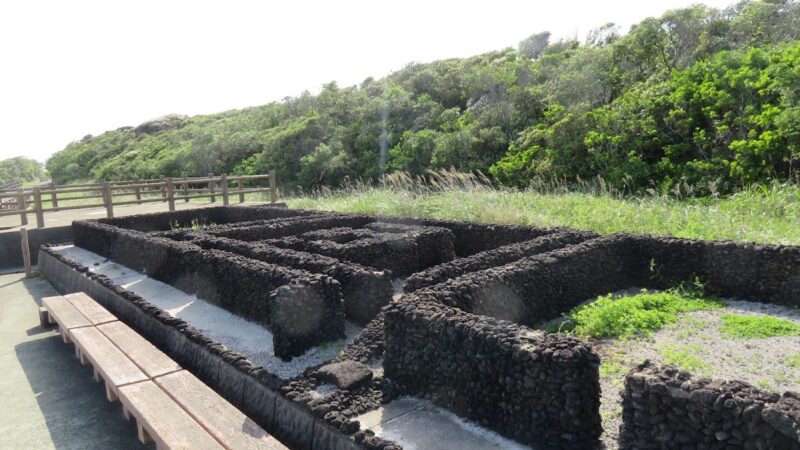
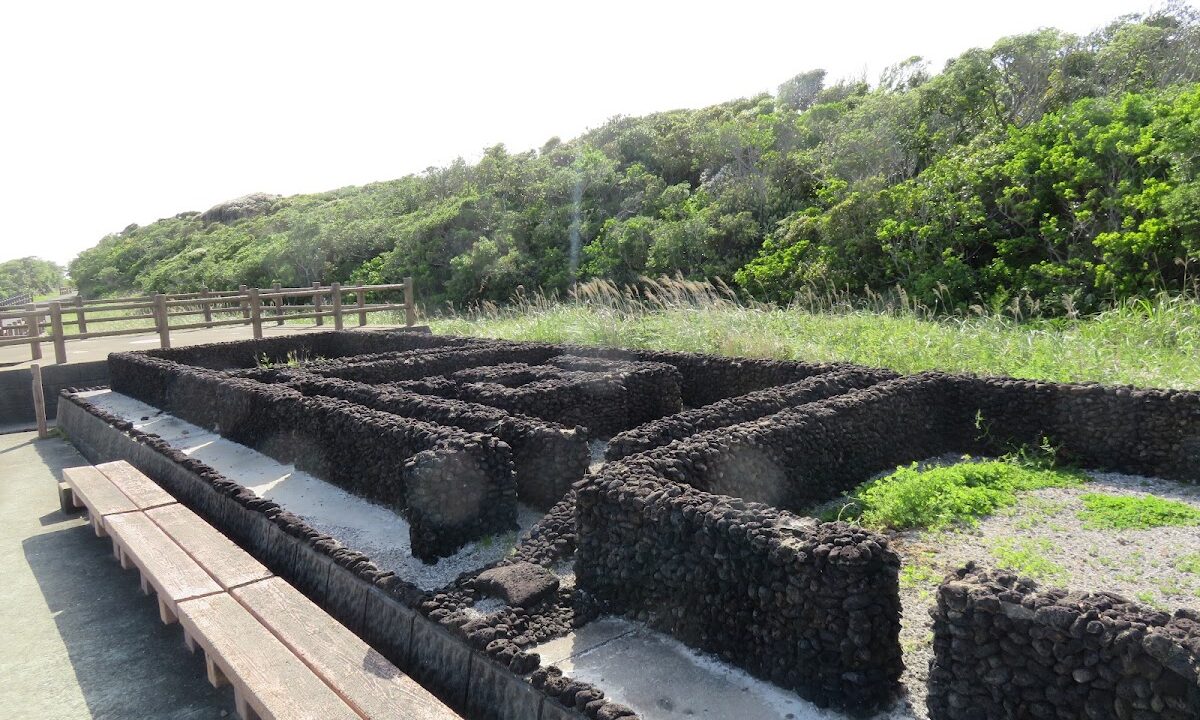
The greatest highlight of Kanjigajo Castle is the stone wall structure, also known as the “Yamazaki Stone Wall.” This stone wall was built using the nozurazumi technique, stacking natural stones, and remains to a maximum height of approximately 2 meters, extending for several tens of meters in length.
The stone wall formed the defensive line of the main enclosure, functioning as a fortress wall to prevent enemy intrusion. Compared to other medieval castles in the Goto Islands, examples of such clearly preserved stone walls are rare, making it a valuable archaeological site.
The stone material used is andesite quarried locally, revealing the castle-building techniques that utilized local resources at the time. Although the stacking method is rough, the combination of stones shows ingenuity, demonstrating its sturdiness that withstood long periods of wind and rain.
Enclosures and Defensive Facilities
Several flat areas (enclosures) can be identified around the main enclosure. These are thought to have been used for garrisoning soldiers and storing supplies. Furthermore, traces of moats and cliffs utilizing the undulations of the terrain can be seen, indicating that defensive features as a mountain castle were incorporated throughout.
Although much of the site is now covered with trees, it must have once offered an open view, allowing for a wide vista of Tomie Bay. From the location where the information board is installed, one can imagine the overall layout of the castle as it was at that time.
Highlights of Kanjigajo Castle
Observation of the Stone Wall Remains
The most noteworthy feature for visitors is undoubtedly the stone wall at Yamazaki. The technique of skillfully combining natural stones in the “nozurazumi” style offers a valuable opportunity to directly observe the castle-building techniques of the Sengoku period. Standing before the stone wall, one can truly appreciate the hard work and high level of skill of the people who built it over 500 years ago.
Of particular note is the selection and arrangement of the stones. Larger stones were placed at the base, and smaller stones were stacked on top to ensure stability. The technique of “mazumi-ishi,” where small stones were packed into the gaps between larger stones for fixation, can also be seen.
View of Tomie Bay
From the castle ruins, you can enjoy a beautiful view of Tomie Bay. The unique landscape of the Goto Islands, with its blue sea and green islands, captivates visitors. The castle’s soldiers of yesteryear likely monitored the sea movements while gazing at this scenery.
The view is especially magnificent on a clear day, making it a recommended spot for photography. Depending on the season, you can also watch the sunset over the sea, enjoying both historical romance and natural beauty simultaneously.
Information Boards and Historical Explanations
At the castle ruins, there are information boards installed by Goto City, providing basic information about the history and structure of Kanjigajo Castle. The boards include a layout map and historical background, making it easy for first-time visitors to understand the castle’s overview.
Those interested in history can gain a deeper understanding by using the information on the boards as a guide while exploring the ruins. Map information is also included, which is helpful for confirming your current location.
Surrounding Natural Environment
The area around the castle ruins is blessed with a rich natural environment, allowing visitors to enjoy the vegetation that changes with the seasons. In spring, the fresh green leaves; in summer, the deep green; in autumn, the vibrant autumn foliage; and in winter, the clear, unobstructed views after the leaves have fallen—each season presents a different face.
A stroll while listening to the birdsong offers a luxurious experience that combines historical exploration with nature observation. However, since you will be walking on mountain paths, appropriate clothing and footwear are necessary.
Access Information
Access from Fukue Port
The most common way to access Kanjigajo Castle is by car from Fukue Port, the gateway to Goto City. Head towards Tomie Town from Fukue Port; the journey takes approximately 30 minutes.
Route by Car:
- Head south on National Route 384 from Fukue Port
- Proceed towards Tomie Town
- Follow the signs for the Yamazaki area to the hilly area
- From the parking area, walk to the castle ruins (approximately 5-10 minutes)
Using Public Transportation
If using public transportation, take the Goto Bus Tomie Line. Take a bus bound for Tomie from Fukue Bus Terminal, get off at the nearest bus stop, and then walk to the castle ruins. However, it takes about 20-30 minutes to walk from the bus stop to the castle ruins, so it’s recommended to check the timetable in advance and plan accordingly.
Notes on using the bus:
- Bus services are limited, so check the timetable in advance.
- Be sure to check the return bus schedule as well.
- Wear comfortable walking shoes.
Using a rental car
Using a rental car is the most convenient way to sightsee in Goto City. There are several rental car companies around Fukue Port, and advance reservations are possible. It’s especially recommended for travelers with limited time, as you can efficiently visit other tourist spots besides Kanjigajo Castle.
Parking Information
There is no dedicated parking lot around the castle ruins, but there are a few parking spaces along the roadside. However, the road is narrow, so please be considerate of traffic. Visiting in a large vehicle is difficult, so we recommend visiting in a regular passenger car.
Notes for Visitors
- Opening Hours: As it is an outdoor ruin, it can be freely visited during the daytime.
- Admission Fee: Free
- Estimated Time Required: Approximately 20-30 minutes for the visit.
- Attire: Comfortable clothing and walking shoes are essential as you will be walking on mountain paths.
- Items to Bring: Drinks, insect repellent (in summer), rain gear (depending on the weather).
- Toilets: There are no toilets around the castle ruins, so please use the restroom beforehand.
- Mobile Phone: Reception is good, but it’s a good idea to download map information just in case.
Nearby Tourist Attractions
Historical Spots in Tomie Town
When visiting Kanjigajo Castle, we recommend also visiting other historical spots in Tomie Town. The Tomie area is dotted with townscapes and historical buildings dating back to the Edo period, allowing you to understand the history of Goto from multiple perspectives.
Tomie Church is a beautiful church that tells the history of Christianity and is a symbolic building of Goto’s Catholic culture. While not part of the “Hidden Christian Sites in the Nagasaki Region,” this is an important spot for understanding the history of local faith.
Fukue Castle (Ishida Castle)
Located in the heart of Goto City, Fukue Castle (Ishida Castle) is a coastal castle known as one of the last castles built in Japan. In contrast to medieval mountain castles like Kanjigajo Castle, Ishida Castle exhibits characteristics of early modern castles, allowing visitors to understand the evolution of castles in Goto.
Although currently the site of Goto High School, the remains such as stone walls and moats are well-preserved and open to visitors. It’s conveniently located within walking distance of Fukue Port.
Onidake
Onidake, a symbol of Fukue Island, is a 315-meter-high volcano, offering 360-degree panoramic views from its summit. Located about 40 minutes by car from Kanjigajo Castle, it’s a spot where you can fully enjoy the natural scenery of Goto.
The grassy slopes of the volcano are perfect for hiking and popular with families. The view at sunset is particularly spectacular and recommended for photography enthusiasts.
Osezaki Lighthouse
Located at the westernmost point of Fukue Island, Osezaki Lighthouse is a beautiful lighthouse selected as one of “Japan’s 50 Best Lighthouses.” The view of the white lighthouse perched on a cliff and the deep blue East China Sea is breathtaking.
It’s about an hour’s drive from Kanjigajo and is a highlight of Goto Islands tourism, attracting many visitors. Walking trails are maintained around the area, allowing visitors to enjoy nature walks.
Mitsuraku District
Located in the northwestern part of Fukue Island, Mitsuraku District is known as a place associated with the Japanese envoys to Tang China. There are numerous spots where you can feel the ancient history, such as the port where the envoy ships waited for favorable winds and the last known place in Japan, called Jihongai.
For history buffs, visiting Kanjigajo Castle along with Goto Island will allow you to gain a comprehensive overview of Goto’s history from ancient times through the medieval and early modern periods.
Goto City Accommodation Information
Accommodation
Goto City offers a variety of accommodations, including hotels, ryokans (traditional Japanese inns), minshuku (guesthouses), and guesthouses. Modern hotels are concentrated in the Fukue city center, offering a wide range of choices from business hotels to resort hotels.
For those seeking a more localized experience, minshuku and guesthouses are recommended. You can enjoy dishes made with fresh local seafood and learn about Goto’s culture and history through interaction with the owners.
There are also outdoor facilities such as camping villages, allowing you to enjoy staying in nature. Many facilities require advance reservations, so early booking is recommended when planning your trip.
Gourmet Information
Goto City is a treasure trove of fresh seafood. In particular, Goto Udon is a famous local specialty, considered one of Japan’s three great udon noodles, characterized by its thin, chewy noodles. Goto udon noodles, served in a broth made from flying fish (ago), are a must-try when visiting.
Also, Kankoro mochi, a traditional Goto confection made with sweet potatoes, is popular for its simple sweetness and makes a great souvenir.
Fresh seafood dishes such as sashimi, sushi, and grilled fish are also exquisite and can be enjoyed at local izakayas and restaurants. Dishes made with locally caught fish are especially fresh and offer a taste you won’t find in the city.
Event Information
Goto City hosts a variety of events throughout the year. There are seasonal delights, including swimming and marine sports events in the summer, harvest festivals and cultural events in the autumn, and the Camellia Festival in the winter.
The Goto Islands are particularly known for their camellias, and you can enjoy the beautiful flowers from winter to spring. Camellia oil production is also thriving, and many camellia-related products are sold.
When planning your trip, checking the event information on the Goto City Tourism Association website will make your trip more fulfilling.
Best Season to Visit Kanjigajo Castle
Since Kanjigajo Castle is an outdoor historical site, it is recommended to visit during periods of good weather.
Spring (March-May):
The fresh greenery is beautiful, and the temperature is mild, making it ideal for strolling. Cherry blossoms and wildflowers bloom, allowing you to enjoy both the beauty of nature and historical exploration.
Summer (June-August):
The greenery is lush, and on sunny days, the blue of Tomie Bay stands out. However, temperatures are high and the sun is strong, so precautions against heatstroke are necessary. Also, since it is a time when there are many insects, don’t forget insect repellent.
Autumn (September-November):
This is the most recommended season. The climate is mild, and you can enjoy the autumn foliage. The air is clear, so the views are excellent.
Winter (December-February):
There are fewer tourists, allowing you to quietly reflect on history. However, it can be windy and cold on some days, so warm clothing is necessary. A benefit is that the ruins become easier to see after the leaves have fallen.
Advice for History Enthusiasts
To gain a deeper understanding of Kanjigajo Castle, prior study is effective. Reading books and materials about the history of the Goto clan and the Goto Islands in the Middle Ages will make your discoveries at the site more meaningful.
Related Books:
- Regional history research books such as “Castles of the Goto Islands”
- Castle research books such as “Medieval Castles of Nagasaki Prefecture”
- History-related pamphlets published by Goto City
These can be viewed at the Goto City Library and Museum, and some are also available online.
At the site, you can gain practical knowledge that you can’t get from textbooks by closely observing the actual ruins, such as the way the stone walls were constructed and how the terrain was utilized. If possible, we recommend bringing a camera or sketchbook to record your observations.
Furthermore, opportunities to speak with local historians and tour guides can provide insights into legends and anecdotes not found on information boards, leading to a deeper understanding.
Learning about the History and Culture of Goto City
Visiting Kanjigajo Castle is a gateway to learning about the rich history and culture of Goto City. The Goto Islands have functioned as a gateway for exchange with the continent since ancient times and are known as a port of call for Japanese envoys to Tang China.
In the Middle Ages, it developed uniquely within the samurai society, and in the early modern period, Christian culture flourished. The settlements of Kuga Island and Naru Island, registered as a World Cultural Heritage site as part of the “Hidden Christian Sites in the Nagasaki Region,” convey the history of Christianity in Goto to the present day.
Visiting medieval castles like Kanjigajo Castle deepens your understanding of Goto’s position within samurai society and its regional defense system. Furthermore, visiting early modern castles such as Fukue Castle and Christian-related heritage sites will provide a three-dimensional understanding of how Goto has changed over time.
Travel Planning Tips
When planning a trip to Goto City, consider the following points:
Access:
Fukue Port can be accessed by ferry or high-speed boat from Nagasaki Port, or by plane from Fukuoka Airport or Nagasaki Airport. Ferries take longer, but offer a scenic sea voyage. Planes are quicker and recommended for those with time constraints.
Length of Stay:
To visit not only Kanjigajo Castle but also the main tourist attractions of Goto City, a minimum of 2 nights and 3 days is necessary. For those who want to leisurely enjoy the island’s charm, a stay of 3 nights and 4 days or more is recommended.
Transportation:
As mentioned above, renting a car is the most convenient option. However, cars may be scarce during peak season, so early booking is important.
Information Gathering:
Check the latest information on the Goto City Tourism Association website and tourist information sites such as “Goto no Shima Tabi” (Goto Island Travel). Downloading maps and brochures in advance is also helpful.
Contact Information:
If you have any questions, you can contact the Goto City Tourism Association for detailed information and advice. Local tourist information centers are also happy to assist you.
Summary
Kanjigajo Castle is a valuable medieval castle ruin remaining in Goto City, Nagasaki Prefecture. The stone masonry remains, also known as “Yamazaki Stone Wall,” are an important historical asset that conveys the castle-building techniques of the Sengoku period, and an essential spot for understanding the history of the Goto Islands.
Built on a hill overlooking Tomie Bay, this castle was once an important defensive base protecting a key point for maritime traffic. The remaining stone walls and baileys tell the story of the wisdom and effort of the people of that time.
To visit, it’s about a 30-minute drive from Fukue Port, and you should allow 20-30 minutes for sightseeing. There are many attractive tourist spots in the surrounding area, such as Tomie Church, Fukue Castle, Onitake Mountain, and Osezaki Lighthouse, allowing you to enjoy the nature and history of Goto City.
Goto City is a region well worth visiting, boasting fresh seafood, local cuisine such as Goto udon noodles, beautiful natural scenery, and a rich history and culture including a World Cultural Heritage site. Why not start your journey to discover the diverse charms of the Goto Islands with a visit to Kanjigajo Castle?
Whether you’re a history buff or a traveler seeking to enjoy nature, Kanjigajo Castle and Goto City are sure to offer an unforgettable experience. Spending time at the tranquil ruins of this mountain castle, reflecting on history from over 500 years ago, will be a precious moment to forget the hustle and bustle of modern life.
-680x450.png)