Kameoka Castle (Iki City, Nagasaki Prefecture) Complete Guide | History, Highlights, and Access Information
What is Kameoka Castle?
Kameoka Castle is a flatland castle located in Gonoura-cho, Iki City, Nagasaki Prefecture, dating from the medieval to early modern periods. Also known as “Kameo Castle,” it played a crucial role as a central political and military base in Iki from the late Kamakura period to the early Edo period.
Built on a hill east of the current Iki City Hall, this castle is a historical site indispensable to understanding Iki’s history and is designated as a cultural property of Nagasaki Prefecture. Part of the main keep has been developed as “Kameoka Castle Park,” and remnants such as the original stone walls still remain.
History of Kameoka Castle
Construction in the Late Kamakura Period
The history of Kameoka Castle dates back to the late Kamakura period. In 1293 (Einin 1), Hata Soumu, the lord of Kishidake Castle in Karatsu, Hizen Province, is said to have advanced into Iki Island and built a castle there. At that time, Iki Island was divided and ruled by various branches of the Matsuura clan, and Kameoka Castle functioned as the Hata clan’s base in Iki.
Unification Rule by the Hata Clan during the Sengoku Period
In 1472 (Bunmei 4), Hata Yasushi, lord of Kishidake Castle, began a full-scale invasion of Iki Island. He successively conquered the five Matsuura clans—the Shisa, Sashi, Yobuko, Kamouchi, and Shiotsuru—who were then dividing and ruling Iki, achieving unified rule over the entire island.
Hata Yasushi appointed Awa-no-kami, a member of his clan, as a deputy at Kameoka Castle, making it his base for controlling Iki. It is believed that the castle underwent extensive renovations during this period, taking on the form of a full-fledged flatland castle with a main keep, second bailey, and third bailey.
Rise of the Hidaka Clan
In 1565 (Eiroku 8), Hidaka Yoshi, a powerful local lord of Iki, overthrew Hata Masa and became the castle lord. While detailed records of this period are scarce, it is known as an event that illustrates the intensity of the power struggles in Iki during the Sengoku period.
Matsuura Domain Rule in the Edo Period
In the Edo period, Iki became part of the territory of the Matsuura clan of the Hirado Domain. The “One Castle Per Province” decree of 1615 led to the nationwide consolidation and reorganization of castles, and it is believed that Kameoka Castle was officially abandoned.
However, it was not completely abandoned. On the site of the third bailey, the “Mushōzu Jinya” (a fortified residence) was built. The castle lord and district magistrate dispatched from the Hirado Domain resided here, continuing the administration of Iki Island. This system was maintained throughout the Edo period, continuing to function as the Matsuura Domain’s base of operations in Iki.
Structure and Layout of Kameoka Castle
Overall Structure of the Castle
Kameoka Castle is a typical hilltop castle, consisting of three main baileys: the main bailey, the second bailey, and the third bailey. The layout, skillfully utilizing the hilly terrain, retains many characteristics of medieval castles.
Structure of the Main Bailey
The main bailey was located in the center of the castle, built on the highest point. Currently, part of the main bailey site has been developed into Kameoka Castle Park, but most of the southern side has been lost, leaving a semicircular depression. This depression is believed to be the remains of a dry moat, preserving traces of the former defensive structure.
The main enclosure (Honmaru) was of medium size for a medieval castle, and it is presumed to have housed the lord’s residence and important facilities.
Second and Third Enclosures
The second and third enclosures (Ninmaru and Sanomaru) surrounded the main enclosure. The third enclosure, in particular, occupied a vast area and played an important role as the site of the Takefu-mizu Jinya (fortified residence) during the Edo period. Currently, these enclosure sites are undergoing urbanization, and only limited remnants of their former appearance remain.
Defensive Structures
The castle’s defensive structures included dry moats, earthworks, and stone walls. The stone walls, in particular, are thought to have been constructed from the late Sengoku period to the early Edo period, making them valuable remains that demonstrate the stage of technological development.
Highlights of Kameoka Castle
Kameoka Castle Park
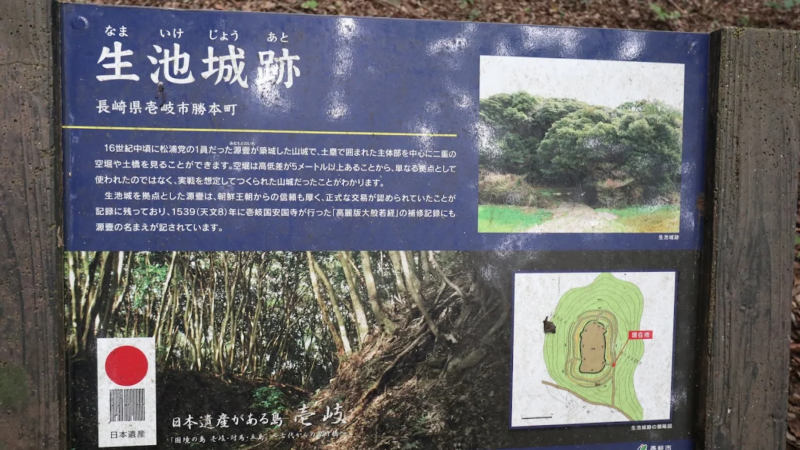
Currently, part of the main enclosure site has been developed into “Kameoka Castle Park,” a place of relaxation for citizens. Information boards are installed within the park, allowing visitors to learn about the castle’s history and structure.
From the park, you can enjoy a panoramic view of Iki city, allowing you to imagine the scenery seen by the former castle lords. It’s also a popular spot for cherry blossom viewing during the season, offering a place to enjoy both historical exploration and nature appreciation.
Stone Wall Remains
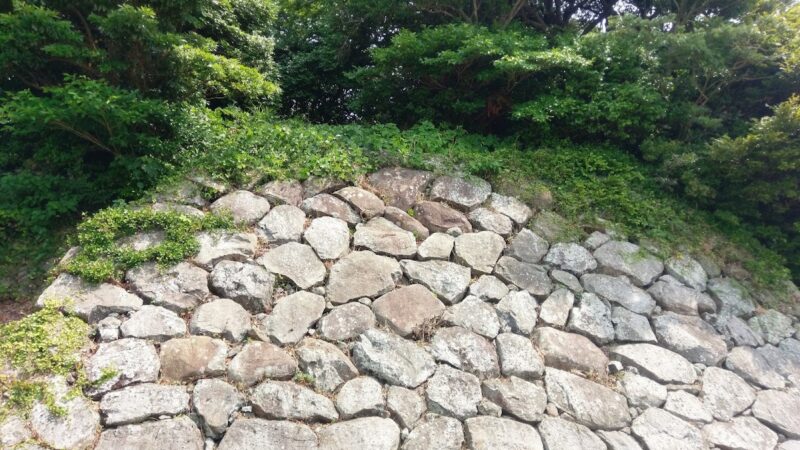
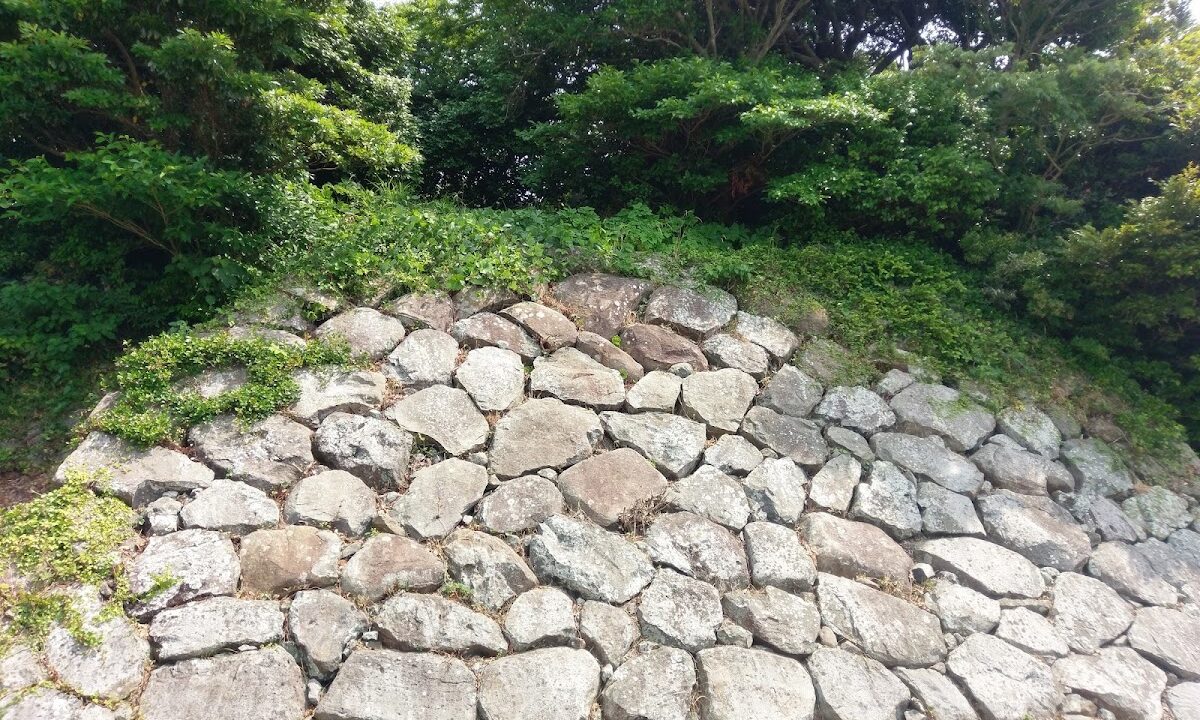
The greatest highlight of Kameoka Castle is the high stone wall remaining on the northern slope of the main enclosure. This wall is relatively well-preserved, allowing for close observation of the stone-laying techniques of the time.
The stone wall was constructed using an old technique called “nozurazumi,” characterized by its simple construction using mostly natural stones. Reaching several meters in height at its highest point, it exudes a powerful presence as a castle ruin.
Dry Moat Remains
The semi-circular depression surrounding the main enclosure is believed to be the remains of a former dry moat. Although it is now largely filled in, the topography allows us to discern the layout of defensive structures, making it a valuable relic from the perspective of castle research.
View
The view from the Kameoka Castle ruins is also not to be missed. Located on a hilltop, it offers panoramic views of Iki City and the surrounding coastline. On clear days, you can also enjoy the beautiful scenery of the Tsushima Strait, truly appreciating Iki’s geographical importance.
Access to Kameoka Castle
Access to Iki Island
Sea Route (Ferry/High-Speed Boat)
- Approximately 1 hour by high-speed boat or 2 hours 20 minutes by ferry from Hakata Port to Iki’s Gonoura Port
- Approximately 1 hour 10 minutes by high-speed boat or 2 hours 10 minutes by ferry from Hakata Port to Iki’s Ashibe Port
- Approximately 1 hour by high-speed boat from Karatsu East Port to Intoji Port
Air Route
- Approximately 30 minutes by plane from Nagasaki Airport to Iki Airport
Access to Kameoka Castle Ruins
Location: Gonoura, Gonoura-cho, Iki City, Nagasaki Prefecture
Access by Car
- Approximately 5 minutes by car from Gonoura Port
- Approximately 20 minutes by car from Iki Airport
- Located east of Iki City Hall, parking available
Public Transportation
- Approximately 15 minutes on foot from Gonoura Port
- Within walking distance from Iki City Hall
Rental Cars & Bicycles
Renting a car or bicycle is convenient for sightseeing on Iki Island. Rental car companies are located near each port and ferry terminal, and advance reservations are possible.
Nearby Tourist Attractions
Iki City Ichikoku Museum
Located about 15 minutes by car from Kameoka Castle, this museum allows you to learn about Iki’s history from ancient to modern times. The exhibits on the Yayoi period’s “Ichikoku” are particularly extensive, and a visit is recommended for understanding the historical background of Kameoka Castle.
Haranotsuji Ruins
This is a large-scale Yayoi period settlement site designated as a National Special Historic Site. It is believed to be the site of the royal capital of “Ichikoku” as described in the “Wei Zhi Woren Zhuan” (Records of the Three Kingdoms, Account of the Wa People), and is an important historical site where you can experience Iki’s ancient history.
Saru-iwa (Monkey Rock)
One of Iki’s representative tourist attractions, this rock jutting out into the sea resembles the profile of a monkey, hence its name. Located about 30 minutes by car from Kameoka Castle, it offers a chance to enjoy the natural beauty of Iki.
Tsukuyomi Shrine
An ancient shrine dedicated to Tsukuyomi-no-Mikoto, a figure in Japanese mythology, and considered the original shrine of Kyoto’s Matsuo Taisha. Iki has over 150 shrines and is also known as the “Island of the Gods.”
Historical Background of Iki
Ancient Iki
Iki has long held an important position as a key point of exchange with the continent. During the Yayoi period, it flourished as “Iki-no-Kuni,” and its name is recorded in the “Wei Zhi Woren Zhuan” (Records of the Three Kingdoms, Account of the Wa People). During the Kofun period, numerous burial mounds were constructed, suggesting a deep connection with the Yamato regime.
Iki Island in the Middle Ages
From the late Heian period to the Kamakura period, Iki Island was under the influence of the Matsuura clan. The Matsuura clan was a samurai group based in northern Kyushu, and they considered Iki Island, a crucial point for maritime traffic, to be important. During the Muromachi period, several clans divided and ruled the island, and this political situation was the background for the construction of Kameoka Castle.
The Mongol Invasions and Iki Island
In the two Mongol invasions of 1274 and 1281, Iki Island was the first target. The first invasion, in particular, resulted in many islanders losing their lives, leaving a deep scar on Iki’s history. This experience is believed to have influenced the subsequent development of castles and fortifications.
Cultural Value of Kameoka Castle
Nagasaki Prefecture Designated Historic Site
Kameoka Castle ruins are registered in the Nagasaki Prefecture Cultural Properties Database and are recognized as an important medieval castle site within the prefecture. Its historical value is highly regarded as the political and military center of Iki Island from the Kamakura period to the early Edo period.
Significance in Medieval Castle Research
Kameoka Castle is a valuable example of the development process of castles from the medieval to the early modern period in northern Kyushu. In particular, it contains interesting elements for research, such as the castle structure under the unique geographical conditions of being on an isolated island, and the defensive system that was mindful of relations with the continent.
Challenges of Preservation and Utilization
Currently, most of the castle ruins are urbanized, and the state of preservation of the remains is not necessarily good. Although a part of the main keep site is preserved as a park, the remains of the second and third baileys have been almost completely lost. The appropriate preservation of the remaining remains and their utilization as a historical resource are challenges for the future.
Points to Note When Visiting
Visiting Hours
Kameoka Castle Park is open at all times and you can visit freely. However, since visibility is poor at night, daytime visits are recommended.
Clothing and Equipment
The castle ruins are located on a hill, and some parts have steep slopes. Comfortable walking shoes and clothing are recommended. In summer, the sun is strong, so a hat and sunscreen are also necessary.
Time Required
Please allow 30 minutes to 1 hour to visit Kameoka Castle Ruins. If you want to carefully observe the remains or enjoy taking photographs, it’s a good idea to allow a little more time.
Nearby Facilities
The Iki City Hall is located near the castle ruins, and facilities such as restrooms are available. Also, the town of Gonoura is nearby, making it convenient for dining and shopping.
Iki’s Food Culture and Local Products
When visiting Kameoka Castle, be sure to enjoy Iki’s rich food culture. ### Iki Beef
Iki Island is known as a production area for Japanese Black cattle, and Iki beef is highly regarded as a high-quality brand of beef. It can be enjoyed at restaurants on the island.
Seafood
Surrounded by the Genkai Sea, Iki Island boasts an abundance of fresh seafood. Sea urchins, abalone, and turban shells, as well as migratory fish like squid and horse mackerel, are particularly delicious.
Iki Shochu
Iki Island is considered the birthplace of barley shochu, and there are several distilleries on the island. Iki shochu is designated as a Geographical Indication (GI) and is a popular souvenir.
The Significance of Visiting Kameoka Castle
Kameoka Castle, though not large in scale, is an important historical site indispensable to understanding the history of Iki Island. This small castle encapsulates important elements of Japanese medieval history, from the Hata clan’s unification of Iki to the Matsuura domain’s rule and the memory of the Mongol invasions.
When visiting Iki, in addition to the beautiful natural scenery and fresh seafood, why not also visit historical sites like Kameoka Castle and reflect on the long history this island has experienced? While the castle ruins are now a quiet park, knowing that this was once the political and military center of Iki will surely change your perspective.
Summary
Kameoka Castle (Kameo Castle) is the remains of a medieval flatland castle in Iki City, Nagasaki Prefecture, which functioned as a base for the control of Iki from the late Kamakura period to the early Edo period. It is an important historical site that tells the story of Iki’s history, including its construction by the Hata clan and their unification of Iki, and its rule by the Matsuura domain during the Edo period.
Currently, part of the main keep site has been developed into Kameoka Castle Park, where visitors can see the remains such as the stone walls. Conveniently located near the Iki City Hall, this historical spot is a popular destination for history buffs and tourists alike, easily accessible during Iki sightseeing.
Enjoying Iki’s rich nature and culinary culture while experiencing the breath of history at Kameoka Castle will surely create unforgettable memories.
-680x450.png)