
Complete Guide to Fukue Castle (Ishida Castle) | A Thorough Explanation of the History and Highlights of Japan’s Last Coastal Castle [Goto City, Nagasaki Prefecture]
Located in the heart of Goto City, Nagasaki Prefecture, Fukue Castle (Ishida Castle) is a valuable historical site known as “Japan’s last coastal castle,” built during the turbulent Bakumatsu period. Completed in 1863, this unique castle was constructed to prepare for the threat of foreign ships, such as the arrival of the Black Ships, and was selected as one of the “Continued Top 100 Japanese Castles” in 2017. This article will fully convey the charm of this rare castle, from its historical background and architectural features to the remaining structures and surrounding tourist spots.
What is Fukue Castle (Ishida Castle)? | Overview of Japan’s Last Coastal Castle
Fukue Castle, officially called Ishida Castle, is a flatland castle built in the center of Fukue Island, the largest island in the Goto Islands. It was planned by Goto Morishige, the 30th lord of the Goto family, and completed during the reign of his son, Goto Morinori, the 31st lord of the domain.
Basic Information
- Location: 1-2 Ikeda-cho, Goto City, Nagasaki Prefecture (near Goto City Hall)
- Year of Construction: Bunkyu 3 (1863)
- Builders: Goto Morinari, Goto Morinori
- Castle Structure: Flatland Castle (Sea Castle)
- Designation: Continued Top 100 Japanese Castles (Announced April 6, 2017)
- Current Status: The site of the main keep is now Goto Prefectural High School, and the site of the second bailey is now Goto City Hall
- Parking: Goto City Hall parking is available (approximately 15 cars)
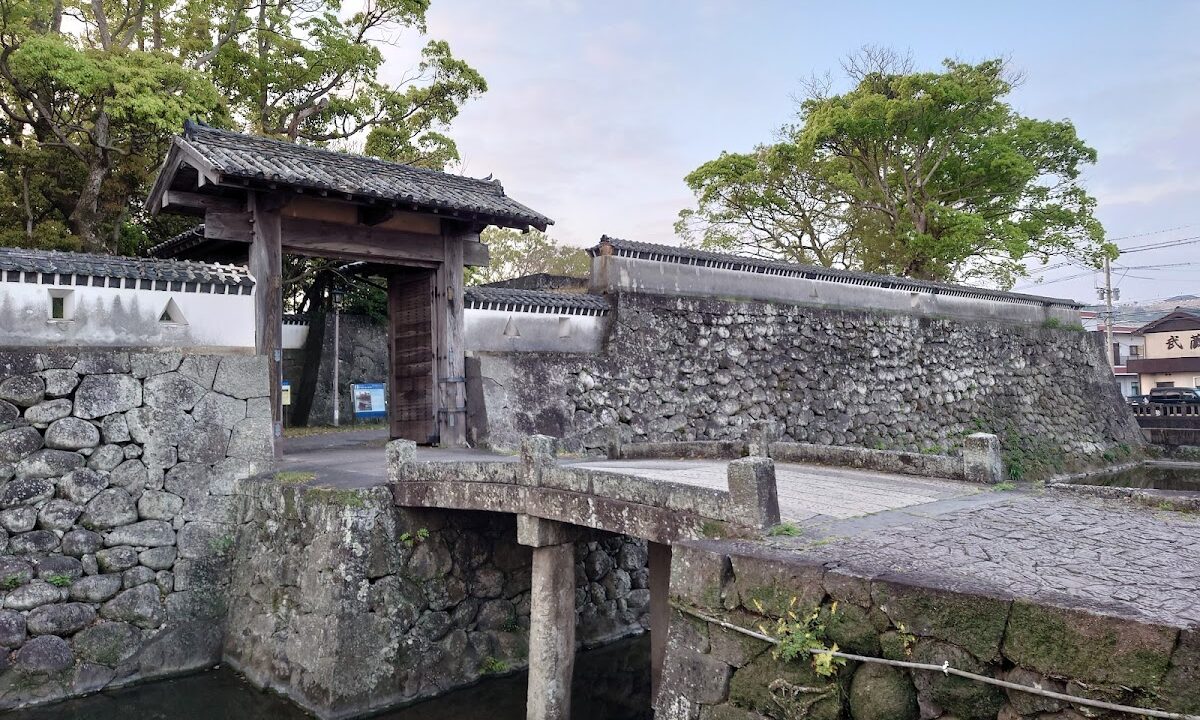
Fukue Castle’s most distinctive feature is its unique location surrounded by the sea on three sides, and the presence of fortifications (gun batteries) to defend against attacks from the sea. Although the castle tower and other structures no longer exist, as it was dismantled in 1872 (Meiji 5) by the Meiji government’s decree abolishing castles just nine years after its completion, the magnificent stone walls, moats, and the remnants of the castle town remain.
Historical Background of Fukue Castle’s Construction | The Arrival of the Black Ships and the Need for Coastal Defense
The Threat of Foreign Ships and the Shogunate’s Sense of Crisis
The construction of Fukue Castle was prompted by the intensified appearance of foreign ships in Japanese waters from the early 19th century. In particular, the Phaeton Incident of 1808 (Bunka 5) was a shocking event in which a British warship intruded into Nagasaki harbor and took Dutch trading post officials hostage. This incident made the Shogunate acutely aware of the importance of coastal defense, and strengthening the defense of the Goto Islands, especially those close to Nagasaki, became an urgent priority.
Strategic Importance of the Goto Domain
The Goto Islands jut out into the East China Sea and played a vital role as Nagasaki’s outer port. Furthermore, since the time of the Japanese envoys to Tang China, it was a crucial point for exchange with the continent and a vital hub for maritime traffic. Therefore, the Goto Domain was burdened with special responsibility as the front line of surveillance and defense against foreign ships.
Castle Construction Permission and Process
Normally, during the Edo period, building a castle without the shogunate’s permission was prohibited. However, due to the unique circumstances of coastal defense, the Goto Domain received formal permission from the shogunate to build a castle. Construction plans began in 1849 (Kaei 2) and were completed in 1863 (Bunkyu 3) after approximately 14 years. This was just five years before the Meiji Restoration, which is precisely why it is called “Japan’s last castle.”
Architectural Features of Fukue Castle | Uniqueness as a Coastal Castle
Location Surrounded by the Sea on Three Sides
The most distinctive feature of Fukue Castle is its structure as a “coastal castle,” facing the sea (Fukue Bay) on three sides. Only the eastern side is connected to land; the other three sides face the sea, indicating a design that anticipates attacks and defenses from the sea. This location is a common feature of other coastal castles, such as Imabari Castle (Ehime Prefecture) and Takamatsu Castle (Kagawa Prefecture), but considering the historical context of the late Edo period, Fukue Castle is the most recent coastal castle.
The Technique and Beauty of the Stone Walls
The stone walls of Fukue Castle, which still remain today, are valuable relics demonstrating the advanced castle-building techniques of the late Edo period. In particular, the stone walls around the main keep were constructed using a precise cutting technique called “kirikomi-hagi,” resulting in a beautiful finish with almost no gaps between the stones.
The height of the stone walls varies depending on the location, but the highest points reach approximately 8 meters, overwhelming visitors. Furthermore, a technique called “sangi-zumi” is used at the corners, achieving both strength and aesthetic appeal.
The Structure of the Moat and Sluice Gate
Fukue Castle’s moat was a “water moat” that drew in seawater, a unique structure where the water level changed with the tides. A sluice gate connecting to the sea was installed, allowing for boat access. Some parts of the moat remain today, allowing visitors to imagine its former appearance.
The Arrangement of the Battery (Fortification)
Fukue Castle, primarily intended for coastal defense, had several battery (fortification) structures. These were facilities for mounting Western-style cannons, serving to defend against attacks from the sea and also to intimidate foreign ships. While only parts remain today, they are important traces that tell the story of the tense international situation at the end of the Edo period.
Remains and Highlights of Fukue Castle Currently Visible
Main Enclosure Site (Goto High School)
The main enclosure site of Fukue Castle is now the grounds of Nagasaki Prefectural Goto High School. While entry to the school grounds is not permitted, the impressive stone walls can be viewed from the surrounding area. The stone walls, especially near the main gate, are remarkably well-preserved, conveying the grandeur of the castle’s past.
As this site is located within school grounds, consideration must be given to avoid disrupting classes during visits. During weekday class hours, viewing is limited to the perimeter; weekends and after-school hours are ideal for visits.
Second Bailey Site (Goto City Hall)
Goto City Hall now stands on the site of the second bailey. Parts of the stone walls and moat remain around the city hall, easily accessible from the parking lot. While the city hall building itself is modern, the contrast with the surrounding stone walls evokes a sense of the passage of time.
Kedashimon Gate Site
The Kedashimon Gate, the castle’s main gate, still retains its stone walls and foundation stones. The path leading from here into the castle was once a route taken by samurai, making it a spot where one can feel the romance of history.
Walking Path Along the Stone Walls and Moat
A walking path is maintained along the stone walls around Fukue Castle. The path along the moat on the west side is a particularly excellent photo spot, allowing visitors to enjoy the beauty of the stone walls reflected in the water. Cherry blossoms bloom in spring, and autumn leaves add color, showcasing the changing scenery of each season.
Goto Family Garden and Shinji-ga-ike Pond | A Daimyo Garden Adjacent to the Castle
Located very close to Fukue Castle is the Goto Family Garden and Shinji-ga-ike Pond. This garden was used as a villa by the Goto family and is a strolling garden with a pond shaped like the Japanese character for “heart” (心).
Garden Design Featuring a Turtle Motif
The most distinctive feature of the Goto Family Garden is its design, which is based on a turtle motif. There is a turtle-shaped island in the center of the pond, and the entire garden is said to represent the shape of a turtle. The lord of the Goto family was said to have greatly favored turtles as a symbol of good fortune, and turtle motifs can be seen throughout the garden.
Visiting Information
- Opening Hours: 9:00 AM – 5:00 PM (may vary depending on the season)
- Admission Fee: Approximately 100 yen for adults (may vary depending on the season)
- Estimated Time Required: Approximately 30 minutes
The garden has a quiet and peaceful atmosphere, and visiting it in conjunction with a visit to Fukue Castle allows you to learn about the cultural aspects of the Goto domain.
Historical Attractions Around Fukue Castle
Goto Tourism and History Museum
Located about a 5-minute walk from Fukue Castle, the Goto Tourism and History Museum offers detailed exhibits on the history and culture of Goto and Fukue Castle. Exhibits include a reconstructed model of the castle, ancient documents, and armor, making it a must-see facility for deepening your understanding of Fukue Castle.
Samurai Residence Street Museum
In the area that flourished as a castle town of Fukue Castle, a street lined with samurai residences remains. The “Samurai Residence Street Museum” features exhibits recreating the life of samurai during that period, allowing visitors to experience the lifestyle of Goto domain samurai during the Edo period.
The landscape of cobblestone streets and white-walled samurai residences creates an atmosphere that feels like stepping back in time.
Minjindo Shrine
Located in the town of Fukue, Minjindo Shrine is a shrine dedicated to people from China (Ming Dynasty). Goto has a long history of interaction with the continent, and has had deep ties with China since the time of the Japanese envoys to Tang China. Minjindo Shrine is a valuable historical site that conveys this history to the present day, and visiting it along with Fukue Castle allows you to understand Goto’s international historical background.
Hexagonal Well
In the town of Fukue, there is a well with an unusual hexagonal shape called “Rokkakuido” (Hexagonal Well). This well, built during the Edo period, was used as a source of water for daily life in the castle town. It still holds water today and is an interesting historical site for understanding the infrastructure of that time.
Fukue Church | A Christian Holy Site in a Castle Town
Within walking distance of Fukue Castle lies the beautiful Fukue Church (Fukue Catholic Church). The Goto Islands are registered as a World Heritage Site as part of the “Hidden Christian Sites in the Nagasaki Region,” and the history of hidden Christians remains strong in this area.
Fukue Church is a beautiful red brick church built during the Meiji era and is one of the centers of Christian faith in the Goto Islands. The presence of such a Christian church in a castle town once ruled by the Goto Domain tells the story of Japan’s complex religious history.
Natural Landscape of Fukue Island | Onidake Mountain and Geopark
Onidake Mountain
Onidake Mountain, located about 15 minutes by car from Fukue Castle, is a volcano with an elevation of 315 meters. This beautiful volcano, covered in grass, offers panoramic views of Fukue town and the sea from its summit. It’s a great spot to experience the magnificent nature of the Goto Islands, especially when combined with a historical exploration of Fukue Castle.
Goto Islands Geopark
The Goto Islands, designated as the “Goto Islands Geopark,” are a region where you can learn about the unique topography and geology formed by volcanic activity. Fukue Island boasts numerous geosites, allowing you to discover the charm of the Goto Islands from both a natural and historical perspective.
Access Information | How to Get to Fukue Castle
Access by Airplane
- From Nagasaki Airport: Approximately 30 minutes from Nagasaki Airport to Fukue Airport (several flights per day)
- From Fukuoka Airport: Approximately 40 minutes from Fukuoka Airport to Fukue Airport (about one flight per day)
- From Fukue Airport to Fukue Castle: Approximately 10 minutes by taxi, approximately 15 minutes by bus
Access by Ferry
- From Nagasaki Port: Approximately 1 hour 25 minutes by high-speed boat (jetfoil), approximately 3 hours 10 minutes by ferry
- From Sasebo Port: Approximately 2 hours 25 minutes by ferry (via Narushima Island)
- From Fukue Port to Fukue Castle: Approximately 15 minutes on foot, approximately 5 minutes by taxi
Getting Around the Island
Renting a car is convenient on Fukue Island. There are several car rental companies around Fukue Port and Fukue Airport. While there are also local bus services, the number of buses is limited, so it’s recommended to check the timetable in advance.
In recent years, “island cycling” has also become popular; renting an electric-assist bicycle and exploring the area around Fukue Castle is a fun option.
Fukue Castle Sightseeing Model Course | 3-Hour Walking Course
Here’s a 3-hour walking model course for efficiently exploring the town of Fukue.
Course Overview
- Fukue Port (Start)
- Fukue Castle (Ishida Castle) Stone Walls and Moat (30 min)
- Goto Family Garden and Shinji Pond (30 min)
- Samurai Residence Street Furusato Museum (30 min)
- Hexagonal Well (15 min)
- Fukue Church (20 min)
- Goto Tourism and History Museum (40 min)
- Fukue Port (Goal)
This course allows you to efficiently visit historical spots in the castle town, centered around Fukue Castle. Along the way, we recommend enjoying local cuisine such as Goto udon noodles and Goto beef in Fukue’s shopping district.
Precautions and Manners When Visiting Fukue Castle
Precautions When Visiting the Main Enclosure (Goto High School)
Since the main enclosure is located on the grounds of an active high school, please observe the following points:
- During weekday class hours, limit your visit to the perimeter.
- Avoid loud conversations and noise.
- Unauthorized entry onto the grounds is strictly prohibited.
- Respect the privacy of students.
Precautions When Taking Photos
- Take care to avoid including school staff or local residents in your photos.
- Do not trespass on private property.
- When using a tripod, choose a location that does not obstruct traffic.
Season and Clothing
- Summer (June-September): Hats and sunscreen are essential due to strong sunlight.
- Winter (December-February): Take precautions against the cold sea breeze.
- Rainy Season (June): Prepare an umbrella or raincoat.
- Comfortable walking shoes are recommended (there are many cobblestone paths and slopes).
To Enjoy the Charms of Fukue Castle to the Fullest
Recommended Prior Study
Before visiting Fukue Castle, acquiring basic knowledge about the history of the late Edo period and coastal defense policies will make your visit more fulfilling. Understanding the historical context, especially events like the Phaeton Incident and the arrival of the Black Ships, will give you a deeper understanding of why this castle was built.
Utilizing Local Guides
The Goto City Tourism Association offers guided tours. Hearing historical anecdotes and information about hidden attractions from local guides provides a valuable experience that you wouldn’t get by exploring on your own.
Continued Top 100 Japanese Castles Stamp
Fukue Castle was selected as one of the “Continued Top 100 Japanese Castles” in 2017. The stamp is located at the Goto Tourism and History Museum, a must-see for castle enthusiasts.
Goto’s Food Culture and Accommodation | Castle Town Gourmet and Island Flavors
Goto Udon
When visiting Goto, you absolutely must try “Goto Udon.” This udon is characterized by its thin, firm noodles and is sometimes counted as one of Japan’s “Three Great Udon Noodles.” It is traditionally eaten with ago dashi (flying fish broth).
Goto Beef
Goto beef, a type of Japanese Black cattle raised in Goto, is a high-grade brand of beef characterized by its fine marbling and elegant sweetness. Several restaurants in Fukue town serve Goto beef.
Fresh Seafood
The seafood caught in the waters around Goto is exquisite. In particular, there is an abundance of blue fish such as horse mackerel, mackerel, and yellowtail, as well as high-end ingredients such as spiny lobster and abalone.
Accommodation
Fukue town offers a variety of accommodations, from hotels to guesthouses and inns. Choosing accommodation near Fukue Castle allows you to enjoy quiet strolls around the castle ruins in the early morning or at dusk.
Summary | Fukue Castle’s Perspective on Late Edo Period Japan
Fukue Castle (Ishida Castle), despite its short lifespan of only nine years, is a valuable historical site that conveys the international crisis faced by Japan in the late Edo period and the efforts of those who tried to respond to it. Its historical value is widely recognized as “Japan’s last sea castle” and as one of the “Continued Top 100 Japanese Castles.”
With its magnificent stone walls and moats, and the lingering atmosphere of a castle town, Fukue is an attractive destination not only for history buffs but also for travelers seeking beautiful scenery and culture. Furthermore, the Goto Islands as a whole possess multifaceted charm, including their Christian history, rich nature, and unique food culture.
When visiting Goto City in Nagasaki Prefecture, be sure to plan a historical walk centered around Fukue Castle. In this place where the tension of the late Edo period, the history of the Goto domain, and the lives of people continuing to the present day intersect, you can experience a part of modern Japanese history.
Fukue Castle, a rare space where the past and present coexist, continues to provide visitors with profound inspiration and learning experiences.
-680x450.png)
