Myokenyama Castle (Tohaku District, Tottori Prefecture) Complete Guide | Thorough Explanation of Layout, History, and Highlights
What is Myokenyama Castle?
Myokenyama Castle is a Sengoku period mountain castle located in Osugi, Kotoura-cho, Tohaku District, Tottori Prefecture. Situated at a strategic point in eastern Hoki Province, it is a historically important fortress that served as the stage for conflicts between the Mori clan and the Oda-aligned Nanjo clan. Even today, the remains of the castle, including clear moats, ridged vertical moats, and steep slopes, are well-preserved, making it a valuable historical site where one can experience the defensive system of a medieval mountain castle.
Basic Information on Myokenyama Castle
Location: Osugi, Kotoura-cho, Tohaku-gun, Tottori Prefecture
Castle Classification: Mountain Castle
Construction Period: Sengoku period
Relative Elevation: Approximately 120m
Main Remains: Enclosures, moats, ridged vertical moats, cliffs, earthworks
Access: From Urayasu Station on the JR San’in Main Line, take the Kotoura Bus Tohaku Line and get off at the “Higashi-Osugi” bus stop, then walk for approximately 8 minutes.
Historical Background of Myokenyama Castle
Construction and Early History
Although there are few clear historical records regarding the construction period and builder of Myokenyama Castle, its structure suggests that it was developed during the mid-to-late Sengoku period. The eastern part of Hoki Province was close to the border with Inaba Province and was a militarily important area as a key point on the San’in Road.
A detailed analysis of the castle’s layout reveals construction from two different periods. The castle’s structure initially consisted of an early castle with enclosure X as the main citadel, and later expanded to a more robust guard post centered around enclosure I1. This transformation is thought to reflect changes in the regional military situation.
Conflict between the Mori and Nanjo Clans
Myokenyama Castle first appears on the historical stage during the Tensho era (1573-1593), when the Mori clan governed Hoki Province. At that time, the Nanjo clan, a powerful local lord in Hoki Province, was initially subordinate to the Mori clan, but switched allegiance to the Oda clan when Oda Nobunaga’s influence extended to the San’in region.
In 1580, when Hashiba Hideyoshi began his siege of Tottori Castle, Hoki Province became the front line between the Oda and Mori forces. With the two forces facing each other across the Yatsuhashi territory, Myokenyama Castle is thought to have been positioned as an important military base for the Mori clan.
The Battle of Tensho 10
In Tensho 10 (1582), Kikkawa Motoharu, a senior retainer of the Mori clan, ordered Moriwaki Echigo-no-kami Haruchika, the lord of Joyama Castle, to capture Myokenyama Castle in order to attack the Nanjo clan, who had switched allegiance to the Oda clan. At this time, Myokenyama Castle is presumed to have been within the Nanjo clan’s sphere of influence, and it was an obstacle to the Mori clan’s advance into eastern Hoki Province.
While the details of Moriwaki Haruchika’s attack are unclear, it is highly likely that Myokenyama Castle was renovated and strengthened as a Mori clan outpost after this battle. Many of the strong defensive structures visible today are presumed to have been constructed during this period.
The Road to Abandonment
When Oda Nobunaga fell in the Honnoji Incident in June of Tensho 10, the situation in the San’in region changed dramatically. When Hashiba Hideyoshi and the Mori clan made peace, military tensions in Hoki Province, which had served as a buffer zone between the two forces, eased.
From the late Tensho era to the Bunroku and Keicho eras, as the Toyotomi regime promoted the development of castles, many small mountain castles were abandoned. Myokenyama Castle is also believed to have ceased its role as a military base during this period. Currently, a Hachiman shrine is enshrined at the castle site, and it continues to be a place of worship for the local community.
Myokenyama Castle’s Layout Structure
Overall Structure and Defensive System
Myokenyama Castle is a typical Sengoku period mountain castle built on a mountaintop approximately 120m high. The castle’s layout is broadly composed of the main part centered on I1 and the outer part including bailey X.
The castle’s overall defensive system utilizes techniques typical of late Sengoku period mountain castles, including partitioning with multiple moats, securing elevation differences with clear cliffs, and flank defense with a series of ridged vertical moats. The sheer number and scale of the moats are particularly impressive, conveying an almost overwhelming sense of defensive intent.
Structure of the Main Enclosure (I1)
The main enclosure (I1) is the largest and most carefully leveled enclosure within the castle. Even today, the terrain remains relatively flat, suggesting the presence of buildings and watchtowers.
High cliffs surround I1, creating a clear elevation difference between it and the lower enclosures. These cliffs are not merely natural terrain changes, but intentionally carved defensive structures that made enemy intrusion difficult.
Large-scale moats are positioned on the north and south sides of the main enclosure, blocking intrusion along the ridge. The moat on the north side, in particular, is remarkably deep and wide, indicating its crucial role in the castle’s defenses.
Arrangement and Characteristics of the Moats
The most distinctive feature of Myokenyama Castle is its series of moats. Multiple moats of varying sizes can be identified within the castle grounds, each deeply cutting through the ridge.
The moats not only cut through the ridge, but some are accompanied by earthen embankments on both sides, and others show traces of what appear to be barriers at the bottom. These moats constituted a multi-layered defensive system designed to progressively hinder enemy advances.
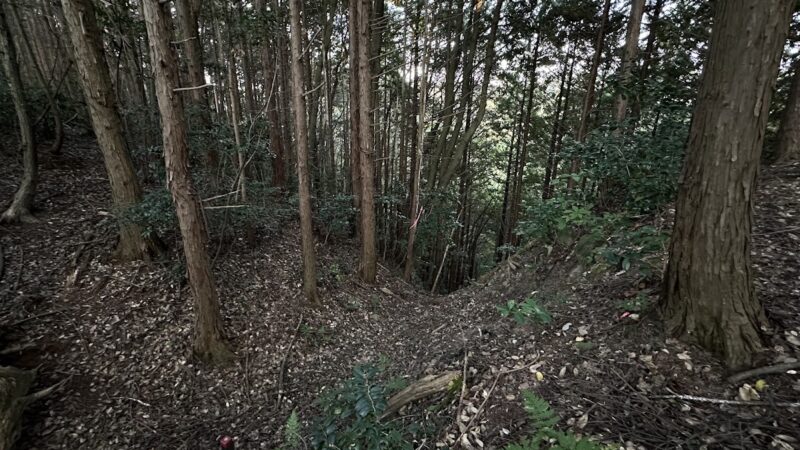
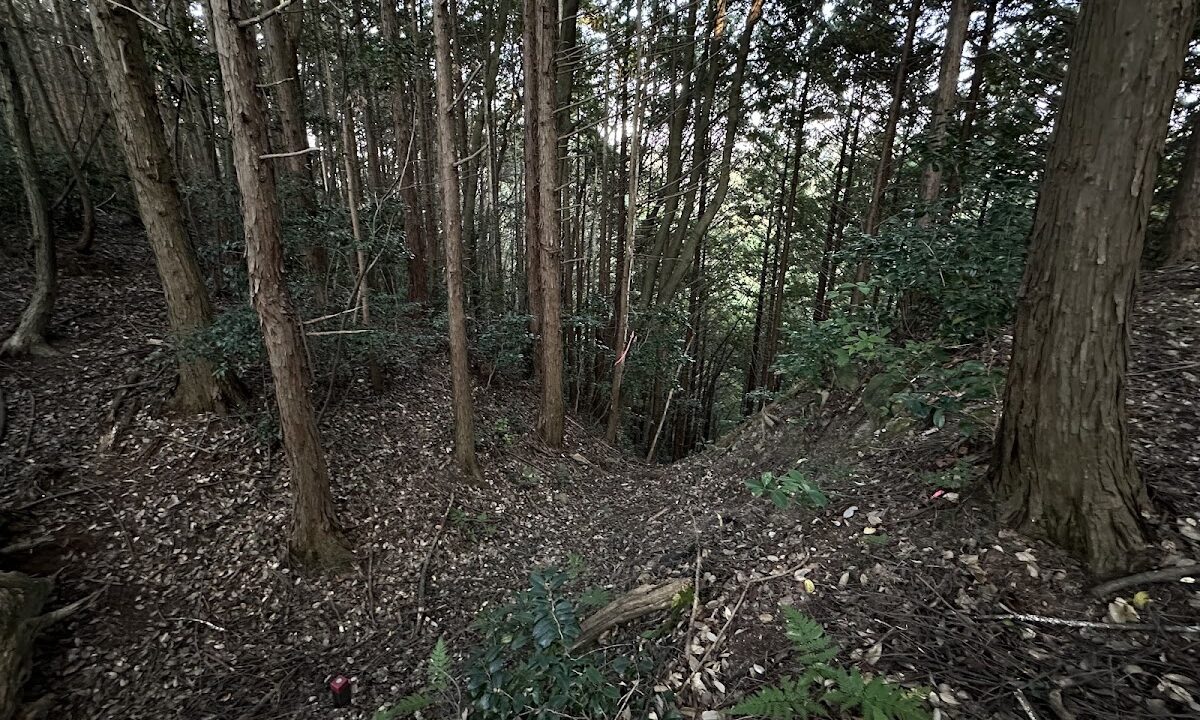
The moats positioned in front of and behind the main enclosure are particularly large in scale and can still be clearly observed today as depressions approximately 3-4 meters deep. Numerous pink ribbons, likely placed after the survey, remain, aiding in the identification of the remains.
Defensive Function of the Ridge-Shaped Vertical Moats
A series of ridge-shaped vertical moats is clearly visible on the northern slope of Myokenyama Castle. A series of vertical trenches, known as “ridge-shaped vertical trenches,” are a defensive structure characterized by multiple trenches excavated continuously parallel to the slope of a mountain. They are a distinctive feature of mountain castles from the late Sengoku period (Warring States period).
These trenches served to restrict enemy movement as they ascended the slope and to enhance the effectiveness of attacks from above. The ridge-shaped vertical trenches at Myokenyama Castle are remarkably well-preserved, providing valuable insights into the castle construction techniques of the Sengoku period.
The spacing and depth of the trenches were calculated, indicating they were not merely drainage facilities but constructed with a clear military purpose. Visiting the site reveals the vividly preserved ridge-shaped terrain, allowing one to appreciate the meticulousness of the defensive system at the time.
Structure of Enclosure X and the Outer Enclosure
Enclosure X, located away from the main enclosure, possesses the characteristics of an independent small castle. It has been suggested that this section may have been constructed at a different time than the main enclosure, providing an important clue in considering the construction process of Myokenyama Castle.
Enclosure X, while having some areas that are not perfectly leveled, possesses its own unique moats and cliffs, making it a structure with independent defensive capabilities. The prevailing theory is that this enclosure was the initial main enclosure of Myokenyama Castle, later expanded and developed into the castle centered around I1.
This double structure indicates that the castle was gradually renovated and expanded in response to changes in its purpose and military situation. The historical progression from an initially small, watchtower-like castle to a full-fledged guard post during the conflict between the Mori and Nanjo clans can be gleaned from the layout of the castle.
Earthworks and Belt Enclosures
Earthworks remain partially around the main enclosure. These earthworks are defensive structures built by piling up earth along the edges of the enclosures, serving to protect against arrows and firearms, as well as providing cover.
The earthworks of Myokenyama Castle are selectively positioned in important directions of the main enclosure, indicating that the strategy was not to surround the entire perimeter, but rather to reinforce particularly important defensive points.
Furthermore, below the main enclosure, there is a long, narrow enclosure called an “obi-kuruwa” (belt enclosure). The obi-kuruwa served to defend the main enclosure, functioning as a buffer zone to prevent enemies from directly reaching it. The obi-kuruwa of Myokenyama Castle is relatively well-preserved, allowing us to understand a part of the castle’s defensive system.
Highlights of Myokenyama Castle
Ascent Routes and Local Conditions
To reach Myokenyama Castle, it’s about an 8-minute walk from the Higashi-Osugi bus stop to the castle entrance. There are mainly two ascent routes: one is a relatively gentle route using the approach to the Hachiman Shrine, and the other is a steep, direct ascent route.
The direct ascent route is shorter in distance but requires climbing a steep slope, making it suitable for those confident in their physical fitness. On the other hand, the Hachiman Shrine approach route is slightly longer, but it follows a well-maintained path, making it recommended for beginners. Many visitors enjoy a combination of ascending via the direct ascent and descending via the shrine approach.
While there are no signposts at the castle ruins, a shrine stands on the site of the main keep, and the approach to the castle and the main enclosures are somewhat maintained. However, prior research is essential to fully understand the details of the remains.
The Impressive Series of Moats
The greatest highlight of Myokenyama Castle is undoubtedly the series of moats. The large-scale moats positioned before and after the main enclosure are overwhelming in both depth and width, demonstrating the high level of castle-building technology of the time.
Standing at the bottom of the moats, the towering cliffs on both sides give the feeling of being in a valley. Considering that this terrain was artificially created, one cannot help but marvel at the labor force mobilization and technical skill of the time.
Numerous pink ribbons placed during the survey remain, making it easy to confirm the location and extent of the moats. Carefully observing each moat allows you to discover subtle structural differences and ingenuity, making it a blissful experience for castle enthusiasts.
Clearly Defined Cliffs and Enclosures
Another highlight of Myokenyama Castle is its clearly defined cliffs. Between the main enclosure and the lower enclosures, a cliff 2-3 meters high is clearly visible, demonstrating the artificial elevation difference.
This cliff is not merely a result of construction, but was intentionally carved steeply for defensive purposes. It would have been extremely difficult for the enemy to climb this cliff, and it would have left them vulnerable to attacks from above, thus functioning as an effective defensive structure.
The leveling of the enclosures is also well done, with the main enclosure in particular maintaining a remarkably flat terrain. However, some enclosures show slightly less leveling, indicating that the overall construction of the castle was not entirely uniform. This is also an interesting point for understanding the actual state of construction at the time.
Observation of the Ridge-Shaped Vertical Moats
The ridge-shaped vertical moats spread across the northern slope are a must-see feature when visiting Myokenyama Castle. The continuous vertical trenches running parallel to the slope remain clearly visible as part of the topography, offering a firsthand glimpse into the defensive techniques of the Sengoku period.
When observing the series of ridged vertical trenches, viewing them from a slightly distant position on the slope reveals their continuity and regularity in arrangement. Furthermore, actually walking between the trenches allows one to experience the difficulty of movement and the limited visibility, truly appreciating their effectiveness as defensive structures.
Visiting during periods of sparse vegetation, such as winter, allows for a clearer observation of the trenches’ shape, making it an ideal season for castle viewing.
Hachiman Shrine and the Continuation of Faith
A Hachiman shrine is enshrined at the site of the main keep, indicating that the castle ruins have been cherished as a place of local faith even after its abandonment. The presence of this shrine has also contributed to the maintenance and preservation of the castle’s access roads and major enclosures.
The coexistence of castle ruins and religious facilities is a typical sight in Japanese mountain castles. The fact that a military facility from the Sengoku period became a spiritual center for the region during times of peace—this layered history is one of the charms of Myokenyama Castle.
Myokenyama Castle and Surrounding Castles
Castle Network in Eastern Hoki Province
Myokenyama Castle played a part in the castle network of eastern Hoki Province. Numerous mountain castles existed in the region, including Joyama Castle, Ueshi Castle, and Utsubuki Castle, and they all worked together to defend the area.
In particular, Joyama Castle was the residence of Moriwaki Haruchika, who was ordered to capture Myokenyama Castle in 1582 (Tensho 10), and therefore had a close relationship with Myokenyama Castle. Understanding these castles comprehensively provides a more three-dimensional view of the military situation in Hoki Province during the Sengoku period.
Mori Clan’s Garrison Castle System
Myokenyama Castle is thought to be one of the garrison castles developed by the Mori clan when they managed Hoki Province. A “banjo” is a general term for subsidiary castles and forts that support the main castle complex, forming a multi-layered defensive system for the defense of the territory.
The Mori clan built a vast territory throughout the Chugoku region, and their rule was supported by a network of banjos throughout the area. The robust layout of Myokenyama Castle reflects the Mori clan’s castle-building techniques and military strategy.
Access and Visiting Information for Myokenyama Castle
Transportation Access
Public Transportation:
- Get off at Urayasu Station on the JR San’in Main Line
- Transfer to the Kotoura Bus Tohaku Line
- Get off at the Higashi-Osugi bus stop, and walk approximately 8 minutes to the castle entrance.
Car:
- Approximately 10 minutes from the Kotoura-Higashi IC on the San’in Expressway
- Parking space is limited, so please be careful not to park on the street.
Points to Note When Visiting
- Equipment: As it is a mountain castle, non-slip shoes such as trekking shoes are essential. Also, be sure to take precautions against insects in the summer and against the cold in the winter.
- Estimated Time Required: If you plan to carefully observe the remains from the top to the bottom of the castle, allow approximately 2-3 hours.
- Signage: There are no detailed information boards at the castle ruins. It is recommended to obtain a map of the castle layout beforehand and confirm the location of the remains.
- Safety Check: The moats and cliffs are steep. Pay close attention to your footing and avoid taking unnecessary risks.
- Manners: Since you may be passing through private property, be considerate of local residents. Also, to protect the remains, be careful not to damage the earthworks or cliffs.
Nearby Tourist Attractions
In addition to visiting Myokenyama Castle, you can also enjoy sightseeing around Kotoura Town.
Tohaku Wagyu: A brand of Japanese Black beef raised in Tohaku County, including Kotoura Town. You can enjoy it at local restaurants.
Nariishi Beach: A rare natural phenomenon can be seen on the coast of Kotoura Town. The sound of stones ringing can be heard as the waves recede.
Mt. Daisen: Mt. Daisen, a symbol of Tottori Prefecture, is about a 30-minute drive from Kotoura Town. You can enjoy mountain climbing and hiking.
Historical Value and Future Preservation of Myokenyama Castle
Academic Value
Myokenyama Castle is a valuable historical site that conveys the mountain castle construction techniques of the late Sengoku period. It is particularly valued for its academic significance in the following respects:
- Changes in Layout: Construction from two different periods has been confirmed, allowing for research into the development of the castle.
- Diversity of Defensive Structures: A variety of defensive techniques are concentrated here, including moats, steep slopes, and ridged vertical trenches.
- Historical Context: It is related to a crucial historical period in the late Sengoku period: the conflict between the Mori clan and the Oda clan.
Preservation Status and Challenges
Currently, the remains of Myokenyama Castle are relatively well preserved. However, the following challenges exist:
Vegetation Management: Located in a forest, there is a risk that the remains will be covered by overgrown vegetation. Regular maintenance such as undergrowth clearing is necessary.
Information Improvement: The lack of detailed information boards at the castle site makes it difficult for general visitors to fully understand the remains. The installation of appropriate information boards is desirable.
Academic Research: Since no full-scale archaeological excavations have been conducted, many aspects of the castle’s detailed structure and historical background remain unclear. Further research and investigation are anticipated.
Utilization as a Local Resource
Myokenyama Castle is a valuable historical resource of Kotoura Town. Appropriate preservation and utilization can yield the following benefits:
History Education: It can be used as educational material for local children to learn about their local history.
Tourism Promotion: It can become a tourist resource attracting castle enthusiasts and history lovers.
Regional Identity: As a historical heritage site that local residents can be proud of, it contributes to the formation of regional identity.
The Appeal of Visiting Myokenyama Castle
Myokenyama Castle lacks flashy stone walls and a keep, but it is a valuable castle site where you can experience the essence of a Sengoku period mountain castle. The continuous moats, clear cliffs, and ridged vertical moats—these remains are evidence of the wisdom and effort that people of that time must have used to protect their lives.
Visiting the site, gazing up at the steep cliffs, and standing at the bottom of the deep moats, allows us to relive the tension of the Sengoku period. Furthermore, tracing the remains scattered throughout the quiet mountains stimulates our historical imagination, allowing us to experience a不思議な感覚 (mysterious feeling) where past and present intersect.
We recommend a visit to Myokenyama Castle not only to castle enthusiasts, but also to anyone interested in history or who enjoys hiking in nature. The memories of the Sengoku period sleeping in the mountains of Tohaku District, Tottori Prefecture—that is the greatest charm of Myokenyama Castle.
Summary
Myokenyama Castle is a Sengoku period mountain castle located in Kotoura Town, Tohaku District, Tottori Prefecture, and played an important role during the conflict between the Mori and Nanjo clans. Built on a mountaintop approximately 120 meters high, the castle boasts robust defensive structures utilizing advanced castle-building techniques of the late Sengoku period, including a series of moats, clearly defined cliffs, and a network of ridged vertical trenches.
In 1582, during the Tensho era, Moriwaki Haruchika is believed to have been in charge of the attack on Myokenyama Castle at the command of Kikkawa Motoharu, and it is thought to have subsequently functioned as a garrison castle for the Mori clan. Even today, the remains are well-preserved, making it a valuable historical site for understanding the structure of mountain castles from the Sengoku period.
While the site lacks sufficient signage and other facilities, this contributes to its charm as a place to quietly observe untouched remains. For castle enthusiasts, it is a hidden gem well worth a visit. When visiting Tottori Prefecture, be sure to stop by Myokenyama Castle and experience the atmosphere of the Sengoku period.