Ebi Castle (Kofu-cho, Hino-gun, Tottori Prefecture) Complete Guide | History, Highlights, and Access Information for a Sengoku Period Mountain Castle
What is Ebi Castle?
Ebi Castle (Ebi-jo) is a Sengoku period mountain castle site located in Ebi, Kofu-cho, Hino-gun, Tottori Prefecture. Also known as Ebi Castle or Ebi Fortress, it is currently protected as a designated historical site of Kofu-cho. Built on a natural stronghold—a cliff jutting out like a tongue, formed by pyroclastic flow plateau created by the volcanic activity of Mt. Daisen and bordering the Hino River—it is known as a representative medieval castle of Hino-gun.
It is said to have been founded in 1484 by Hachizuka Awamori and served as the residence of four generations of the Hachizuka clan. Gold-leafed shachi (mythical fish-like creature) roof tiles, the first of their kind in the San’in region, were unearthed from the castle ruins, conveying the splendor of the castle’s architecture at the time.
History of Emi Castle
Construction and Rule by the Hachizuka Clan
The history of Emi Castle begins in 1484 (Bunmei 16), when Hachizuka Awamori built the castle. The Hachizuka clan were powerful local lords in Hino District, Hoki Province, and expanded their influence through iron production and iron mine management in the region.
Following the first Hachizuka Awamori, the second Mikawa no Kami, the third Tanba no Kami, and the fourth Uemon no Jo all used this castle as their residence for generations. The Hachizuka clan controlled a strategic transportation hub in the Hino River basin and, backed by their economic power from iron production, played an important role in western Hoki Province during the Sengoku period.
Relationship with the Amago Clan
In the mid-Sengoku period, the Hachizuka clan came under the control of the Amago clan, a powerful daimyo of Izumo Province. The Amago clan extended their influence throughout the San’in region, and Emi Castle became one of the important bases for the Amago clan’s control of Hoki Province. During this period, it is believed that the Hachizuka clan served as vassals of the Amago clan, responsible for governing and defending the surrounding area.
The Fall of Eiroku Castle and the Downfall of the Hachizuka Clan
In 1564 (Eiroku 7), Emi Castle underwent a major turning point. The Mori clan, who were becoming the dominant power in the Chugoku region, invaded Hoki Province and attacked Emi Castle. After a fierce battle, Emi Castle fell, and the Hachizuka clan was killed in action, leading to their downfall. This fall brought an end to the approximately 80-year history of Emi Castle under the Hachizuka clan, spanning four generations.
Renovations by the Mori and Kikkawa Clans
After the fall of the castle, Emi Castle came under the control of the Mori clan, and the Kikkawa clan, a branch of the Mori family, became the castle lords. It is believed that the Kikkawa clan renovated the castle and established stronger defensive structures. The gold-leafed shachi (mythical fish-like creature) roof tiles and paulownia leaf crest roof tiles unearthed during the excavation are presumed to be from renovations during this period, suggesting that the Kikkawa clan considered Emi Castle an important base.
Later, due to the changing circumstances after the Battle of Sekigahara, Emi Castle was abandoned, but its remains have been well preserved to this day.
Layout and Remains of Emi Castle
Location and Topographical Characteristics
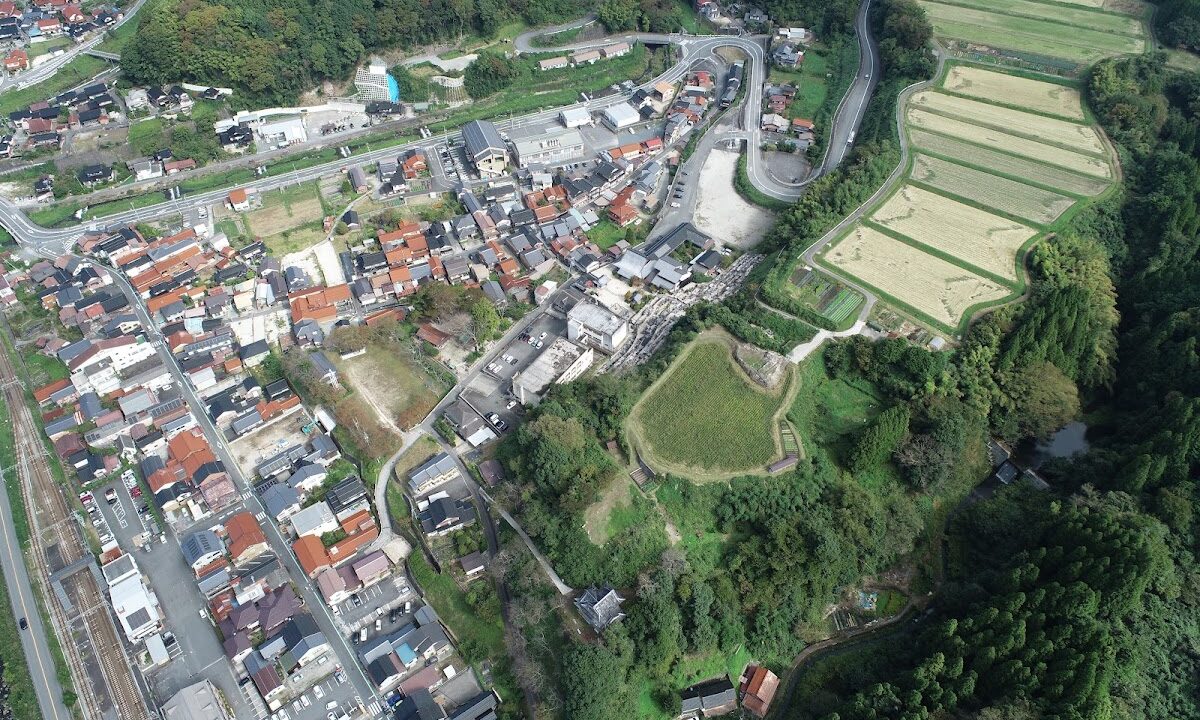
Emi Castle is located east of JR Ebi Station, built on the tip of a plateau that extends in a tongue shape towards the Hino River. This plateau is a pyroclastic flow plateau formed by the volcanic activity of Mt. Daisen, and is surrounded by steep cliffs, making it a natural stronghold. The north and east sides, in particular, are sheer cliffs facing the Hino River, making it an extremely difficult terrain for attackers.
Only the rear (west side) of the castle continues to the plateau, so the main defensive facilities are concentrated in this direction. The skillful use of this terrain in the castle’s layout demonstrates the high level of castle-building technology during the Sengoku period (Warring States period).
Main Enclosure (Honmaru) and Keep Base
The main enclosure (Honmaru), the central part of Emi Castle, is located at the highest point on the tip of the plateau. A keep base remains in the center of the main enclosure, suggesting that a keep or turret once stood here. Foundation stones and tile fragments have been unearthed around the keep base, confirming the existence of a considerably large structure.
While the main enclosure is relatively compact, it boasts a robust defensive structure, surrounded by earthen ramparts and strategically placed stone walls.
Large Moat and Stone Turret Base
To the east rear of the main enclosure (on the plateau side) lies the large moat, the castle’s most significant defensive feature. This moat deeply cuts through the plateau, completely isolating the main enclosure. Its considerable depth is still evident today.
A stone-walled watchtower base is situated facing the moat, designed to intercept enemies approaching from across the moat. The stonework techniques were state-of-the-art for the time and are believed to have been implemented during renovations by the Kikkawa clan.
Hachimanmaru and the Enclosures
Several enclosures, including Hachimanmaru, are located around the main enclosure. Hachimanmaru is the second most important enclosure after the main enclosure, playing a role in complementing its defenses. The other enclosures are arranged in a stepped pattern according to the terrain, forming multiple defensive lines.
It is presumed that these enclosures housed soldiers’ quarters, armories, and food storage facilities. The enclosures are separated by small moats and steep slopes, creating an effective defensive structure.
Stone Walls and Earthworks
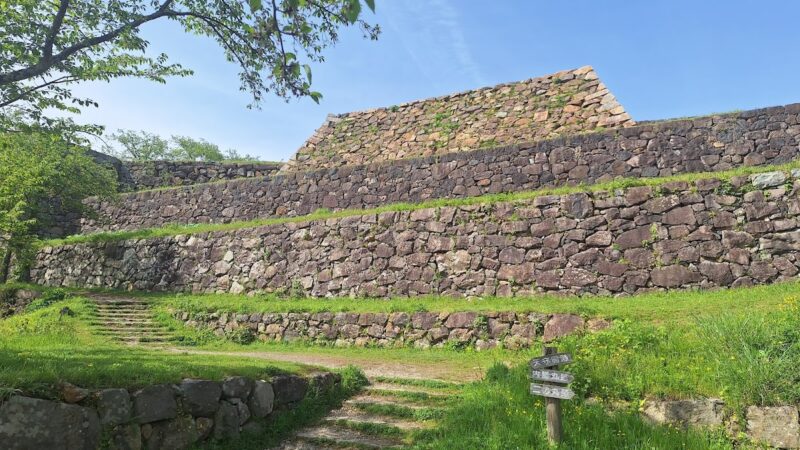
A notable feature of the remains of Emi Castle is the numerous stone walls found throughout. Stone walls were used around the main enclosure, the watchtower base, and parts of the baileys, indicating that advanced castle construction techniques were employed for the time. While most of the stone walls are built using the “nozurazumi” (rough stone masonry) method, some processed stones were also used, suggesting traces of gradual renovations.
Earthworks remain in various locations within the castle grounds, positioned along the edges of the baileys and around the entrances (koguchi). The height of the earthworks varies, but in some places they exceed 2 meters, serving both defensive and concealing functions.
Discovery of Gold-Leaf Tiles and Their Significance
First Gold-Leaf Shachihoko Tiles in the San’in Region
During the excavation of the Emi Castle ruins, gold-leaf shachihoko tiles, the first of their kind in the San’in region, were unearthed. This discovery is extremely unusual for a regional mountain castle and provides valuable evidence of Emi Castle’s importance.
Shachihoko tiles were typically used to decorate the roofs of important buildings such as keeps and watchtowers, and gold-leafed shachihoko tiles were used on even more prestigious buildings. The use of gold-leafed shachi (mythical fish-like creature) roof tiles at Emi Castle indicates that this castle was not merely a local mountain castle, but rather one maintained by a powerful and wealthy force.
Excavation of Paulownia Leaf Crest Roof Tiles
Along with the gold-leafed shachi tiles, roof tiles bearing the paulownia leaf crest were also unearthed. The paulownia crest is known for its use by Toyotomi Hideyoshi, but it was also used by the Mori and Kikkawa clans. These paulownia leaf crest roof tiles are thought to have been installed during renovations by the Kikkawa clan, indicating that Emi Castle was an important base for the Mori and Kikkawa clans.
These tiles are on display at the Kofu Town Historical and Folk Museum, where visitors can see the actual objects. Although the gold leaf’s luster has faded, the exquisite craftsmanship remains intact, demonstrating the high level of technology at the time.
Archaeological Value
The discovery of gold-leafed roof tiles has significant academic importance beyond mere luxurious decoration, as follows:
Firstly, it has brought new insights to the study of architectural styles in regional mountain castles. Previously, gold-leaf tiles were thought to be limited to castles in the Kinai region and large cities, but the example of Emi Castle indicates that similar technology was introduced to important regional strongholds during the late Sengoku period.
Secondly, it provides clues to the castle development policies of the Mori and Kikkawa clans. The scale of resources invested by the Kikkawa clan in Emi Castle is thought to reflect the strategic importance of this region.
Thirdly, it provides material for elucidating the distribution and technology transmission networks of the time. Research is underway to investigate how gold leaf and advanced tile-making techniques were brought to Emi Castle, examining their routes and background.
Highlights of Emi Castle
Spectacular Views from a Cliff
One of the greatest highlights of Emi Castle is the view from its location. The castle ruins are situated on a cliff overlooking the Hino River, offering views of the river below and the majestic Mt. Daisen in the distance. The view from near the main enclosure is particularly magnificent, and it’s impossible not to feel a sense of historical romance when you imagine that the castle lords of the Sengoku period gazed upon the same scenery.
In spring, the fresh greenery, and in autumn, the vibrant autumn leaves color the surrounding mountains, allowing you to enjoy the beautiful scenery of each season.
The Impressive Great Moat
A must-see when visiting the castle ruins is the great moat behind the main enclosure. Even today, the scale and power of this deeply excavated moat are fully apparent. Looking up from the bottom of the moat, you’ll be overwhelmed by the height of the cliffs on both sides, and you’ll truly understand the difficulty of attacking the castle by crossing this moat.
The stone-built turret base facing the moat is also well-preserved, allowing you to observe the construction of the stone walls up close.
Replica Turret
A replica turret stands in one corner of the castle ruins, serving as a symbolic presence of Emi Castle. While this turret is not a historical building, it helps to convey the atmosphere of a Sengoku period mountain castle. From the area around the replica turret, you can see the entire castle site, making it an ideal spot to understand the layout and structure of the castle.
Stone Walls and Remains
The stone walls remaining throughout the castle grounds are an important highlight of Emi Castle. The stone walls of the turret base, in particular, are well-preserved, allowing you to observe the nozurazumi (rough-stone masonry) technique. The cliffs and earthworks of the baileys are also well-preserved, allowing you to learn about the structure of a mountain castle from the Sengoku period.
When exploring the remains, pay attention to your footing and imagine the defensive lines and movement routes of the time to gain a deeper understanding of the castle’s structure.
Kofu Town Historical and Folk Museum
When visiting Emi Castle, we highly recommend also visiting the Kofu Town Historical and Folk Museum. The museum is conveniently located across from JR Ebi Station.
Gold Leaf Tiles Exhibition
The museum’s main highlight is the exhibition of gold leaf shachi (mythical fish-like creature) tiles and paulownia leaf crest eaves tiles excavated from the Emi Castle site. Visitors can see the actual artifacts up close and appreciate their exquisite craftsmanship and the high level of technology at the time. The exhibition panels provide detailed explanations of the gold-leaf tile production techniques and their historical significance.
Emi Castle Related Materials
The museum displays historical documents, excavation reports, and artifacts related to the history of Emi Castle. Detailed information on the lineage of the Hachizuka clan and the changes in Emi Castle can be obtained. A reconstructed model of Emi Castle is also on display, helping to understand the overall structure of the castle.
History and Culture of Kofu Town
Beyond Emi Castle, the museum features extensive exhibits on the history and folklore of Kofu Town. Exhibits on the history of iron production, tools used in rural life, and records of traditional events provide insight into the local community during the time Emi Castle existed.
Basic Information
- Address: 2083-2 Ebi, Kofu-cho, Hino-gun, Tottori Prefecture
- Opening Hours: Normally 9:00-17:00 (Please confirm)
- Closed: Mondays, the day after national holidays, New Year holidays (Please confirm)
- Admission Fee: Approximately 200 yen for adults (Please confirm details)
- Inquiries: Kofu-cho Tourism Association (0859-75-6007)
Access Information
Access by Public Transportation
Using JR
- Get off at JR Hakubi Line “Ebi Station,” approximately 15 minutes on foot
- Approximately 1km from Ebi Station to the castle ruins entrance, approximately 10-15 minutes on foot from the entrance to the main keep
Ebi Station is a station where express trains also stop, and is accessible from Okayama and Yonago. The path from the station to the castle ruins is flat, and the Kofu-cho Historical and Folk Museum is located along the way.
Access by Car
Using the Yonago Expressway
- Approximately 5 minutes from the “Kofu IC” on the Yonago Expressway
- Parking: Several parking spaces are available around the castle ruins (free of charge)
Using General Roads
- Along National Route 181, there are signs from the center of Kofu Town.
If traveling by car, it is convenient to search for “Kofu Town Historical and Folk Museum” or “Emi Castle Ruins” on your car navigation system.
Precautions When Visiting the Castle
- As the castle ruins are on a mountain, comfortable shoes and clothing are essential.
- In summer, it is recommended to bring insect repellent and drinking water.
- Be careful as the ground can be slippery during and after rain.
- In winter, there is a possibility of snow, so please check in advance.
- There are no toilets or vending machines within the castle ruins, so please prepare accordingly.
Nearby Tourist Attractions
Okudaisen Area
Kofu Town, where Emi Castle is located, is a tourist area at the southern foot of Mt. Daisen, known as “Okudaisen.”
Okudaisen Ski Resort
In winter, you can enjoy skiing and snowboarding. There are courses for all skill levels, from beginners to advanced skiers, making it popular with families.
Okudaisen Forest
This forest area retains abundant nature, making it ideal for hiking and trekking. The beautiful natural scenery, including primeval beech forests and clear streams, is a major attraction.
Onizumiyama Mountain
This mountain is a symbol of Kofu Town, and hiking trails are well-maintained. From the summit, you can enjoy panoramic views of Mt. Daisen and the Hino River basin, gaining a broad understanding of the location of Emijo Castle.
Michi-no-Eki Okudaisen
Located along National Route 482, this roadside station offers local specialties and fresh agricultural products. Products made with natural water from Okudaisen are also popular. The restaurant serves dishes made with local ingredients.
Hino River
The Hino River, flowing below Emijo Castle, is known for its clear waters, and in summer, you can enjoy river activities and ayu (sweetfish) fishing. A walking path is maintained along the riverbank, making it ideal for a stroll.
Best Season to Visit Emi Castle
Spring (April-May)
This is a beautiful season of fresh greenery. The trees around the castle ruins are budding, and you can enjoy a refreshing walk in the crisp air. The temperature is mild, making it the perfect season to visit the castle. However, be careful as the ground may be muddy immediately after the snow melts.
Summer (June-August)
The greenery becomes lush, and a vibrant landscape unfolds. However, it is a season of high temperatures and many insects, so heat protection and insect repellent are essential. Visiting in the early morning or evening is recommended.
Autumn (September-November)
This is the season of autumn leaves, and can be considered the best season to visit Emi Castle. The surrounding mountains turn red and yellow, offering spectacular views. The temperature is comfortable, making it ideal for visiting the castle. The best time to see the autumn leaves is especially from late October to early November.
Winter (December-March)
During periods of heavy snowfall, access to the castle ruins may be difficult. However, the snow-covered castle ruins offer a fantastical beauty unique to winter. Warm clothing and non-slip shoes are essential for a visit. Checking snow conditions beforehand is recommended.
The Charm and Historical Value of Emi Castle
Emi Castle is a valuable Sengoku period mountain castle ruin remaining in Kofu-cho, Hino-gun, Tottori Prefecture. It flourished as the residence of four generations of the Hachizuka clan, and its history of being renovated by the Mori and Kikkawa clans after its fall in the Eiroku era tells the story of the turmoil in the San’in region during the Sengoku period.
The discovery of the first gold-leafed shachi (mythical fish-like creature) roof tiles in the San’in region has brought a new perspective to the study of local mountain castles, indicating that Emi Castle was not merely the castle of a local powerful family, but an advanced fortress incorporating central castle-building techniques and culture.
The castle’s layout, which takes advantage of its natural fortifications on a cliff, and the remains such as the large moat and stone walls, are valuable historical materials that convey the castle-building techniques of the Sengoku period. Furthermore, the view overlooking the Hino River and Mount Daisen possesses not only historical value but also appeal as a tourist destination.
Visiting Emi Castle in conjunction with the Kofu Town Historical and Folk Museum will allow you to gain a deeper understanding of its history and culture. When visiting Tottori Prefecture, be sure to visit Emi Castle and experience the spirit of the Sengoku period.
Kofu Town in Hino District, Tottori Prefecture, where the castle is located, is a fascinating region where the rich nature of Oku-Daisen harmonizes with history. Starting your visit to Emi Castle and exploring the surrounding tourist spots will make for a fulfilling trip.