History and Remains of Awakurayama Castle (Minobu-cho, Yamanashi Prefecture) – A Thorough Explanation of Mountain Castles in Kai Province
Basic Information on Awakurayama Castle
Awakurayama Castle is a medieval mountain castle located in Awakura, Minobu-cho, Minamikoma-gun, Yamanashi Prefecture. Built on a mountaintop at an altitude of 704m, it is known as a typical Kai Province mountain castle with a rugged location, having a relative height of approximately 495m from the foot of the mountain.
Location and Geographical Characteristics
Location: Awakura, Minobu-cho, Minamikoma-gun, Yamanashi Prefecture
Former Province: Kai Province
Altitude: 704m
Relative Height: Approximately 495m
Classification/Structure: Mountain Castle
Awakurayama Castle is located in a corner of the Minobu Mountains, built on a strategically important location overlooking a tributary of the Fuji River system. Awakurayama Castle is a mountain castle that utilizes the particularly rugged terrain of Minamikoma District, Yamanashi Prefecture, and functioned as a defensive structure that made maximum use of the natural landscape.
Cultural Property Designation and Current Status
Currently, Awakurayama Castle has not received any specific cultural property designation, but it is considered an important historical site in the study of medieval castles in Yamanashi Prefecture. The castle ruins retain relatively well-preserved remains such as earthworks, baileys, and moats, making it a valuable historical site for understanding the construction techniques and defensive systems of medieval mountain castles in Kai Province.
History and Construction Background of Awakurayama Castle
Builder and Construction Period
The builder and exact construction period of Awakurayama Castle are not clearly known due to limited historical records. However, given the historical background of this region, it is highly likely that it was built by a force related to the Takeda clan, which ruled Kai Province during the Sengoku period.
The area around Minobu Town was within the sphere of influence of the Anayama clan, a senior retainer of the Takeda clan, and Awakurayama Castle may have also been under the control of the Anayama clan. The Anayama clan was a powerful samurai family within the Takeda clan, having married the sister of Takeda Shingen, and they ruled the Minobu region.
Strategic Position in Kai Province
Awakurayama Castle is thought to have functioned as one of the castles forming the defensive line of southern Kai Province. Many other castles and fortifications were located in the surrounding area, including Shimoyama Castle (approx. 1.7 km), Hakii Castle (approx. 3.0 km), and Suganuma Castle (approx. 6.3 km), and these worked together to form a regional defense network.
The Fujikawa River basin, in particular, was an important transportation route connecting Kai Province and Suruga Province, and was a militarily and economically significant region. It is presumed that Awakurayama Castle played a role in monitoring and controlling this transportation route.
Role During the Takeda Clan Era
During the time of Takeda Shingen, mountain castles and forts were built throughout Kai Province as part of the administration of the domain. Awakurayama Castle may have been renovated and expanded during this period. The Takeda clan established a network of “beacon towers” and built an information transmission system, and it is possible that Awakurayama Castle functioned as part of this system.
Nearby beacon towers such as Miyagi (approximately 2.7 km) and Nishijima (approximately 9.0 km) were located, and it is thought that these were coordinated for information transmission and surveillance.
Changes after the fall of the Takeda clan
After the fall of the Takeda clan in 1582, Kai Province came under the control of Oda Nobunaga, and then Tokugawa Ieyasu. It is believed that many mountain castles were abandoned during this period, but there are no clear records regarding the specific date of Awakurayama Castle’s abandonment.
During the Edo period, a time of peace arrived, and the military value of mountain castles was lost. It is likely that Awakurayama Castle was completely abandoned around this time and subsequently reverted to forest.
Layout and Remains of Awakurayama Castle
Characteristics of the Castle Structure
Awakurayama Castle, as a typical mountain castle of Kai Province, has a layout that skillfully utilizes the steep terrain. The following main remains have been confirmed:
Main Remains:
- Earthworks
- Enclosures (Kuruwa)
- Moats
Structure of Earthworks
Multiple earthworks have been confirmed within the castle grounds. Earthworks are earthen walls built to prevent enemy intrusion, and are constructed around enclosures and along important defensive lines. The earthworks of Awakurayama Castle are efficiently arranged using the terrain of the mountain ridges and slopes, showing ingenuity in achieving maximum defensive effect with minimal effort.
Arrangement of Enclosures (Kuruwa)
Awakurayama Castle has multiple enclosures. A characteristic feature is the stepped layout, with enclosures arranged in stages around the main enclosure (Honmaru). Each enclosure differs in size and shape according to the terrain, and each is designed to function as an independent defensive unit.
From the main enclosure at the mountaintop, one can overlook the surrounding mountains and the Fujikawa River basin, indicating a layout that emphasizes surveillance.
Moats and Vertical Moats
Remains such as moats (horikiri) that divide the ridge and vertical moats (tatebori) dug vertically into the slope have been confirmed. These are defensive structures designed to block enemy incursions and make attacks difficult.
In particular, moats designed to prevent incursions from the ridge are crucial facilities for the defense of mountain castles, and traces of them can be found at Awakurayama Castle.
Ascent Route and Entrance
The ascent route to the castle is a steep mountain path, making it difficult to approach. Further investigation into the location and structure of the entrance (koguchi) is expected through on-site surveys.
Relationship with Surrounding Castles
Relationship with Shimoyama Castle
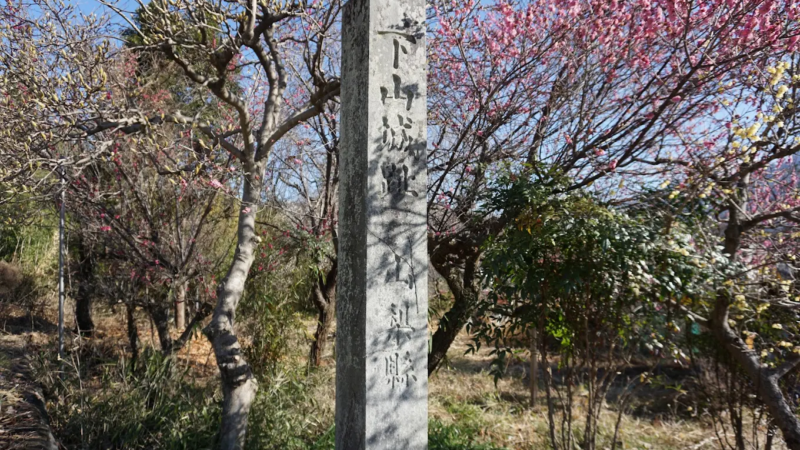
Shimoyama Castle is located approximately 1.7 km from Awakurayama Castle. Shimoyama Castle is a castle located in Shimoyama, Minobu-cho, Minamikoma-gun, Yamanashi Prefecture, and is believed to have been the residence of the Shimoyama clan. Shimoyama Castle is a town-designated historical site, and an explanatory sign has been installed.
Shimoyama Castle is a residence built on relatively flat land, differing in character from the rugged mountain castles like Awakurayama Castle. It is possible that the clan lived in a residence like Shimoyama Castle during peacetime and took refuge in mountain castles like Awakurayama Castle during wartime.
Hakii Castle and Hakii Clan Residence
Hakii Castle is located approximately 3.0 km away, and the Hakii Clan Residence (approximately 5.4 km further away) also exists. The Hakii clan was a family with deep ties to the Nichiren sect and was an important regional force involved in the establishment of Minobu-san Kuonji Temple.
Hakii Castle was a mountain castle that served as the base of the Hakii clan, and it is believed to have formed part of the defense network of the Minobu region along with Awakurayama Castle.
Coordination with Suganuma Castle
Suganuma Castle is located approximately 6.3 km away. Suganuma Castle is also one of the important castles in southern Kai Province, and these castles cooperated with each other to form a wide-area defense system.
Other Surrounding Castles
The following castles and fortifications are located around Awakurayama Castle:
- Hyobu-daira Residence (approx. 2.3km)
- Miyagi Beacon Tower (approx. 2.7km)
- Obikane Residence (approx. 2.8km)
- Yoda Residence (approx. 3.3km)
- Tokiwa Residence (approx. 5.2km)
- Baba Residence (approx. 6.6km)
- Kamogari Castle Mountain (approx. 7.2km)
- Hisanari Castle Mountain (approx. 7.4km)
These castle complexes functioned as bases for powerful local samurai groups, coordinating with each other to control and defend the region.
Historical Background of Minobu Town
Minobu-san Kuonji Temple, Head Temple of the Nichiren Sect
Minobu Town is known as a temple town where Minobu-san Kuonji Temple, the head temple of the Nichiren sect, is located. Since Nichiren entered the temple in 1281, Kuonji Temple has developed as the center of the Nichiren sect. In the Middle Ages, religious institutions played not only places of worship but also important political and economic roles. Minobu-san Kuonji Temple also developed while maintaining relationships with influential local figures, and it is thought that this was not unrelated to the existence of fortresses like Awakurayama Castle.
Transportation and Economy in the Fujikawa River Basin
The Fujikawa River, which flows through Minobu Town, was an important transportation route connecting Kai Province and Suruga Province. Goods and information flowed through river transport and land routes, giving this region an economically important position.
Awakurayama Castle is thought to have played a role in monitoring and defending these transportation routes, and it may have functioned not only as a military facility but also in protecting economic interests.
Territorial Management by the Anayama Clan
The Minobu region was within the sphere of influence of the Anayama clan, a senior retainer of the Takeda clan. The Anayama clan reached its peak during the time of Anayama Nobukimi (Baisetsu), and held significant influence within the Takeda family, even marrying the sister of Takeda Shingen.
The Anayama clan established multiple castles and residences within their territory and organized a group of retainers to manage their domain. It is highly probable that Awakurayama Castle was maintained and managed under the control of the Anayama clan as part of this domain management.
Access and Visiting Information for Awakurayama Castle
Access Methods
Awakurayama Castle is located in Awakura, Minobu-cho, Minamikoma-gun, Yamanashi Prefecture. However, as it is a rugged mountain castle, sufficient preparation and caution are necessary for a visit.
Public Transportation:
- The nearest station is JR Minobu Line “Minobu Station”.
- From the station, travel by car or taxi is required.
Car:
- Accessible via National Route 52 from the Chubu Odan Expressway “Nakatomi IC”.
- Prior confirmation of parking space near the castle entrance is necessary.
Precautions for Visiting the Castle
Awakurayama Castle is a rugged mountain castle with a relative height of approximately 495m. Please note the following points when planning your visit.
- Equipment: Prepare appropriate clothing and shoes for mountain climbing, drinking water, food, etc.
- Physical Fitness: Due to the significant elevation difference, a certain level of physical fitness is required.
- Season: Snow is possible in winter, and heatstroke is a concern in summer.
- Avoid Solo Activities: Visiting in groups is highly recommended.
- Prior Research: Check the condition of the climbing route beforehand.
Nearby Attractions
When visiting Awakurayama Castle, we recommend also visiting other historical sites and tourist spots in Minobu Town.
Minobu-san Kuonji Temple: As the head temple of the Nichiren sect, it houses numerous important cultural properties and historical buildings.
Honkoku-ji Temple: A Nichiren sect temple, it is an important temple that conveys the history of the region.
Shimoyama Castle Ruins: A town-designated historical site with an explanatory sign; visiting it together with Awakurayama Castle will deepen your understanding.
Kawachi-ryo Ichinomiya Kamo Shrine: A shrine that conveys the history of the region.
The Value of Awakurayama Castle in the Study of Mountain Castles in Kai Province
The Importance of Mountain Castle Research
Awakurayama Castle occupies an important position in castle research as a typical example of a medieval mountain castle in Kai Province. While numerous mountain castles exist in Yamanashi Prefecture, many lack historical records, and their true nature needs to be clarified through archaeological and layout surveys.
Awakurayama Castle retains relatively well-preserved remains such as earthworks, baileys, and moats. Excavations and detailed surveys could potentially yield significant information about the castle construction techniques and defensive systems of mountain castles in Kai Province.
Takeda Clan’s Castle Policy
Takeda Shingen is said to have left behind the words, “People are the castle, people are the stone walls, people are the moats.” In reality, he built numerous castles within his territory and strategically positioned them. Awakurayama Castle can be positioned as part of this Takeda clan’s castle policy.
Takeda clan castles were characterized not by functioning in isolation, but by the cooperation of multiple castles to form a wide-area defense network. Studying the relationship between Awakurayama Castle and the surrounding castle complex can shed light on the reality of the Takeda clan’s territorial control.
Contribution to Regional History Research
Research on Awakurayama Castle also contributes to the regional history research of Minobu Town and Minamikoma District. It provides clues to understanding how medieval local communities were organized and what kinds of samurai groups were active.
By comprehensively studying local legends, place names, temple and shrine records, and castle ruins, it becomes possible to paint a more detailed historical picture.
Preservation of Awakurayama Castle and Future Challenges
Current Status of Ruins Preservation
Awakurayama Castle is not currently designated as a specific cultural property, but its ruins remain within the forest. While it is returning to nature due to the lack of human intervention, the risk of destruction is relatively low.
However, in the long term, there is a possibility that the ruins may be damaged by changes in vegetation or natural disasters, and appropriate preservation management is desired.
Need for Research
Sufficient academic research has not yet been conducted on Awakurayama Castle. The following research is expected in the future:
- Detailed Site Survey: Recording the precise layout and structure of the remains.
- Survey: Creating an accurate site map through topographic surveying.
- Excavation: Dating artifacts and clarifying the castle’s characteristics.
- Literature Research: Gathering information from ancient documents and local materials.
- Comparative Study with Surrounding Castles: Clarifying the regional castle network.
Potential for Utilization and Dissemination
Awakurayama Castle is a rugged mountain castle, making general tourism difficult. However, it is a valuable field for castle enthusiasts and history researchers.
As a historical and cultural resource of Minobu Town, the following uses are conceivable:
- Installation of Information Boards: Installing explanatory boards at the castle entrance and key locations.
- Guided Tours: Conducting guided tours by local guides.
- Preparation of Materials: Providing information through brochures and websites.
- Educational Use: Utilizing local history learning in local schools.
Summary
Awakurayama Castle is a mountain castle located in Awakura, Minobu-cho, Minamikoma-gun, Yamanashi Prefecture, at an altitude of 704m (relative height 495m). It is an important medieval castle in Kai Province, retaining remains such as earthworks, baileys, and moats. It is believed to have functioned under the influence of the Takeda clan, particularly as part of the domain management of the Anayama clan, a key vassal.
Numerous castles and fortifications, including Shimoyama Castle, Hakii Castle, and Suganuma Castle, were located in the surrounding area, and these cooperated to form a regional defense network. Located in a strategically important location in the Fujikawa River basin, it is presumed to have played an important role in monitoring and controlling transportation routes.
Currently, Awakurayama Castle stands quietly amidst the forest, but it is a historical site of significant value in the study of mountain castles in Kai Province and regional history. Further research is expected to uncover even more historical facts.
When visiting Minobu Town, paying attention not only to Kuonji Temple, the head temple of the Nichiren sect, but also to medieval castles such as Awakurayama Castle will allow you to experience the multifaceted history of this region. The view from the mountaintop after climbing the steep mountain path may be the same view that the samurai who once defended this castle saw.