Complete Guide to Fukakusa Castle (Hokuto City, Yamanashi Prefecture) | History and Highlights of the Castle of the Horiuchi Clan, Vassals of the Takeda Clan
What is Fukakusa Castle?
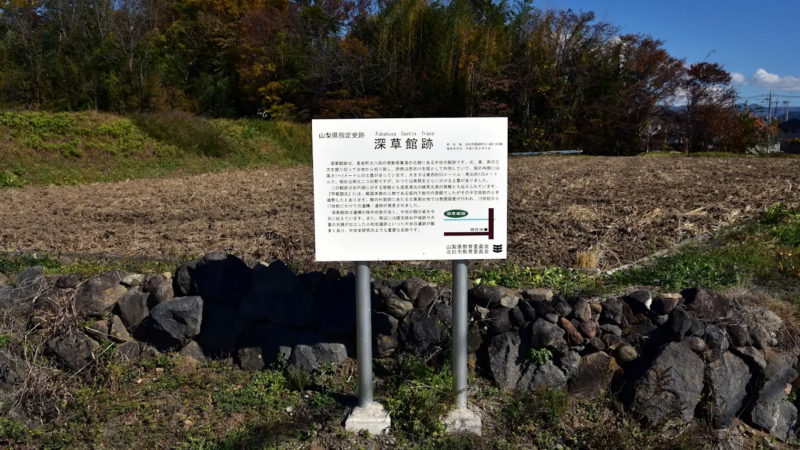
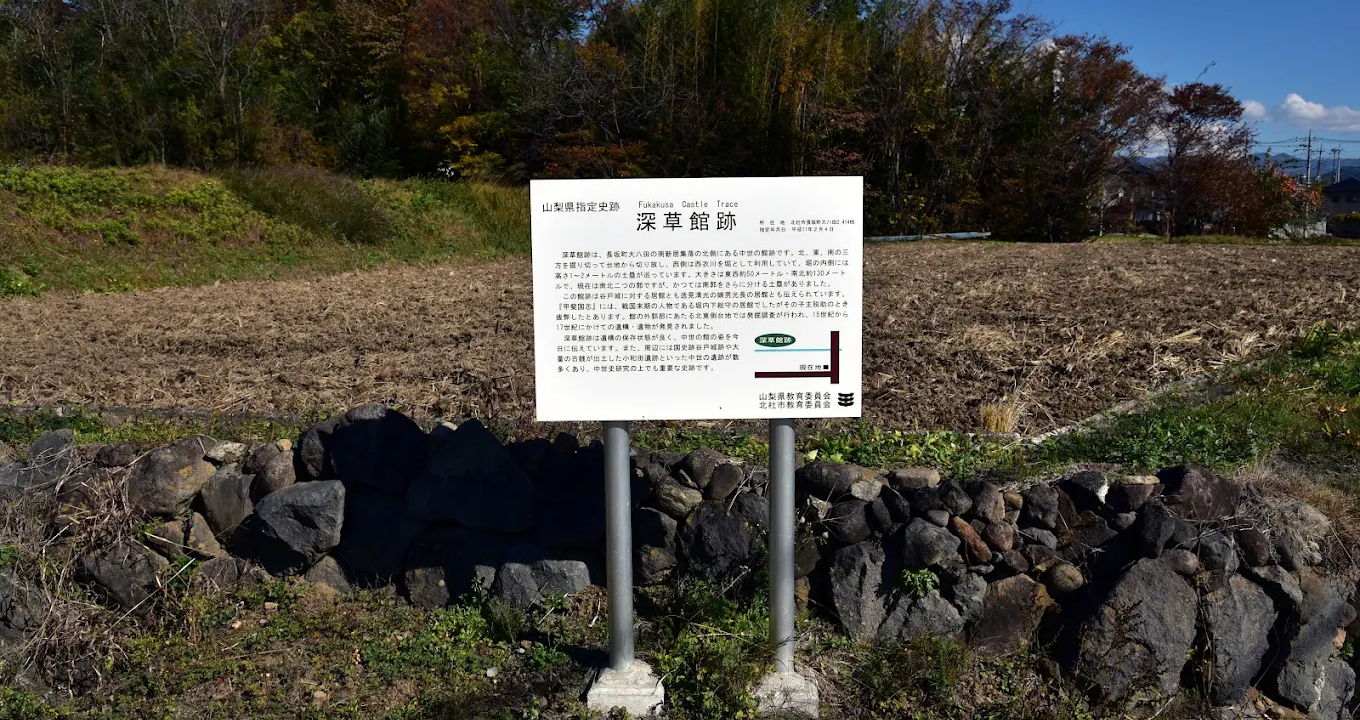
Fukakusa Castle is a medieval mountain castle located in Nagasaka-cho, Hokuto City, Yamanashi Prefecture. Also known as Fukakusa-kan and Fukakusa-rui, it is known as a hill castle built on the hilly area at the southern foot of the Yatsugatake Mountains. As the residence of the Horiuchi clan, important vassals of the Takeda clan, it played an important role during the Sengoku period (Warring States period).
Located at the southwestern end of a tongue-shaped plateau at an altitude of approximately 760 meters, it is a natural stronghold, sandwiched between two rivers, the Higashi-Kinugawa to the east and the Nishi-Kinugawa to the west. This geographical feature was an important factor in enhancing the castle’s defensive capabilities.
Currently, some remains of the castle are preserved, making it a valuable historical site for studying medieval castles in Yamanashi Prefecture. From the castle ruins, one can enjoy magnificent mountain scenery including the Yatsugatake mountain range and Mount Kai-Komagatake, making it a popular spot not only for history buffs but also for nature lovers.
History of Fukakusa Castle
The Horiuchi Clan and the Construction of Fukakusa Castle
Fukakusa Castle was built by the Horiuchi clan, vassals of the Takeda clan. The Horiuchi clan was one of the powerful vassal groups that played an active role during the time of Takeda Shingen and was entrusted with governing this region.
The only castle lords recorded are Horiuchi Shimousa-no-kami and his son, Horiuchi Chikara-no-suke. It is believed that the Horiuchi clan used Yato Castle as their main castle, and Fukakusa Castle functioned as a branch castle. Yato Castle is located in Yato, Oizumi-cho, Hokuto City, and together with Fukakusa Castle, it formed a defensive network covering the southern foothills of the Yatsugatake Mountains.
Role during the Takeda Clan Era
Fukakusa Castle held a crucial position in the Takeda clan’s territorial management. Its location in the hilly area southwest of the Yatsugatake Mountains made it a strategically important location, forming part of the northern defense line of Kai Province.
During the time of Takeda Shingen, this region was also used as a base for military operations toward Shinano Province. It is presumed that multiple subsidiary castles and forts were positioned around Fukakusa Castle, creating a coordinated defense system.
The Horiuchi clan not only governed the region but also acted as generals within the Takeda army. Fukakusa Castle is thought to have served not only as a residence but also as a supply base and intelligence hub.
The Era of Horiuchi Chikara-no-suke and the Fall of the Castle
During the time of Horiuchi Chikara-no-suke, Fukakusa Castle fell. While detailed records are scarce, it is presumed that the castle was attacked by hostile forces during the decline of the Takeda clan’s power.
In March 1582 (Tensho 10), Takeda Katsuyori committed suicide at Mount Tenmoku, marking the end of the Takeda clan. It is believed that Fukakusa Castle was temporarily without an owner as a result of this downfall.
The Tensho-Jingo War and the Hojo Clan’s Use
After the fall of the Takeda clan, the Tensho-Jingo War erupted over control of Kai Province. This conflict involved three parties—Tokugawa Ieyasu, Hojo Ujimasa, and Uesugi Kagekatsu—vying for control of Kai and Shinano Provinces.
During this Tensho-Jingo War, Fukakusa Castle was utilized by the Hojo clan. The Hojo clan, a powerful daimyo in the Kanto region based in Odawara, used Fukakusa Castle as a military base in their expansion into Kai Province.
The Hojo clan invaded the southern foothills of the Yatsugatake Mountains and seized former Takeda castles, including Fukakusa Castle. However, once Tokugawa Ieyasu established control over Kai Province, the Hojo clan was forced to withdraw.
Abandonment and Aftermath
After the Hojo clan’s withdrawal, Fukakusa Castle lost its military value and was abandoned. After the Tensho-Jingo War ended and Tokugawa Ieyasu gained control of Kai Province, a new system of governance was established.
Under Tokugawa rule, flatland castles and encampments became more important than medieval mountain castles, and hill castles like Fukakusa Castle were gradually abandoned. In the Edo period, castle sites were used for farmland and forests.
However, remnants such as earthworks and baileys remain as topographical features, conveying the castle’s appearance to this day.
Structure and Remains of Fukakusa Castle
Location and Topographical Characteristics
Fukakusa Castle was built on the southwestern end of a tongue-shaped plateau located almost in the center of the southern foothills of the Yatsugatake Mountains. Located at a relatively high elevation of 760 meters, it boasts an excellent location offering panoramic views of the surrounding area.
The Higashi-Kinugawa River flows to the east, and the Nishi-Kinugawa River to the west. These two rivers, carved into the plateau, act as natural moats. This geographical feature made Fukakusa Castle a formidable defensive stronghold, protected on three sides by steep cliffs.
To the southeast lies the Minami-Arai settlement, with irrigation canals utilizing the water resources of the Higashi-Kinugawa and Nishi-Kinugawa rivers winding through the settlement. This water system is believed to have also been used to secure water for daily life within the castle.
Layout and Defensive Structures
The layout (design and arrangement) of Fukakusa Castle made maximum use of the tongue-shaped plateau topography. Multiple baileys were arranged around the main enclosure, creating a tiered defensive line.
Earthworks surrounded the castle, and parts of them can still be seen today. Earthen ramparts served to prevent enemy intrusion and also ensured visibility from within the castle.
It is presumed that defensive structures such as trenches and vertical moats were also constructed. These were designed to limit enemy access routes and facilitate defense by cutting off the ridge of the plateau.
Existing Remains
Currently, the following remains are preserved at the Fukakusa Castle site:
Earthen Ramparts: Parts of the earthen ramparts that surrounded the castle can still be seen as part of the topography. While the height varies depending on the location, it is clearly an artificial mound of earth.
Kuruwa Remains: Flat terrain is arranged in stages, allowing us to infer the layout of the former kuruwa (enclosures). The largest flat area, believed to be the main enclosure, and the remains of smaller kuruwa surrounding it can be seen.
Cut Slopes: Between the kuruwa, artificially cut steep slopes (cut slopes) remain. This is a defensive structure designed to hinder enemy movement.
Although the remains are partially preserved due to years of weathering and development, they are valuable resources for understanding the basic structure of medieval mountain castles.
Related Castles in the Surrounding Area
Several castles from the Takeda clan era exist around Fukakusa Castle.
Yato Castle: This castle is thought to be the main castle of Fukakusa Castle, located in Yato, Oizumi-cho, Hokuto City. It was larger than Fukakusa Castle and was the base of the Horiuchi clan.
Other Branch Castles: Several small castles and forts that formed part of the Takeda clan’s defense network were scattered around the southern foothills of the Yatsugatake Mountains. These are thought to have worked together to form a comprehensive defense system for the region.
Highlights of Fukakusa Castle
Historical Value
Fukakusa Castle is an important historical site for understanding the Takeda clan’s territorial management and the activities of their retainers. In particular, as the residence of the Horiuchi clan, vassals of the Takeda family, it is a valuable historical site that conveys the realities of regional governance during the Sengoku period.
The historical episode of the Hojo clan’s use of the castle during the Tensho-Jingo War also speaks to its importance. It is evidence that this region was the stage for fierce battles during the chaotic period after the fall of the Takeda clan.
Natural Scenery
From the Fukakusa Castle ruins, you can enjoy a magnificent view of the Yatsugatake mountain range. Located at an altitude of 760 meters, it is a spectacular viewpoint offering panoramic views of the surrounding mountains and the Kofu Basin.
You can enjoy the beautiful nature of each season: fresh greenery in spring, deep green in summer, autumn leaves in fall, and snow-covered landscapes in winter. The autumn foliage season, in particular, is the perfect time to enjoy both historical exploration and nature appreciation.
Learning about the Structure of Medieval Mountain Castles
Fukakusa Castle is a historical site of high educational value, allowing you to learn about the typical structure of medieval mountain castles. Basic defensive structures such as earthworks, baileys, and steep slopes remain, allowing visitors to observe the castle-building techniques of the time firsthand.
The castle’s layout, which utilizes the tongue-shaped plateau topography, is a prime example of the wisdom of castle design during the Sengoku period. You can understand the defensive system, which combines natural terrain with artificial defensive structures, by observing the actual landscape.
Nearby Historical Spots
Numerous historical sites related to the Takeda clan exist around Fukakusa Castle. From Yato Castle to temples and shrines associated with Takeda Shingen, and ancient battlefields, there are many attractive spots for history buffs.
Furthermore, Hokuto City is known for its springs, selected as one of “Japan’s 100 Best Waters,” allowing visitors to enjoy the pristine waterside scenery along with their historical walks.
Access Information
Location
Fukakusa Castle Ruins are located in Nagasaka-cho, Hokuto City, Yamanashi Prefecture. Specifically, the address is around Ohachida, Nagasaka-cho, Hokuto City.
Access by Car
Using the Chuo Expressway:
- Approximately 5 kilometers from the Nagasaka Interchange, about 10 minutes by car.
- After exiting the interchange, head north on National Route 141 and follow the signs.
Parking: There is no dedicated parking lot around the castle ruins. When visiting, you will need to use nearby public parking lots or find a place where you can park on the street. However, please be considerate of local residents.
Access by Public Transportation
Using the JR Chuo Main Line:
- Approximately 40 minutes on foot from JR Nagasaka Station (about 3 kilometers).
- Approximately 10 minutes by taxi.
Bus Service: There are limited bus services that run from Nagasaka Station to near the castle ruins. We recommend checking the Hokuto City Bus timetable in advance.
Precautions for Visiting
Clothing and Equipment: The castle ruins are located in a forest, and there are areas with unstable footing. We recommend wearing comfortable shoes and clothing that allows for easy movement.
Season: Snowfall in winter can make walking difficult. Visiting from spring to autumn is recommended.
Visiting Hours: The castle ruins are always open, but visits after sunset should be avoided. Visit during daylight hours with ample time.
Facilities: There are no toilets or rest facilities around the castle ruins. Please prepare accordingly before visiting.
Surrounding Facilities
Nagasaka Station Area: Restaurants and convenience stores are available for rest and meals before or after your visit.
Hokuto City Tourist Information Center: Located near Nagasaka Station, you can obtain information on historical sites in the city, including Fukakusa Castle. Maps and brochures are also available.
Relationship between Fukakusa Castle and the Takeda Clan
Takeda Clan’s Retainer Organization
The Takeda clan was a powerful daimyo family that expanded their influence from their base in Kai Province (present-day Yamanashi Prefecture) during the Sengoku period. During the time of Takeda Shingen, the “Koshu Hatto no Shidai” (Koshu Laws and Regulations) were enacted, establishing the foundation for governing the territory.
The secret to the Takeda clan’s strength lay in the existence of an excellent group of retainers. Powerful generals known as the “Twenty-Four Generals of Takeda” supported Shingen and played active roles throughout the region. The Horiuchi clan was also a member of this group of retainers, entrusted with governing the southern foothills of the Yatsugatake Mountains.
The Role of the Horiuchi Clan
The Horiuchi clan was a family that served the Takeda clan as hereditary retainers for generations. Based at Fukakusa Castle and Yato Castle, they were responsible for governing and defending the southern foothills of the Yatsugatake Mountains.
This region was also important as a rear support base for military operations toward Shinano Province. It is believed that the Horiuchi clan handled various tasks necessary for conducting war, such as securing provisions, managing logistics, and gathering intelligence.
Impact of the Fall of the Takeda Clan
The fall of the Takeda clan in 1582 (Tensho 10) had a significant impact on Fukakusa Castle. While detailed records of what became of the Horiuchi clan after losing their lord are scarce, it is presumed that, like many Takeda retainers, they either served under Tokugawa Ieyasu or Hojo Ujimasa, or returned to farming.
Fukakusa Castle itself, having lost the Takeda clan’s backing, significantly diminished its value as a military base. Although it was temporarily used by the Hojo clan during the Tensho-Jingo War, it ultimately met its fate as a ruined castle.
Points to Note When Visiting Fukakusa Castle
Preparations
To make your visit to Fukakusa Castle more fulfilling, please prepare the following beforehand:
Historical Preparation: Gaining basic knowledge of the Takeda clan’s history and the Tensho-Jingo War will allow you to more deeply understand the significance of the castle ruins.
Obtaining a Map: Having a detailed map of the area around the castle ruins will make it easier to understand the relative locations of the remains.
Weather Check: Since footing becomes difficult in rainy weather, it is recommended to visit on a sunny day.
Visiting Tips
Time Allocation: Allow 1.5 to 2 hours to thoroughly explore the entire castle ruins.
Photography: Taking photos from angles that clearly show the features of the remains, such as earthworks and baileys, will deepen your understanding when you review them later.
Topographical Observation: Walking around and observing the castle’s location on a tongue-shaped plateau between the East and West Kinugawa rivers will help you understand the castle’s defensive system.
Combined Sightseeing
Visiting the following spots in conjunction with your visit to Fukakusa Castle will allow you to experience the charm of Hokuto City more deeply.
Yato Castle Ruins: Visiting Yato Castle, the main castle of Fukakusa Castle, will provide a more comprehensive understanding of the Horiuchi clan’s rule.
Kiyoharu Art Village: An art facility utilizing the former Kiyoharu Elementary School, located about 15 minutes by car from Fukakusa Castle. Sanbuichi Spring Water: This spring water, selected as one of Japan’s 100 Best Waters, is perfect for refreshing yourself after a historical walk.
History and Culture of Hokuto City
Overview of Hokuto City
Hokuto City is located in the northwestern part of Yamanashi Prefecture. It was formed in 2004 through the merger of seven towns and villages in Kitakoma District (Akeno Village, Sutama Town, Takane Town, Nagasaka Town, Oizumi Village, Hakushu Town, and Mukawa Village). In 2006, Kobuchizawa Town was also incorporated, resulting in the current city boundaries.
The city area is vast, surrounded by some of Japan’s most representative mountain landscapes: the Yatsugatake mountain range to the north, the Southern Alps (starting from Mount Kaikomagatake) to the southwest, Mount Kayagatake to the east, and Mount Mizugaki to the northeast.
The Takeda Clan and the Hokuto City Area
The Hokuto City area was an important territory controlled by the Takeda clan during the Sengoku period (Warring States period). The southern foothills of the Yatsugatake Mountains, in particular, were considered crucial as a base for military operations toward Shinano Province.
Besides Fukakusa Castle, several other castle ruins from the Takeda era remain within the city, including Yato Castle, Shishiku Castle, and Kyoraiishi Castle. These castles were interconnected, forming a comprehensive defense network for the entire region.
Abundant Nature and Culture
Hokuto City is known as the “Mountain of Water,” with abundant spring water flowing from the Yatsugatake Mountains and the Southern Alps. Three locations boast springs selected as one of “Japan’s 100 Best Waters,” and this pure water supports the region’s agriculture and sake brewing industry.
Furthermore, taking advantage of its high altitude and long hours of sunshine, the area is a thriving center for cultivating highland vegetables and wine production. In recent years, the number of new residents has increased, and the area is also attracting attention in the fields of art and crafts.
Hokuto City is known as the “Mountain of Water,” with abundant groundwater springs from the Yatsugatake Mountains and the Southern Alps. Three locations have been selected as “Japan’s 100 Best Waters,” and this pure water supports the region’s agriculture and sake brewing industry.
In addition, taking advantage of the climate conditions of high altitude and long hours of sunshine, the cultivation of highland vegetables and wine production are flourishing. ## Summary
Fukakusa Castle is a valuable medieval mountain castle site remaining in Hokuto City, Yamanashi Prefecture. As the residence of the Horiuchi clan, vassals of the Takeda clan, it played an important role during the Sengoku period (Warring States period). The castle’s layout, utilizing the topography of a tongue-shaped plateau at the southern foot of the Yatsugatake Mountains, demonstrates the high level of castle-building technology of the time.
The remaining earthworks and baileys are valuable teaching materials for learning about the structure of medieval mountain castles. Furthermore, the view of the Yatsugatake mountain range from the castle ruins is an attractive point where you can enjoy both historical exploration and nature appreciation simultaneously.
Its history, including its use by the Hojo clan during the Tensho-Jingo War after the fall of the Takeda clan and its subsequent abandonment, tells the story of the turbulent Sengoku period. By visiting Fukakusa Castle, you can get a firsthand feel for the rise and fall of the Takeda clan and the realities of regional rule during the Sengoku period.
When visiting Hokuto City, be sure to visit the Fukakusa Castle ruins and experience the romance of history and the magnificent natural scenery. By visiting the surrounding valley castles and famous spring water spots in conjunction with this area, you can experience the charm of this region more deeply.