Takaoka Castle (Takaoka City, Toyama Prefecture) Complete Guide | From Maeda Toshinaga’s Retirement Castle to One of Japan’s Top 100 Castles: A Thorough Explanation
Located in the heart of Takaoka City, Toyama Prefecture, Takaoka Castle is a flatland castle built in 1609 by Maeda Toshinaga, the second head of the Kaga Maeda family. Although it was abandoned after only five years, its excellent layout and beautiful moat have been preserved to this day, and it has been selected as one of Japan’s Top 100 Castles. This article provides a thorough explanation of Takaoka Castle, Toyama Prefecture’s only castle among Japan’s Top 100, covering its history, structure, highlights, and the current appeal of Takaoka Old Castle Park.
History of Takaoka Castle
Background of Construction by Maeda Toshinaga
The construction of Takaoka Castle began as a political and military decision following Maeda Toshinaga’s retirement. Born as the eldest son of Maeda Toshiie, Toshinaga became the head of the Kaga Maeda family after his father’s death in 1599, becoming a daimyo who ruled over the three provinces of Kaga, Noto, and Etchu.
In 1605, Toshinaga handed over the family headship to his younger brother, Maeda Toshitsune, and decided to retire. Initially, he used Toyama Castle as his retirement home, but in March 1608, Toyama Castle burned down. This fire prompted Toshinaga to decide to construct a new retirement castle.
Reasons for Choosing Sekino
The location Toshinaga chose for his new castle was Sekino in Imizu District, Etchu Province (present-day Kojō, Takaoka City, Toyama Prefecture). The reasons for choosing this location are as follows:
- Transportation Hub: A key transportation hub where the Hokuriku Road and Hida Road intersect.
- Economic Importance: Located near the mouths of the Oyabe River and Sho River, offering excellent water transport.
- Defensive Advantages: Allows for defense utilizing the surrounding terrain.
- Center for Domain Management: Geographically advantageous for governing the three provinces of Kaga, Noto, and Etchu.
Toshinaga built a castle and castle town in Sekino and named it “Takaoka.” This name is said to originate from a line in the Chinese classic “Book of Songs”: “The phoenix sings on that high hill.”
Castle Design by Takayama Ukon
The castle design (layout) of Takaoka Castle was handled by Takayama Ukon, known as a Christian daimyo. Ukon was highly regarded as a master castle builder and was involved in the construction of castles such as Akashi Castle and Obama Castle. On the other hand, there is also a theory that Toshinaga himself designed the castle’s layout. In any case, Takaoka Castle was built as a modern castle utilizing the latest technology of the time. Construction began in 1609, and Toshinaga entered the castle on September 13th of the same year.
Abandoned in Just 5 Years
Takaoka Castle’s history was extremely short. Upon Toshinaga’s death on June 20, 1614, Takaoka Castle was abandoned in 1615 due to the “One Castle Per Province” decree.
The “One Castle Per Province” decree was an Edo shogunate law ordering the demolition of castles other than the residence of each daimyo. Since the residence of the Kaga Maeda family was Kanazawa Castle, Takaoka Castle was targeted for demolition. However, Takaoka, as a castle town built by Toshinaga, was allowed to survive and developed into a commercial and industrial town.
Development of Takaoka Castle Town
After the castle was abandoned, the Maeda family implemented policies to maintain and develop the town of Takaoka:
- Encouragement of Commerce and Industry: Merchants and artisans were invited from various regions to promote industry.
- Establishment of a Market: Regular markets were held to cultivate Takaoka as a commercial center.
- Development of the Foundry Industry: The tradition of Takaoka copperware began, becoming a local industry that continues to this day.
Thanks to these policies, the moats and earthworks, which represent the castle’s substantial value, were preserved without being demolished and remain in good condition to this day.
Structure of Takaoka Castle
Characteristics of the Castle Layout
Takaoka Castle is a typical flatland castle, and its most distinctive feature is its layout, which skillfully utilizes water moats. The total area of the castle is approximately 210,000 square meters, and water moats occupy about one-third of the total area, giving it a unique structure among Japanese castles.
The castle consisted of multiple enclosures (kuruma), each separated by a moat:
- Honmaru: The central part of the castle, where Toshinaga’s residence was located
- Ninokuruwa: Surrounding the Honmaru
- Sannomaru: The outer enclosure
- Akenomaru: An enclosure located on the east side
- Kajimaru: An enclosure believed to have been where blacksmiths resided
Design of the Moat
Takaoka Castle’s moat was a large-scale structure that drew water from the Oyabe River. The moat was over 50 meters wide in its widest points and sufficiently deep. This moat served the following functions:
- Defensive Function: A physical barrier preventing enemy intrusion
- Water Transport Function: Used as a transport route for goods
- Landscape Function: A visual effect that enhanced the castle’s grandeur
Even today, most of this moat remains in good condition and is the main attraction of Takaoka Old Castle Park.
Earthworks and Stone Walls
At Takaoka Castle, both stone walls and earthworks were used. While stone walls were used for the main keep and important enclosures, much of the castle was constructed of earthworks. This is thought to be due to the short construction period and the limited availability of stone materials.
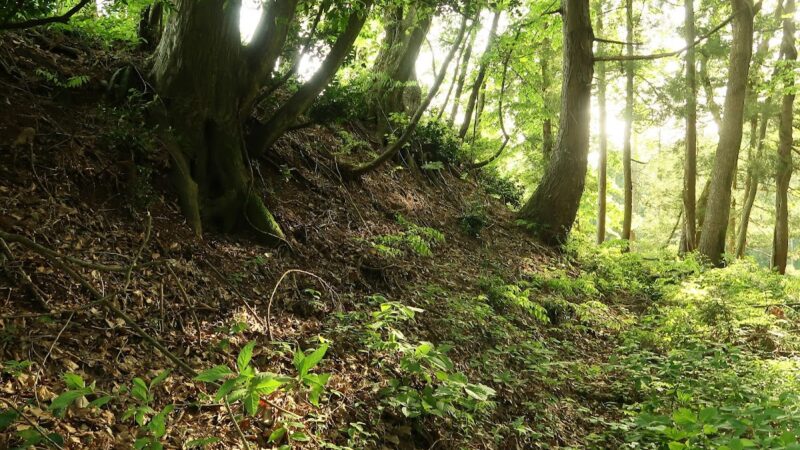
The earthworks that remain today are valuable relics demonstrating the castle-building techniques of the time. Trees grow densely on top of the earthworks, forming the landscape of the castle ruins park.
Layout of Structures
Since structures such as the keep and turrets were demolished when the castle was abandoned, no building remains exist today. However, archaeological excavations and research of ancient documents have revealed the existence of the following structures:
- Main Keep Palace: The residence of Toshinaga
- Turrets: Multiple turrets were located on the site
- Castle Gates: Gates connecting the various enclosures
Regarding the keep, there are no definitive records of whether it was built, and opinions are divided among researchers. It has been suggested that the keep may not have been completed due to the short period of time the castle was abandoned.
Takaoka Old Castle Park
History of Park Development
Takaoka Castle ruins were developed as a park during the Meiji era. In 1875 (Meiji 8), the castle ruins were leased from the prefecture to Takaoka Town and opened to the public as “Old Castle Park.” This is one of the earliest examples of park development in Japan.
Main Developments Since the Meiji Era:
- Meiji Era: Basic park development, start of cherry tree planting
- Taisho Era: Development of park paths, installation of rest facilities
- Showa Era: Expansion as a place of relaxation for citizens, construction of cultural facilities
- Heisei Era: Preservation and development as a historical site, selection as one of Japan’s Top 100 Castles (2006)
National Historic Site Designation and Japan’s Top 100 Castles
Takaoka Castle ruins were designated as a national historic site in 1972 (Showa 47). This was because the moats and earthworks, which had been well preserved even after the castle was abandoned, were evaluated as having high historical value as remnants of a modern castle. Furthermore, in 2006, it was selected as one of the “100 Famous Castles of Japan” by the Japan Castle Association. Takaoka Castle is the only castle in Toyama Prefecture to be included in this list, and it is positioned as a representative castle ruin of Toyama Prefecture.
100 Best Cherry Blossom Viewing Spots in Japan
Takaoka Old Castle Park is also famous as a cherry blossom viewing spot. Approximately 2,700 cherry trees are planted in the park, offering a variety of cultivars, mainly Somei Yoshino, but also Edo Higan cherry and mountain cherry trees.
In 1981, it was selected as one of the “100 Best Cherry Blossom Viewing Spots in Japan.” Every year from early to mid-April, during the blooming season, many visitors come to enjoy the blossoms, and the trees are illuminated at night. The reflection of the cherry blossoms in the moat is particularly beautiful and has become a spring tradition in Takaoka.
Facilities and Highlights within the Park
Takaoka Old Castle Park contains various facilities in addition to the remains of the castle:
Historical and Cultural Facilities
- Takaoka City Museum: A museum introducing the history and culture of Takaoka. It also exhibits materials related to Takaoka Castle.
- Imizu Shrine: A shrine located on the site of the former main keep. Dedicated to Maeda Toshinaga
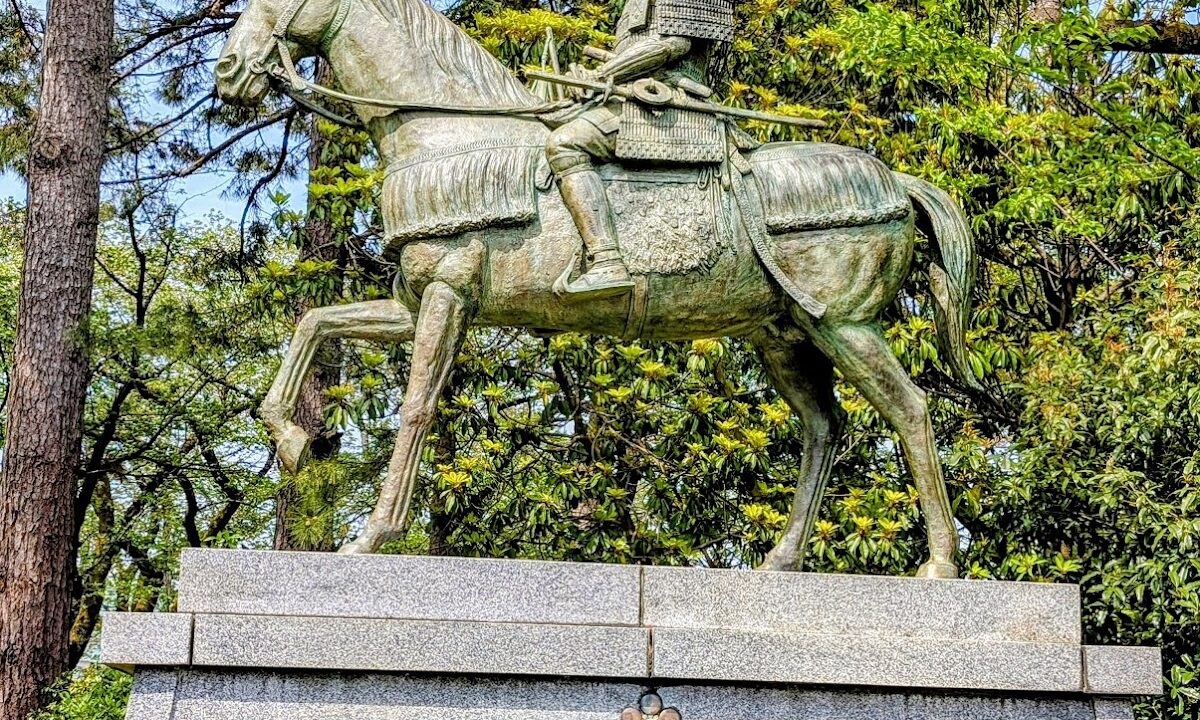
- Statue of Lord Maeda Toshinaga: A statue of Toshinaga installed in the park
Nature and Scenery
- Moat: A vast moat occupying one-third of the approximately 210,000 square meters
- Earthworks: Earthworks that retain their original form can be found in various places
- Forest: A forest with large trees such as zelkova and camphor trees
Recreational Facilities
- Zoo: Small but popular with children
- Gymnasium/Martial Arts Hall: Sports facilities
- Lawn Area: A place of relaxation for citizens
Seasonal Charms
Takaoka Kojō Park shows different faces throughout the four seasons:
Spring (March-May)
- Cherry Blossoms: 2,700 cherry trees bloom all at once
- Fresh Greenery: Young leaves sprout, and the entire park is enveloped in bright green
Summer (June-August)
- Deep Green: The deep green is reflected in the moat, creating a cool and refreshing landscape.
- Lotus Flowers: Lotus flowers bloom in part of the moat.
Autumn (September-November)
- Autumn Leaves: Zelkova and maple trees change color, adorning the moat.
- Tranquility: A peaceful stroll in a tranquil atmosphere.
Winter (December-February)
- Snowscape: The snow-covered castle ruins possess a fantastical beauty.
- Winter Birds: Migratory birds fly to the moat.
Cultural Value of Takaoka Castle
Position in the History of Early Modern Castles
Takaoka Castle is an important example of the development process of early modern castles. The Keicho era (1596-1615) was the peak period of castle construction after the Battle of Sekigahara, and Takaoka Castle reflects the castle-building techniques of that era.
In particular, the layout, centered on the moat, represents one perfected form of defensive system in flatland castles, making it a valuable resource for castle history research.
The Relationship Between the Maeda Family and Takaoka
Takaoka Castle and the town of Takaoka are crucial to understanding the Maeda family’s territorial management strategy. Toshinaga positioned Takaoka not merely as a retirement castle, but as a base for controlling Etchu Province.
The Maeda family’s policies, which continued to support the town’s development even after the castle’s abandonment, provide an interesting example in Japanese urban history: the transformation from a castle town to a commercial and industrial city.
Excellent Preservation
The most striking feature of the Takaoka Castle ruins is that, even more than 400 years after its abandonment, the moat and earthworks are remarkably well-preserved. While many castle ruins have been lost due to urbanization and development, the Takaoka Castle ruins were protected when the site was developed into a park during the Meiji era.
This excellent state of preservation is the basis for its designation as a National Historic Site and its inclusion as one of Japan’s 100 Famous Castles.
Takaoka City Museum and Takaoka Castle
Located within Takaoka Old Castle Park, the Takaoka City Museum is an essential facility for learning about the history of Takaoka Castle and Takaoka.
Permanent Exhibitions
The museum features the following exhibits related to the history of Takaoka Castle:
- Model of Takaoka Castle: A model recreating the castle’s appearance at the time of its construction
- Historical Documents and Maps: Historical materials concerning Takaoka Castle and its surrounding town
- Excavated Artifacts: Tiles and ceramics unearthed during archaeological excavations
- Materials Related to Maeda Toshinaga: An introduction to the life and achievements of Toshinaga
Special Exhibitions
Special exhibitions focusing on the history of Takaoka Castle and Takaoka are held regularly, showcasing the latest research findings.
Access
Access by Train
If using JR
- Get off at Takaoka Station on the JR Hokuriku Main Line, approximately 15 minutes on foot
- Get off at Takaoka Station on the Ainokaze Toyama Railway, approximately 15 minutes on foot
If using Tram
- Get off at Kyukan Iryo Center-mae (Emergency Medical Center) on the Manyo Line, approximately 5 minutes on foot
Access by Car
If using Expressway
- Approximately 10 minutes from Takaoka IC on the Noetsu Expressway
- Approximately 15 minutes from Kosugi IC on the Hokuriku Expressway
Parking
- Takaoka Kojō Park Parking (Free, approximately 120 spaces)
- Paid parking available nearby
Access by Bus
From Takaoka Station, take the Kaetsuno Bus or City Loop Bus and get off at Takaoka Kojō Park.
Nearby Tourist Attractions
Around Takaoka Kojō Park, there are numerous tourist attractions where you can experience Takaoka’s history and culture:
Takaoka Daibutsu (Great Buddha of Takaoka)
Located about a 10-minute walk from Takaoka Kojō Park, the Takaoka Daibutsu is a bronze Buddha statue built using the culmination of Takaoka’s bronze ware techniques. It is considered one of the “Three Great Buddhas of Japan,” alongside those of Nara and Kamakura.
Kanaya-machi
Kanaya-machi, known as the birthplace of Takaoka casting, is a beautiful Important Preservation District for Groups of Traditional Buildings, featuring rows of houses with latticework windows. Approximately a 15-minute walk from Takaoka Kojō Park.
Zuiryūji Temple
Zuiryūji Temple, built as the family temple of Maeda Toshinaga, is a Soto Zen temple designated as a National Treasure. Its magnificent temple layout is a must-see. Approximately a 10-minute walk from Takaoka Station.
Yamamachi-suji
Yamamachi-suji, where merchant buildings from the Meiji to early Showa periods remain, is designated as an Important Preservation District for Groups of Traditional Buildings. It boasts a charming streetscape lined with earthen storehouses.
Tips for Enjoying Takaoka Castle
Estimated Time Required for Visiting
If you plan to thoroughly explore Takaoka Castle Park, the following time allocation is recommended:
- Short Stroll: 30 minutes to 1 hour
- Thorough Visit: 1 hour 30 minutes to 2 hours
- Including Museum Visit: 2 hours to 3 hours
Recommended Visiting Route
- Learn about the history of Takaoka Castle at the Takaoka City Museum
- Visit the Main Enclosure Site (Imizu Shrine)
- Stroll along the Promenade by the Moat
- Climb the Earthwork to enjoy a panoramic view of the entire park
- Visit Cherry Blossom Viewing Spots during cherry blossom season
Best Photo Spots
- Moat and Cherry Blossoms: A classic spring photo spot
- View from Asahi Bridge: A panoramic view of the moat and earthwork
- Torii Gate of Imizu Shrine: An iconic landscape of the main enclosure site
- Autumn Foliage in the Moat: Autumn colors reflected on the water’s surface
Event Information
Takaoka Old Castle Park hosts various events throughout the year:
- Takaoka Cherry Blossom Festival (Early to Mid-April): Illuminations and stage events
- Takaoka Tanabata Festival (August): Tanabata decorations appear in the park
- Takaoka Manyo Festival (October): A festival of history and culture
Current Status and Challenges of Takaoka Castle Research
Results of Archaeological Excavations
Multiple archaeological excavations have been conducted at the Takaoka Castle site. These investigations have revealed the following:
- Structure and construction techniques of the stone walls
- Layout and scale of the buildings
- Life within the castle as seen from excavated artifacts
- Structure and water management system of the moats
Future Research Topics
Many aspects of Takaoka Castle remain unresolved:
- Presence and structure of the keep
- Detailed construction process
- Integrated urban planning with the castle town
- Changes in the remains after the castle’s abandonment
Future archaeological excavations and historical research are expected to unravel these mysteries.
Summary
Takaoka Castle, built by Maeda Toshinaga as his retirement castle, existed for only a short period of five years. However, its excellent layout and moats have been preserved for over 400 years to this day.
Selected as one of Japan’s Top 100 Castles and designated as a National Historic Site, the Takaoka Castle ruins are a representative historical heritage of Toyama Prefecture. Takaoka Old Castle Park, currently located in the heart of Takaoka City, is a beloved place of relaxation and tourist attraction, showcasing the beauty of each season: cherry blossoms in spring, lush greenery in summer, vibrant autumn leaves, and snowy winter landscapes.
Despite its convenient location in the city center, the tranquil space surrounded by a vast moat and lush greenery offers a respite from the hustle and bustle of the city. When visiting Takaoka, be sure to visit Takaoka Old Castle Park and reflect on the castle as envisioned by Maeda Toshinaga.
Combining this with a visit to the Takaoka City Museum, walking along the moat, climbing the earthworks, and paying respects at the Imizu Shrine on the site of the former main keep will allow you to gain a deeper understanding of Takaoka Castle’s history and culture. Takaoka Castle, the only castle in Toyama Prefecture included in Japan’s Top 100 Castles list, continues to offer visitors the romance of history and the solace of nature.