Tsutsujigasaki Mansion Ruins, Kofu City (Yamanashi Prefecture) – A Thorough Explanation of Takeda Shingen’s Base
Overview
Tsutsujigasaki Mansion was a residence from the Sengoku period located in Kofu-cho, Kofu City, Yamanashi Prefecture, and is known as the base of the Takeda clan, the shugo (military governor) of Kai Province. Currently, the Takeda Shrine stands on the site, and it is designated as a national historic site as the “Takeda Clan Residence Ruins.”
The residence, built by Takeda Nobutora in Eisho 16 (1519), was subsequently inherited by Takeda Shingen and Takeda Katsuyori, and functioned as the center of the Takeda clan’s domain management for approximately 60 years, spanning three generations. Along with the Katsunuma Clan Residence Ruins in Koshu City, it is a site of extremely high historical value as a medieval castle ruin.
The site of the residence is a square-shaped building measuring approximately 200 meters east-west and 190 meters north-south. It is believed to have been built based on the Hana-no-Gosho (Muromachi Palace), the residence of the Ashikaga shoguns. Even today, the remains of earthworks, dry moats, gates, and wells are well-preserved, making it a valuable historical site that conveys the appearance of a residence from the Sengoku period.
History of Tsutsujigasaki Residence
Changes in the Shugo (Provincial Governor) Office and Fuchu (City Hall) of Kai Province
The location of the Shugo (Provincial Governor) office in Kai Province changed over time. The Takeda clan was appointed Shugo of Kai Province during the Nanboku-cho period, and the initial Shugo office was located in Isawa (present-day Fuefuki City).
During the Muromachi period, the Shugo office moved to Kawada (Kawada-cho, Kofu City), and thereafter, the location of the Shugo office continued to change in accordance with the expansion of the Takeda clan’s power and the political situation. This relocation of Fuchu is an important element in the process of establishing the Takeda clan’s system of rule within Kai Province.
Construction of Tsutsujigasaki Castle and the Founding of Kofu by Takeda Nobutora
Construction of Tsutsujigasaki Castle was started by Takeda Nobutora in Eisho 16 (1519). As Nobutora advanced the unification of Kai Province, he selected Tsutsujigasaki as his new base.
The reasons for choosing this location include the following:
- It was located in the center of the Kofu Basin, making it suitable as a center for governing the domain.
- It had a fortified mountain to the north, which could function as a defensive fort.
- It had abundant water resources, making it suitable for maintaining the residence.
- It was a transportation hub, making communication with various regions easy.
Nobutora developed a castle town centered around Tsutsujigasaki Castle, which became the foundation of present-day Kofu City. In this sense, Nobutora is also called the “founder of Kofu.” In parallel with the construction of the castle, the surrounding streets were improved, temples and shrines were arranged, and merchants and industrialists were attracted, promoting planned urban development. ### Tsutsujigasaki Castle in the Era of Takeda Shingen and Katsuyori
In 1541, when Takeda Nobutora was exiled to Suruga by his eldest son, Harunobu (later Shingen), Tsutsujigasaki Castle became Shingen’s residence. Using the castle built by his father as his base, Shingen pursued an aggressive policy of territorial expansion, including the invasion of Shinano, the Battle of Kawanakajima against Uesugi Kenshin, and the invasion of Suruga.
During Shingen’s time, Tsutsujigasaki Castle was not merely a residence, but functioned as the command center for the administration of his territory. Government affairs were conducted within the castle, councils with senior retainers were held, and military strategies were planned. Furthermore, the residences of his retainers were located around the castle, and the castle town played a crucial role in supporting the Takeda clan’s power base.
When Shingen died in 1573, his eldest son, Katsuyori, inherited the family headship. Initially, Katsuyori used Tsutsujigasaki Castle as his base, but in 1581, he built the more defensible Shinpu Castle (Nirasaki City) and moved his base there.
This move ended Tsutsujigasaki Castle’s role as the Takeda clan’s base, a role it had held for approximately 60 years. However, just one year after the move to Shinpu Castle, in 1582, the Takeda clan was destroyed by an invasion by the Oda-Tokugawa allied forces, and Tsutsujigasaki Castle entered a period of war.
Tsutsujigasaki Castle in the Early Modern and Modern Periods
After the fall of the Takeda clan, Kai Province came under the control of Oda Nobunaga, and Kawajiri Hidetaka was appointed as the lord of Kofu Castle. However, during the chaotic period following the Honnō-ji Incident, Kawajiri was defeated in an uprising, and Kai Province became a battleground between the Tokugawa and Hōjō clans.
Subsequently, Hashiba Hidekatsu and Katō Mitsuyasu became the lords of Kai Province, but during the Bunroku era (1592-1596), Kōfu Castle was newly constructed, and the center of Kai Province completely shifted from Tsutsujigasaki Mansion to Kōfu Castle.
Throughout the Edo period, the site of Tsutsujigasaki Mansion fell into disrepair, but due to reverence for the Takeda clan, the site was carefully preserved. Even after the Meiji Restoration, admiration for Takeda Shingen continued, and in 1919 (Taisho 8), Takeda Shrine was built on the site of the mansion.
In 1938 (Showa 13), the Tsutsujigasaki Mansion site was designated a national historic site as the “Takeda Clan Residence Site,” officially recognizing its historical value. Currently, while the site is maintained as the grounds of Takeda Shrine, archaeological excavations are continuously being conducted, gradually revealing the actual state of the residence during the Sengoku period.
Structure and Remains of the Mansion
Basic Structure of the Mansion
Tsutsujigasaki Mansion is a square-shaped residence, approximately 200 meters east-west and 190 meters north-south, surrounded by earthen ramparts and a dry moat, a typical form of a medieval residence. The structure of the mansion is believed to have been modeled after the Hana no Gosho (Muromachi Palace), the residence of the Ashikaga shoguns in Kyoto, and was designed as a dignified residence.
It is thought that the interior of the mansion consisted of a group of buildings including the main hall, the private residence, and the meeting hall. Excavations have confirmed the remains of foundation stones for buildings, garden structures, and drainage facilities, indicating a high level of functionality and aesthetic consideration as a residence.
Earthworks and Dry Moat
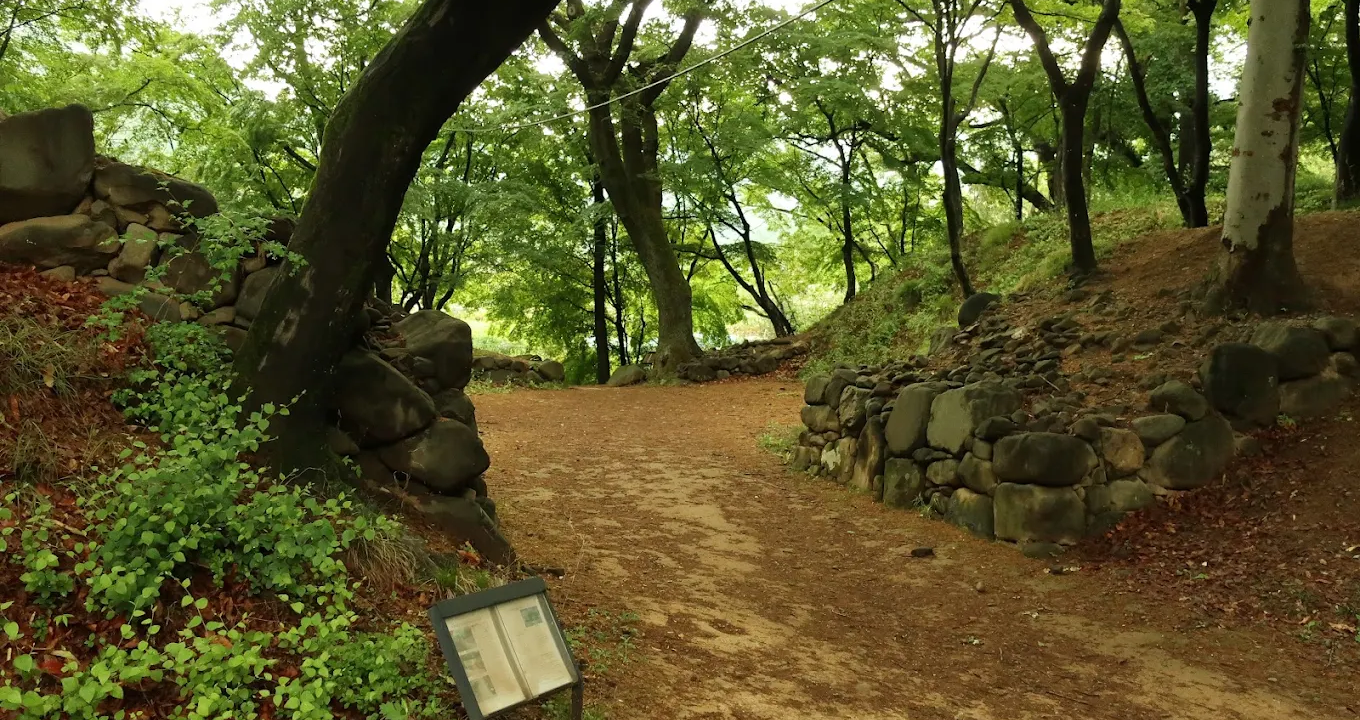
The earthworks surrounding the Tsutsujigasaki Mansion remain in good condition today. The earthworks are approximately 3-5 meters high and served a defensive function for the mansion. A dry moat was dug outside the earthworks, forming a double line of defense.
The dry moat is estimated to have been approximately 10-15 meters wide and 3-4 meters deep. Although partially filled in, clear traces of the dry moat can be seen on the west and north sides.
Entrances (Koguchi)
Entrances to the mansion were located on the east, west, and south sides. The main entrance on the east side, in particular, corresponds to the current main entrance of Takeda Shrine and is a sturdy structure reinforced with stone walls.
This stone wall is thought to be a later modification rather than from the Takeda period, but the location of the gate itself is believed to have remained unchanged since the Takeda era. The gate’s structure is curved to prevent enemy intrusion, demonstrating defensive ingenuity.
Wells and Water Facilities
Several wells were located within the castle grounds. Currently, a well called “Hime no Ido” (Princess’s Well) remains on the grounds of Takeda Shrine, and there is a legend that it was used for the first bath of Takeda Shingen’s daughter.
Furthermore, archaeological excavations have revealed that waterways and drainage facilities were constructed within the castle. These facilities are thought to have been used to maintain the sanitary conditions of the residence and to supply water to the gardens.
Layout of the Enclosures
Tsutsujigasaki Castle consisted of multiple enclosures, including the main enclosure (Hon-kuruma), the West Enclosure, and the East Enclosure. The western enclosure is currently occupied by the Shingen Museum (Kofu City Takeda Clan Residence Site Historical Museum), which is used to showcase the results of archaeological excavations and the history of the three generations of the Takeda clan.
Each enclosure was demarcated by earthworks and moats, and it is presumed that each had a different function. The main enclosure likely housed core buildings such as the main hall, while the other enclosures are thought to have contained offices for retainers and warehouses.
Archaeological Remains Revealed by Excavations
Since the 1960s, continuous archaeological excavations have been conducted, uncovering many important remains. Foundation stone building remains, garden remains, stonework remains, and artifacts such as ceramics and metal products have been unearthed, gradually revealing the true nature of the residence.
Of particular note is the discovery of garden remains. Traces of ponds and stonework have been confirmed, indicating that the Takeda clan’s residence was not merely a military facility but also possessed cultural aspects.
Castle Town (Takeda Castle Town)
Streets and Major Highways of the Castle Town
The castle town, centered around the Tsutsujigasaki Mansion, had a systematically planned network of streets. Roads radiating from the mansion connected to major highways leading to various regions, forming the core of the transportation network for governing the domain.
The following highways were particularly important:
- Koshu Kaido: The predecessor of the major trunk road connecting Edo and Kofu
- Bodo: A military road leading to Shinano
- Sunshu Oukan: A road leading to Suruga
The streets of the castle town combined a grid-like layout with sections following the natural terrain. Merchant and industrial buildings lined the main streets, forming the center of economic activity.
Arrangement of Merchant and Samurai Districts
The castle town was clearly divided according to its function. The area surrounding the castle was home to the residences of powerful vassals, forming a samurai district. Meanwhile, merchant districts developed along the main roads, where commercial activity flourished.
A craftsman’s district also formed, with various artisans such as blacksmiths, carpenters, and weavers residing there. These artisans played a crucial role in supporting the Takeda clan’s military activities and daily life.
Religious Spaces within the Castle and Influential Temples and Shrines in the Castle Town
Numerous temples and shrines were located within the Tsutsujigasaki Castle and its surrounding castle town. These temples and shrines served as objects of worship for the Takeda clan, while also functioning as defensive strongholds for the castle town.
The following are some of the major temples and shrines:
- Nōsei-ji Temple: One of the Takeda clan’s family temples
- Tōkō-ji Temple: A Rinzai Zen temple restored by Takeda Shingen
- Chōzen-ji Temple: The family temple of Takeda Shingen’s mother, Lady Ōi
- Enkō-in Temple: The family temple of Takeda Shingen’s principal wife, Lady Sanjō
These temples and shrines were located on the south and east sides of the castle town, forming a “temple town” that also functioned as a defensive line against external enemies. The Takeda clan maintained good relations with religious forces by protecting these temples and shrines and guaranteeing their landholdings.
There were also spaces for worship within the castle grounds, and archaeological excavations have confirmed the remains of a building believed to be a Buddhist hall. The Takeda clan were devout Buddhists, and Shingen, in particular, is known to have been deeply devoted to Zen Buddhism.
Fortified Castles and Fortresses
Yogaiyama Castle (Fortified Castle)
Yōgaiyama Castle (Yōgaiyama Fortified Castle) was built on a mountaintop approximately 2 kilometers north of Tsutsujigasaki Mansion. This mountain castle functioned as a fortified castle (an emergency refuge) for Tsutsujigasaki Mansion, forming a typical medieval castle system with a residence in peacetime and a mountain castle for emergencies.
Yōgaiyama Castle was built on a mountaintop at an altitude of approximately 780 meters and is a full-fledged mountain castle with a complex layout of baileys and strong defensive facilities. There is a legend that Takeda Shingen was born at this Yogaiyama Castle, and the “Yōgaiyama Castle Ruins” are designated as a national historic site.
Main Features of Yogaiyama Castle:
- A natural stronghold utilizing the steep terrain
- Multiple baileys arranged in a stepped pattern
- Defensive lines created by vertical moats and trenches
- Strategic location overlooking Tsutsujigasaki Mansion
Surrounding Fortresses
The Kofu Basin, centered around Tsutsujigasaki Mansion, was home to numerous subsidiary castles and fortresses. These functioned as part of the Takeda clan’s territorial defense system, coordinating with each other to protect the safety of Kai Province.
Major Fortresses:
- Shinpu Castle: The last stronghold built by Takeda Katsuyori
- Iwadono Castle: A defensive base to the east
- Yato Castle: A defensive base to the north
These fortresses were connected by a communication network using signal fires, ensuring rapid information transmission in emergencies.
Complete Horse Skeleton Excavated from the Takeda Clan Residence Site
During an excavation in 1992, a complete horse skeleton was unearthed from the Tsutsujigasaki Residence site, attracting considerable attention. The horse was discovered in the remains of the residence’s moat and was remarkably well-preserved.
Characteristics of the Excavated Horse:
- Estimated height: approximately 140 centimeters
- Valuable historical evidence illustrating the characteristics of warhorses during the Sengoku period
- Possibility of a ceremonial burial based on burial circumstances
The Takeda clan was known as the “Cavalry Corps of Kai Province” and fought through the Sengoku period with superior cavalry tactics. This horse skeleton is a valuable archaeological artifact illustrating the characteristics of the horses that formed the foundation of the Takeda clan’s military power.
Analysis of the skeleton revealed that the horse was well-nourished and carefully cared for. Furthermore, the presence of battle scars on the bones suggests the possibility of actual combat participation.
Currently, the complete skeleton of this horse has been restored and is on display at the Shingen Museum, making it an important exhibit for understanding the equestrian culture of the Takeda clan.
Local Information
Access Methods
Access by Train
- Approximately 30 minutes on foot from the North Exit of Kofu Station on the JR Chuo Main Line
- Approximately 8 minutes by bus from the North Exit of Kofu Station bound for “Takeda Shrine,” get off at the last stop.
Access by Car
- Approximately 20 minutes from the Kofu-Showa Interchange on the Chuo Expressway
- Parking: Free parking available for Takeda Shrine visitors
Visitor Information
Takeda Shrine
- Visiting Hours: Grounds are open freely (Treasure Hall: 9:30 AM – 4:00 PM)
- Closed: Treasure Hall is closed on Wednesdays (or the following day if Wednesday is a public holiday)
- Admission Fee: Grounds are free, Treasure Hall: 300 yen for adults
Shingen Museum (Kofu City Takeda Clan Residence Ruins Historical Museum)
- Opening Hours: 9:00 AM – 5:00 PM (Last entry 4:30 PM)
- Closed: Tuesdays (or the following day if Tuesday is a public holiday), New Year holidays
- Admission Fee: Free
- Exhibit Contents: History of the three generations of the Takeda clan, results of archaeological excavations, excavated artifacts, etc.
Highlights
- Earthworks and Dry Moat: The earthworks and dry moat surrounding the residence are valuable remains that allow you to experience the defensive facilities of a residence from the Sengoku period.
- Stone Wall of the Main Gate: The main gate, which serves as the front entrance to Takeda Shrine, showcases a sturdy structure reinforced with stone walls.
- Princess’s Well: This well, which is said to have been used for the first bath of Takeda Shingen’s daughter, still holds water today.
- Shingen Museum: Exhibiting the results of archaeological excavations and excavated artifacts, this is an ideal facility for understanding the reality of Tsutsujigasaki Residence.
- Takeda Shrine Treasure Hall: Items related to the Takeda clan are on display, allowing you to learn about the history and culture of the Takeda clan.
Nearby Attractions
- Yōgaiyama Castle Ruins: The fortified outpost of Tsutsujigasaki Mansion. A hiking trail is maintained, allowing visitors to view the remains of the mountain castle (approximately 2 hours round trip).
- Kōfu Castle Ruins (Maizuru Castle Park): A modern castle built after the fall of the Takeda clan. Approximately 30 minutes on foot from Tsutsujigasaki Mansion.
- Temples and Shrines Associated with the Takeda Clan: Visit temples and shrines scattered throughout the castle town, such as Nōsei-ji, Tōkō-ji, and Chōzen-ji.
Event Information
- Takeda Twenty-Four Generals Cavalry Procession: A major event held annually around April 12th during the Shingen Festival, recreating the departure of the Kōshū army.
- Takeda Shrine Grand Festival: The annual festival of Takeda Shrine, held on April 12th.
Summary
The Tsutsujigasaki Mansion Ruins are a historical site of immense importance in Japanese Sengoku period history, serving as the base of the Takeda clan, renowned as the strongest in the Sengoku era, for three generations. Even today, approximately 500 years after its construction by Takeda Nobutora, the remains of earthworks, dry moats, and gatehouses remain remarkably well-preserved, conveying the appearance of a Sengoku period residence.
Designated a national historical site, it attracts many visitors as the Takeda Shrine, while ongoing archaeological excavations continue to yield new discoveries, making it a scientifically significant site. The Shingen Museum presents the latest research findings in an easy-to-understand manner, allowing visitors to gain a deep understanding of the history and structure of Tsutsujigasaki Mansion.
When visiting Kofu City, we highly recommend visiting the Tsutsujigasaki Mansion Ruins, standing in the place where Takeda Shingen dreamed of unifying Japan, and experiencing the romance of the Sengoku period. By visiting the surrounding fortified mountain castles and the temples and shrines in the castle town, you can gain a deeper understanding of the overall picture of the Takeda clan’s territorial management.