Oguni Castle, Mogami Town (Yamagata Prefecture) | Tracing the History of a Sengoku Period Mountain Castle and the Retainers of the Mogami Clan
Oguni Castle is a Sengoku period mountain castle located in Honjo, Mogami Town, Mogami District, Yamagata Prefecture. Also known as Iwabenotate or Honjotate, it served as an important branch castle of the Mogami clan, playing a key defensive role in the border region between Uetsu and Dewa Provinces. Even today, a marker indicating the “Site of Oguni Castle’s Main Enclosure” stands on the mountaintop, making it a valuable historical site where remnants such as baileys and earthworks can be seen.
Overview of Oguni Castle
Oguni Castle is a mountain castle built on a ridge approximately 280 meters above sea level and 70 meters above ground level on the left bank of the Kinudegawa River, east of Mukai-machi, the central area of Mogami Town. It is known as the residence of the Oguni clan (Kuramasu clan), retainers of the Mogami clan who ruled Oguni-go in Mogami District, Dewa Province.
Basic Information
- Location: Honjo, Shiroyama, Mogami-cho, Mogami-gun, Yamagata Prefecture
- Former Province: Mogami-gun, Dewa Province
- Castle Type: Mountain Castle
- Other Names: Iwabe-tate (Iwabe-kan), Honjo-kan
- Builder: Hosokawa Naomoto (as Iwabe-kan), Oguni Mitsumoto (renovated as Oguni Castle)
- Main Lords: Mogami Hosokawa clan, Oguni clan (Kuramasu clan)
- Construction Period: Sengoku period (details unknown)
- Year of Abandonment: Genna 8 (1622)
- Remains: Enclosures, earthworks, moats
Oguni Castle is highly regarded as a large-scale medieval mountain castle site representative of Yamagata Prefecture, and has a history of being positioned as an important branch castle on the border of Uetsu Province by Sengoku daimyo such as the Muto, Uesugi, and Mogami clans.
The History of Oguni Castle
The history of Oguni Castle is complex, having developed through multiple stages. While the exact date of its construction is unknown, it functioned as the political and military center of Oguni-go during the Sengoku period (Warring States period).
The Era of the Mogami-Hosokawa Clan and Iwabe Manor
The origins of Oguni Castle are believed to lie in “Iwabe Manor,” built by Hosokawa Naomoto of the Mogami-Hosokawa clan, who ruled Oguni-go during the Sengoku period. The Hosokawa clan was a branch of the Mogami clan and held considerable power as local lords in this region. Hosokawa Naomoto moved from his previous base, Tomizawa Manor, to Iwabe Manor, developing it as the site of his residence.
The Mogami-Hosokawa clan, a branch of the Mogami clan, was entrusted with governing Oguni-go, but their power gradually changed amidst the turmoil of the Sengoku period.
The Rise of the Mogami Clan and Kuramasu Mitsutada
During the Tensho era (1573-1592), Mogami Yoshiaki expanded his power in Dewa Province. Mogami Yoshiaki unified the Mogami district from his base at Yamagata Castle and further strengthened his influence over the surrounding areas.
Mogami Yoshiaki granted the Oguni region to his retainer, Kurazou Mitsutada (also known as Kurazou Awano-kami), who distinguished himself in the Battle of Mankigahara. Kurazou Mitsutada was a well-known and trusted retainer of the Mogami clan.
Establishment of the Oguni Clan and Castle Renovation
Kurazou Mitsumoto, the eldest son of Kurazou Mitsutada, inherited the family headship and changed his name to “Oguni Mitsumoto,” taking the name of his territory. Oguni Mitsumoto extensively renovated Iwabe Manor, developing it into a full-fledged mountain castle. This led to the establishment of the name “Oguni Castle,” and it began to function as the residence of the Oguni clan.
Oguni Castle was strategically located near the border of Uetsu Province and served as an important military base protecting the border with the Shonai region (present-day Tsuruoka City and Sakata City). For the Mogami clan, Oguni Castle held immense strategic value as a defensive line against the Uesugi clan and the forces of Shonai to the west.
The Battle of Sekigahara and the Keicho Dewa Campaign
In the Battle of Sekigahara in 1600, fierce fighting also took place in the Tohoku region. Mogami Yoshiaki sided with Tokugawa Ieyasu’s Eastern Army, facing the Western Army led by Uesugi Kagekatsu. During this period, Oguni Castle is believed to have functioned as a frontline fortress preparing for the Uesugi invasion.
As a result of the Battle of Sekigahara, Mogami Yoshiaki’s achievements were recognized, and in 1601, he annexed the Uesugi territory in Shonai, expanding the Mogami clan’s territory to a maximum of 570,000 koku. During this time, Oguni Castle became even more important as a base for the Mogami clan’s western control.
The Dispossession of the Mogami Clan and the Abandonment of the Castle
In 1622 (Genna 8), the Mogami clan was dispossessed of their domain due to a family dispute over succession. Following this, Oguni Castle was seized and demolished by the Date clan of the Sendai Domain in Mutsu Province.
Oguni Mitsumoto, the castle lord, was placed under the custody of the Nabeshima clan of the Saga Domain in Hizen Province, and Oguni-go became part of the newly established Shinjo Domain (Tozawa clan). A Shinjo Domain magistrate’s office was established at the foot of Oguni Castle, and the region came under Shinjo Domain’s control thereafter.
Thus, Oguni Castle was abandoned after a short period of just over 20 years, but its remains are still well-preserved today.
Structure of Oguni Castle
Oguni Castle is a typical Sengoku period mountain castle, characterized by its defensive structures that skillfully utilize the natural terrain. Multiple baileys are arranged around the mountaintop, which is approximately 280 meters above sea level.
Main Enclosure (Honmaru)
The main enclosure, the heart of the castle, is located on a flat, leveled ridge. Currently, a marker post indicating the “Site of Oguni Castle’s Honmaru” stands here, conveying the castle’s history to visitors.
From the main enclosure, one can enjoy a panoramic view of the town of Mogami to the west, allowing one to imagine the castle lord at the time surveying his territory from this vantage point. The excellent view was also an important factor in monitoring enemy movements.
Arrangement of Enclosures
Oguni Castle features multiple enclosures arranged in a stepped pattern around the main enclosure. These enclosures served not only as defensive spaces but also as garrisons for soldiers and storage areas for supplies.
There are elevation differences between the enclosures, creating a structure that prevents enemies from easily advancing upwards. Furthermore, earthen ramparts were built around each enclosure, enhancing its defensive capabilities.
Earthen Ramparts and Moats
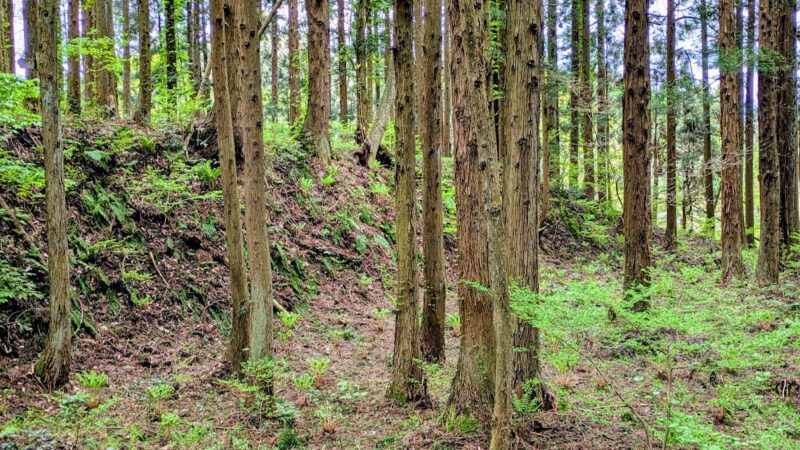
Earthen ramparts are an important defensive feature of Oguni Castle. Earthen ramparts are earthen walls built by piling up soil, which prevented enemy intrusion and also served as shields during attacks from within the castle. Traces of these ramparts can still be seen around each enclosure today.
Furthermore, it is believed that trenches were also constructed to divide the ridge. These trenches were defensive structures designed to prevent enemies from advancing along the ridge, and were highly effective in mountain castles.
Characteristics of the Castle Layout
The layout (design and arrangement of the castle) of Oguni Castle makes maximum use of the terrain, with a relative elevation of approximately 70 meters. The difference in elevation from the foot of the mountain to the main enclosure was a major obstacle for attackers and a favorable condition for defenders.
The western side of the castle has a steep slope, functioning as a natural stronghold. On the other hand, the eastern side has a relatively gentle ridge, and it is presumed that particularly strong defensive structures were positioned on this side.
Access
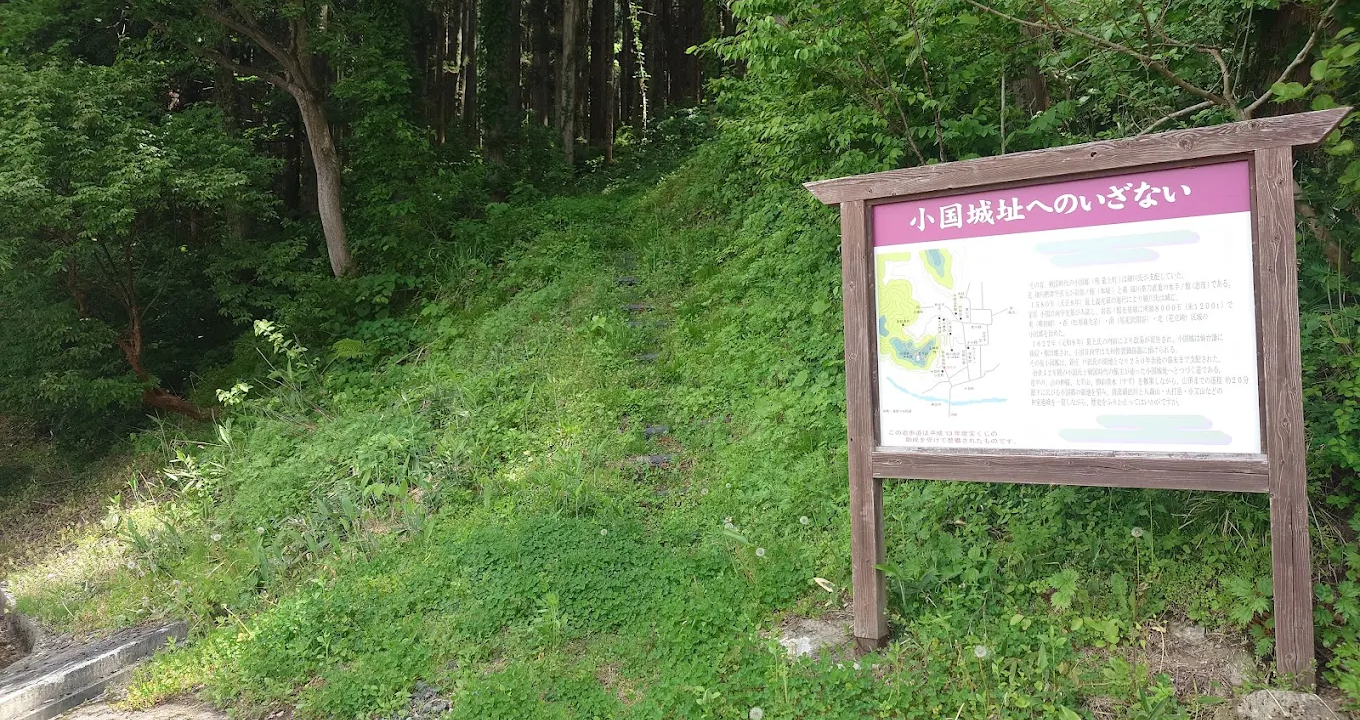
Access to the Oguni Castle ruins is as follows:
Public Transportation
- Approximately 20 minutes on foot from JR Rikuu East Line “Mogami Station”
- After getting off at Mogami Station, proceed towards the center of Mogami Town.
- Follow the signs towards Shiroyama (Castle Mountain).
- The hike from the trailhead to the main keep ruins at the summit takes approximately 15 minutes.
By Car
- Approximately 60 minutes via National Route 13 from Tohoku Chuo Expressway “Higashine IC”
- Approximately 90 minutes via National Route 47 from Yamagata Expressway “Murata JCT”
- There is a parking lot in the center of Mogami Town, from which it is accessible on foot.
Notes for Visitors
Oguni Castle Ruins is a mountain castle, and hiking is required to reach the main keep ruins. Please note the following points.
- Appropriate Attire: Please wear clothing and shoes suitable for mountain climbing.
- Season: During winter (December to March), climbing the castle will be difficult due to snow.
- Time: Allow approximately one hour for the round trip climb.
- Safety: Avoid visiting alone; it is recommended to visit with multiple people whenever possible.
Highlights of Oguni Castle
The Marker and View at the Main Enclosure Site
The biggest highlight of Oguni Castle is the marker standing at the site of the main enclosure and the view of Mogami town from there. From the mountaintop at an altitude of 280 meters, you can enjoy a panoramic view of the central area of Mogami town spreading along the Kinudegawa River, experiencing the scenery seen by the former castle lord.
On a clear day, you can even see the mountains on the border of Uetsu in the distance, giving you a real sense of Oguni Castle’s importance as a border guard point.
Well-Preserved Remains
Although approximately 400 years have passed since the abandonment of Oguni Castle, the remains of the castle, such as the baileys and earthworks, are relatively well-preserved. In particular, the earthworks around the main bailey are clearly visible, making them valuable resources for understanding the structure of mountain castles during the Sengoku period.
For castle enthusiasts and history buffs, the opportunity to actually walk through the remains and consider the defensive system of the time is a major attraction.
Historical Value
Oguni Castle is recognized as “a large-scale medieval mountain castle site representative of Yamagata Prefecture” and is an important historical site for understanding the region’s history. As a site that tells the story of the expansion of the Mogami clan’s power, the tensions along the Uetsu border, and the turning point in history when the Mogami clan was dispossessed, it holds high academic value.
Nearby Historical Sites and Tourist Attractions
Related Historical Sites in Mogami Town
When visiting Oguni Castle, we recommend also visiting other historical sites in Mogami Town.
- Tomizawa Manor Site: The site of the residence of the Hosokawa clan before they moved to Iwabe Manor.
- Oguni Magistrate’s Office Site: The site of the magistrate’s office of the Shinjo Domain, established after the abandonment of Oguni Castle.
- Mogami Town Historical and Folk Museum: Exhibits materials related to the history of Oguni Castle and Mogami Town.
Mogami Town Tourism
Mogami Town is a region rich in nature and offers attractions beyond historical exploration.
- Akakura Onsen: A representative hot spring resort in Mogami Town.
- Maemori Plateau: A plateau resort where you can enjoy outdoor leisure activities.
- Boundary Guard’s House: A thatched-roof farmhouse designated as a National Important Cultural Property.
Historical Background of Oguni Castle and the Mogami Clan
Expansion of the Mogami Clan’s Power
To understand the history of Oguni Castle, it is important to know the process of the Mogami clan’s power expansion. The Mogami clan was a powerful daimyo of Dewa Province, and reached its peak during the time of Mogami Yoshiaki.
Mogami Yoshiaki unified Mogami County with his exceptional political skills and military strength, and further expanded his power into Murayama County and Okitama County. In the Battle of Sekigahara, he sided with the Eastern Army against the Uesugi clan, and after his victory, he also acquired the Shonai region, becoming a powerful daimyo with a domain of 570,000 koku.
The Importance of the Uetsu Border
Oguni-go, where Oguni Castle is located, was a crucial transportation hub connecting the Mogami and Shonai regions. Controlling this area was extremely important for military operations and trade towards Shonai.
The Mutō, Uesugi, and Mogami clans all considered Oguni Castle important due to this geographical location. Controlling the Uetsu border meant holding the key to regional control.
The Impact of the Mogami Clan’s Dispossession
The dispossession of the Mogami clan in 1622 significantly altered the political landscape of Dewa Province. The vast 570,000 koku domain was divided, leading to the establishment of the Shinjo Domain (60,000 koku under the Tozawa clan) and the Yamagata Domain (240,000 koku under the Torii clan), among others.
Oguni-go became part of the Shinjo Domain, and Oguni Castle lost its military value and was abandoned. From then on, this region remained under the control of the Shinjo Domain throughout the Edo period.
Current Status and Challenges of Oguni Castle Research
While the basic history of Oguni Castle is clear, many aspects remain unexplained.
Determining the Construction Date
The exact date of construction of Oguni Castle (Iwabe-kan) is unknown. It is believed to have been built by Hosokawa Naomoto, but further research is needed to determine the exact period.
Details of the Castle’s Scale and Structure
While the existence of baileys and earthworks has been confirmed through on-site surveys, further research is needed to determine a detailed layout of the entire castle and the functions of each facility. Archaeological excavations could reveal a more concrete picture of the castle.
The whereabouts of the Oguni clan
The details of what life Oguni Mitsumoto led after the Mogami clan’s downfall are unknown. Further historical records are needed to uncover his fate after being placed under the care of the Nabeshima clan.
Summary
Oguni Castle is a valuable Sengoku period mountain castle site remaining in Mogami-cho, Mogami-gun, Yamagata Prefecture. Beginning as the Iwabe Manor of the Mogami-Hosokawa clan, it was developed into a full-fledged mountain castle by the Oguni clan, vassals of the Mogami clan, and played an important role as a strategic point on the border between Uetsu and Echigo provinces.
Although it was abandoned in 1622 after the Mogami clan’s downfall, remnants such as baileys and earthworks remain well-preserved on the mountaintop, allowing visitors to imagine its former appearance. From the main keep site at an altitude of approximately 280 meters, one can enjoy a panoramic view of Mogami town, appreciating the castle’s strategic location.
It is accessible in about 20 minutes on foot from Mogami Station on the JR Rikuu East Line, and anyone can visit with the right hiking gear. As a representative medieval mountain castle site in Yamagata Prefecture, it is a historical site well worth visiting for history buffs and castle enthusiasts.
The history of Oguni Castle is a valuable historical legacy that tells the story of the rise and fall of the Mogami clan, the tensions along the border between Uetsu and Echigo provinces, and the transition period from the Sengoku period to the Edo period. By visiting the site, you can experience local history that you cannot learn from textbooks.