Complete Guide to Shimizu Castle (Okura Village) | A Thorough Explanation of its History and Highlights in Mogami District, Yamagata Prefecture
What is Shimizu Castle?
Shimizu Castle (Shimizu-jo) is a Japanese castle (hilltop castle) located in Shimizu, Okura Village, Mogami District, Yamagata Prefecture, and is now a designated historical site of Yamagata Prefecture. Built on a hill overlooking the Mogami River, this castle played an important role for approximately 140 years as the base of the Shimizu clan, who controlled most of the Mogami region during the Sengoku period.
Constructed in 1476 by the first lord, Shimizu Sonjiro Mitsuhisa, Shimizu Castle is located on the northern edge of a plateau between the Mogami River and its tributary, the Fujitazawa River, functioning as a natural stronghold. From the main keep, one can see the majestic flow of the Mogami River below, conveying its strategic importance at the time.
Designated a Yamagata Prefecture Historic Site on December 27, 2011, the castle remains, including dry moats and baileys, are still well-preserved, making it a valuable historical site for learning about the castle structure of the Sengoku period.
History and Background
Construction of Shimizu Castle and the Establishment of the Shimizu Clan
The history of Shimizu Castle begins with Narusawa Mitsuhisa, a member of the Mogami clan and great-grandson of Shiba Kaneyori. In 1474, Mitsuhisa built a residence in Okura-mura Shinden (present-day Shirasuka) to advance into the Mogami region. Two years later, in 1476, he built Shimizu Castle on a hill overlooking the Mogami River and adopted the name Shimizu.
This region was the front line where the three major powers—the Mogami clan, the Muto clan (Daihoji clan), and the Onodera clan—were vying for power, and Shimizu Castle played a crucial role as a strategic base. The first lord, Mitsuhisa, took the name Shimizu Sonjiro, and thereafter, the Shimizu clan developed into a powerful local family in Mogami County.
Development of the Shimizu Clan and Control of the Mogami Region
The Shimizu clan served as castle lords for generations, expanding their influence in the Mogami region. In particular, during the time of the 7th lord, Shimizu Okura-no-Daisuke Yoshichika, the Shimizu clan’s power reached its peak. Yoshichika was born the third son of Mogami Yoshiaki and was adopted into the Shimizu clan, thus maintaining strong ties with the main branch of the Mogami clan.
The place name “Okura-mura” originates from the name of this 7th lord, Shimizu Okura-no-Daisuke Yoshichika. This place name, derived from Yoshichika’s official title “Okura-no-Daisuke,” speaks to the significant influence the Shimizu clan had on this region.
Based at Shimizu Castle, the Shimizu clan controlled the water transport on the Mogami River and dominated the economic and military strongholds of the surrounding area, playing a crucial role in the Mogami region during the Sengoku period. The castle town developed into a political and economic center of the region, with residences for retainers and residential areas for townspeople.
The Downfall of the Mogami Family and the Fall of Shimizu Castle
The fate of Shimizu Castle was closely linked to the actions of the Mogami family. In the Battle of Sekigahara in 1600, Mogami Yoshiaki distinguished himself on the Eastern Army (Tokugawa Ieyasu’s side), and the Mogami family became a powerful daimyo with a domain of 570,000 koku. However, after Yoshiaki’s death, the Mogami family was plagued by internal conflict.
Shimizu Yoshichika prioritized relations with the Toyotomi family, particularly Toyotomi Hideyori, and showed a stance of opposition to Tokugawa Ieyasu. This difference in political stance made the internal conflict within the Mogami family decisive. There were also movements within the Mogami family to secretly collude with the Tokugawa, and the struggle for succession intensified.
In 1622 (Genna 8), the Mogami family was dispossessed of their territory, and Shimizu Yoshichika shared the same fate. After Yoshichika’s death in 1613 (Keicho 18), Shimizu Castle was abandoned, marking the end of approximately 140 years of Shimizu clan rule. In 2013, the 400th anniversary of the castle’s fall, following the death of Yoshichika, the last castle lord of the Mogami family, was commemorated with various events.
Structure and Layout of Shimizu Castle
Location as a Natural Fortress
Shimizu Castle is a natural fortress, consisting of a terrace jutting out from the left bank of the Mogami River and the deep valleys surrounding it. Built on the northern edge of a plateau between the Mogami River and its tributary, the Fujitazawa River, its layout takes advantage of the impregnable terrain, surrounded on three sides by steep cliffs.
Due to its location, Shimizu Castle was ideally situated for monitoring and controlling water transport on the Mogami River, functioning not only as a military base but also as an economically important strategic point. The view of the Mogami River from the main keep ruins was spectacular, and the castle lords of the time must have enjoyed this view as well. Even today, from the main keep ruins, one can see the flow of the Mogami River below, giving a real sense of its natural fortress status.
Layout of the Main Keep and Second Keep
Shimizu Castle is a flatland castle with a multi-bailey layout. The main keep was located at the northern end of the plateau, with the second keep to its south. The main keep measured approximately 65 meters east-west and 83 meters north-south, and was separated from the second keep by an inner moat.
The second keep measured approximately 94 meters east-west and 77 meters north-south, and functioned as an important defensive structure protecting the main keep. While the castle grounds, including both the main keep and second keep, are relatively compact, a robust defensive system was constructed, taking advantage of the steep terrain.
Arrangement of Enclosures and Dry Moats
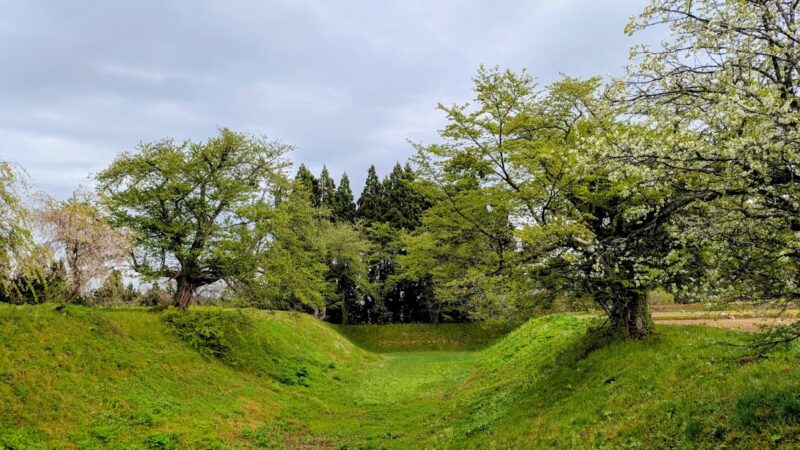
The core of Shimizu Castle’s defensive system lies in its multiple enclosures and dry moats. Deep dry moats surrounded the main keep and second enclosure, and their remains can still be clearly seen today. These moats served to prevent enemy intrusion and also clearly demarcate the various sections within the castle.
The enclosures were arranged in stages, requiring the enemy to break through multiple lines of defense before reaching the main keep. This multi-layered defensive system allowed Shimizu Castle, though small, to function as a fortress boasting high defensive capabilities.
Main Gate and Castle Facilities
The main gate, the Otemon, the castle’s main entrance, was located on the south side of the second enclosure. The remains of the Otemon still exist today, providing clues to the castle’s structure at the time. A dedicated parking lot is located outside the Otemon, allowing visitors to view the castle ruins from here.
It is believed that the castle grounds contained facilities such as the lord’s residence, vassal quarters, and an armory, but no buildings remain today, and we can only infer the layout from the ruins. However, the arrangement of the dry moats and baileys provides a good understanding of the castle’s structure during the Sengoku period.
Ruins and Highlights
Well-Preserved Dry Moats
The greatest highlight of Shimizu Castle is its well-preserved dry moats. Multiple dry moats remain clearly visible, including the inner moat separating the main bailey and the second bailey, and the outer moat surrounding the castle. These dry moats are sufficiently deep and wide, making them valuable remains that allow us to experience the castle’s defensive system during the Sengoku period.
Walking along the bottom of the dry moats, you will be surprised by their depth and steep walls. You will be able to appreciate the high level of castle-building technology and thorough consideration for defense at the time. Furthermore, the shape and arrangement of the dry moats reveal ingenious designs that restricted enemy movement and gave an advantage to attacks from within the castle.
Spectacular View from the Main Keep Ruins
The main keep ruins are the highlight of a visit to Shimizu Castle. Located at the northern edge of the plateau, the main keep ruins offer a magnificent view of the Mogami River flowing below. This view truly deserves to be called a “spectacular view” and continues to captivate visitors.
The Mogami River is one of Japan’s three fastest-flowing rivers, and its powerful current, combined with the surrounding mountains, creates a beautiful landscape. Standing on the main keep ruins, one can understand why this location was chosen for the castle – its natural fortifications. The scenery is beautiful in every season, with the fresh green of spring, the deep green of summer, the autumn foliage, and the snowy landscape of winter offering different expressions with each season.
Burial Grounds of Successive Castle Lords
The Shimizu Castle ruins contain the burial grounds of successive lords of the Shimizu clan, who lived through the Sengoku period. From the first lord, Mitsuhisa, to the last lord, Yoshichika, the gravestones of successive Shimizu clan lords stand side by side, conveying the history of the warlords who ruled this land. The burial grounds are enveloped in a tranquil atmosphere, allowing visitors to reflect on the warriors who survived the turbulent Sengoku period. In particular, the tomb of Shimizu Okura Daisuke Yoshichika, the 7th lord of the castle, is cherished by the local people as the person after whom Okura Village is named.
Castle Site Memorial and Information Board
At the Shimizu Castle site, there is a castle site memorial erected in 1939 when the site was designated a Yamagata Prefecture Historic Site and Place of Scenic Beauty. This monument, inscribed with the then-governor Ishiguro Takeshige’s own handwriting, is a culturally significant artifact of high historical value.
Detailed information boards and signs are installed within the castle site, making it easy for first-time visitors to understand the castle’s history and structure. The information boards contain information on the history of Shimizu Castle, a layout map, and explanations of major remains, serving as an excellent guide for visitors.
Archaeological Materials and Excavation Surveys
Excavated Artifacts
Multiple excavations have been conducted at the Shimizu Castle site, yielding artifacts dating from the Sengoku period to the early Edo period. Pottery fragments, roof tiles, iron artifacts, and coins have been discovered, providing clues to the life and culture within the castle at the time.
Of particular note are the unearthed pottery fragments imported from China and the Korean Peninsula. These are evidence that the Shimizu clan participated in a wide-area trade network via the Mogami River’s water transport system, indicating that it was not merely a local castle but an economically important base.
Preservation Status of the Ruins
Shimizu Castle ruins were designated a Yamagata Prefecture Historic Site on December 27, 2011, and preservation management has been strengthened. Major remains such as dry moats and baileys are well-preserved, making them valuable teaching materials for learning about the structure of castles during the Sengoku period.
The Okura Village Board of Education regularly carries out grass cutting and maintenance, maintaining an environment that is easy to visit. However, some areas are restricted to protect the remains. When visiting, please follow the instructions on the information boards and take care not to damage the remains.
Research Findings and Academic Value
Shimizu Castle Ruins hold a significant position in the study of Sengoku period castles in the Mogami region. As a castle of the Mogami clan and a key transportation and economic hub in the Mogami River basin, it is being studied from multiple perspectives.
Recent research is revealing that the layout of Shimizu Castle was expanded and modified over time. Analysis of the remains suggests a development from an early, small mountain castle to a complex flatland castle with a sophisticated defensive system in the late Sengoku period. These research findings provide valuable data for understanding the history of castle development during the Sengoku period.
Tourist Information and Visitor Guide
Points to Note When visiting Shimizu Castle Ruins, paying attention to the following points will help you appreciate the castle’s charm more deeply.
Observation of the Dry Moat: The inner moat separating the main keep and the second bailey is particularly well-preserved, allowing you to experience the castle-building techniques of the Sengoku period. Pay attention to the height and steepness of the walls when viewed from the bottom of the moat. View from the Main Enclosure: The breathtaking view overlooking the Mogami River is a must-see. You can truly appreciate its strategic location as a natural stronghold, and enjoy the beautiful scenery of each season.
Layout of the Enclosures: Observe how the multiple enclosures were arranged to form a defensive system. You can see the ingenuity of the layered defensive lines.
Lords’ Burial Grounds: Visit the burial grounds of successive Shimizu clan members and reflect on the warriors who survived the Sengoku period.
Best Time to Visit
Shimizu Castle Ruins are open year-round, but there are times that are particularly recommended for visiting.
Spring (April-May): The fresh greenery is beautiful, and the pleasant weather makes it ideal for visiting. The surrounding scenery becomes even more vibrant during cherry blossom season.
Autumn (October-November): The autumn foliage is beautiful, and the view from the main enclosure is especially magnificent. The mountains around the Mogami River change color, offering a spectacular view. Summer (June-August): The greenery is lush, and the entire castle ruins are enveloped in deep green. However, grass grows quickly during this time, so caution is needed when observing the remains.
Winter (December-March): The castle ruins in a snowy landscape are also picturesque, but the ground can be slippery, so adequate equipment and caution are necessary.
Estimated Time and Tour Route
The standard time required for a visit to Shimizu Castle Ruins is approximately 30 minutes to 1 hour. If you want to carefully observe the remains and enjoy taking photographs, it’s best to allow about 1 hour and 30 minutes.
Basic Course (30 minutes): Parking Lot → Otemon Gate Ruins → Ninomaru (Second Bailey) → Honmaru (Main Bailey) → Parking Lot
Enhanced Course (1 hour): Parking Lot → Study the Information Board → Otemon Gate Ruins → Observe the Dry Moat → Ninomaru (Second Bailey) → Inner Moat → Honmaru (Main Bailey) → Enjoy the View → Cemetery → Memorial Monument → Parking Lot
Detailed Course (1 hour 30 minutes): Includes all the information from the Enhanced Course, plus additional time for observing the surrounding baileys and outer moat, and for photography.
Clothing and Items to Bring
The following clothing and items are recommended for visiting Shimizu Castle Ruins:
Clothing: Comfortable walking shoes (sneakers or hiking boots), and easy-to-move clothing. A hat and insect repellent are necessary in summer, and warm clothing in winter.
Items to Bring: Drinks, camera, binoculars (for enjoying the view), rain gear (weather can change quickly).
Notes: There are no toilets or shops within the castle ruins. Please prepare in advance before visiting.
Access
Access by Public Transportation
Using JR
The nearest station is Shinjo Station on the JR Ou Main Line, Rikuu East Line, and Rikuu West Line. The distance from Shinjo Station to Shimizu Castle Ruins is approximately 15 kilometers.
- By taxi from Shinjo Station: Approximately 20 minutes, fare approximately 3,500 to 4,000 yen
- By bus from Shinjo Station: Since the number of bus routes is limited, it is necessary to check the timetable in advance.
From Tokyo: Approximately 2 hours 30 minutes to Yamagata Station by Yamagata Shinkansen, then approximately 1 hour to Shinjo Station by Ou Main Line from Yamagata Station.
From Sendai: Approximately 2 hours 30 minutes to Shinjo Station via Yamagata Station by Ou Main Line from Sendai Station.
Access by Car
Access by car is the most convenient. A dedicated parking lot is available at Shimizu Castle Ruins.
From Yamagata
- Head north on National Route 13, passing through Shinjo city center.
- Head south on National Route 458 from Shinjo city center.
- After crossing the Mogami River, turn onto the prefectural road and follow the signs.
- Estimated time: Approximately 1 hour 30 minutes from Yamagata city center.
From Shinjo city center
- Head south on National Route 458 towards the Okura Village Office.
- After crossing the Mogami River, you will see a sign for Shimizu Castle on the prefectural road.
- Estimated time: Approximately 20 minutes from Shinjo Station.
Using the Expressway
- Approximately 1 hour from Higashine IC on the Tohoku Chuo Expressway via National Route 13.
- Approximately 1 hour 20 minutes from Yamagata Kita IC on the Yamagata Expressway via National Route 13.
Car Navigation Settings
When searching with your car navigation system, please enter the following information.
- Facility Name: “Shimizu Castle Ruins” or “Shimizu Castle Site”
- Address: Shimizu, Okura Village, Mogami District, Yamagata Prefecture
- Phone Number: Okura Village Tourism Association (0233-75-2323)
Parking Information
Shimizu Castle Ruins has a dedicated parking lot outside the main entrance.
- Parking Capacity: Approximately 10 regular cars
- Fee: Free
- Usage Time: No restrictions (however, nighttime visits are not recommended)
- Large Buses: Advance notice is recommended
The entrance to the castle ruins is a short walk from the parking lot, and there are signs and markers, so you won’t get lost.
Nearby Tourist Attractions
Hijiori Onsen
Hijiori Onsen, located about 20 minutes by car from Shimizu Castle Ruins, is a famous hot spring with a history of over 1200 years. It’s a quiet hot spring town nestled in the mountains, retaining the atmosphere of a traditional therapeutic bathing resort. Visiting it in conjunction with a visit to Shimizu Castle is highly recommended.
Mogami River Boat Trip
A boat trip down the Mogami River is a popular activity where you actually travel down the river, the same river you see from Shimizu Castle. Enjoy the magnificent nature and clear waters while listening to the boatman’s commentary. You’ll truly understand why Shimizu Castle was built at such a strategic point on the Mogami River from the river’s surface.
Local Cuisine of Okura Village
In Okura Village, you can enjoy local cuisine made with local ingredients. The mountain vegetable and river fish dishes are especially exquisite and highly recommended for a meal after visiting Shimizu Castle. The local soba noodles are also highly regarded and popular with many tourists.
Shikamura Rice Terraces
The Shikamura rice terraces, selected as one of Japan’s Top 100 Rice Terraces, are a representative spot of Okura Village’s beautiful rural landscape. Located about 15 minutes by car from the Shimizu Castle ruins, the scenery is particularly stunning during the rice planting season and in autumn when the rice stalks are ripe.
History and Culture of Okura Village
Origin of the Village Name
As mentioned above, the name of Okura Village originates from the name of the 7th lord of the castle, Shimizu Okura-no-Daisuke Yoshichika. This name, derived from Yoshichika’s official title “Okura-no-Daisuke,” reflects the significant influence the Shimizu clan had on this region.
Although the village was established during the Meiji era when the town and village system was implemented, the selection of its name, incorporating the name of Shimizu Yoshichika, who ruled this area during the Sengoku period, demonstrates the local people’s respect for history and tradition.
Local Cultural Assets
Besides the Shimizu Castle ruins, Okura Village boasts numerous cultural assets and historical sites. Medieval mountain castle ruins, old shrines and temples, and traditional houses are scattered throughout the area, conveying a deep sense of history.
In particular, temples and shrines associated with the Shimizu clan preserve cultural assets from that period, providing clues to understanding the beliefs and culture of the Sengoku period. The village’s local history museum displays materials related to Shimizu Castle and the Shimizu clan, allowing visitors to learn more about the history.
Traditional Events and Festivals
In Okura Village, traditional events and festivals passed down through generations are still preserved. Some of these events date back to the time of the Shimizu clan and form the core of the region’s identity.
In particular, the autumn harvest festival and the spring harvest prayer festival strongly reflect the region’s history and culture, leaving a deep impression on visitors.
Research and Preservation Activities for Shimizu Castle
Current State of Academic Research
Academic research on the Shimizu Castle ruins is continuously being conducted by researchers from within and outside Yamagata Prefecture. Multifaceted research is being conducted from the perspectives of castle archaeology, medieval history, and local history, accumulating new discoveries and insights.
In recent years, in particular, detailed research has been conducted on the position of Shimizu Castle within the castle network of the Mogami River basin and the relationship between the Shimizu clan and surrounding forces. These research findings have been presented at academic conferences and published in papers, enhancing the historical value of Shimizu Castle.
Preservation and Maintenance Plan
A long-term preservation and maintenance plan has been formulated for the Shimizu Castle ruins, which have been designated a Yamagata Prefecture historical site. While prioritizing the protection of the remains, efforts are also being made to improve the safety and convenience of visitors.
The Okura Village Board of Education, among others, regularly carries out grass cutting and tree management, striving to preserve the remains in good condition. Furthermore, the updating of information boards and explanatory signs, and the improvement of visiting paths are being systematically implemented.
Community Preservation Activities
The cooperation of local residents is essential for the preservation of the Shimizu Castle ruins. Local history enthusiasts and cultural property protection groups play a central role in activities such as cleaning and volunteering to guide visitors.
In addition, local elementary and junior high schools conduct local history lessons using the Shimizu Castle ruins as teaching material, aiming to pass on history to the next generation. By allowing children to learn about and take pride in their local history, a foundation for the protection of cultural properties for the future is being built.
The Value of Visiting Shimizu Castle
As a Place for Historical Learning
Shimizu Castle ruins are an excellent learning resource for studying the structure of castles during the Sengoku period (Warring States period). The remains, such as dry moats and baileys, are well-preserved, and by actually walking around and experiencing them, you can gain a deep understanding of the castle-building techniques and defensive philosophies of the time.
You will feel the persuasive power and presence of the real thing, which cannot be obtained from textbooks or documents alone. It is a valuable historical site not only for history enthusiasts but also for students and researchers.
A Fusion of Nature and History
The charm of Shimizu Castle ruins is not limited to its historical value. The breathtaking view overlooking the Mogami River, the beauty of nature in each season, and the tranquil atmosphere create a space where nature and history are beautifully fused.
By visiting the castle ruins, you can relive the scenery seen by the warlords of the Sengoku period and feel the romance of history. Furthermore, a stroll in nature is refreshing for both mind and body, making it an attractive tourist destination.
Understanding Local Culture
Visiting the Shimizu Castle Ruins is an entry point to understanding the history and culture of Okura Village and the Mogami region. By learning about the history of the Shimizu clan, you can learn how this region was formed and developed.
Understanding various historical backgrounds, such as the story of Shimizu Yoshichika, from whom the village is named, the prosperity brought about by water transport on the Mogami River, and the political situation during the Sengoku period, will deepen your understanding of Okura Village.
Summary
Shimizu Castle (Okura Village, Mogami District, Yamagata Prefecture) is a flatland castle built in 1476 (Bunmei 10) that functioned as a strategic point in the Mogami region for approximately 140 years. Built on a natural fortress overlooking the Mogami River, this castle, as the base of the Shimizu clan, played a significant role in the history of the Sengoku period and is now preserved as a Yamagata Prefecture designated historical site.
With its well-preserved dry moats and baileys, and the spectacular view from the main keep site, the Shimizu Castle Ruins offer plenty to see and are recommended not only for history buffs but also for those who want to enjoy nature. Its convenient location, just a 20-minute drive from Shinjo Station, is a major draw. Combining a visit with a trip to the nearby Hijiori Onsen hot springs or a boat ride down the Mogami River will enhance your sightseeing experience.
Why not visit the Shimizu Castle ruins, which still convey the spirit of the Sengoku period, and experience the charm of history and nature interwoven together?