Nagatoro Castle (Higashine City) Complete Guide | History, Remains, and Access Explained in Detail
Nagatoro Castle, nestled quietly in the rural area of Higashine City, Yamagata Prefecture, is a valuable historical site that has witnessed approximately 600 years of history, from the Kamakura period to the Meiji Restoration. Also known as “Karigane-jo” (Wild Goose Castle), this flatland castle played an important role as a retirement castle for the Mogami clan and later as a fortified residence for the Yonezu clan during the Edo period. This article will provide a comprehensive overview of the castle ruins, from its detailed history and highlights of the existing remains to access information for visitors.
Historical Changes of Nagatoro Castle
Construction in the Kamakura Period and the Nishine Clan
The history of Nagatoro Castle dates back to the Kamakura period. It is said to have been built during the Kenchō era (1249-1255) by the Nishine clan, who ruled this area at the time. The Nishine clan, as local lords of the Murayama region of Dewa Province, established this castle as their base of operations in the area.
At the time of its construction, Nagatoro Castle was designed as a highly defensible flatland castle, utilizing the surrounding rivers and wetlands. It was relatively large for a residence of a local samurai during the Kamakura period, reflecting the considerable power of the Nishine clan at the time.
The Muromachi Period and the Mogami Clan
As time progressed, during the Muromachi period, Nagatoro Castle came under the control of the Mogami clan. The Mogami clan expanded their power as a powerful daimyo in Dewa Province, gaining control of the entire Murayama region.
Of particular note is that in 1415 (Oei 22), Mogami Mitsuie, the lord of Yamagata Castle, chose Nagatoro Castle as his retirement home. Mogami Mitsuie, the fourth head of the Mogami clan, had Yamagata Castle as his base, but after relinquishing his family headship, he moved to Nagatoro Castle. The fact that Nagatoro Castle was chosen as the retirement castle of a former lord indicates that its scale and facilities were well-equipped.
During the time of the Mogami clan, the castle was expanded and improved, developing into a large-scale flatland castle with triple moats. It is believed that the exemplary flatland castle structure, with its main keep, second bailey, and third bailey, was completed during this period.
Daikan Jinya (Magistrate’s Office) in the Edo Period
With the arrival of the Edo period, Nagatoro Castle took on a new role. After the Mogami clan was dispossessed in 1622, the Murayama region of Dewa Province became a direct territory of the shogunate and the domains of hereditary daimyo. A magistrate’s office was established in Nagatoro, functioning as a center for administration and tax collection in the surrounding area.
During the time of the magistrate’s office, Nagatoro Castle increasingly took on the character of a local administrative center rather than a military fortress. Nevertheless, structures such as moats and earthworks from the medieval period were maintained, preserving its dignity as a magistrate’s office.
The Era of the Yonezu Clan of Nagatoro Domain
A notable turning point in the history of Nagatoro Castle occurred in 1798 (Kansei 10). In this year, the Yonezu clan, lords of the Kariya Domain in Mikawa Province, were granted a territory of 10,000 koku in Nagatoro, establishing the Nagatoro Domain. The Yonezu clan was a family that served the shogunate as hereditary daimyo, and Nagatoro Castle became the official domain’s headquarters.
Although a small domain, the Yonezu clan’s Nagatoro Domain established a well-organized domain and contributed to the development of the region. The headquarters served as both the lord’s residence and the domain’s administrative center, with the residences of the retainers also located in the surrounding area. The Yonezu clan ruled this area for approximately 70 years until the Meiji Restoration.
The Meiji Restoration and the Preservation of the Castle Ruins
With the Meiji Restoration, the Nagatoro Domain, like other domains, ceased to exist due to the abolition of the feudal domains and the establishment of prefectures. In 1871 (Meiji 4), the Nagatoro Domain was abolished, and the castle ruins were sold off to private individuals.
While many castle ruins were lost due to development, the Nagatoro Castle ruins were preserved in relatively good condition. In particular, the moat of the second bailey remains clearly visible as a water moat, allowing us to imagine its former appearance. Its value as a historical site of the Meiji Restoration has been recognized, and it has been cherished as a historical symbol of the region.
Structure and Layout of Nagatoro Castle
Characteristics as a Flatland Castle
Nagatoro Castle is a typical flatland castle. Unlike mountain castles or hill castles, it was built on flat land, and therefore could not utilize natural elevation differences for defense. Instead, Nagatoro Castle skillfully combined water moats and earthen ramparts to create a strong defensive system.
The advantage of a flatland castle lies in its ease of daily life and political and economic activities. Since Nagatoro Castle was also used as a retirement castle and encampment, its design emphasized livability and convenience. This castle ruin boasts a tranquil landscape that harmonizes with the surrounding rural area.
The Structure of the Triple Moat
The most distinctive feature of Nagatoro Castle is its triple moat system surrounding the main keep, second bailey, and third bailey. These moats, arranged sequentially from the center outwards, served to progressively prevent enemy incursions.
The main keep was the core of the castle, housing the lord’s residence and other important buildings. The inner moat surrounding the main keep is thought to have been the deepest and widest. Although the main keep’s moat has now been filled in and lost, its location can be inferred from the subtle undulations of the terrain.
The second bailey surrounded the main keep, housing the residences of retainers and warehouses. The second bailey’s moat remains well-preserved as a water moat and is the main highlight of the Nagatoro Castle ruins. The rectangular moat measures approximately 250 meters on each side, making it quite large. The water-filled moat is a valuable historical relic that conveys the grandeur of the castle at that time.
The Third Bailey was the outermost part of the castle, serving to further defend the outer areas. While the moat of the Third Bailey is now completely filled in, the current road layout reveals that three layers of roads surround the castle ruins. This indicates the location of the moat in its heyday, giving a real sense of the scale of Nagatoro Castle.
Earthworks and Entrance Gates
Earthworks, along with the moat, were important defensive structures. At Nagatoro Castle, earthworks were built surrounding each bailey. Some of these earthworks still remain today, visible as mounds of earth about 2-3 meters high.
The entrance gates (koguchi) to the castle were also crucial defensive structures. It is presumed that Nagatoro Castle had curved entrance gates to prevent direct incursions. This was a design choice to slow down enemy advances and give the defenders an advantage.
Current Highlights of Nagatoro Castle Ruins
The Moat of the Second Bailey
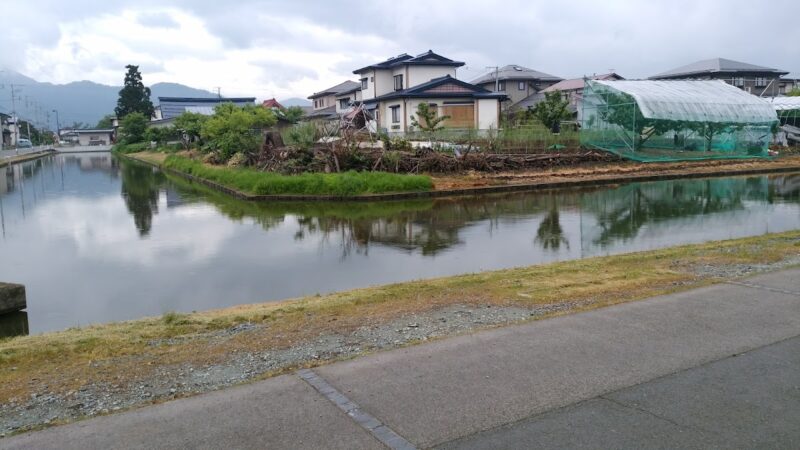
The biggest highlight when visiting Nagatoro Castle Ruins is the existing moat of the second bailey. The square-shaped moat is approximately 10-15 meters wide and 2-3 meters deep, and still holds water.
A walk around the moat is approximately 1 kilometer long. The moat, quietly nestled in the rural landscape, displays different expressions throughout the seasons. Cherry blossoms bloom in spring, the greenery deepens in summer, autumn leaves are reflected on the water’s surface, and a snowy landscape unfolds in winter.
The moat’s water is supplied from groundwater and surrounding agricultural water, maintaining a constant water level. This moat not only serves as a historical site but also functions as a source of agricultural water for the region, playing a practical role even today.
Topography and Layout of the Castle Ruins
Although the Nagatoro Castle ruins are now residential and farmland, careful observation reveals the original layout. Within the second bailey, a slightly elevated area remains where the former main bailey once stood.
The outer perimeter of the third bailey is reflected in the current road layout. Looking at a map, it’s clear that roads surround the castle ruins in a triple concentric pattern. This matches Edo-period maps, indicating that the basic structure of the castle has been preserved to the present day.
Around the castle ruins, there are also remnants of what appear to be former samurai residences. The orderly layout and remnants of hedges that likely surrounded the residences evoke the atmosphere of an Edo-period jinya town.
Information Boards and Explanatory Facilities
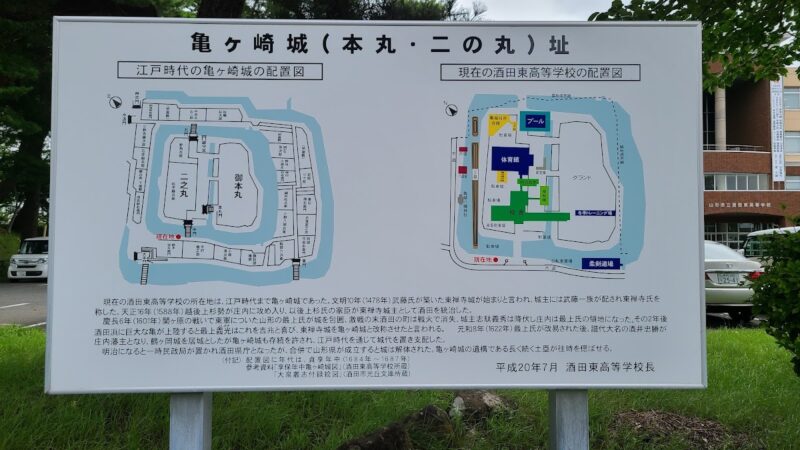
Nagatoro Castle ruins have several information boards and explanatory panels installed by Higashine City. These boards provide detailed information on the castle’s history, structure, and highlights, allowing even first-time visitors to deepen their understanding of the castle ruins.
The main information board is located near the moat of the second bailey, displaying a map of the entire castle site and a historical timeline. The board is visually easy to understand, with numerous photographs and illustrations.
Quiet Environment and Rural Landscape
One of the charms of Nagatoro Castle Ruins is its tranquil environment. Because it hasn’t been commercialized, there are few visitors, allowing for a leisurely exploration of the historical site. Surrounded by rural landscapes, it offers a peaceful setting for contemplating history.
The castle ruins are particularly enchanting in the early morning and at dusk. The moat shrouded in morning mist and the earthworks illuminated by the setting sun reveal different expressions depending on the time of day. It’s an ideal environment for photography, making it a hidden gem for castle enthusiasts and history buffs.
Historical Background of Nagatoro Castle and Higashine City
Position of the Higashine Region in Medieval History
Higashine City, where Nagatoro Castle is located, is situated in the northern part of the Murayama region of Yamagata Prefecture and has flourished as a transportation hub since ancient times. In the medieval period, it was a strategically important area as a junction of water transport on the Mogami River and land transportation routes.
Nagatoro Castle, as one of the powerful castles in the Higashine region, served as a base for regional control. Higashine Castle (in the central part of Higashine City) is also nearby, and it is believed that the two castles cooperated with each other in the defense and governance of the region.
The Mogami Clan’s Territory and Nagatoro Castle
The Mogami clan, as a Sengoku period daimyo of Dewa Province, expanded their power mainly in the Murayama region. During the time of Mogami Yoshiaki, the Mogami clan reached its peak, controlling most of Dewa Province.
Nagatoro Castle functioned as part of the Mogami clan’s network of branch castles. For the Mogami clan, whose base was Yamagata Castle, the Higashine region was a route for expanding northward and also a border area with the Date clan of Yonezawa and the Ando clan of Akita. Nagatoro Castle was an important base demonstrating the Mogami clan’s power in this strategically important location.
The Murayama Region and the Nagatoro Domain in the Edo Period
The Murayama region during the Edo period had a complex territorial layout. It consisted of daimyo territories such as the Yamagata Domain (Torii clan, later Mizuno clan, etc.), the Tendo Domain (Oda clan), and the Shinjo Domain (Tozawa clan), as well as territories directly controlled by the shogunate and territories of hatamoto (direct retainers of the shogun).
The Nagatoro Domain was a small domain with a 10,000 koku (unit of rice production) yield, but as the territory of the Yonezu clan, a hereditary daimyo, it held a certain political status. Despite its small size, it operated as an independent domain, contributing to the local community.
The people of the Nagatoro Domain were primarily engaged in agriculture. Agricultural production, primarily rice cultivation, formed the economic base of the domain, and the domain strived to improve its productivity. Furthermore, Nagatoro was close to Higashine Onsen (hot spring resort), suggesting interaction with the hot spring area.
Access Information and Visitor Guide
Access by Public Transportation
The most convenient way to reach Nagatoro Castle Ruins is via the JR Ou Main Line.
- Nearest Station: JR Ou Main Line “Higashine Station” or “Sakuranbo-Higashine Station”
- From Higashine Station: Approximately 15 minutes on foot (approx. 1.2 km)
- From Sakuranbo-Higashine Station: Approximately 9 minutes by car; taxi is recommended (approx. 4 km)
If walking from Higashine Station, refer to the signs in front of the station and head northeast through the Higashine town area. After passing through residential and rural areas, you will arrive in the Nagatoro district. There are guide signs along the way, so you are unlikely to get lost.
If you plan to use the bus, Higashine City operates a community bus service, but the number of services is limited, so it is recommended to check the timetable in advance.
Access by Car
Access by private car or rental car is the most convenient.
- From Higashine-Kita IC on the Tohoku Chuo Expressway: Approximately 5 minutes (approx. 3 km)
- From Yamagata-Kita IC on the Yamagata Expressway: Approximately 20 minutes (approx. 15 km)
From Higashine-Kita IC, take National Route 287 towards the Nagatoro area. Following the signs will ensure you arrive without getting lost.
Regarding parking, there is no dedicated parking lot for the castle ruins, but you can use nearby public facilities or spaces along the roadside. However, as this is a residential area, consideration should be given to avoiding disturbing nearby residents.
Precautions During Visits
You can freely visit the Nagatoro Castle Ruins, but please note the following:
- Consideration for Private Property: Much of the castle ruins are currently private property. The area around the moat of Ninomaru is a public space, but permission from the owner is required to enter other areas.
- Consideration for Agricultural Work: The surrounding area is farmland, and agricultural work is carried out there. Please be careful not to damage crops or interfere with agricultural work.
- Safety Management: The area around the moat has uneven footing in some places. It is especially slippery during rainy weather and winter, so please be extra careful.
- Take Your Trash Home: There are no trash cans at the castle ruins. Please be sure to take your trash home with you.
- Photography Etiquette: Photography is permitted, but please be considerate of the privacy of local residents and refrain from photographing houses or people without their permission.
Estimated Visiting Time
Please allow the following time as a guideline for visiting Nagatoro Castle Ruins.
- Short Visit: 30 minutes to 1 hour
- In-depth Visit: 1 to 2 hours
- Including a Stroll Through the Surrounding Area: 2 to 3 hours
While a simple walk around the moat of Ninomaru takes about 30 minutes, if you plan to carefully read the information boards, take photos, and observe the surrounding terrain, you should allocate 1 to 2 hours.
Nearby Tourist Attractions
When visiting Nagatoro Castle Ruins, we recommend also visiting nearby tourist attractions.
Higashine Onsen: A hot spring resort located about 10 minutes by car from Nagatoro Castle Ruins. With a history of approximately 900 years since its opening, it boasts many hot spring inns. After visiting the castle ruins, it’s a good idea to relax and unwind in the hot springs.
Higashine City Cherry Blossom Tantokuru Center: An exhibition facility dedicated to cherries, a specialty product of Higashine City. You can learn about the history, cultivation methods, and varieties of cherries. A direct sales store is also attached, where you can purchase fresh cherries during the peak season. Higashine City Museum of Art: A cultural facility in Higashine City, exhibiting works by artists associated with the region. Regular special exhibitions are also held, allowing visitors to enjoy art appreciation.
Odajima Castle Ruins: Another castle ruin located within Higashine City. Visiting this site along with Nagatoro Castle will provide a deeper understanding of the region’s medieval history.
Best Season
Nagatoro Castle Ruins can be visited throughout the year, but each season offers its own unique charm.
Spring (April-May): Cherry blossom season. Cherry trees are planted around the moat, and when in full bloom, the reflection of the blossoms on the water creates a beautiful scene. It’s also the season of fresh greenery, making for a pleasant stroll in the refreshing weather.
Summer (June-August): The greenery is lush, and the moat is full of water. However, temperatures are high, and there are many insects such as mosquitoes, so insect repellent is necessary. Visiting in the early morning or evening is recommended.
Autumn (September-November): This is the season for autumn leaves. The surrounding trees change color, and the reflection of the autumn leaves in the moat is exceptionally beautiful. It’s also the harvest season, the rural landscape is beautiful, and the weather is stable, making it the most suitable time to visit.
Winter (December-March): The castle ruins in a snowy landscape also have their own charm. The moat sometimes freezes over, and the castle ruins enveloped in silence during winter are fantastical. However, the footing becomes poor due to snow and ice, so cold weather gear and safety precautions are necessary.
Value of Nagatoro Castle as a Cultural Property
Evaluation as a Historic Site
Nagatoro Castle Ruins are protected as a designated historical site of Higashine City. With a history spanning approximately 600 years from the Kamakura period to the Meiji Restoration, it is a valuable historical site with remains that reflect the characteristics of each era.
In particular, the existing moat of the second bailey is highly valued as an important remains that conveys the appearance of the Edo period encampment. Nationwide, it is rare to find a fortified residence site with such a well-preserved moat, making it of significant academic value.
Importance in Local History Research
Nagatoro Castle ruins provide important historical materials for studying the medieval and early modern history of Yamagata Prefecture. In particular, it is a valuable source of information for understanding the realities of branch castles within the Mogami clan’s sphere of influence, the structure of fortified residences of small domains during the Edo period, and the changes in the local community of the Murayama region.
Recent archaeological excavations and research on ancient documents are gradually revealing the true nature of Nagatoro Castle. Continued research is expected, and new discoveries are anticipated.
Efforts for Preservation and Utilization
Higashine City is working on the preservation and utilization of Nagatoro Castle ruins. Regular maintenance of the moat, installation of information boards, and environmental improvements such as grass cutting are carried out.
Furthermore, preservation activities are also undertaken by local residents, including cleaning activities around the castle ruins and the holding of historical learning sessions. The aim is for the site to become a beloved historical landmark for the local community, a cherished part of the region’s history.
Going forward, strengthening information dissemination and improving the visitor environment are key challenges in making Nagatoro Castle Ruins known to a wider audience. A balance between preservation and utilization, while also considering its potential as a tourist resource, is required to ensure the site’s historical value is not diminished.
Summary: The Significance of Visiting Nagatoro Castle Ruins
Nagatoro Castle Ruins may not be a flashy tourist destination, but it is a valuable historical site that quietly speaks of history. Approximately 600 years of history, from its construction in the Kamakura period to its retirement as the Mogami clan’s castle, its role as a fortified residence in the Edo period, and through the turbulent times of the Meiji Restoration, is etched into this land.
The existing moat of the second bailey is a valuable relic that conveys the appearance of the castle at that time, and its quiet presence amidst the rural landscape deeply moves visitors. For history buffs, castle enthusiasts, and anyone seeking a peaceful setting to reflect on history, Nagatoro Castle Ruins is an ideal destination.
When visiting Higashine City in Yamagata Prefecture, be sure to stop by Nagatoro Castle Ruins. Combining a visit with a trip to Higashine Onsen (hot springs) allows you to enjoy both historical exploration and relaxing hot springs. Detailed information boards are available, making it an enjoyable historical site even for first-time visitors.
Nagatoro Castle Ruins is a place where you can truly appreciate the depth of Japanese regional history and the value of historical heritage rooted in the community. We hope this article inspires you to visit Nagatoro Castle Ruins.