Tsuru Castle (Toyooka City, Hyogo Prefecture) Complete Guide | History and Access Information for the Castle of the Yamana Four Heavenly Kings, the Taisho Clan
Tsuru Castle, located in Toyooka City, Hyogo Prefecture, is an important mountain castle indispensable to understanding the history of the Tajima region. As the residence of the Taisho clan, who wielded power in the lower reaches of the Maruyama River from the Nanboku-cho period to the Sengoku period, it became the political and military center of the region. This article provides a comprehensive introduction to Tsuru Castle, including its detailed history, highlights of its remains, and access information, making it a fascinating tourist spot.
Basic Information on Tsuru Castle
Tsuru Castle is a medieval mountain castle located in Tsurugajo, Yamamoto, Toyooka City, Hyogo Prefecture. Built on a hill approximately 100 meters above sea level, its relative height is about 80 meters. Due to its location near the mouth of the Maruyama River, it was a strategically important fortress controlling a key point for both water and land transportation in the Tajima region.
Location and Basic Data
- Location: Tsurugajo, Kaminotani, Yamamoto, Toyooka City, Hyogo Prefecture
- Alternate Name: Taisho Castle
- Castle Structure: Mountain Castle
- Construction Period: Eikyo Era (1429-1441)
- Builder: Yamana Sozen (Tradition)
- Main Lord: Taisho Clan
- Year of Abandonment: Tensho Era (1573-1592)
- Remains: Enclosures, earthworks, moats, vertical moats
- Designated Cultural Property: City-designated Historic Site
History of Tsuru Castle
Construction History and the Situation in Tajima during the Eikyo Era
Regarding the construction of Tsuru Castle, tradition remains that it was built during the Eikyo Era (1429-1441) by Yamana Sozen, the governor of Tajima Province. Yamana Sōzen is known as the commander-in-chief of the Western Army during the Ōnin War, and it is believed that he built this castle in Tajima Province to solidify the Yamana clan’s power base there.
During the Eikyō era, Tajima was a time when the Muromachi Shogunate’s system of rule was being established. The Yamana clan held a vast sphere of influence in the San’in region, including Tajima, Inaba, and Hōki, and boasted such great power that they were called the “Lord of Six-tenths.” Tsuru Castle is thought to have functioned as one of the important bases supporting this system of rule.
The Taisho Clan and the Four Heavenly Kings of Yamana
The Taisho clan is the one who made history as the de facto lord of Tsuru Castle. The Taisho clan were influential local figures in Tajima Province and were counted as one of the “Four Heavenly Kings of Yamana.” The Four Heavenly Kings of Yamana refer to four powerful vassals who served the Yamana clan, and the Taisho clan, as the foremost of them, built a powerful force in the lower reaches of the Maruyama River.
Tsuru Castle, the base of the Taisho clan, was not merely a military stronghold, but also the political and economic center of the region. Its location, controlling the Maruyama River’s water transport and easily connecting to ports on the Sea of Japan, enabled the accumulation of economic power through trade.
Developments from the Nanboku-cho Period to the Sengoku Period
During the Nanboku-cho period, the Tajima region was one of the front lines where the forces of the Southern and Northern Courts fiercely clashed. The Taisho clan, along with the Yamana clan, sided with the Northern Court and confronted the forces of the Southern Court. It is presumed that Tsuru Castle strengthened its defensive capabilities during this period under high military tension.
In the mid-Muromachi period, the Onin War (1467-1477) broke out. This conflict, in which the Western Army led by Yamana Sozen and the Eastern Army led by Hosokawa Katsumoto clashed in Kyoto, had a significant impact on the Tajima region. The Taisho clan fought alongside the Yamana clan on the Western Army side, and Tsuru Castle is believed to have played a crucial role as a base for rear support.
Changes and Abandonment of Castles during the Sengoku Period
With the start of the Sengoku period, the Tajima region experienced a turbulent era due to internal conflicts within the Yamana clan and the rise of Oda Nobunaga. During the Tensho era (1573-1592), Hashiba Hideyoshi (later Toyotomi Hideyoshi) launched an invasion of Tajima.
In 1580, Hideyoshi began his campaign to pacify Tajima, conquering the Yamana clan and their retainers one after another. The Taisho clan was also caught up in this conflict, and it is believed that Tsuru Castle was attacked by Hideyoshi’s army. Ultimately, Tsuru Castle was abandoned, and the power of the Taisho clan declined.
After its abandonment, Tsuru Castle was used as farmland and forest throughout the Edo period, and its function as a castle was completely lost. However, the name “Tsuruga Castle” has remained in the region as a place name and in local legends, preserving the history of this area to this day.
Layout and Remains of Tsuruga Castle
Overall Structure of the Castle
Tsuruga Castle has the structure of a typical medieval mountain castle. Multiple baileys are arranged around the main bailey, and the layout is fortified with moats and vertical trenches. Its location, approximately 80 meters above sea level, was a major obstacle for attacking enemies, and it also offered excellent views of the Maruyama River basin from within the castle.
The castle’s size was standard for a medieval local lord’s residence, and it is estimated to have been large enough to accommodate several dozen to one hundred soldiers at any given time. In times of war, it was possible to mobilize local lords and farmers from the surrounding area to form a garrison of several hundred men.
Characteristics of the Main Bailey (Honmaru)
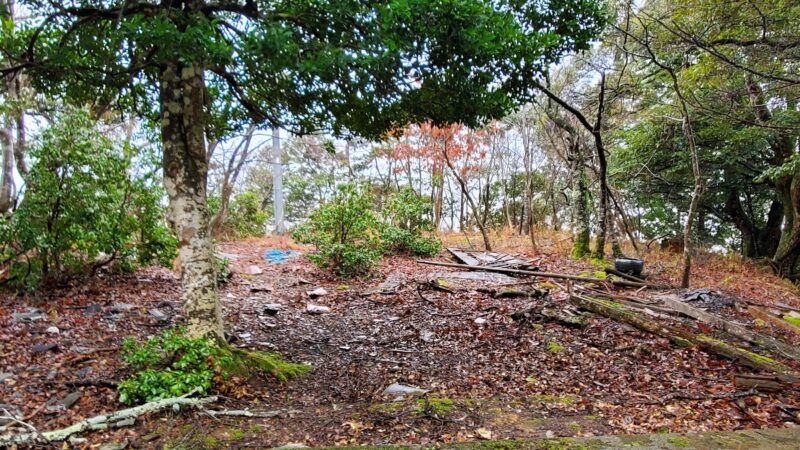
The main bailey is located at the highest point of the castle and is a flat bailey measuring approximately 40 meters east-west and 30 meters north-south. Even today, a clear, flat area remains, suggesting that the lord’s residence and watchtowers once stood here.
Traces of earthworks can be seen around the main enclosure, with particularly well-preserved earthworks about 1-2 meters high remaining on the north and east sides. These earthworks are thought to have protected the castle from enemy arrows and firearms, and also functioned as foundations for buildings.
Second and Third Enclosures
Several enclosures are arranged in a stepped pattern around the main enclosure. The second enclosure, located south of the main enclosure, was an important defensive stronghold second only to the main enclosure, and is presumed to have been used as a soldiers’ quarters and armory.
The third enclosure, located in the northwest of the castle, played a role in preventing intrusion from the rear entrance. These enclosures worked together to form a defensive network, creating a multi-layered defensive system.
Moats and Vertical Ditches
Notable defensive features of Tsuru Castle include multiple moats and vertical ditches. A moat (horikiri) is a dry moat dug across a ridge, serving as an important defensive structure to prevent enemy intrusion. At Tsuru Castle, a large moat is located behind the main enclosure (east side), reaching a depth of approximately 5 meters and a width of approximately 10 meters.
A vertical moat (tatebori) is a moat dug vertically along a slope, serving to prevent enemy soldiers from climbing the slope. At Tsuru Castle, multiple vertical moats have been identified, particularly on the south and north slopes, demonstrating a defensive strategy for the entire slope.
Structure of the Koguchi (Entrance)
The koguchi, the entrance to a castle, is the most important defensive structure. Tsuru Castle’s koguchi is located in the southwest of the main enclosure and is presumed to have had a staggered koguchi structure. A staggered koguchi is a design that makes enemy intrusion difficult by making the entrance bend in a crank-like shape rather than being straight.
Remnants of earthworks and stone walls remain around the koguchi, suggesting a high probability that gates or watchtowers were once located there.
Highlights and Sightseeing Points of Tsuru Castle
Historical Ruins
The greatest attraction of visiting Tsuru Castle is the opportunity to experience the remains of a medieval mountain castle firsthand. Standing on the flat surface of the main enclosure, you can imagine the view the lord of the Taisho clan had as he surveyed the Tajima region from this spot.
The remains, such as earthworks and moats, remain remarkably clear even after more than 500 years, demonstrating the high level of medieval castle-building technology. The large moat behind the main enclosure, in particular, is highly regarded among castle enthusiasts for its scale and excellent state of preservation.
Stunning Views
The view from the main enclosure is one of Tsuru Castle’s greatest attractions. The Maruyama River flows majestically below, offering a panoramic view of Toyooka city. On a clear day, you can even see the Sea of Japan, giving you a real sense of why the Taisho clan chose this location as their base.
While enjoying the scenery, you can understand that this area was once a crucial hub for both water and land transportation, and a strategically important location. It’s also a spot where you can enjoy the changing seasons, with cherry blossoms in spring and autumn leaves in fall.
Nearby Historical Spots
Around Tsuru Castle, there are various historical sites that tell the story of the Tajima region. In Toyooka city, other historical castles such as Izushi Castle and Toyooka Castle remain, allowing you to enjoy a castle tour.
Furthermore, temples and shrines associated with the Taisho clan remain in the Maruyama River basin, and combining them with a historical walking tour will allow you to understand the history of Tajima more deeply.
Access and Visiting Information
Access by Public Transportation
The nearest station to Tsuru Castle is Toyooka Station on the JR San’in Main Line or Kyoto Tango Railway (formerly Kitakinki Tango Railway). It’s approximately a 25-minute walk from Toyooka Station to Tsuru Castle.
Route from Toyooka Station:
- Exit Toyooka Station and head northwest.
- Cross National Route 312 and head towards Maruyama River.
- Enter the Yamamoto area and follow the signs to the castle entrance.
The path from the station is flat, but the trail from the entrance to the castle grounds is mountainous, so comfortable walking shoes are recommended.
Access by Car
If traveling by car, the Toyooka Minami IC or Toyooka Kita IC on the Kita-Kinki Toyooka Expressway are convenient. From the IC, it takes approximately 15-20 minutes via local roads to reach the vicinity of the castle entrance.
Route from Toyooka Minami IC:
- Exit Toyooka Minami IC and head north on National Route 312.
- Pass through Toyooka city center to the Yamamoto area.
- Follow the signs to the castle entrance.
There are a few parking spaces near the castle entrance, but they are limited, so caution is advised during busy times.
Important Notes for Visitors
Tsuru Castle is not a well-maintained tourist facility, but a mountain castle preserved as a historical site. Please note the following points when visiting:
- Attire: Comfortable clothing and walking shoes are essential as you will be walking on mountain paths. Trekking shoes are especially recommended after rain, as the paths can become slippery.
- Estimated Time: Allow approximately 20-30 minutes from the entrance to the main enclosure, 30 minutes to 1 hour for sightseeing inside the castle, and about 20 minutes for descending, for a total of 1 hour 30 minutes to 2 hours.
- Season: In summer, vegetation can be overgrown, making it difficult to see the remains. Insect repellent is also necessary due to the abundance of insects. Visiting from autumn to spring is recommended.
- Safety Precautions: Avoid visiting alone; it is recommended to visit with multiple people if possible. Check cell phone reception beforehand.
- Manners: To protect the historical site, please be careful not to damage the remains or litter.
Best Time to Visit
The best time to visit Tsuru Castle is from autumn to spring. Especially from November to March, the vegetation has withered, making the ruins easier to see, and the temperature is suitable for hiking.
Spring (late March to April) is a beautiful time with cherry blossoms in bloom. Autumn (October to November) offers stunning autumn foliage, and the scenery along the Maruyama River basin is magnificent.
The History of the Tajima Region and the Role of Tsuru Castle
Historical Importance of Tajima Province
From ancient times, Tajima Province held an important position as a transportation hub connecting the San’in and Sanyo regions, and even Kyoto. Facing the Sea of Japan, this region, blessed with abundant marine resources and agricultural products, was one of the important provinces under the Ritsuryo system in ancient times.
In the Middle Ages, Tajima developed as the base of the Yamana clan. The Yamana clan became a powerful force during the Muromachi period, controlling 11 of the 66 provinces of Japan, and was known as the “Lord of One-Sixth.” Tajima was the core of this power base, a crucial region supporting the Yamana clan’s influence.
Strategic Value of the Maruyama River Basin
The Maruyama River basin, where Tsuru Castle is located, was a particularly strategically important area within the Tajima region. The Maruyama River is a major river flowing from the inland areas of Tajima to the Sea of Japan, and has long functioned as a vital artery for water transport.
Controlling this water transport directly led to the transportation of goods, military mobility, and economic power. The Taisho clan established their power base in the lower Maruyama River basin, with Tsuru Castle as their base, precisely to maximize this strategic value.
Relationship Between the Yamana Clan and Local Lords
Understanding the history of Tsuru Castle is crucial to understanding the relationship between the Yamana clan, a shugo daimyo (provincial governor), and the Taisho clan, a local lord. In the medieval system of government, shugo daimyo (provincial governors) did not directly govern their vast territories, but rather indirectly through local lords.
The Taisho clan, as powerful vassals of the Yamana clan, were counted among the “Four Heavenly Kings of the Yamana” and were entrusted with governing the Maruyama River basin. While this relationship was one of master and vassal, the Taisho clan possessed considerable autonomy, maintaining its own military and economic power.
Tsuru Castle is a fortress that symbolizes this medieval power structure, a historical heritage site that tells the story of the complex relationship between shugo daimyo and local lords.
Recommended nearby spots when visiting Tsuru Castle
Tourist spots in Toyooka City
When visiting Tsuru Castle, combining your visit with a tour of other tourist spots in Toyooka City will make your trip even more fulfilling.
Izushi Castle Town: Izushi Town in Toyooka City retains a strong atmosphere of an Edo-period castle town. There are plenty of sights to see, including the Izushi Castle ruins, famous Izushi soba restaurants, and old townscapes. It’s about a 30-minute drive from Tsuru Castle.
Kinosaki Onsen: One of Japan’s leading hot spring resorts, where you can enjoy visiting various public baths. This charming hot spring town, frequently featured in literary works, is perfect for relaxing after visiting Tsuru Castle. It’s about a 20-minute drive from Tsuru Castle.
Stork Park: A facility dedicated to the protection and breeding of storks, a national special natural monument. A valuable spot to learn about coexisting with nature, it’s about a 15-minute drive from Tsuru Castle.
Other Castles in the Tajima Region
For castle enthusiasts, we recommend visiting other castle ruins in the Tajima region.
Izushi Castle: The residence of the Izushi Domain, with remaining stone walls and turrets. As a castle from the early modern period, it has a different structure from Tsuru Castle, and comparing them allows you to understand the evolution of castles.
Takeda Castle Ruins: Famous as the “Castle in the Sky,” Takeda Castle Ruins is a representative mountain castle of the Tajima region. Larger in scale than Tsuru Castle, its stone walls are remarkably well-preserved. Located in Asago City, it’s about an hour’s drive from Tsuru Castle.
Yagi Castle Ruins: A mountain castle located in Yabu City, associated with the Yamana clan. It has historical connections to Tsuru Castle, having been active around the same time.
Gourmet Food and Souvenirs
The Tajima region is also known for its rich food culture.
Tajima Beef: One of Japan’s leading high-grade wagyu beef brands, with numerous restaurants in Toyooka City serving it.
Izushi Soba: A specialty of Izushi town, served in a unique style on small plates. Some restaurants offer soba-making experiences.
Matsuba Crab: Available only during the winter season (November to March), Matsuba crabs caught in the Sea of Japan are exquisite. They can be enjoyed at restaurants and inns in Toyooka City.
Recommended souvenirs include processed Tajima beef products, local sake, and Izushi pottery.
Preservation and Future Prospects of Tsuru Castle
Preservation Activities as a Historic Site
Tsuru Castle is protected as a designated historical site by Toyooka City, and preservation activities are ongoing by local history enthusiasts and castle researchers. Regular mowing and maintenance of the remains are carried out, and efforts are being made to pass on this valuable historical heritage to future generations.
In recent years, with the rise of the castle boom, the number of visitors to Tsuru Castle has also been increasing. However, excessive tourism development could lead to the destruction of the remains, making the balance between preservation and utilization a challenge.
Progress of Archaeological Excavations and Research
Many parts of Tsuru Castle have not yet undergone full-scale archaeological excavations, and there is a possibility of new discoveries through future investigations. Further research is expected, particularly regarding the detailed structure of the main enclosure and baileys, the layout of buildings, and excavated artifacts.
With the recent advancements in castle research, the value of medieval mountain castles is being re-evaluated. Tsuru Castle, as an important site for understanding the history of the Tajima region, may attract even more attention in the future.
Utilization for Regional Development
Tsuru Castle, a valuable historical resource of Toyooka City, is being utilized for regional development. As part of historical tourism, castle tours and history lectures are being planned, contributing to the promotion of the region’s attractions.
Future plans include exploring new forms of utilization, such as virtual restoration using digital technology and historical experiences using AR (augmented reality). These efforts are expected to convey the historical value of Tsuru Castle to a wider audience.
Summary
Tsuru Castle in Toyooka City, Hyogo Prefecture, is a mountain castle that played a crucial role in the history of the Tajima region as the residence of the Taisho clan, one of the four great generals of the Yamana clan. Having survived the turbulent times from the Nanboku-cho period to the Sengoku period, its remains still speak to us of medieval history.
The remains, including the main enclosure, baileys, moats, and vertical trenches, are well-preserved, allowing visitors to learn about the typical structure of a medieval mountain castle. Furthermore, the view from the main enclosure is magnificent, offering a panoramic view of the Maruyama River basin that is well worth a visit.
Located within walking distance of Toyooka Station, yet nestled in a tranquil mountain setting, Tsuru Castle is a hidden gem for history and castle enthusiasts. When visiting the Tajima region, be sure to stop by Tsuru Castle and experience the view that the Taisho clan once saw.
Nearby, there are plenty of other attractive tourist spots, such as Kinosaki Onsen and the castle town of Izushi. A journey exploring the history and culture of the Tajima region, starting from Tsuru Castle, is sure to create unforgettable memories.
Experience history, enjoy the scenery, and immerse yourself in Tajima’s rich culinary culture. Tsuru Castle awaits you as the starting point for such a fulfilling journey.