Complete Guide to Hadakasu Castle (Hyogo Prefecture): Highlights of the Retired Castle in Tanba: Triple Moats and Stone Walls
About Hadakasu Castle
Hadakasu Castle is a Sengoku period mountain castle located in Hadakasu, Tanba-Sasayama City, Hyogo Prefecture. The place name “Hadakasu” is pronounced “Hadakasu,” and is known as one of the most difficult place names to pronounce among the mountain castles of the Tanba region. Built on a mountaintop approximately 326 meters above sea level, the castle’s main enclosure was situated about 60 meters above ground level and played an important role as a subsidiary castle of Momii Castle.
Even today, the remains of earthworks, moats, stone walls, and baileys are well-preserved, making it a valuable historical site that conveys the castle-building techniques of the Tanba region during the Sengoku period. In particular, the defensive structure known as the triple moat is the castle’s greatest highlight and attracts the attention of castle enthusiasts.
History of Yasuguchi Castle
Construction History and the Momii Clan
There are various theories regarding the construction period of Yasuguchi Castle, but the most widely accepted theory is that it was built around the 16th century, during the Genki era (1570-1573), by Momii Tsunashige, the lord of Momii Castle. Some traditions attribute its construction to Shirai Ukon, but historical evidence for this is limited.
Momoi Tsunashige married the sister of Hatano Hideharu, the lord of Yagami Castle, and was known as a powerful local lord in the Tanba region. It is believed that upon retirement, Tsunashige moved from his base at Momii Castle to Yasuguchi Castle, taking his second son, Momii Masatsuna, with him. This characteristic as a retirement castle is one of the important features in Yasuguchi Castle’s history.
Akechi Mitsuhide’s Conquest of Tanba and the Fall of the Castle
In October 1577 (Tensho 5), Akechi Mitsuhide, acting on orders from Oda Nobunaga, led a large army to invade Tanba Province. During this conquest of Tanba, Anguchi Castle, along with its main castle, Momii Castle, became a target of Mitsuhide’s forces.
Akechi Mitsuhide’s conquest of Tanba was a crucial part of Oda Nobunaga’s strategy for unifying Japan, and the local lords of Tanba offered fierce resistance. However, faced with the overwhelming military strength and tactics of the Oda army, Anguchi Castle, along with Momii Castle, met its fate and fell.
With this fall, the power of the Momii clan declined, and Anguchi Castle ceased to play a vital role. After its fall, the castle was abandoned and disappeared from the historical stage.
The Situation in Tanba during the Sengoku Period
During the Sengoku period, when Anguchi Castle existed, the Tanba region was under a complex political situation with various local lords, primarily the Hatano clan, vying for power. The Hatano clan, based at Yagami Castle, reigned as the most powerful force in Tanba, and a network of numerous branch castles, including those of the Momii clan, formed around them.
Anguchi Castle, as a branch castle of Momii Castle, played a vital role in this network. Located along an old highway, it is believed to have also served to control a strategic transportation hub.
Structure and Layout of Anguchi Castle
Main Enclosure and Bailey Arrangement
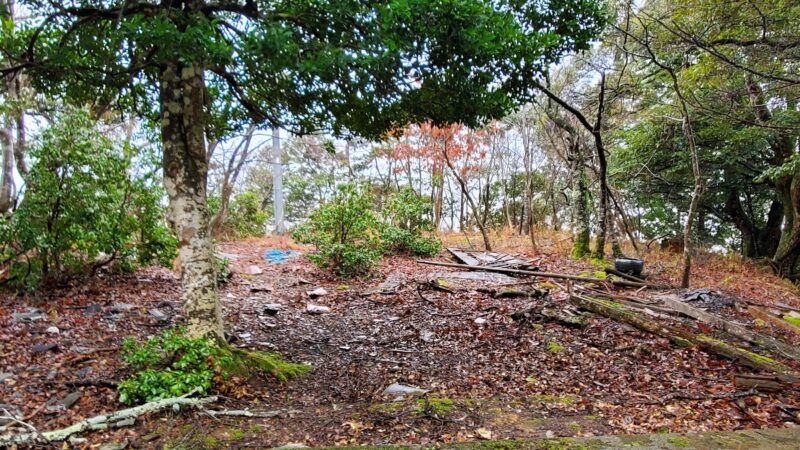
The main enclosure of Anguchi Castle is located on the mountaintop, with multiple baileys arranged along the ridge in a series of interconnected enclosures. The main enclosure has a relatively large, flat area, indicating that its design also considered its function as a living space.
Earthworks surround the main enclosure, enhancing its defensive capabilities. Furthermore, elevation changes were incorporated between the baileys, demonstrating ingenuity in making enemy intrusion difficult. This layout exhibits typical characteristics of mountain castles in the Tanba region during the late 16th century, making it a valuable resource for understanding the level of castle construction technology at the time.
Structure of the Triple Moat
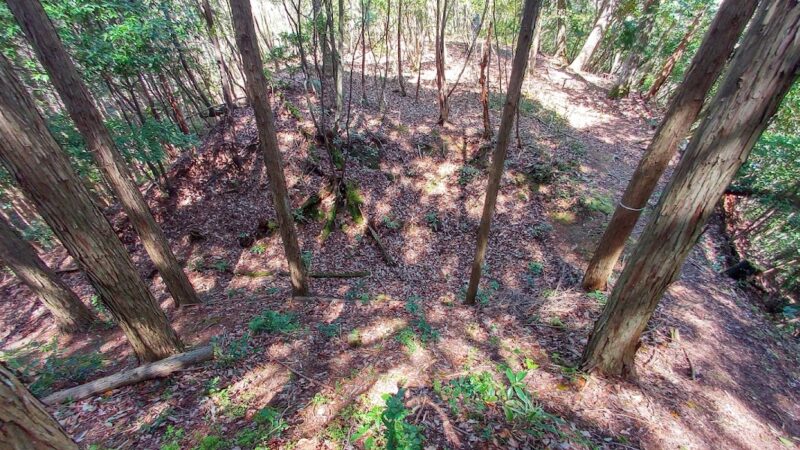
The greatest highlight of Anguchi Castle is the triple moat located behind the main bailey. A moat is a defensive structure created by vertically cutting through a ridge, playing a crucial role in preventing enemy intrusion. At Anguchi Castle, these moats are arranged in a triple-layered configuration, forming an extremely strong defensive line.
Each moat reaches a depth of several meters, a remarkable level of detail for a small mountain castle. The central moat, in particular, is the deepest, demonstrating the high level of castle construction technology of the time. Earthen ramparts also remain between the triple moats, indicating the construction of a multi-layered defensive system combining moats and ramparts.
Stone Masonry and Stone Walls
Remains of stone masonry and stone walls from that period still exist at Anguchi Castle. These were built using a technique called “nozurazumi,” a simple construction utilizing natural stones.
The stone masonry is mainly found on the edges of the baileys and around the entrances (koguchi), serving to reinforce the earthworks. Rather than being complete stone walls, it’s a structure where stones were piled on top of the earthworks to increase strength, making it a valuable example of the developmental stage of stone wall technology in the Tanba region during the 16th century.
Earthworks and Defensive Structures
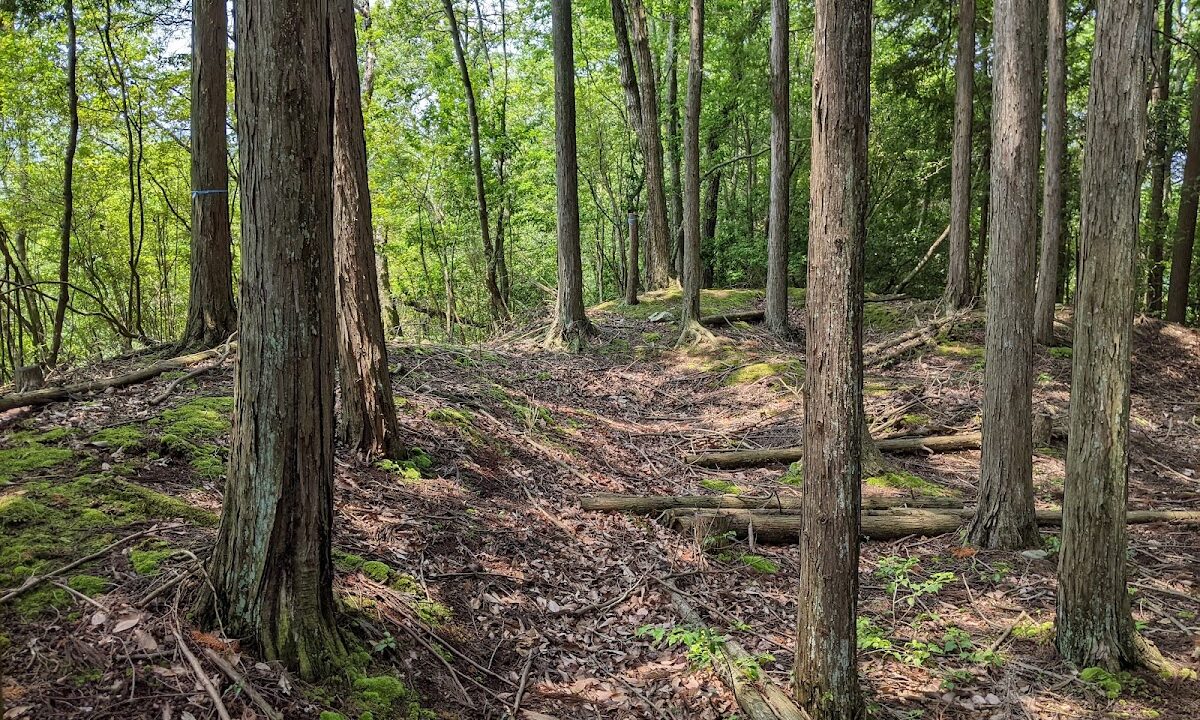
Earthworks surround each bailey at Anguchi Castle. These earthworks are defensive structures built by piling up earth, preventing enemy intrusion and protecting against arrows and gunfire.
The earthworks around the main bailey are particularly high, indicating their importance as a defensive stronghold. Furthermore, outer baileys are positioned outside the earthworks, confirming the construction of a multi-layered defensive system.
Highlights and Remains of Yasuguchi Castle
Condition of Existing Remains
Even more than 400 years after its fall, Yasuguchi Castle retains many remains in excellent condition. The flat surfaces of the baileys, including the main enclosure, are clearly visible, and the earthworks and moats retain much of their original form.
The triple moat, in particular, is remarkably well-preserved, allowing visitors to witness its scale and structure firsthand. Furthermore, the stonework shows minimal collapse, making it possible to observe the construction techniques of the time up close. These remains are extremely valuable resources for understanding mountain castles of the Sengoku period.
Points of Interest to Castle Enthusiasts
The reason Yasuguchi Castle attracts attention among castle enthusiasts lies in its extensive remains. Despite its small size, it possesses a large-scale defensive structure—a triple moat—and its stonework and earthworks are clearly preserved, making it an ideal castle site for learning about the structure of mountain castles.
Furthermore, its historical background as a subsidiary castle of Momii Castle, and its involvement in the crucial Sengoku period event of Akechi Mitsuhide’s conquest of Tanba, are elements that attract the interest of history enthusiasts.
Related Castles in the Surrounding Area
Several castles, including Momii Castle, exist in the vicinity of Yasuguchi Castle. Momii Castle, the main castle, is located close to Yasuguchi Castle, and visiting both castles together allows for a deeper understanding of the subsidiary castle network.
In addition, other subsidiary castles such as Higashi-Momii Castle and Araki Castle are scattered throughout the area. Positioning Yasuguchi Castle within this group of castles reveals aspects of regional control in Tanba during the Sengoku period. Visiting Yasuguchi Castle along with other major castles in the Tanba region, such as Yagami Castle and Sasayama Castle, will provide a more comprehensive understanding.
Access and Visiting Information for Yasuguchi Castle
Location and Transportation
Yasuguchi Castle is located in Yasuguchi, Tonooku, Tanba-Sasayama City, Hyogo Prefecture. Public transportation access is limited, so visiting by private car is recommended.
It is approximately a 15-20 minute drive from Sasayama city center, the nearest major city. Access to the vicinity of the castle ruins is possible by following the old highway from the national or prefectural roads.
Precautions for Visiting the Castle
As Anguchi Castle is a mountain castle, a certain level of physical fitness and equipment is required for the climb. Since some parts of the hiking trail are not well-maintained, wearing appropriate footwear such as trekking shoes is recommended.
In summer, vegetation can be overgrown, making it difficult to see the remains. Spring and autumn are generally more suitable seasons for visits, and winter offers clearer views, making it easier to observe the remains. However, the ground can be slippery in winter, so caution is necessary.
Estimated Visiting Time
For a visit to Anguchi Castle, allow approximately 1.5 to 2 hours, including the time spent climbing up and descending. If you wish to carefully observe the remains or take photographs, you may need more time. While a visit focusing on the main enclosure and triple moat can be completed in about an hour, a more thorough exploration is recommended to fully grasp the overall layout.
Nearby Tourist Attractions
Numerous tourist attractions exist around Anguchi Castle in Tamba-Sasayama City. Sasayama Castle Ruins are designated a national historic site, and the large main hall has been restored. Visitors can also enjoy the atmosphere of the castle town.
Furthermore, the Tachikui district, known for its Tamba ware pottery, and shops selling local specialties such as black beans and chestnuts are scattered throughout the area. A visit to Anguchi Castle, combined with these attractions, will allow you to fully enjoy the history and culture of Tamba-Sasayama.
Historical Value of Anguchi Castle
As a Castle of the Tamba Local Lords
Anguchi Castle holds an important position in regional history research as a castle of the local lords of Tamba during the Sengoku period. The remains of Anguchi Castle provide valuable physical evidence for understanding what kind of castle the Momii clan, a small to medium-sized local lord, built and how they governed the region.
The fact that it also served as a retirement castle is interesting and offers valuable insights into the lifestyles of samurai during the Sengoku period and the realities of family succession.
Its Role in Akechi Mitsuhide’s Conquest of Tanba
Anguchi Castle also possesses military historical value as a castle involved in Akechi Mitsuhide’s conquest of Tanba, a crucial military operation in Sengoku history. Mitsuhide’s conquest of Tanba was an important part of Oda Nobunaga’s strategy for unifying Japan, and the history of Anguchi Castle, which fell during this process, serves as an important case study for understanding the relationship between Sengoku daimyo and local lords of the time.
Significance in Mountain Castle Research
From the perspective of castle archaeology, Anguchi Castle is an excellent example of the level of mountain castle construction technology in the Tanba region during the late 16th century. The remains, such as the triple moat and stone walls, concretely demonstrate the technological level and defensive philosophy of the time, making it a valuable sample for mountain castle research.
The fact that it is a relatively small castle yet possesses comprehensive defensive facilities reflects the tense military situation of the Sengoku period.
The Network of Yasuguchi Castle and Momii Castle
Role as a Sub-Castle
Yasuguchi Castle was built as a sub-castle of Momii Castle and formed part of the defensive network within the Momii clan’s territory. Sub-castles served to defend the main castle and also functioned as bases for controlling the territory.
In the case of Yasuguchi Castle, given its location along an old highway, it is presumed to have also played a role in monitoring traffic routes and managing travelers. Furthermore, due to its nature as a retirement castle, it also functioned as a residence for the head of the family after passing on the family headship.
The Momii Clan’s Sphere of Influence
The Momii clan, as a local lord of Tanba Province, controlled the territory by strategically placing multiple sub-castles around Momii Castle. Besides Yasuguchi Castle, other sub-castles such as Higashi-Momii Castle have been identified, and this castle network, including these, maintained the Momii clan’s sphere of influence.
This network of branch castles is a typical form of regional control during the Sengoku period, and Anguchi Castle occupies an important position as a concrete example.
Significance of Visiting Anguchi Castle
Experiencing the Sengoku Period
By visiting Anguchi Castle, you can directly experience the reality of a mountain castle from the Sengoku period. Seeing the scale of the triple moat and the structure of the stone walls will allow you to gain a deeper understanding of the castle-building techniques and defensive philosophies of the time.
The greatest significance of a site visit lies in being able to experience firsthand the topography and the ingenuity of the castle’s layout, which are difficult to convey through books and photographs alone.
Learning about Local History
Visiting Anguchi Castle is also an excellent opportunity to learn about the history of the Tanba-Sasayama region. You can learn about a variety of historical themes, such as the history of local lords like the Momii and Hatano clans, the historical event of Akechi Mitsuhide’s conquest of Tanba, and the transformation of local communities during the transition from the Sengoku period to the early modern period.
Practical Castle Research
For castle enthusiasts and researchers, Anguchi Castle is an ideal site for practical research on mountain castles. Various research activities can be conducted, including observation of remains, creation of layout maps, and comparative studies with other castles.
The triple moat, in particular, is an excellent textbook example, making it a valuable field for learning about the structure and function of moats.
Preservation and Future of Anguchi Castle
Preservation Status of Remains
Currently, the remains of Anguchi Castle are preserved in relatively good condition. This is mainly because the area has been used as forest land, thus avoiding large-scale development. However, natural weathering and tree growth may gradually damage the remains.
As a regional historical heritage site, it has reached a stage where appropriate preservation and management are required.
Expectations for Utilization
Anguchi Castle is a valuable historical asset of Tamba-Sasayama City, and its utilization as a tourist resource is also expected. It is desirable to create an environment where more people can visit safely by installing appropriate signage and improving the access routes.
Furthermore, its use as a venue for local history education and the hosting of events for castle enthusiasts are also potential future possibilities.
Summary
Anguchi Castle (Tamba-Sasayama City, Hyogo Prefecture) is a mountain castle built as a branch castle of the Momii clan in Tanba during the Sengoku period. Momii Tsunashige moved there as his retirement castle, and it played an important role until its fall in 1577 during Akechi Mitsuhide’s conquest of Tanba.
Even today, the remains of the castle, including the triple moat, stone walls, earthworks, and baileys, are well-preserved, making it a valuable historical site that conveys the mountain castle construction techniques of the late 16th century. The triple moat, in particular, is Anguchi Castle’s greatest highlight, and its scale and structure attract the attention of castle enthusiasts.
As a branch castle of Momii Castle and as a castle involved in Akechi Mitsuhide’s conquest of Tanba, Anguchi Castle is indispensable for understanding the history of the Tanba region during the Sengoku period. When visiting Tanba Sasayama, this hidden gem of a castle is definitely worth a visit.
By carefully observing the remains of the mountain castle while feeling the spirit of the Sengoku period, you can reflect on the lives of the people and the history of battles of that time. Anguchi Castle is a fascinating historical site worth visiting for both history buffs and castle enthusiasts.