Ichigoyama Castle (Takasaki City, Gunma Prefecture) Complete Guide | History, Remains, and Access Information
What is Ichigoyama Castle?
Ichigoyama Castle is a medieval mountain castle located in Taihira, Yoshii-cho, Takasaki City, Gunma Prefecture. Built on the summit of Mt. Ushifuseyama, at an altitude of 441 meters (some sources say 491 meters), this castle was an important military facility developed by Uesugi Norizane, the Kanto Kanrei (governor of the Kanto region), as a western defense base for Hirai Castle.
Currently, it is maintained as Ushifuseyama Nature Park, and a replica castle tower stands on the summit. This observation deck is a popular spot offering panoramic views of Takasaki city and the three mountains of Joshu (Mt. Akagi, Mt. Haruna, and Mt. Myogi). Locally, the name “Ichigoyama Castle” is not commonly used; it is known as “Ushifuseyama Nature Park” or simply “Mt. Ushifuseyama.”
History of Ichigoyama Castle
Background of Construction and Uesugi Norizane
Ichigoyama Castle is believed to have been built around 1438 (Eikyo 10). During this period, the conflict between Ashikaga Mochiuji, the Kamakura Shogun, and Uesugi Norizane, the Kanto Kanrei (deputy shogun of the Kanto region), was escalating in the Kanto area. This conflict developed into a large-scale war known as the “Eikyo Rebellion.”
Uesugi Norizane withdrew from Kamakura and established his base at Hirai Castle (Fujioka City) in Kozuke Province (present-day Gunma Prefecture). Necessitated by the need to construct a defense network centered around Hirai Castle, Norizane is believed to have built Ichigoyama Castle and Shinbori Castle as western defenses.
Function as a Beacon Tower
Due to its mountaintop location, Ichigoyama Castle is presumed to have prioritized its function as a beacon tower (smoke signal tower) rather than a practical siege facility. From its mountaintop, over 400 meters above sea level, the castle offered a wide panoramic view of the surrounding area, making it an ideal location for a communication hub to quickly detect enemy movements and transmit information.
The actual castle’s size was likely that of a small fort, and it is believed not to have been structured to house a large army. Its primary role was as an information and communication base, playing a part in the defense network centered around Hirai Castle.
Alternative Theories Regarding the Tahira Clan and Construction Period
On the other hand, there is a theory that the castle was built by the Tahira clan and constructed during the Eiroku era (1558-1569). According to this theory, Ichigoyama Castle was built approximately 120 years after the time of Uesugi Norizane.
The Tahira clan were local lords who controlled the area around Yoshii Town and held power in this region during the late Sengoku period. Due to limited historical sources, a definitive conclusion has not been reached regarding which theory is correct, but the theory that Uesugi Norizane built the castle is generally widely accepted.
Takeda Shingen’s Invasion of Kozuke Province and the Fall of Ichigoyama Castle
Ichigoyama Castle first appears on the historical stage during Takeda Shingen’s invasion of western Kozuke Province in 1563.
Takeda Shingen, based in Kai Province (present-day Yamanashi Prefecture), sought to expand his power into northern Kanto after pacifying Shinano Province (Nagano Prefecture). The Takeda army, beginning its invasion of western Kozuke Province, first targeted Ichigoyama Castle.
A fierce battle ensued between the Takeda army and the Uesugi forces defending the castle, ultimately resulting in the tragic demise of Ichigoyama Castle, which was completely burned down and destroyed. After this battle, the Takeda army also captured Niibori Castle, leading to the collapse of the Uesugi defenses in western Kozuke Province.
With this fall, Ichigoyama Castle disappeared from history. It was never rebuilt and remains a ruined castle to this day.
Structure and Remains of Ichigoyama Castle
Castle Location and Layout
Ichigoyama Castle is a mountain castle built on the summit of Ushifuseyama Mountain. It is estimated to have had a relatively simple structure, unlike the large-scale mountain castles of the Sengoku period that featured extensive baileys, and its layout was small, centered around the summit.
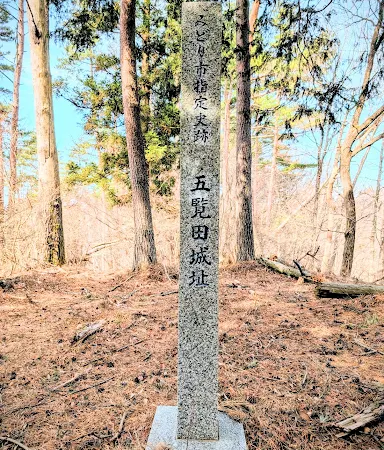
While traces of basic defensive structures for a mountain castle, such as moats and earthworks, can be confirmed, many of the original remains have been altered or lost due to later development and construction work associated with the construction of a replica keep.
Existing Remains
The main remains that can be confirmed today are as follows:
Traces of Earthworks
A small amount of earthworks, believed to be earthworks, remains around the replica keep. However, it is difficult to determine which parts are original remains and which are later additions.
Remnants of Moats
A terrain resembling the remains of a moat can be seen along the hiking trail leading to the summit. However, it is now developed as a road and walking path, and no clear remains are left.
Remains of the Enclosure
The flat area at the summit is thought to be the site of the main enclosure, but it has been significantly altered by the construction of a replica keep and a parking lot.
Preservation Status of the Remains
Castle enthusiasts and history researchers have given harsh evaluations, with many critical opinions such as “the remains were destroyed to build roads and observation decks” and “historical value has been lost.” Indeed, it cannot be denied that much of the remains of the medieval castle were lost due to park development projects from the late Showa era to the early Heisei era.
On the other hand, it has also been utilized as a local tourist resource and has become a place familiar to many people. It can be said to be a case that symbolizes the challenge faced by castle ruins throughout Japan: balancing the preservation of historical heritage with tourism development.
Replica Keep (Ushifuseyama Observation Deck)
Construction History
In December 1989 (Heisei 1), a replica keep was constructed on the summit of Ushifuseyama Mountain as the “Ushifuseyama Observation Deck.” This structure is not based on historical research of Ichigoyama Castle, but rather is a facility that prioritizes its function as an observation deck.
Discrepancy with Historical Research
This replica castle tower has received strong criticism from castle enthusiasts. The main points of criticism are as follows:
- Ignorance of Historical Context: The architectural style of a castle tower did not exist during the medieval period when Ichigoyama Castle existed. Castle towers became common from the late Sengoku period to the early Edo period.
- Inconsistency with Historical Facts: It is impossible that such a large structure existed at Ichigoyama Castle, which was a small fort and signal fire station.
- Destruction of Historical Remains: Historical remains that may have originally remained were destroyed in order to construct the castle tower.
Although officially labeled as an “observation deck” rather than a “castle tower,” its exterior design is clearly modeled after a castle tower.
Value as an Observation Deck
Despite the historical research issues, its function as an observation deck is excellent. The view from the summit is magnificent, offering the following vistas:
- Takasaki City: The city of Takasaki spreads out below.
- The Three Mountains of Joshu: You can enjoy a panoramic view of the three famous mountains of Jomo: Mt. Akagi, Mt. Haruna, and Mt. Myogi.
- Kanto Plain: On clear days, you can see as far as the Kanto Plain.
- Towards Tomioka Silk Mill: You can also see the direction of the Tomioka Silk Mill, a World Heritage Site.
Visitor reviews frequently praise the view, with comments such as “The scenery is spectacular” and “You should bring binoculars,” making it a very popular viewpoint.
Facility Information
- Admission Fee: Free
- Opening Hours: 9:00 AM – 4:00 PM (Gate opening/closing time)
- Parking: Free parking available at the summit
- Facilities: Toilets and rest areas available
Access Information
Access by Car
Most Common Access Method
The most convenient way to access Ichigoyama Castle (Ushifuseyama Nature Park) is by car. A paved road leads to the summit, allowing you to drive up.
Route from Major Roads
- Approximately 15 minutes from the Joshinetsu Expressway “Yoshii IC”
- From National Route 254, take the prefectural road to the summit
- Set your car navigation system to: “Ushifuseyama Nature Park” or “Tahira, Yoshii-cho, Takasaki City, Gunma Prefecture”
Parking Information
A free parking lot is available at the summit. Approximately 20 regular-sized cars can park there.
Important Notes
- The gate is open from 9:00 AM to 4:00 PM. Vehicles are not permitted outside of these hours.
- The mountain road has narrow sections, so please be careful of oncoming traffic.
- The road may be icy in winter.
Access by Public Transportation
By Train
- Get off at Yoshii Station on the Joshin Electric Railway.
- From the station, it’s approximately a 1 hour 30 minute to 2 hour walk to the summit.
By Bus
Unfortunately, there are no direct bus routes to Ushifuseyama Nature Park. Taking a taxi from Yoshii Station is the most practical option.
Hiking
If you hike from the base, the trail is well-maintained. The elevation difference is approximately 300 meters, and the climb takes about 1 hour. It’s a hiking course that can be enjoyed as moderate exercise.
Address and Location Information
- Address: 4457 Taihira, Yoshii-machi, Takasaki City, Gunma Prefecture
- Coordinates: Approximately 36°13′N, 138°59′E
- Elevation: 441 meters (some sources say 491 meters)
Visitor Guide and Highlights
Highlights as a Castle Ruins
Searching for Traces of Earthworks
Careful observation around the reconstructed keep will reveal faint traces of earthworks. Strolling while imagining the castle’s appearance in its heyday is also enjoyable.
Reading the Topography
By observing the mountaintop location and surrounding terrain, you can understand why the castle was built in this location and what kind of defensive functions it had.
View from a Signal Station
From the observation deck, you can see the direction of Hirai Castle and the surrounding mountains. You can get a sense of how information was transmitted when it functioned as a signal station.
Highlights of the Observation Deck
Panoramic View
Enjoy a 360-degree panoramic view. The scenery is especially beautiful at sunset, making it ideal for photography.
Bringing Binoculars is Recommended
As recommended in visitor reviews, bringing binoculars allows you to observe distant mountains and city details, doubling your enjoyment.
Seasonal Scenery
- Spring: Cherry blossoms and fresh greenery
- Summer: The contrast between deep green and blue sky
- Autumn: Autumn leaves and views of the three mountains of Joshu
- Winter: Snow-covered mountains and crisp air
Estimated Time Required
- Visiting the observation deck only: Approximately 20-30 minutes
- Including a stroll around the area: Approximately 1 hour
- Including hiking: 2-3 hours round trip
Notes for Visitors
- Strictly observe opening hours: The gate closes at 4:00 PM. Please allow ample time for your visit to avoid being trapped.
- Clothing: The temperature at the summit is lower than in the lowlands, so we recommend bringing a jacket.
- Insect Repellent: There are many insects in the summer, so it’s a good idea to bring insect repellent spray.
- Drinks: There are no vending machines, so please bring your own drinks.
Nearby Tourist Spots
Hirai Castle Ruins
Hirai Castle, the main castle of Ichigoyama Castle, is located in Fujioka City. It played an important role as the base of the Kanto Kanrei Uesugi clan, and visiting it in connection with Ichigoyama Castle will deepen your understanding.
Niibori Castle Ruins
Niibori Castle, which formed part of the defense network of Hirai Castle along with Ichigoyama Castle, is also nearby. This castle also fell during the invasion of Takeda Shingen.
Tomioka Silk Mill
The Tomioka Silk Mill, a World Heritage Site, is about a 30-minute drive away. You can visit this modernization heritage site from the Meiji era.
Historic Streetscape of Yoshii Town
Yoshii Town retains its old streetscape, making it ideal for historical walks. You can learn about the region’s history at the local history museum.
Evaluation and Challenges of Ichigoyama Castle
Evaluation from Castle Enthusiasts
On castle information websites such as Kojodan, Ichigoyama Castle receives a relatively low rating. The average rating is around ★★☆☆☆ (2.44), with many critical comments such as “the remains are lost” and “the replica keep does not match historical facts.”
Castle enthusiasts describe it as a “storm of criticism,” giving it a harsh evaluation from a historical value perspective.
Evaluation from Local Residents and Tourists
On the other hand, local residents and general tourists appreciate the “wonderful scenery” and “easy-to-access viewpoint.” Many positive evaluations are seen from those who prioritize current usability over historical accuracy.
Future Challenges
The challenges facing Ichigoyama Castle symbolize universal problems faced by castle ruins throughout Japan:
- Balancing the preservation of historical heritage with tourism development
- Providing accurate historical information
- Achieving both regional revitalization and cultural property protection
Currently, tourism development has been prioritized, but future management should prioritize the provision of accurate historical information and the protection of remaining structures.
Summary
Ichigoyama Castle (Takasaki City, Gunma Prefecture) is a medieval mountain castle built by Uesugi Norizane, the Kanto Kanrei (governor of the Kanto region), as a western defensive base for Hirai Castle. It was a small fort that functioned as a signal fire station and was completely destroyed and fell in 1563 during an attack by Takeda Shingen.
Currently, it is maintained as Ushifuseyama Nature Park, and a replica castle tower (observation deck) has been built on the mountaintop. While there are some issues from a historical perspective, it’s an excellent viewpoint, offering stunning views of Takasaki city and the three mountains of Joshu.
Access is good, as you can drive to the summit. Be sure to check the gate opening hours (9:00 AM to 4:00 PM) before visiting.
Although the castle ruins are limited, understanding the historical context will allow you to grasp the role of Ichigoyama Castle in the Sengoku period history of the Kanto region and a part of the conflict between the Uesugi and Takeda clans. Enjoy the view from the observation deck while reflecting on the historical drama that unfolded here.