Nakijin Gusuku (Okinawa Prefecture) Complete Guide | A Thorough Explanation of the History, Highlights, and Visiting Information of this World Heritage Site
Located at the entrance to Yanbaru in northern Okinawa Island, Nakijin Gusuku (Nakijin Castle Ruins) is a magnificent castle ruin that tells the story of the Ryukyu Kingdom’s history. Registered as a component of the UNESCO World Heritage Site “Gusuku Sites and Related Properties of the Ryukyu Kingdom” in 2000, it is a representative historical site of Okinawa, attracting approximately 300,000 visitors annually.
Built on a hill approximately 100 meters above sea level, Nakijin Castle flourished as the residence of the King of Hokuzan during the Sanzan period (14th century), when Ryukyu was divided into three kingdoms. Its stone walls, second only in scale to Shuri Castle, stretch for approximately 1.5 kilometers, and their graceful curves, skillfully utilizing the natural terrain, captivate visitors.
This article comprehensively covers everything you need to know before visiting Nakijin Gusuku, from its historical background to its actual highlights, admission fees, access information, and year-round events. ## What is Nakijin Gusuku? A Ryukyu Castle Registered as a World Heritage Site
The Meaning of Gusuku and the Characteristics of Nakijin Castle
“Gusuku” means “castle” in the Ryukyuan language, but it was not merely a military facility. Gusuku were centers of politics, religion, and daily life, and also possessed the character of a place of prayer. Nakijin Gusuku is also believed to have served as both the residence of the King of Hokuzan and a sacred site.
The most distinctive features of Nakijin Castle ruins are its magnificent scale and beautifully curved stone walls. The entire castle complex covers approximately 37,000 square meters, making it the second largest in Okinawa Prefecture after Shuri Castle. The stone walls were built using a technique called “nozurazumi” (rough stone masonry) with Ryukyu limestone, designed to blend seamlessly with the natural bedrock.
Significance of World Heritage Registration
In December 2000, Nakijin Castle ruins were registered as a World Cultural Heritage site as part of the “Gusuku Sites and Related Properties of the Kingdom of Ryukyu.” This group of heritage sites consists of the following nine assets:
- Nakijin Castle Ruins
- Zakimi Castle Ruins
- Katsuren Castle Ruins
- Nakagusuku Castle Ruins
- Shuri Castle Ruins
- Sonohiyan Utaki Stone Gate
- Tamaudun Mausoleum
- Shikinaen Garden
- Seifa Utaki
These are internationally recognized as valuable heritage sites that demonstrate the political, economic, and cultural development of the Ryukyu Kingdom. Nakijin Castle Ruins, in particular, is positioned as an important historical site that conveys the history of the Three Kingdoms period.
History of Nakijin Gusuku | From the Glory of the Hokuzan King to the Unification of Ryukyu
The Three Kingdoms Period and the Hokuzan Kingdom
Nakijin Castle appeared on the historical stage from the 13th to the 14th centuries. At that time, Ryukyu was in the “Three Kingdoms Period,” divided into three kingdoms: Hokuzan, Chuzan, and Nanzan, vying for supremacy.
Nakijin Castle served as the residence of the Hokuzan King, becoming a base for controlling the northern part of Okinawa Island. The Hokuzan Kingdom prospered economically through trade with China (Ming Dynasty), and its wealth and power are evident from the size of the castle. In particular, for several generations, starting with Haniji, considered the first Hokuzan King, rule was centered around Nakijin Castle.
The Fall of Hokuzan in 1416
The end of the Three Kingdoms period was brought about by the unification of Ryukyu by Sho Hashi of Chuzan. In 1416, Sho Hashi attacked Nakijin Castle and destroyed the last Hokuzan King, Han Anchi. This battle led to the fall of the Hokuzan Kingdom, and Ryukyu moved towards unification.
King Han’anchi was known as a king skilled in martial arts, and Nakijin Castle was considered an impregnable fortress. However, it fell to the skillful strategies of Sho Hashi. This historical event marked a crucial turning point in the formation of the Ryukyu Kingdom.
The Kanshu System during the Ryukyu Kingdom Era
After the fall of Hokuzan, an administrator called a Kanshu (administrator) was dispatched from the Ryukyu Royal Government to Nakijin Castle. The Kanshu acted as the government’s representative, governing the northern region, and this system continued for approximately 250 years until 1665.
During the Kanshu era, Nakijin Castle took on a stronger character as an administrative center rather than a military base, and facilities such as government offices and warehouses were established within the castle. However, with the abolition of the Kanshu system in 1665, Nakijin Castle gradually lost its function and eventually became a ruined castle.
Highlights of Nakijin Castle | Exploring the Castle Grounds
Heiro-mon Gate | The Main Gate to the Castle
A visit to Nakijin Castle ruins begins at the Heiro-mon Gate. This gate is the main entrance to the castle and is characterized by its imposing structure built of Ryukyu limestone. High stone walls rise on both sides of the gate, giving visitors a sense of the castle’s grandeur.
The Heiro-mon Gate was restored in 1962 by the Ryukyu Government, and it preserves its original appearance. Passing through the gate, a stone-paved path leading into the castle grounds appears, giving you the feeling of stepping back in time.
The Beauty of the Old Road and Stone Walls | Landscape Created by Curves
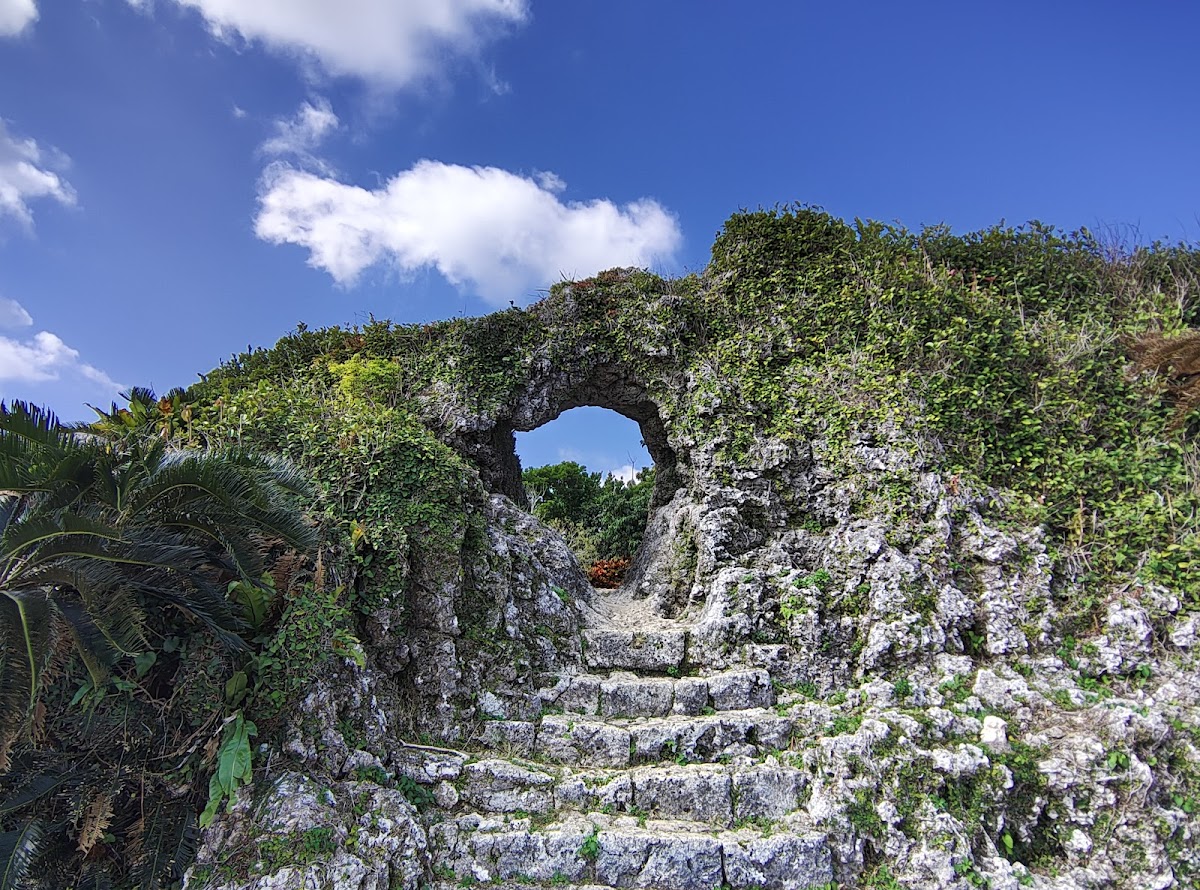
After passing through the Heiro-mon Gate, the old road leading into the castle grounds stretches out before you. This road gently ascends, following the natural terrain, and on both sides, beautiful curved stone walls that characterize Nakijin Castle continue.
The most distinctive feature of Nakijin Castle’s stone walls is that they are not straight lines, but rather form smooth curves. This was due to their construction to conform to the terrain, and also served as a defensive measure. The curved walls made enemy intrusion difficult and also created a visually beautiful landscape.
The height of the stone walls varies depending on the location, but the highest points reach approximately 8 meters. Built using the nozura-zumi technique, where natural stones are stacked as they are, they remain remarkably strong even after more than 600 years.
Ooba (Great Courtyard) | Ceremonial Ground
Climbing the old road leads to a plaza called Ooba. This is the largest space within the castle grounds and is believed to have been the site of ceremonies and political events.
From Ooba, you can enjoy a panoramic view of the East China Sea over the castle walls, and on clear days, you can even see Iheya Island and Izena Island. This scenic viewpoint is a popular spot for many visitors to Nakijin Castle ruins to take photographs.
Main Enclosure (Honmaru) | The Heart of the Hokuzan King
Continuing from the main courtyard, you reach the main enclosure (shukaku), the highest point of the castle. Also known as the “Honmaru,” this is believed to be the site of the Hokuzan King’s residence.
The main enclosure was the most important section of the castle and the political center. While only foundation stones and other remains exist today, it is believed that the king’s residence and government offices once stood here. The view from the main enclosure is magnificent, offering panoramic views of the town below and the surrounding sea.
Shigema Gate Enclosure (Shigemajokaku) | A Sacred Place of Prayer
Located north of Nakijin Castle, the Shigema Gate Enclosure is considered a particularly sacred place within the castle. Here, there is a place of worship called “Tenchijiamachiji,” which is still a place of prayer for locals today.
This is an important area demonstrating that the gusuku (castle) was not merely a military facility, but also a place of prayer. From the Shigeshimamon Enclosure, you can see the cliffs on the north side of the castle and the sea, giving you a real sense of Nakijin Castle’s location as a natural stronghold.
Outer Enclosures and Castle Walls | The Complete Defensive System
Nakijin Castle consists of several outer enclosures (gaikaku) centered around the main enclosure. These enclosures were separated by stone walls, forming a tiered defensive system.
The total length of the castle walls is approximately 1.5 kilometers, making it the second largest after Shuri Castle. The castle walls were skillfully constructed utilizing the varying terrain, making them extremely difficult for attackers to conquer. Walking along the castle walls, you can feel the grandeur and the high level of castle-building technology firsthand.
Nakijin Gusuku Cherry Blossom Festival | A Winter Tradition
Japan’s Earliest Cherry Blossom Spot
Nakijin Castle Ruins are also known as a famous cherry blossom spot. Every year from late January to early February, approximately 660 Taiwanese cherry trees (Prunus campanulata) planted within the castle grounds bloom simultaneously, adorning the stone walls with pink blossoms.
Unlike cherry blossoms on mainland Japan, Okinawan cherry blossoms are characterized by their deep pink color and downward-facing blossoms. The cherry blossoms at Nakijin Castle Ruins are famous as “Japan’s earliest cherry blossom festival,” making it a rare spot to enjoy cherry blossoms in the middle of winter.
The Charm of the Nakijin Castle Cherry Blossom Festival
During the annual Nakijin Castle Cherry Blossom Festival, the castle is illuminated at night. The contrast between the illuminated stone walls and the cherry blossoms is fantastic, allowing visitors to enjoy the castle ruins in a different light than during the day.
The 18th Cherry Blossom Festival in 2025 (Reiwa 7) will be held for nine days, from January 25th (Saturday) to February 2nd (Sunday). The castle is open from 8:00 AM to 9:00 PM (last entry at 8:30 PM), and the castle is illuminated from 6:00 PM to 9:00 PM.
During this period, local specialty products are sold and traditional performing arts are showcased, offering a valuable opportunity to experience the culture of Nakijin Village.
Admission Fees, Opening Hours, and Access Information
Admission Fees
The admission fees for Nakijin Castle Ruins are as follows:
Regular Period
- Adults: 600 yen
- Elementary, Junior High, and High School Students: 450 yen
- Children under elementary school age: Free
Group Discount (20 or more people)
- Adults: 480 yen
- Elementary, Junior High, and High School Students: 360 yen
Tickets can be purchased at the Gusuku Exchange Center located at the entrance to the castle ruins. This center also features exhibits about Nakijin Castle Ruins, and we recommend visiting before your tour.
Opening Hours
- Normal Period: Opens at 8:00 AM, last entry at 5:30 PM, closes at 6:00 PM
- Cherry Blossom Festival Period: Opens at 8:00 AM, last entry at 8:30 PM, closes at 9:00 PM
- Closed Days: Open all year round
*Opening hours may change due to weather or facility circumstances. We recommend checking the official website before visiting.
Access Methods
Access by Car
- From Naha Airport: Approximately 1 hour 30 minutes via Okinawa Expressway
- From Kyoda IC: Approximately 30 minutes via National Route 58 and Prefectural Route 505
- Navigation System Address: 5101 Imadomari, Nakijin Village, Kunigami District, Okinawa Prefecture
Parking
- Parking Lots 1, 2, and 3 are available
- Parking Fee: Free
- Capacity: Approximately 320 cars
Access by Bus
- Yanbaru Express Bus: Get off at “Nakijin Castle Ruins Entrance” stop, approximately 15 minutes on foot
- Local Bus: Routes 65 and 66: Get off at “Nakijin Castle Ruins Entrance” stop
Estimated Time Required
Please allow the following time for visiting Nakijin Castle Ruins:
- Standard Visit: Approximately 60-90 minutes
- Guided Visit: Approximately 90-120 minutes
- Thorough Photography: Approximately 120 minutes or more
The castle grounds have uneven terrain and many stone steps, so we recommend wearing comfortable shoes.
Free Guide Service | Nakijin Gusuku Study Group
Volunteer Guide Activities
At Nakijin Castle Ruins, the “Nakijin Gusuku Study Group,” a volunteer organization officially recognized by Nakijin Village, provides free guide services. Normally, two guides are on duty in shifts, guiding visitors through the castle grounds.
The guides work 365 days a year without rest, guiding over 2,500 groups and more than 10,000 people annually. Listening to explanations from guides well-versed in local history and culture will deepen your understanding of Nakijin Castle Ruins and make for a more fulfilling visit.
Benefits of Using a Guide
Using a volunteer guide will provide you with the following information:
- Stone wall construction techniques and historical background
- The rise and fall of the Hokuzan Kingdom and the story of Ryukyu unification
- The roles and functions of various parts of the castle
- Local legends and folktales
- Photo spots and tips for sightseeing
Guidance is free and no reservation is required. You can apply at the Gusuku Exchange Center and be guided on the spot (waiting times may occur during busy periods).
The Charms of Nakijin Village | Sightseeing Around the Gusuku
Characteristics of Nakijin Village
Nakijin Village is a village of approximately 9,000 people located in the northern part of Okinawa Island, on the northern side of the Motobu Peninsula. Situated at the entrance to the naturally rich region known as “Yanbaru,” it has long been a center of agriculture and fishing.
The village’s main industry is agriculture, with a particularly high cultivation of watermelons, mangoes, and dragon fruit. It also boasts a beautiful coastline and is a popular base for marine leisure activities.
Nearby Tourist Attractions
Kouri Island
- Approximately 15 minutes by car from Nakijin Village
- Spectacular views from Kouri Bridge
- Clear, crystal-clear beaches
Churaumi Aquarium
- Approximately 20 minutes by car from Nakijin Village
- One of the world’s largest aquarium tanks
- Exhibits of whale sharks and manta rays
Imadomari Fukugi Tree-lined Street
- Approximately 5 minutes by car from Nakijin Castle Ruins
- Traditional Okinawan windbreak forest
- Ideal for strolling
Nakijin Soba Street
Nakijin Village is also known as “Soba Street,” with many Okinawan soba restaurants lining the streets. Visitors can enjoy unique soba dishes made with locally sourced ingredients, making it a popular destination for tourists visiting in conjunction with castle tours.
Preservation and Utilization of Nakijin Castle
Historic Site Designation and Preservation Activities
Nakijin Castle Ruins were designated a national historic site in 1972 and registered as a World Heritage Site in 2000. Currently, the Nakijin Village Board of Education is leading efforts to preserve and utilize the historical site.
Restoration of the stone walls and archaeological excavations are ongoing, and new discoveries are frequently being made. In the 2010s, excavations around the main enclosure unearthed building foundations and pottery fragments, shedding light on the lifestyle of the time.
Educational Activities and Regional Development
Nakijin Castle Ruins is not merely a tourist attraction; it is also used as an educational site. Local elementary and junior high school students visit the castle ruins as part of their curriculum to learn about local history. Lectures and study sessions are also regularly held by the “Nakijin Gusuku Study Group.”
As a World Heritage Site, Nakijin Castle Ruins significantly contributes to the regional development of Nakijin Village. The approximately 300,000 tourists who visit annually stimulate the local economy and create jobs.
Photo Spots and Instagrammable Locations
Recommended Photo Spots
Nakijin Castle Ruins is a popular photo spot among many photography enthusiasts and social media users.
View from the Main Enclosure
- Stone walls against the backdrop of the East China Sea
- Ideal for photographing sunrises and sunsets
- The sea’s color changes with the seasons
Curved Stone Walls
- Beautiful lines created by the stone walls along the old road
- Contrast between the stone walls and the sky
- Harmony with green plants
During the Cherry Blossom Festival
- Collaboration of stone walls and cherry blossoms
- A fantastical scene with nighttime illumination
- A record photograph of Japan’s earliest cherry blossoms
Precautions when taking photographs
- Do not climb or touch the stone walls to protect the historical site
- Be considerate of other visitors
- Prior permission is required for drone photography
- Avoid using tripods during crowded times
The Future of Nakijin Gusuku
Commitment to Sustainable Tourism
Nakijin Village is promoting sustainable tourism while protecting its value as a World Heritage Site. To prevent overtourism and pass on the historical site to future generations, the following initiatives are being undertaken:
- Monitoring of visitor numbers
- Regular inspection and restoration of stone walls
- Improvement of tour routes
- Reduction of environmental impact
Introduction of Digital Technology
In recent years, Nakijin Castle Ruins has been considering offering new experiences utilizing digital technology. Plans are underway to recreate the castle’s former appearance using AR (augmented reality) technology and to enhance multilingual support in audio guide apps.
This is expected to allow more people to understand and enjoy the history and culture of Nakijin Castle Ruins.
Summary | Experience the Charm of Nakijin Gusuku
Nakijin Gusuku (Nakijin Castle Ruins) is a valuable World Heritage Site that tells the history of the Ryukyu Kingdom and is a must-see spot when visiting northern Okinawa Island.
Highlights of Nakijin Castle
- Historical Value as a World Heritage Site: An important historical site that tells the story of the history from the Three Kingdoms period to the unification of Ryukyu.
- Magnificent Scale and Beautiful Stone Walls: The 1.5km-long, beautifully curved stone walls are breathtaking.
- Spectacular Views: The main enclosure offers a panoramic view of the East China Sea.
- Japan’s Earliest Cherry Blossoms: Enjoy the Kanhizakura cherry blossoms from late January, illuminated at night.
- Comprehensive Guide Service: Detailed explanations by free volunteer guides.
- Easy Access: Approximately 1 hour and 30 minutes by car from Naha; ample parking available.
Nakijin Castle Ruins is not merely a historical site; it is a sacred place where the lives and prayers of the Ryukyu people breathe life into. By tracing the traces of history etched into the stone walls and experiencing the views seen by the King of Hokuzan, you can touch upon the profound culture and history of Okinawa.
When you visit northern Okinawa Island, be sure to stop by Nakijin Castle and experience the charm of this World Heritage site with all your senses. Standing before the stone walls that rise against the backdrop of the beautiful ocean, you will feel as if the glory of the Ryukyu Kingdom from over 600 years ago has come to life before your eyes.