Iwaya Castle (Dazaifu City, Fukuoka Prefecture) Complete Guide | Takahashi Shōun’s Epic Siege and the Castle’s Highlights
Located on the slopes of Mt. Shiōji in Dazaifu City, Fukuoka Prefecture, Iwaya Castle is a mountain castle known as the site of a fierce battle at the end of the Sengoku period. The “Battle of Iwaya Castle,” fought in 1586 (Tenshō 14), where Takahashi Shōun, a senior retainer of the Ōtomo family, faced a massive Shimazu army of 40,000 with only a little over 700 men, is recounted as one of the most brutal siege battles in Japanese Sengoku history.
This article comprehensively explains everything you need to know before visiting Iwaya Castle, from its historical background and castle structure to its highlights and access methods.
The History of Iwaya Castle | From the Otomo Clan’s Base of Control in Chikuzen to the Stage of a Last Stand
Background of Construction and Initial Role
It is said that Iwaya Castle was built during the Tenbun era (1532-1555) by Takahashi Akimune, a senior retainer of the Otomo clan. Built on Mount Iwaya, at an altitude of 281 meters, this mountain castle, along with Tachibana Castle, was an important military base for the Otomo clan’s control of Chikuzen Province.
Mount Shioji has been recognized as a strategically important military point since ancient times, and ancient mountain castles such as Ono Castle were built in this area. Iwaya Castle utilized this geographical advantage to monitor and defend the Dazaifu area. From the castle, one could see the cityscape of Dazaifu and the Chikushi Plain, indicating its strategically crucial location.
Succession from Takahashi Akimune to Takahashi Shōun
Takahashi Akimune, the castle’s builder, was a senior retainer of Ōtomo Sōrin, but later rebelled against the Ōtomo family and defected to the Mōri clan. Subsequently, Ōtomo Sōrin sent Yoshihiro Shigetane (later Takahashi Shōun), the son-in-law of Tachibana Dōsetsu, as an adopted son of the Takahashi family and made him the lord of Iwaya Castle.
Takahashi Shōun was known as a particularly loyal warrior within the Ōtomo family and, along with Tachibana Dōsetsu, became a pillar supporting the declining Ōtomo family. Shōun governed Chikuzen Province from Iwaya Castle and dedicated himself to maintaining the Ōtomo family’s power.
The Battle of Iwaya Castle in 1586
In 1586, the Shimazu clan of Satsuma, aiming to unify Kyushu, began their invasion of Chikuzen Province with Shimazu Tadanaga as their commander-in-chief. The Shimazu army’s strength was said to be around 40,000 to 50,000 men, an overwhelming force. On the other hand, Takahashi Shōun’s forces defending Iwaya Castle numbered only about 700 to 800 men. The troop disparity was more than 50 times, a desperate situation, but Shōun decided to hold out. His reason was to buy time until Toyotomi Hideyoshi’s Kyushu conquest army arrived, delaying the Shimazu army’s advance.
The Shimazu army’s attack, which began on July 27th, was extremely fierce. The Shimazu army, with its overwhelming numbers, surrounded Iwaya Castle and continued their attacks day and night. Shōun and the castle defenders continued their desperate resistance, inflicting heavy losses on the Shimazu army. It is said that the Shimazu army suffered losses of several thousand men.
A tragic end and suicidal last stand
After approximately two weeks of fierce fighting, on July 27th (or 28th), Iwaya Castle finally fell. Takahashi Shōun fought to the very end, committing suicide within the castle. He was 39 years old. It is said that the retainers who besieged Iwaya Castle with Shōun fought to the last man, all perishing in a suicidal display.
Shōun’s death poem is said to be, “Though flowing, ultimately it becomes the sea; like water, how can it not return to its original droplet?” This expresses the state of mind of a warrior who had accepted death.
This valiant fight at Iwaya Castle significantly delayed the Shimazu army’s advance, allowing Toyotomi Hideyoshi’s Kyushu conquest army to arrive. Shōun’s sacrificial siege greatly contributed to the establishment of the Toyotomi regime in Kyushu.
Developments after the Battle of Iwaya Castle
After the fall of Iwaya Castle, the Shimazu army launched an attack on Tachibana Castle, but Tachibana Castle, defended by Shōun’s son, Tachibana Muneshige (adopted son of Tachibana Dōsetsu), did not fall easily. Soon after, Toyotomi Hideyoshi’s large army arrived in Kyushu, and the Shimazu clan surrendered. The Sengoku period in Kyushu came to an end.
Iwaya Castle was abandoned after the Battle of Sekigahara when the Kuroda clan took control of Chikuzen Province, and only the castle ruins remain today.
Iwaya Castle’s Fortification Structure | A Mountain Castle Utilizing the Topography of Shioji Mountain
Location and Layout Characteristics
Iwaya Castle is a typical mountain castle built on a corner of Shioji Mountain, near the summit of Iwaya Mountain (281 meters above sea level). With a relative height of approximately 230 meters, it offered high defensive capabilities against attacks from the foot of the mountain.
Shioji Mountain is a mountain range consisting of four peaks: Oshiroyama (Oonoyama), Iwaya Mountain, Mizugameyama, and Oharayama, and has been considered a strategically important military point since ancient times. Iwaya Castle’s design maximizes this geographical advantage.
Main Enclosures and Remains
Honmaru (Main Enclosure)
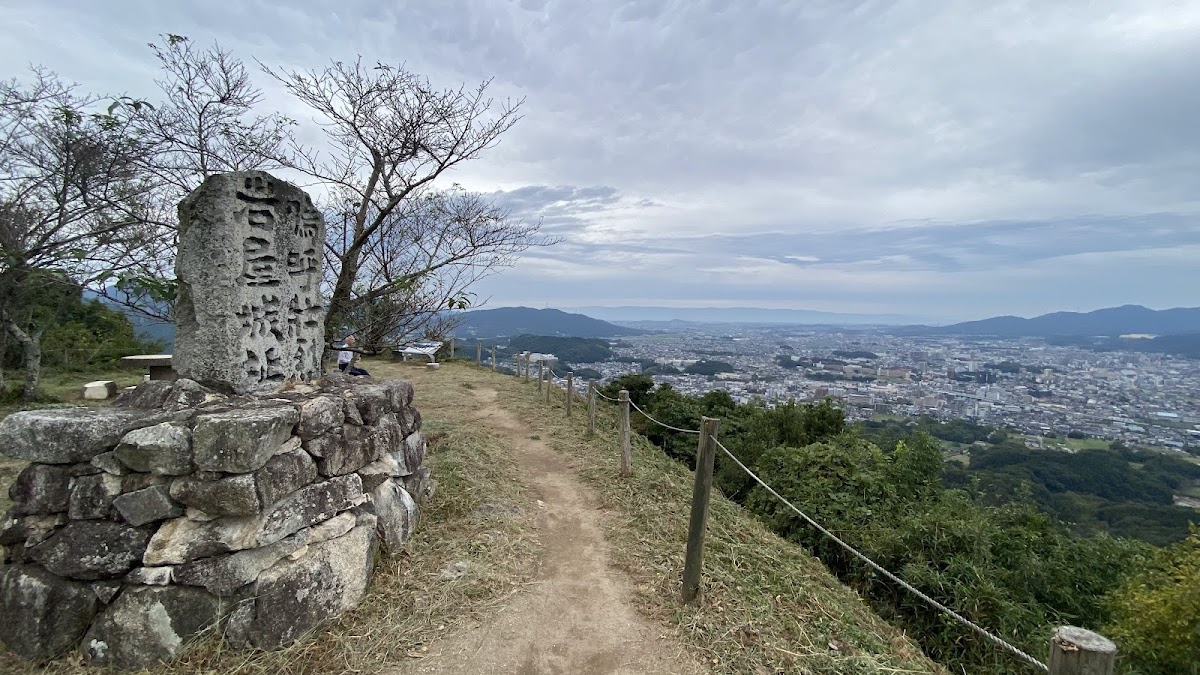
The Honmaru site is now also called “Kō-no-maru” and is the core enclosure of Iwaya Castle. Here stands a stone monument inscribed with “Ah, the Magnificent Site of Iwaya Castle,” erected by descendants of Takahashi Shōun, and it serves as a symbol of Iwaya Castle.
From the main keep, you can enjoy a panoramic view of Dazaifu city and the Chikushi Plain, and on clear days, you can even see as far as Hakata Bay. This excellent view speaks to the castle’s high level of surveillance. In spring, cherry blossoms bloom, making it a spot where you can enjoy both a historical atmosphere and the beauty of nature.
Second Bailey
Below the ridge on the southwest side of the main keep lies the second bailey, where the graves of Takahashi Shōun and his retainers are currently located. A monument inscribed with Shōun’s death poem is also here, conveying to visitors the resolve and loyalty of a Sengoku period warlord.
Although the main keep and second bailey are currently separated by a forest road, it is believed that they once formed a continuous defensive line.
Earthworks and Moats
To the north and rear of the main keep, earthworks and moats remain, allowing you to see defensive structures characteristic of mountain castles. These were important structures designed to prevent enemy intrusion, enhancing the defensive capabilities of Iwaya Castle.
Belt Enclosures
Belt enclosures were arranged around the main keep, forming a multi-layered defensive structure. These enclosures restricted the movement of attackers and provided a favorable combat environment for the defenders.
Access to the Castle
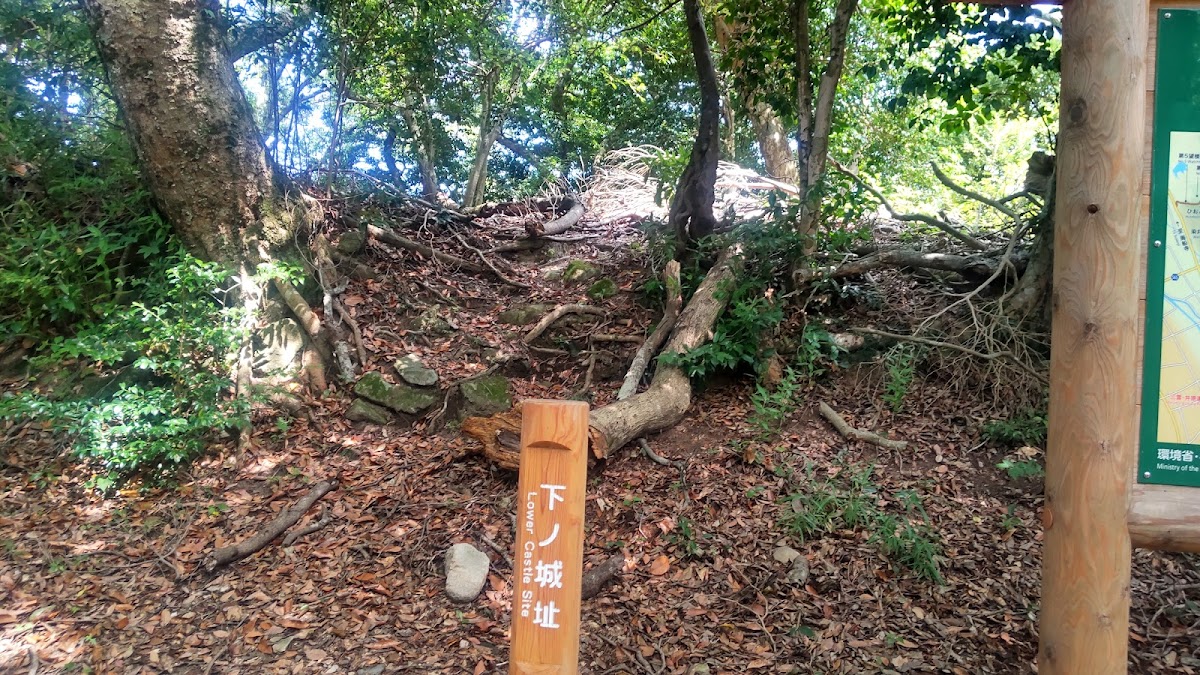
Currently, Iwaya Castle can be accessed via a forest road (Shiojiyama Forest Road) leading from Dazaifu Station towards Ono Castle. There is an entrance to the castle path along the forest road, and climbing the mountain trail from there leads to the main keep ruins.
Although the access path is well-maintained, it is a mountain path, so comfortable walking shoes are recommended. The climb takes approximately 15-20 minutes on foot.
Highlights of Iwaya Castle | Historical Monuments and Scenic Viewpoints
The “Ah, the Valiant Iwaya Castle Ruins” Monument
The “Ah, the Valiant Iwaya Castle Ruins” monument, standing on the site of the main keep, is an important monument that all visitors to Iwaya Castle must see. This monument was erected by descendants of Takahashi Shōun and commemorates the fierce battle fought by Shōun and his retainers.
Standing before the monument, one can reflect on the fierce battle that took place here over 400 years ago. Especially at sunset, the silhouette of the monument overlaps with the cityscape of Dazaifu, creating a deeply moving scene.
Takahashi Shōun’s Grave and Farewell Poem Monument
The graves of Takahashi Shōun and his retainers are located on the site of the second bailey, serving as a place of remembrance for visitors. There is a monument inscribed with Shōun’s death poem: “Though it flows, it ultimately becomes the sea; like water, it will surely return to its original droplets.” This allows us to understand the warrior’s final thoughts.
This poem expresses the Buddhist concept of impermanence, suggesting that human life, like a flowing river, returns to the sea (the Buddhist world), demonstrating Shōun’s profound spirituality as he accepted his death.
Scenic Viewpoint
The view from the main keep of Iwaya Castle is one of its greatest attractions, captivating visitors. Below, the city of Dazaifu spreads out, offering panoramic views of historical sites such as Dazaifu Tenmangu Shrine, Mizuki Castle ruins, and the Dazaifu Government Office ruins.
On clear days, you can see across the Chikushi Plain to Hakata Bay, allowing you to appreciate the historical importance of northern Kyushu from ancient times to the present day. The beauty of the scenery changes with the seasons—cherry blossoms in spring, lush greenery in summer, vibrant autumn leaves, and crisp winter air—making it a truly captivating place.
The Nature and Ancient Ruins of Shioji Mountain
Shioji Mountain, where Iwaya Castle is located, not only contains the remains of Iwaya Castle from the Sengoku period, but also the remains of Ono Castle, an ancient mountain castle built in the 7th century. Ono Castle is a Korean-style mountain castle built after the Battle of Baekgang to prepare for invasions by Tang China and Silla, and is designated as a National Special Historic Site.
When visiting Iwaya Castle, exploring these ancient ruins as well allows you to experience the military history of Kyushu, spanning from ancient times to the Sengoku period.
Access and Visiting Information for Iwaya Castle
Basic Information
- Location: Urajo, Dazaifu City, Fukuoka Prefecture (Mikasa District, Chikuzen Province)
- Castle Structure: Mountain Castle
- Year of Construction: Tenbun Era (1532-1555)
- Builder: Takahashi Akimune
- Main Lords: Takahashi Akimune, Takahashi Shoun
- Elevation: 281 meters
- Relative Height: Approximately 230 meters
- Remains: Enclosures, earthworks, moats, stone monuments, burial grounds
Access by Public Transportation
The nearest station is Dazaifu Station on the Nishitetsu Dazaifu Line. Walking from the station to the Iwaya Castle ruins takes approximately 1 hour. Alternatively, you can take the Mahoroba-go (community bus) from Dazaifu Station towards Shiojiyama and then walk up from the castle entrance. However, since you will need to hike a mountain trail, you should plan your trip with plenty of time to spare.
Access by Car
By car, it takes about 10 minutes from Dazaifu Interchange to reach the vicinity of the entrance to the Shiojiyama Forest Road. There is parking space along the forest road, and from there you can hike up to the main castle ruins.
Entering “Iwaya Castle Ruins” or “Shiojiyama” into your car navigation system will guide you there. However, the forest road has some narrow sections, so caution is required when driving.
Points to Note When Visiting
- Attire: Since you will be walking on mountain paths, comfortable shoes and clothing that allows for easy movement are recommended.
- Season: The cherry blossom season in spring and the autumn foliage season are particularly beautiful, but in summer, heat protection is necessary, and in winter, warm clothing is required.
- Time Required: If you plan to leisurely explore the main keep and the second keep ruins, please allow 1-2 hours.
- Restrooms: There are no restrooms near the castle ruins, so it is recommended to use the facilities in Dazaifu city beforehand.
- Drinking Water: Please bring plenty of drinking water, especially in summer.
Nearby Tourist Attractions
When visiting Iwaya Castle, it is recommended to also visit other historical spots in Dazaifu.
- Dazaifu Tenmangu Shrine: A nationally famous shrine dedicated to Sugawara no Michizane, the god of learning.
- Dazaifu Government Office Ruins: The ruins of the ancient political, diplomatic, and military center of Kyushu.
- Mizuki Castle Ruins: An ancient defensive facility built after the Battle of Baekgang.
- Ono Castle Ruins: The remains of an ancient mountain castle on Mt. Shioji.
- Kanzeonji Temple: An ancient temple built by Emperor Tenji to pray for the repose of his mother, Empress Saimei.
By visiting these spots, you can gain a comprehensive understanding of the history of Dazaifu, which spans from ancient times to the Sengoku period.
Takahashi Shōun, a Warrior | A Symbol of Loyalty and Bravery
The Life and Character of Shōun
Takahashi Shōun (1548-1586) was originally named Yoshihiro Shigetane and was born the second son of Yoshihiro Kanri, a senior retainer of the Ōtomo family. Shōun enjoyed the deep trust of Ōtomo Sōrin and, along with Tachibana Dōsetsu, was considered one of the two pillars supporting the Ōtomo family.
Shōun was not only renowned for his military prowess but also for his character, earning the deep trust of his retainers and subjects. His son, Muneshige (later Tachibana Muneshige), who married Tachibana Dōsetsu’s daughter, Ginchiyo, is known as the only Western Army general to regain his position as a daimyo after the Battle of Sekigahara.
Shōun’s Strategic Judgment
During the siege of Iwaya Castle, Shōun fully understood the disparity in troop strength between his forces and those of the Shimazu army. Nevertheless, he chose to hold out because he had a clear strategic objective: to buy time until Toyotomi Hideyoshi’s Kyushu conquest army arrived.
Shōun instructed his son, Tachibana Muneshige, not to send reinforcements to Iwaya Castle but to strengthen the defenses of Tachibana Castle. This was a father’s decision prioritizing the survival of Muneshige and the Tachibana family.
Influence on Later Generations
Takahashi Shōun’s heroic end has been recounted as an ideal of bushido (the way of the samurai) since the Edo period. His loyalty to his lord, strategic self-sacrifice, and valor to the very end have impressed many, making him a model samurai.
Even today, many visitors to the Iwaya Castle ruins are deeply moved by Shōun’s way of life and express their respect for his high moral character.
Historical Significance of the Battle of Iwaya Castle
Turning Point in the Unification of Kyushu
The Battle of Iwaya Castle marked a crucial turning point in the Sengoku period (Warring States period) in Kyushu. At a time when the Shimazu clan’s unification of Kyushu was almost complete, Shōun’s siege bought time, enabling Toyotomi Hideyoshi’s intervention.
If Iwaya Castle had fallen quickly, the Shimazu army might have conquered northern Kyushu sooner, making Hideyoshi’s pacification of Kyushu more difficult.
Tactical Value of Siege Warfare
The Battle of Iwaya Castle served as an example of the strategic value of siege warfare under overwhelmingly unfavorable circumstances. The fact that a force of just over 700 men held off an army of tens of thousands for approximately two weeks, inflicting heavy losses, demonstrates the defensive strength of mountain castles and the effectiveness of siege tactics.
Symbol of Bushido Spirit
The fighting spirit of Takahashi Shōun and his retainers in the Battle of Iwaya Castle had a significant impact on the formation of later generations of Bushido spirit. The elements of loyalty to one’s lord, fighting for honor, and a noble end were passed down as the ideal image of a samurai in the Edo period.
Summary | Iwaya Castle: An Important Stage in Kyushu’s Sengoku History
Iwaya Castle is not merely the remains of a mountain castle, but an important historical stage in Kyushu during the late Sengoku period. Takahashi Shōun’s heroic siege warfare continues to be recounted to this day as a symbol of Bushido spirit, inspiring many people.
From the castle ruins located on the slopes of Mt. Shioji, you can enjoy a panoramic view of Dazaifu city and the Chikushi Plain, truly appreciating the historical importance of northern Kyushu since ancient times. The “Ah, the Magnificent Iwaya Castle Ruins” monument and the tomb of Takahashi Shoun are precious historical relics that convey the weight of history to visitors.
When visiting Dazaifu, be sure to also visit the Iwaya Castle ruins, along with Dazaifu Tenmangu Shrine and the Dazaifu Government Office ruins. It will be a valuable opportunity to experience the lives of the Sengoku period warlords and the depth of Kyushu’s history. The effort of climbing the mountain path will be fully rewarded by the spectacular view from the summit and the profound historical experience.