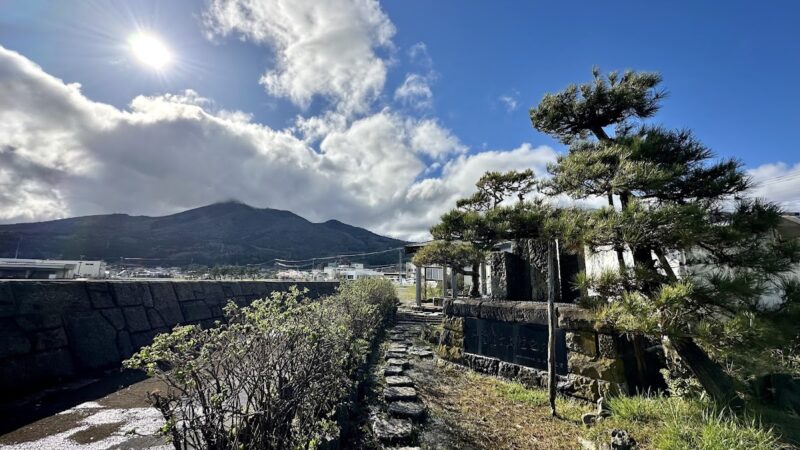
Complete Guide to Akaishi Castle (Ajigasawa Town, Aomori Prefecture): Exploring the Birthplace of Tsugaru Tamenobu and the Remains of Fushida Castle
Akaishi Castle, located in Ajigasawa Town, Nishitsugaru District, Aomori Prefecture, is a historical mountain castle known as the birthplace of Tsugaru Tamenobu, a hero who unified the Tsugaru region during the Sengoku period. Also known as “Fushida Castle,” this castle site, characterized by its unique dry moat shape, still retains well-preserved remains such as earthworks and dry moats, making it a valuable historical site that conveys the castle architecture of the Tsugaru region during the Sengoku period.
Overview and Historical Background of Akaishi Castle
Basic Information on Akaishi Castle
Akaishi Castle is a medieval mountain castle located in Akaishi Town, Ajigasawa Town, Nishitsugaru District, Aomori Prefecture. Belonging to Tsugaru District, Mutsu Province, it was built on a mountain called Dandanyama, approximately 140 meters above sea level, east of the Hishoda settlement and north of Takakura Shrine. Although relatively small in scale, the castle functioned as an important base in the Tsugaru region during the Sengoku period (Warring States period).
While parts of the castle site are now used as orchards, the main remains are preserved, making it a worthwhile historical site for castle enthusiasts and history buffs.
Construction History and the Oura Clan’s Rule
Akaishi Castle is said to have been built by Oura Mitsunobu as a branch castle of Taneri Castle (present-day Ajigasawa-machi, Nishitsugaru-gun, Aomori Prefecture). Oura Mitsunobu was a member of the Nanbu clan and a warlord who expanded his power in the Tsugaru region. While using Taneri Castle as his base, Mitsunobu strengthened his control over the territory by building several branch castles in the surrounding area.
After its construction, Akaishi Castle was entrusted to the Omagari clan, vassals of Oura Nobutake (later Ichimachi Iki), Mitsunobu’s younger brother, who served as castle lords. During this period, Akaishi Castle is thought to have played a key role in the Oura clan’s castle network, centered around Taneri Castle, and functioned as a defensive stronghold in the western Tsugaru region.
Importance as the Birthplace of Tsugaru Tamenobu
Later, Takeda Jinzaburo Morinobu, the second son of Oura Masanobu, became the lord of Akaishi Castle. It is said that Tsugaru Tamenobu was born at this castle in 1550. Tamenobu later unified the Tsugaru region and became the first lord of the Hirosaki Domain.
While there are various theories regarding Tamenobu’s origins, the theory that he was born at Akaishi Castle is considered the most likely. After spending his childhood at Akaishi Castle, Tamenobu moved to Taneri Castle, where he was adopted into the Oura clan and rose to prominence. Subsequently, through his skillful diplomacy and military prowess, Tamenobu effectively made the Tsugaru region, which had been under the control of the Nanbu clan, independent, and was officially recognized as the lord of Tsugaru by Toyotomi Hideyoshi.
Thus, Akaishi Castle holds special historical significance as the birthplace of a hero who greatly altered the history of the Tsugaru region.
Origin of the name “Fukuja-jo” and the castle’s characteristics
Origin of the alternative name “Fukuja-jo”
Akaishi Castle is also known by the alternative name “Fukuja-jo” (Crouching Snake Castle). This name originates from the shape of the three diagonally oriented square dry moats located on the southwest side of the castle’s main entrance. It is said that from a distance, these dry moats resemble a coiled snake, hence the name “Fukuja-jo.”
This unique arrangement of dry moats not only serves as a defensive structure but also creates a visually striking landscape, making it Akaishi Castle’s most distinctive feature. Such symbolic names are rare in castle architecture of the Sengoku period, and this is an important element that speaks to the individuality of Akaishi Castle.
Location and Strategic Significance as a Mountain Castle
Akaishi Castle was built on a relatively low mountain, approximately 140 meters high, but it boasts an excellent vantage point overlooking the surrounding plains. This location held significant military importance.
From the castle, one could overlook the Akaishi River basin, which flows into the Sea of Japan, and monitor the transportation routes connecting the western Tsugaru coastline with the inland areas. Furthermore, the Akaishi River, originating in the Shirakami Mountains (a World Natural Heritage site), functioned as an important waterway at the time, and it is believed that Akaishi Castle also played a role in managing this waterway.
As a branch castle of Taneri Castle, Akaishi Castle was responsible for the crucial tasks of coastal security and transportation route management in the Oura clan’s domain administration.
Structure and Remains of Akaishi Castle
Arrangement of the Main Enclosure and Baileys
The main enclosure (honmaru) of Akaishi Castle is located on the summit of the terraced mountain and has an oval shape. The castle features a stepped layout with a series of enclosures (kuruwa) extending westward from the main enclosure, characterized by its terraced design.
The main enclosure is relatively small, suggesting it served more as a defensive stronghold in emergencies than as a residential area. While each enclosure has been carefully leveled, slight slopes remain in some areas, offering insights into the civil engineering techniques of the time.
The fortified cliffs (kirigishi) are well-constructed, demonstrating ingenuity in preventing enemy intrusion. The defensive structure, utilizing the elevation differences between enclosures, demonstrates a practical design philosophy despite its small scale.
Features of the Dry Moats and Earthworks
The most notable feature of Akaishi Castle is the dry moat, which gave rise to the aforementioned nickname “Fushija Castle” (meaning “Crouching Snake Castle”). A bow-shaped dry moat is located south of the main enclosure, serving as an important defensive structure to prevent intrusion into the main enclosure.
Three obliquely oriented dry moats are located southwest of the main entrance, working in conjunction to hinder enemy advances. The depth and width of the dry moats vary depending on the location, but they can still be clearly seen today, making them valuable remains that allow us to appreciate the castle-building techniques of the Sengoku period.
To the west, a belt-shaped enclosure continues, and traces of earthworks can also be seen here. These earthworks served not only as defensive walls but also to clearly define the boundaries of the enclosures. While the remaining earthworks are lower than they were originally due to weathering, their arrangement allows us to understand the castle’s defensive structure.
Current State of Preservation
The Akaishi Castle ruins are currently partially used as an orchard, so they do not completely retain their original appearance. However, the main remains such as the dry moats, earthworks, and the arrangement of the enclosures are relatively well preserved, allowing us to understand the basic structure of the castle.
The dry moats, in particular, are well-preserved, and the three obliquely oriented square dry moats, which gave the castle its name “Fukuja Castle,” can be truly appreciated by seeing them in person. The area used as an orchard also utilizes the flat surface of the enclosures, making it an interesting example of the continuity of land use. ## Highlights and Notes on Akaishi Castle
Main Points of Interest
When visiting Akaishi Castle, keeping the following points in mind will help you understand the castle’s charm more deeply.
1. Three Slanted Square-Shaped Dry Moats
The dry moats, which give Akaishi Castle its name (Fukujajo), are its greatest highlight. Located on the southwest side of the main gate, these moats, when viewed from a distance, truly resemble a coiled snake. Upon closer inspection, you can see that the depth, width, and slope of the moats were carefully calculated and designed, demonstrating the high level of castle-building technology during the Sengoku period.
2. View from the Main Enclosure
From the main enclosure, located on the summit of the terraced mountain, you can enjoy a panoramic view of the surrounding landscape. On a clear day, you can see the Sea of Japan, the Akaishi River basin, and even Mount Iwaki in the distance. This view speaks to how strategically important Akaishi Castle was built.
3. Bow-Shaped Dry Moat
The bow-shaped dry moat located south of the main enclosure is also noteworthy. This dry moat functioned as the last line of defense to the main enclosure, guiding the attackers along the edge of the enclosure and giving the defenders an advantage.
4. Belt Enclosure and Earthworks
The belt enclosure extending to the west surrounds the main enclosure, forming a multi-layered defensive structure. Traces of earthworks remain, allowing us to imagine how the castle was defended at the time.
Historical Value and Significance as a Cultural Property
Akaishi Castle holds extremely high historical value as the birthplace of Tsugaru Tamenobu, a historically important figure. Tamenobu unified the Tsugaru region and laid the foundation for the Hirosaki Domain, which continued throughout the Edo period, making him an indispensable figure in the history of Aomori Prefecture.
Furthermore, as a castle ruin, it represents a typical example of a mountain castle in the Tsugaru region during the Sengoku period, and is a valuable resource for studying the castle construction techniques and defensive philosophies of the time. In particular, the unique layout of the dry moats, which gave rise to the castle’s nickname “Fushija Castle” (Crouching Snake Castle), is a feature rarely seen in other castles, highlighting the distinctive character of Akaishi Castle.
Currently, Akaishi Castle ruins are being preserved by local history enthusiasts and castle researchers, and future designation as a cultural property and development are anticipated.
Access and Visiting Guide
How to Access Akaishi Castle
Access by Car
The most convenient way to access Akaishi Castle is by car.
- From Aomori City: Approximately 60km southwest on National Route 101, approximately 1 hour and 15 minutes
- From Hirosaki City: Approximately 40km northwest on National Route 101, approximately 50 minutes
- From Goshogawara City: Approximately 30km west on National Route 101, approximately 40 minutes
From the center of Ajigasawa Town, head towards Akaishi Town and aim for the Hishoda settlement. Using Takakura Shrine as a landmark will make it easier to find. While there isn’t a designated parking area around the castle ruins, you can park in safe places along the roadside. However, please be mindful of private land used as orchards, and take sufficient care when entering.
Access by Public Transportation
If using public transportation, the nearest station is Ajigasawa Station on the JR Gonō Line. The Akaishi Castle ruins are approximately 8km from the station, taking about 15 minutes by taxi or about 1 hour and 40 minutes on foot.
There are also local buses operating within Ajigasawa town, but the number of services is limited, so it is recommended to check the timetable in advance.
Points to Note When Visiting
When visiting Akaishi Castle ruins, please note the following:
1. Consideration for Private Land
Part of the castle ruins is private land used as an orchard. When visiting, please be very careful not to damage the fruit trees or crops, and do not enter areas marked as off-limits.
2. Clothing and Equipment
As this is a mountain castle, comfortable walking shoes and clothing are essential. Especially after rain or in winter, the ground can become slippery, so we recommend wearing non-slip shoes such as trekking boots. Also, bring insect repellent in summer and warm clothing in winter.
3. Visiting Hours
Since there are no lighting facilities at the castle ruins, visiting during daylight hours is essential. In summer, sunset is late, so you can visit until evening, but in winter, we recommend visiting earlier in the day.
4. Weather Considerations
During bad weather, the ground becomes extremely dangerous, so we recommend refraining from visiting. The risk of falling is particularly high during strong winds and rain, especially near the dry moats and earthworks.
Estimated Visiting Time
For a thorough observation of the remains at Akaishi Castle Ruins, allow approximately 1 to 1.5 hours. If you only want to see the main remains, 30 minutes should suffice.
If you plan to take photographs or conduct detailed observations, we recommend allowing extra time.
Nearby Tourist Attractions and Related Historical Sites
Major Tourist Attractions in Ajigasawa Town
When visiting Akaishi Castle, we recommend also visiting other tourist attractions in Ajigasawa Town.
Taneri Castle Ruins
Taneri Castle, the main castle of Akaishi Castle, was built by Oura Mitsunobu and is also known as the castle where Tsugaru Tamenobu was adopted. Located about 20 minutes by car from Akaishi Castle, the “Mitsunobu-ko no Yakata” (Mitsunobu’s Residence) has been developed as the birthplace of the Tsugaru clan. Visiting both Akaishi Castle and Taneri Castle will allow you to gain a deeper understanding of the historical flow from the Oura clan to the Tsugaru clan.
Shirakami Mountains and Akaishi Stream
The Akaishi River, which originates in the Shirakami Mountains (a World Natural Heritage site), offers beautiful scenery along the Akaishi Forest Road. Many unusual rock formations are present, and the scenery of the blue-tinged rocks in the approximately 15km upstream section is particularly magnificent. The autumn foliage season is particularly beautiful, attracting many tourists.
Ajigasawa Onsen
Ajigasawa Town, facing the Sea of Japan, has several hot spring facilities. It’s perfect for relaxing after a tiring tour of the castle ruins. You can also enjoy dishes made with fresh local seafood.
Mt. Iwaki
Mt. Iwaki, also known as Tsugaru Fuji, is a majestic peak towering over the south side of Ajigasawa Town and is a symbol of the town. You can hike or drive to near the summit and enjoy spectacular views of the Tsugaru Plain and the Sea of Japan.
Related Castles in the Tsugaru Region
Besides Akaishi Castle, many other historical castle ruins remain in the Tsugaru region.
Hirosaki Castle
Hirosaki Castle, built by Tsugaru Tamenobu’s son, Nobuhira, is a valuable castle with an existing keep. It functioned as the base of the Tsugaru clan throughout the Edo period and is now designated as a National Important Cultural Property. It is nationally famous as a cherry blossom viewing spot, and many tourists visit in spring.
Horikoshi Castle
This castle was the base of the Tsugaru clan before Hirosaki Castle was built. It was also the first castle where Tamenobu resided, and it became a base for unifying Tsugaru. It is currently maintained as a historical park.
Namioka Castle
A flatland castle built by the Kitabatake clan, it is a representative example of medieval castles in the Tsugaru region. It is also known as a castle that was captured by Tamenobu.
By visiting these castles, you can gain a more comprehensive understanding of the history of the Tsugaru region from the Sengoku period to the Edo period.
Akaishi Castle and the Life of Tsugaru Tamenobu
Tamenobu’s Origins and Childhood at Akaishi Castle
Tsugaru Tamenobu is said to have been born in 1550 (Tenbun 19) at Akaishi Castle as the son of Takeda Jinzaburo Morinobu. His childhood name is said to have been Ogimaru. There are several theories regarding Tamenobu’s origins, but the most widely accepted is that he was born and spent his childhood at Akaishi Castle.
At a young age, Tamenobu was adopted by Oura Tamenori of Taneri Castle and raised as the successor to the Oura clan. This adoption paved the way for his later unification of Tsugaru.
The Road to Tsugaru Unification
Tamenobu began to rise to prominence during the Eiroku era (1558-1570). At that time, the Tsugaru region was under the control of the Nanbu clan, but in reality, it was a situation where various local lords held sway.
Through skillful diplomacy and military action, Tamenobu successively brought surrounding forces under his control. In particular, the capture of Ishikawa Castle in 1578 was a crucial turning point in the unification of Tsugaru. Afterward, he captured Namioka Castle, Oura Castle, and others, bringing almost the entire Tsugaru region under his control.
In 1590 (Tensho 18), Tamenobu participated in Toyotomi Hideyoshi’s siege of Odawara and was officially recognized as the lord of Tsugaru. This effectively made the Tsugaru region independent from the Nanbu clan, and Tamenobu established his position as an independent daimyo.
Establishment of the Hirosaki Domain and Tamenobu’s Achievements
In the Battle of Sekigahara, he sided with the Eastern Army and was granted a territory of 47,000 koku in Tsugaru by Tokugawa Ieyasu. Tamenobu retired in 1603 (Keicho 8), handing over the family headship to his eldest son, Nobutake (later Nobuhira), but he retained real power.
Tamenobu died in Kyoto in 1607 (Keicho 12) at the age of 58. After Tamenobu’s death, the Hirosaki Domain continued to exist throughout the Edo period and ruled the Tsugaru region until the Meiji Restoration.
Akaishi Castle holds a special place in the history of the Tsugaru region as the castle that produced such a great warrior.
History and Culture of Ajigasawa Town
Origins of Ajigasawa Town
Ajigasawa Town is located in Nishitsugaru District, Aomori Prefecture, and developed as a port town facing the Sea of Japan. The town’s name is said to have originated from the fact that there was a stream (sawa) where many horse mackerel (aji) were caught.
During the Edo period, it flourished as an outer port of the Hirosaki Domain and thrived as a port of call for Kitamae ships. It played an important role as a center for the collection and distribution of rice and marine products, becoming the economic center of western Tsugaru.
Following the implementation of the municipal system in 1889 (Meiji 22), it became Ajigasawa Town. In 1955 (Showa 30), Ajigasawa Town, Akaishi Village, Nakamura, Narusawa Village, and Maido Village merged to form the current Ajigasawa Town.
Geography and Natural Environment
Ajigasawa Town is long and narrow from north to south, with a vast area of 342.99 square kilometers. To the north, it faces the Sea of Japan, and to the south, it is bordered by the World Natural Heritage site “Shirakami Mountains” and the majestic peak “Mt. Iwaki,” making it a town rich in nature, boasting the perfect combination of “sea, mountains, and rivers.”
Three rivers—the Akaishi River, originating in the Shirakami Mountains, and the Nakamura River and Narusawa River, originating in Mt. Iwaki—flow through the town and empty into the Sea of Japan. These rivers provide abundant water resources, supporting agriculture and fisheries.
Local Products and Food Culture
Ajigasawa Town is blessed with abundant seafood and mountain produce. Fresh seafood caught in the Sea of Japan, especially flounder and squid, is renowned as a delicacy. Asparagus, cultivated in the cool climate at the foot of Mount Iwaki, is a popular local specialty.
Apple cultivation is also thriving, with various apple varieties produced in orchards spreading across the foothills of Mount Iwaki. The use of the Akaishi Castle ruins as an orchard demonstrates the region’s tradition of apple cultivation.
Summary: The Charm and Value of Visiting Akaishi Castle
Akaishi Castle (Ajigasawa Town, Aomori Prefecture) is a fascinating historical site, possessing both historical value as the birthplace of Tsugaru Tamenobu, a historically important figure, and unique castle features, including its distinctive dry moat layout, earning it the nickname “Fukuja Castle” (Crouching Snake Castle).
The well-preserved remains of the castle, such as the dry moats and earthworks, convey the appearance of a mountain castle in the Tsugaru region during the Sengoku period, making it a highly worthwhile place to visit for castle enthusiasts and history buffs. From the castle, built on terraced mountains 140 meters above sea level, you can enjoy panoramic views of the Sea of Japan and the Akaishi River basin, truly appreciating its strategic importance at the time.
Ajigasawa Town is a naturally rich area surrounded by the Shirakami Mountains, a World Natural Heritage site, and the majestic Mount Iwaki. In addition to visiting Akaishi Castle, you can enjoy a variety of attractions, including related historical sites such as Taneri Castle, the beautiful scenery of the Akaishi Gorge, hot springs, and local specialties.
When visiting Aomori Prefecture, be sure to visit Akaishi Castle and experience the history of the birthplace of Tsugaru Tamenobu, the hero who unified Tsugaru, and the allure of the Sengoku period castle remains. The remains, carefully preserved even while being used as an orchard, speak to the local people’s respect for history and will surely leave a deep impression on visitors.