Toda Castle: An Impregnable Fortress of the Sengoku Period and the Glory of the Amago Clan
Toda Castle is a representative mountain castle of the Sengoku period, located in Hirose-cho, Yasugi City, Shimane Prefecture. Built around the summit of Mount Gassan, this castle is known as the base of the Amago clan, the rulers of the Chugoku region, and was called an “impregnable fortress” due to its magnificent scale and robust defensive structure. It is now designated as a national historic site and is also selected as one of Japan’s 100 Famous Castles.
History of Toda Castle
Construction and the Rise of the Amago Clan
There are various theories regarding the construction period of Toda Castle, but it is believed to have been built by the Sasaki clan, who ruled this area from the late Heian period to the early Kamakura period. Initially a small mountain castle, it developed into a full-fledged castle when the Amago clan came to control the area during the Muromachi period.
The Amago clan rapidly expanded their power during the Sengoku period following the Ōnin War, based in Izumo Province. Amago Tsunehisa, in particular, was known as a brilliant strategist, and from his base at Tomita Castle, he controlled a vast territory spanning 11 provinces in the Chūgoku region. Tsunehisa undertook extensive renovations of Tomita Castle, transforming it into an impregnable fortress that skillfully utilized the terrain of Mount Gassan.
The Amago Clan’s Golden Age
In the first half of the 16th century, the Amago clan reached its peak. During the reigns of Amago Tsunehisa and Haruhisa, they controlled 11 provinces: Izumo, Iwami, Oki, Hōki, Inaba, Mimasaka, Bizen, Bitchū, Bingo, Aki, and Harima, becoming the largest Sengoku daimyo in the Chūgoku region. Tomita Castle functioned not merely as a military base, but as a center of politics, economy, and culture, and the castle town also flourished greatly.
At that time, Tomita Castle was a large fortress with multiple enclosures (kuruwa) arranged around the main keep at the mountaintop, including the Yamanaka-Goten and Yamashita-Goten, stretching approximately 4 kilometers in total length. Merchants and artisans gathered in the castle town, forming a vibrant community.
Conflicts with the Mori Clan and the Fall of the Castle
The Amago clan’s prosperity did not last forever. As Mori Motonari, based in Aki Province (present-day Hiroshima Prefecture), expanded his power, the two clans fiercely clashed over hegemony in the Chugoku region.
From 1562 to 1563, the Mori army launched the First Battle of Gassan-Tomita Castle, but was repelled by Tomita Castle’s strong defenses and the valiant efforts of the Amago army. However, in 1565, Mori Motonari again led a large army to besiege Tomita Castle. This Second Battle of Gassan-Tomita Castle became a long siege primarily involving a strategy of starvation.
The Mori army completely cut off the supply lines to the castle and successively captured the surrounding subsidiary castles. Inside the isolated Tomita Castle, food supplies ran out, and the morale of the castle’s defenders declined. Finally, in November 1566, Amago Yoshihisa decided to surrender, and Tomita Castle was opened to the public. This marked the end of the Amago clan as a Sengoku daimyo.
Tomita Castle After the Mori Clan
The Mori clan, having acquired Tomita Castle, made it their base for controlling Izumo Province. They renovated parts of the castle and continued to use it as an important military base. However, after the Battle of Sekigahara, when the Mori clan’s territory was reduced to the two provinces of Suo and Nagato, Horio Yoshiharu took up residence in Tomita Castle.
Horio Yoshiharu initially used Tomita Castle as his residence, but judging it inconvenient as a political and economic center due to its mountainous terrain, he began construction of Matsue Castle in 1611. When Matsue Castle was completed in 1611, Tomita Castle was abandoned. Since then, Tomita Castle has disappeared from the stage of history, and its remains have gradually returned to nature over the long years.
Structure and Characteristics of Tomita Castle
Layout Centered Around Mount Gassan
The most distinctive feature of Tomita Castle is its magnificent scale, utilizing the entire 197-meter-high Mount Gassan as a castle fortification. The main keep was located at the summit, and from there, multiple baileys were arranged along the ridge, creating a typical structure of a multi-bailey mountain castle.
The main baileys included the main keep (Yamanaka Goten) at the summit, the second bailey, the third bailey, and Senjodaira (Yamashita Goten) at the foot of the mountain. These baileys were separated by stone walls and earthen ramparts, and their defenses were reinforced by moats and vertical trenches.
Yamanaka Goten and Yamashita Goten
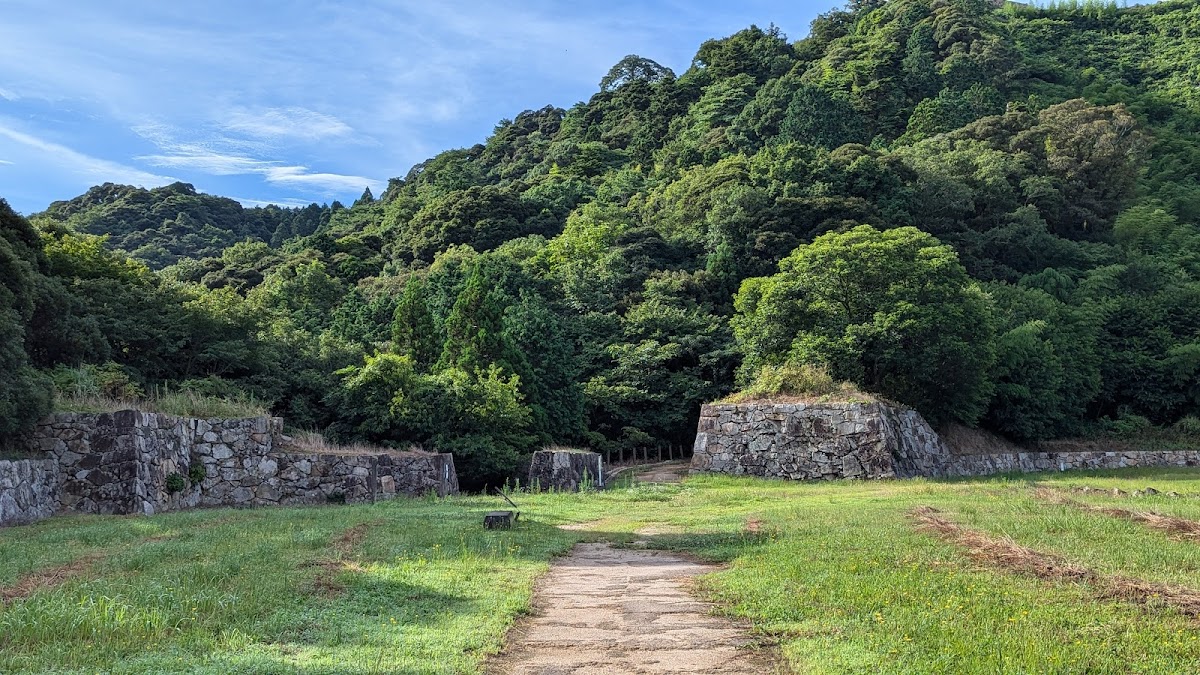
Tomita Castle had two main residences: the “Yamanaka Goten” and the “Yamashita Goten.” The Yamanaka Palace was located near the summit of Mount Gassan and served as the final defensive stronghold during wartime. The Yamashita Palace, on the other hand, was located at the foot of the mountain in Senjōdaira and functioned as the government office and residence during peacetime.
This dual structure was a clever design to balance the convenience of daily administrative affairs with the defensive capabilities of wartime. The Yamashita Palace was used for domain administration and diplomacy, while the Yamanaka Palace was used for siege during times of conflict.
Stone Walls and Defensive Structures
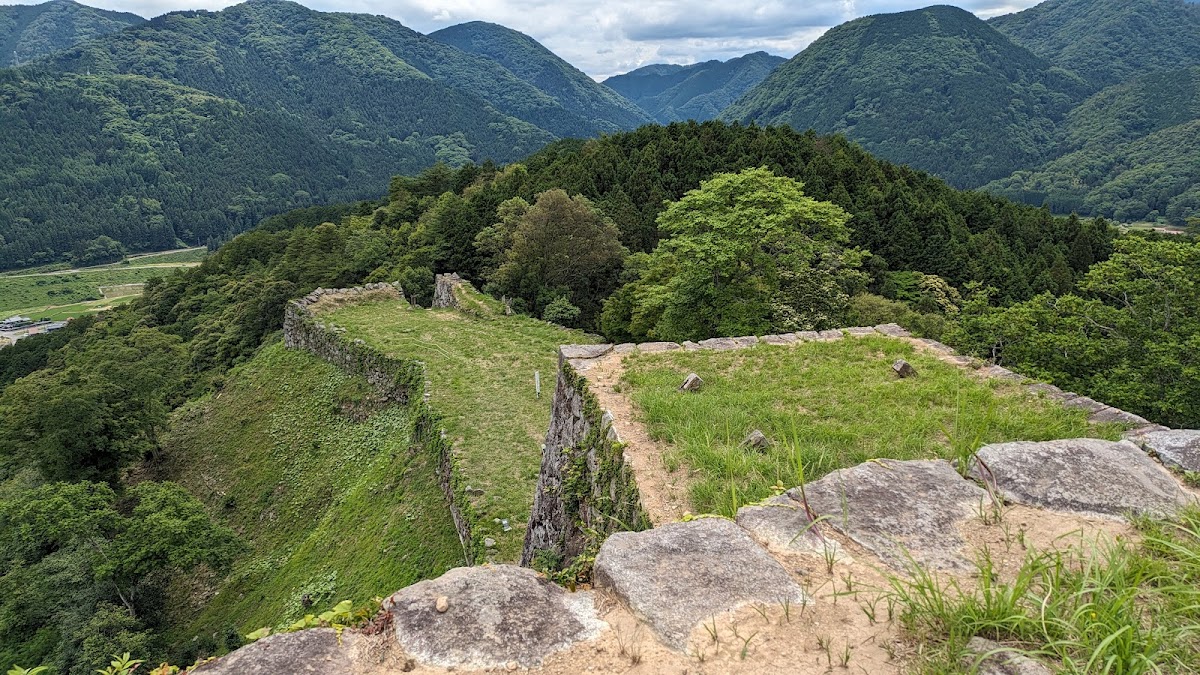
Stone walls remain throughout Tomita Castle. The stone walls at Sugaya-guchi are particularly impressive, demonstrating the high level of stonework technology of the time. Furthermore, numerous moats were constructed within the castle grounds, showcasing ingenious methods to prevent enemy intrusion.
There were several routes to the summit, but all were steep and winding, making them extremely difficult for attackers. The route known as “Nanamagari” (Seven Bends) is particularly famous, winding and twisting repeatedly as it leads to the summit.
Vast Castle Grounds
Tomita Castle’s grounds extended not only to Mount Gassan but also to the surrounding mountains. Multiple entrances (gateways), such as Shioya-guchi, Sugaya-guchi, and Mikomori-guchi, were established, each with its own defensive structures. The total length of the castle grounds reached approximately 4 kilometers, making it one of the largest mountain castles of the Sengoku period.
Including the castle town, the urban area centered around Tomita Castle is believed to have been quite extensive. Merchant and artisan districts formed along the Iinashi River, functioning as a center of economic activity.
Highlights of Tomita Castle
View from the Main Keep Site
From the main keep site at the summit of Mount Gassan, a magnificent panoramic view unfolds, encompassing Lake Nakaumi, Mount Daisen, and the Izumo Plain. On a clear day, you can even see the Sea of Japan in the distance, giving you a real sense of why this location was strategically important. This view is one of the greatest attractions of visiting Tomita Castle.
The site of the main keep is now home to the Katsuhitakamori Shrine, dedicated to the Amago clan. This shrine was built on the site of Gassan Tomita-ji Temple, the Amago clan’s family temple, and serves to appease the spirits of the Amago.
Senjodaira (Site of the Yamashita Palace)
Senjodaira, at the foot of the mountain, is, as its name suggests, a vast flat area where the Yamashita Palace once stood. Currently a wide grassy field, it allows one to imagine the scale of the buildings in its heyday. From here, it’s relatively easy to reach the summit, and many climbers start their ascent from this point.
Information boards and explanatory signs are installed at Senjodaira, allowing visitors to learn about the history and structure of Tomita Castle. Furthermore, remnants of earthworks and moats remain in the surrounding area, allowing for close observation of the castle’s remains.
Stone Walls
Stone walls remain in various locations throughout Tomita Castle. The stone walls near Sugaya-guchi, in particular, are well-preserved and are valuable relics for understanding the stonework techniques of the Sengoku period. The castle employs a technique called “nozurazumi,” which involves stacking natural stones, giving it a simple yet powerful impression.
Stone walls remain around the Yamanaka Palace, indicating that important baileys were surrounded by stone walls. These stone walls are thought to have been built during the Amago or Mori clan period.
Moats and Vertical Moats
Important defensive features of Tomita Castle include moats and vertical moats. Moats were dug to cut across ridges, preventing enemy intrusion and defining baileys. Tomita Castle has numerous moats of varying sizes, their sheer scale being astonishing.
Vertical moats were dug along slopes, preventing enemies from climbing them. The vertical moats at Tomita Castle are deep and long, demonstrating the advanced castle-building techniques of the time.
Ascent Route
There are several routes to Tomita Castle, but the most popular is the one from Senjōdaira to the summit. This path, known as Nanamegari (Seven Bends), winds its way up a steep slope. Along the way, you’ll find the remains of baileys such as Ninomaru and Sannomaru, allowing for rest stops during the ascent.
The climb takes approximately 30 to 40 minutes one way, and the path is well-maintained and relatively easy to walk. However, there are steep slopes and stairs, so comfortable clothing and shoes are recommended.
Tomita Castle and the Culture of the Amago Clan
The Amago Clan’s Rule
The Amago clan ruled their territory not only through military force but also through their excellent governing abilities. Amago Tsunehisa was a strategist renowned as a “master strategist,” skillfully using diplomacy and political maneuvering to expand his power. He also focused on developing his territory, encouraging industries such as iron smelting.
The town of Tomita Castle became a thriving economic center, attracting many merchants and artisans. The Amago clan focused on establishing markets and developing distribution networks, solidifying the foundation of their domain’s management.
Culture and Religion
The Amago clan was also enthusiastic about promoting culture. Many monks and cultural figures were invited to Tomita Castle, and Kyoto culture was introduced. Tea ceremonies and linked verse poetry flourished, boasting a high level of culture for a regional city during the Sengoku period.
In terms of religion, the Amago clan protected Buddhism and built many temples within their territory. Gassan Tomita-ji Temple prospered as the Amago clan’s ancestral temple, and a Kannon Hall was built on the mountaintop. Shintoism was also valued, and several shrines were enshrined within the castle grounds.
The Legend of the Amago Ten Braves
After the fall of the Amago clan, Yamanaka Shikanosuke, who worked to restore the Amago clan, is known as the foremost of the “Amago Ten Braves.” Shikanosuke is famous for the anecdote of praying to the crescent moon, “I pray that you grant me seven trials and eight hardships,” and his loyalty and bravery have been passed down through generations.
Yamanaka Shikanosuke attempted to restore the Amago clan by supporting Amago Katsuhisa, but was ultimately defeated by the Mori clan and lost his life before achieving his goal. However, his spirit of loyalty moved many people, and he was featured as a subject in kōdan (storytelling) and jōruri (puppet theater) during the Edo period.
Tomita Castle Today
National Historic Site Designation and Preservation Activities
Tomita Castle ruins were designated a national historic site in 1934 (Showa 9). Later, in 1997 (Heisei 9), an additional designation was made, expanding the protected area. Currently, Yasugi City is leading the preservation and development efforts, and archaeological excavations of the remains and maintenance of the castle access routes are being carried out continuously.
In 2006, it was selected as one of “Japan’s Top 100 Castles,” increasing its national recognition. The castle ruins are well-preserved and are valued as a precious historical site that conveys the appearance of a mountain castle from the Sengoku period.
Yasugi City Historical Museum
At the foot of the Tomita Castle ruins is the Yasugi City Historical Museum, which displays a wealth of materials related to Tomita Castle and the Amago clan. Through castle models, excavated artifacts, and ancient documents, you can learn about the history of Tomita Castle in detail.
The museum also regularly holds special exhibitions, introducing the latest research findings on Tomita Castle and the Amago clan. When visiting Tomita Castle, gaining some background knowledge at this museum before climbing the castle will allow you to understand its history more deeply.
Access and Visiting Information
To reach the Tomita Castle ruins, take a bus from JR Yasugi Station for approximately 30 minutes, get off at the “Municipal Hospital” bus stop, and then walk for approximately 20 minutes. If traveling by car, it’s about a 10-minute drive from the Yasugi Interchange on the San’in Expressway to the parking lot near the castle ruins.
Climbing the castle is possible year-round, and admission is free. However, as it is a mountain castle, climbing may be difficult depending on the weather and season. Especially in winter, there may be snow, so it is recommended to check the information beforehand.
The climb takes about 30 to 40 minutes one way, so please allow ample time. Also, since you will be walking on mountain paths, it is important to prepare comfortable clothing, walking shoes, and drinks.
Events and Uses
Yasugi City hosts various events utilizing Tomita Castle. Every autumn, the “Tomita Castle Festival” is held, featuring a samurai procession and reenactments of the Sengoku period. Guided tours are also regularly offered, allowing visitors to explore the castle ruins while listening to expert explanations.
In recent years, games and novels set in Tomita Castle have appeared, spreading interest among younger generations. It has become a popular spot not only for history buffs but also for people who enjoy hiking and nature observation.
Historical Significance of Tomita Castle
Mountain Castle Architecture of the Sengoku Period
Tomita Castle is an important historical site that represents the pinnacle of mountain castle architecture during the Sengoku period. Its layout, which made maximum use of the terrain of Mount Gassan, and its defensive structures such as stone walls and moats, represent the pinnacle of castle-building technology at the time. Research into Tomita Castle is essential for understanding the history of castles during the Sengoku period.
In particular, the dual structure of the Yamanaka Palace and Yamashita Palace is interesting in terms of the division of functions between peacetime and wartime, and is thought to have influenced later early modern castles.
Sengoku History of the Chugoku Region
Tomita Castle played a central role in the Sengoku history of the Chugoku region. The conflict between the Amago and Mori clans significantly altered the power balance of the Chugoku region and had a major impact on subsequent history. The battle for Tomita Castle is studied as an important case study in the history of Sengoku battles.
The rise and fall of the Amago clan has been passed down through generations as a story symbolizing the rise and fall of Sengoku daimyo. Tomita Castle continues to hold significant historical importance as the setting for many events.
Regional Historical Heritage
Tomita Castle is a representative historical heritage site of Yasugi City and Shimane Prefecture. It serves as a core element of regional identity and a valuable tourist resource, contributing to regional development. Through Tomita Castle, one can learn about and take pride in the region’s history and culture.
Yasugi City is developing a historical tourist route centered around Tomita Castle, collaborating with surrounding historical sites and cultural facilities. Tomita Castle is not merely a historical ruin, but a cultural heritage that continues to thrive in the region today.
Summary
Tomita Castle, as a representative mountain castle of the Chugoku region during the Sengoku period, continues to fascinate many people. This castle, the stage for the rise and fall of the Amago clan, was known as an “impregnable fortress” due to its magnificent scale and robust defensive structure.
The castle grounds, stretching from the summit to the foot of Mount Gassan, contain numerous remains, including the main keep, the mountain palace, and the lower palace, preserving the appearance of a mountain castle from the Sengoku period. Defensive structures such as stone walls and moats are also well-preserved, allowing visitors to appreciate the advanced castle-building techniques of the time.
Currently, Tomita Castle Ruins are designated a national historic site and are one of Japan’s 100 Famous Castles. Preservation and maintenance efforts by Yasugi City are underway, making it a popular spot for history buffs and tourists. The view from the summit is magnificent, offering panoramic views of Lake Nakaumi, Mount Daisen, and the Izumo Plain.
Visiting Tomita Castle allows you to experience the history of the Sengoku period firsthand and reflect on the rise and tragedy of the Amago clan. It’s a recommended place not only for history enthusiasts but also for those who enjoy nature and hiking. When visiting Shimane Prefecture, be sure to visit Tomita Castle Ruins and experience its magnificent history and beautiful scenery.