Azuchi Castle: A complete story of a Japanese fantasy and a strange castle fortress
Azuchi Castle is a new type of fort built in Japan by the conqueror Nobunaga Ida during the War. The castle fort was first built in 1576, and it took about three years to build.It was the first construction in the history of Japanese castle forts, and it was also an example of the conquest of the Azuchi-Momoyama period. Three years after the original production of `Honnoji no Chang'', the work was written under the title `You Qi Castle”, but the novelty of Kazuhiro’s grandeur was still lost in today’s world.
Historical background and significance of Azuchi Castle construction
Azuchi Castle: A truly Japanese base
During the long term of the war, Takeda won the battle during the Shimodawara war, and Nobunaga Takeda decided to build a new base, and since then it has been a Japanese road. The position of the other selected commanders from Gifu Castle to Azuchiyama on the shores of Lake Biwa and Nari was also important.
Azuchi is a major waterway transportation hub connecting the East Coast and Hokkaido routes to and from Kyoto, as well as serving as a political and military authority. I believe that this building is not only a military fortress, but also a political and cultural center.
Construction history and period
In January 1576 (Tensho 4), Azuchiyama was constructed by Shincho. Since then, Niwa Takahide has been appointed as a master of the military, and has been summoned to become a master stonesmith and woodworker from all over the country. It took about three years to build Azuchi Castle, and the cost was enormous. The main castle was completed in May 1579 (Tensho 7), and Nobunaga Ida moved in immediately.
Azuchi Castle-like construction was completed using advanced technology at the time, and the construction process began with stone burial mound-like construction. The construction was planned, completed, and completed in Azuchiyama, and hundreds of thousands of units were spent on the construction of a large scale model.
Azuchi Castle Location Japanese Geography Special Expedition
Azuchiyama topography Japanese strategy strategy
Azuchiyama is the location of Azuchi Castle, it is a low dwarf mountain hill, and the sea level is 198.9 meters (also has a record of 199 meters). The area stands out from the rest of the world, including Lake Biwa, three-faced natural water, and a natural fortress. Azuchiyama is currently located in the north direction of JR Azuchi Station, belonging to Azuchi-cho, Omihachiman City.
Azuchi Castle’s geographical location has excellent defense, and it is also very convenient to use Lake Biwa’s waterways for transportation, and is close to Kyoto. Since the design of the director, the national issue has been issued.
Formation of a castle town in Yojo City
At the same time as Azuchi Castle was being built, the castle town of Ichiza was also constructed. Shinshu promotes the “乐市乐za” policy, and is a Japanese craftsman who attracts merchants. The castle town’s roads were directly connected, temples were built, samurai residences and commercial buildings were built, and the current name of the castle town was its predecessor.
New construction of Azuchi Castle
Nippon Choza full scale castle tower
Azuchi Castle’s most famous special expedition was the castle tower of Kouya, which consisted of five floors and seven floors, six floors above ground and one underground. This is the first full-scale castle tower in the history of Japanese castle forts. The castle fort had a height of 32 meters and was one of the best constructions in Japan at the time.
The main theme is that each layer of the inside of the castle tower has different decorations. Comprehensive works by Hidetaka Kano, a top-notch painter in Japan, and the gold screen paintings, which are gorgeous and sparkling, are worth a visit. The octagonal structure is made of octagonal structure, and the outer wall is made of gold leaf.
New stone mound construction
Azuchi Castle’s stone burial mound represents the most advanced technology at the time. At the time of the installation, the Japanese castle fort had no previous structure, and the central castle was completely constructed.
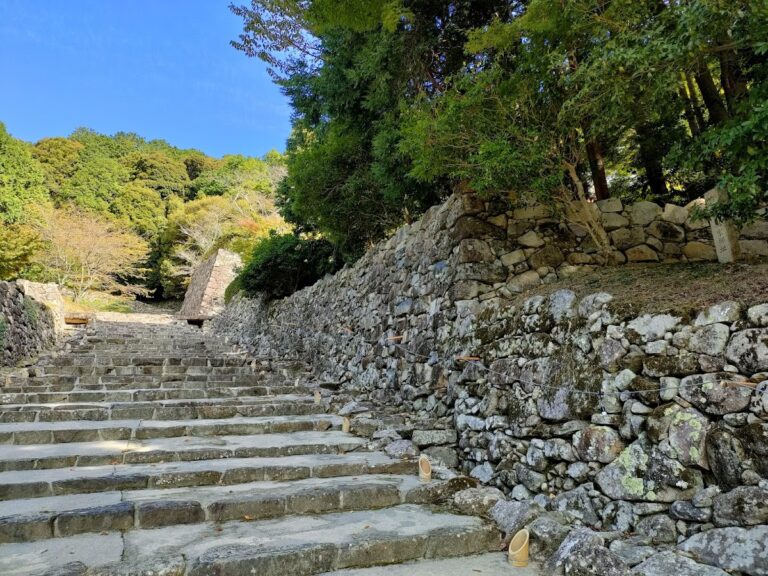
The special name is the main dry road of the main road, the straight extension, the width of about 6 meters, the length of about 180 meters, and the stone wall with a height of more than 5 meters. The use of a large amount of huge stones in this small castle has the power to conquer the outside world. The exhibition of stone craftsmen has been completed, and during the passage of the coarse stone to the fine stone, it is an important monument in the history of the construction of the castle fort.
Clothing station and defense system
Azuchiyama-naihenpuhaku, the main castle of Waji Castle, the residence of an important vassal of the Yamanaka clan. I’m sure this is where Hideyoshi Ariba Shiba (Hideyoshi, his vassal in the future), Toshiie Maeda, Ieyasu Tokugawa, and other great military commanders lived.
Inside the main city, outside the main city, the palace hall, and the official political activity ceremony. Each burial mound is separated by stone tombs, the entrance (mouth) is designed in a square shape (square burial mound), and has extremely high defensive functions.
Azuchi Castle’s cultural features
Mural by Eitoku Kano
The interior decoration of Azuchi Castle’s castle tower was painted by Kano Eitoku, one of the greatest painters of the time. Each layer of wall painting is different: one layer depicts pine and bamboo, two layers depicts flowers, three layers depict Chinese historical events, four layers depict Buddhist teaching materials, five layers depict Confucian thought.
In this small mural, we can see the way of visualizing the world view of Nobunaga Tian’s thoughts, and the political information of the transcendental decoration. It’s a shame, the original story is sure to be a big fire in one place, but I’ll leave it to you.
Surprise of the teacher
Luis Frois visited Empress Azuchi Castle, recorded the details and listened to other places. In addition, the castle tower is magnificent, the stone walls are solid and the interior decoration is luxurious, and it is called “The most beautiful castle in Europe”.
This is a small record of the research on the renovation of Azuchi Castle, and the new and shocking power of Azuchi Castle at the time of its exhibition.
Honnoji Temple and Azuchi Castle Burning
Tensho Tennen no Eki
On June 2, 1582, Akechi Mitsuhide’s revolt occurred at Honno-ji Temple in Kyoto, and the fate of Azuchi Castle resulted in a sexual change. After the change of Honno-ji Temple, Nobutada’s chief son, Nobutada Akuta, died during the Nijo Miyano War, and the Akuta clan entered the country, resulting in confusion.
Mitsuhide Akechi’s occupation of Azuchi Castle, however, during the Yamazaki War, Empress Hideyoshi Hashiba left Azuchi Castle unoccupied. On June 15th, 13th June, Azuchi Castle was burned down and the castle tower was destroyed.
Various explanations for the causes of burns
The reason for the burning of Azuchi Castle is that there are many different ways to explain it. Among them, the comprehensive Akechi military fire, the release of Nobunaga Shita’s second son, Nobuo Shita, and the unexpected fire that led to the fortification, etc., etc., but the establishment of the city was confirmed.
No matter what, three years after the construction of Azuchi Castle, it was fired, and since then it has become a “ghost castle” in the history of history. After this, Azuchi Castle was re-erected, the final submergence was completed, and the remains of the Tadurumo wall remained.
Current status of Azuchi Castle
Nationally designated special building historical protection
Azuchi Castle site was designated in 1926 (Taisho 15) as a national historical museum, and in 1952 (Showa 27) as a designated national historical historical site. In the near future, the Omihachiman City joint protection and security management, and the opening of public transportation.
The main road to the mountain is in good condition, and visitors can climb the original stone mound and base stone. It takes about 30 to 40 minutes to climb the mountain, and there are clear signs along the way.
Main highlights
Main road: One line of magnificent mountain climbing route, approximately 180 meters long stone tunnel, each stone mile approximately 6 meters long. The exhibition of tall stone tombs on both sides of the castle fort is a magnificent performance.
Tenshūdai: The castle tower remains, and the foundation stone still exists. Here you can see a panoramic view of Lake Biwa and the Omi plains, as seen by Nobunaga Ida.
Remains of Hideyoshi Hashiba’s former residence: Ishuroki, this is the stone burial mound, and this is Hideyoshi’s former residence.
Toshiie Maeda’s former residence: This is the site of Toshiie Maeda’s late residence.
Honjo Castle Site: Below the base of the castle tower, this is the site of the temple hall and other construction sites.
Second Castle Site: Located on the east side of the main castle site, this is the family residence of Nobunaga Kuta.
Archaeological excavation and research exhibition
Since 1940, the Department of Archeology has opened its doors to excavation work, the construction of stone mounds, and the construction department’s excavated artifacts such as roof tiles and ceramics, showing the true face of Azuchi Castle.
The reason for this is that it was first obtained in 1989 (Heisei 1), and a large-scale model was acquired as a series of important works, comprehensive main road construction was completed, and gilt roof tiles were excavated from the stone burial technique. These small research results have helped to promote the restoration work of Azuchi Castle.
Azuchi castle repair and heavy construction test
Each modification
The original appearance of Azuchi Castle in the area that can be completed, and the construction and construction of the construction.
Shinchoden (Omihachiman City): Exhibited at the 1992 World Expo in Western Japan. The gold-leaf Japanese murals on the walls are used to display the magnificent statues of Azuchi Castle during its heyday.
Azuchi Castle Archeology Museum: Exhibition of excavated cultural artifacts from Azuchi Castle museum, exhibition of Azuchi Castle research results.
Azuchi Castle Virtual Reality Item
Omihachiman City’s actual implementation of “Azuchi Castle Illusion”, the latest numerical technology used for each item. Once the items have been accepted, we will use high-quality CG technology to create a 360-degree virtual reality (VR) scene at 16 locations within the Azuchi Castle site, and use high-quality CG technology to create a uniform view of the scene. A view of the Azuchi Castle during its heyday when it was used as an intelligent machine or a flat-plate electric machine.
In addition to the existing ruins of the commander’s existing stone burial ground, the construction of Azuchi Castle was carried out in the ancient days of Hiroki.
Azuchi Castle transportation and travel information
Transportation method
Fire car: Take the JR Biwako line, and get off at the Azuchi station. It takes about 25 minutes to walk from the bus station and you can reach the Azuchi Castle Ruins entrance. Car rental service provided by car station.
Self-driving: Depart from Tatsuo IC or Yokkaichi IC on the Nameishin Expressway, about a 30 minute drive. Azuchi Castle ruins provide free parking.
Visitor knowledge
Opening time:Usually 9:00 am to 5:00 pm (may vary depending on the season)
Gate ticket: 700 yen for adults, 200 yen for high school and junior high school students and below (to be completed in 2024)
Running time: Approximate return time from main road to Tenshu Apingdai 1 to 1.5 hours
Wearing: Yuyu demand for many kinds of clothing, shoes and Japanese clothing for the construction.
Zhoukan Scenic Spot
Azuchi Castle Archaeological Museum: 5 minutes by car from the Azuchi Castle ruins. Understand the castle’s history and the culture of the Azuchi, Momoyama period.
Shincho’s former residence: Exhibited Tenshu Aka’s 复原 model. A performance at Azuchi Castle.
Guonji Castle Site: Located at the southern foot of Mt. Azuchi, this is the castle fort site of the Rokkaku clan. The work is one of Japan’s five great mountain castles, and Azuchi Castle is the site of Kanonji Castle.
Omihachiman Castle Town: A castle town built by Yukinomi Hidetsugu, designated as an important protection district for buildings.
Azuchi Castle: Implications of Japanese history
New fort construction
Azuchi Castle is a new type of castle fort, and it is completely different from Yamashiro, Yamashiro, and Yamashiro. As a result, it has the characteristics of a complete castle tower (castle tower), which was later used for castle forts such as Luxury Castle, Osaka Castle, Jiangxia Castle, etc., and was the prototype of early modern castle forts in Chengdu.
Azuchi Castle has many elements to examine, such as the well-used stone burial ground, the design of the main road, and the integration of the castle town with the city of Changcheng City, and the post-construction of the fort in the city.
Fortress creation and power-like conquest
Azuchi Castle is not a military fortress, but it is also a powerful political conquest. During the construction of the high-rise area where the monarch resides, the famous “tenshu” (tenshu) is being built, and this law is the head of Tian Shinlong, and the future monarch’s continuity.
The influence of Hideyoshi’s vassal, Osaka Castle, and Tokugawa Ieyasu’s Eko Castle, the capital of Azuchi Castle.
Cultural historical status
Azuchi Jōya is an exploration of the Azuchi-Momoyama era with deep cultural roots. The unique cultural elements of the time were carefully elaborated, such as the Kano school’s screen paintings, gold-plated decorations, and other influences of southern barbarian culture.
It is a place of multicultural exchange such as tea ceremony, Noh theater, and Christianity, and it is the center of cultural policy of Nobunaga Kuta.
Azuchi Castle Research Guide
Repair research status
Azuchi Castle castle tower repair work Masayoshi A joint exhibition by construction historians, archaeologists, industry historians, and other field researchers. Other historical documents, such as the history of the new dynasty, the records of monks, and the results of archaeological excavations, as well as other research on the fort’s comparison, and the subsequent establishment of detailed correction plans.
The structure of the castle tower, Naito’s successive construction plan is the most famous, but recent research has been submitted and there are new points of view, and there is a record of conflict.
Numerical technology use
We are currently researching the latest numerical technology, example three-dimensional drawing, zero-human machine, virtual reality/augmentation technology, and Azuchi Castle. In this way, it is possible to build a number of buildings that can be used to improve the quality of construction, and to build a public body in Azuchi Castle’s ancient Japanese style environment.
The actual progress of Azuchi Castle in Omihachiman City is an example of the progress of this technological development, and the progress that has been made in the future.
Summary: Azuchi Castle’s current investigation
The existence of Azuchi Castle lasted for only three years, but the construction of the Japanese castle fort had an insignificant impact on the history of Japanese culture. Azuchi Castle is the epitome of the nation’s heroism, a new ideology, the foundation of a deep and deep culture, and a true symbol of the conquest of “unity in armed forces.”
Nowadays, the remaining stone burial mounds on Mt. We are on the main road along the way, and when the castle tower is looking at Lake Biwa, the function is heavy and warm, and the scenery we see in this year is different, and we think about other dreams and embrace it.
Azuchi Castle is often referred to as “Ghost Castle”, but its history is based on the research results and the latest scientific and technological advances, and the city’s dynamic exhibition has brought out the traditional Japanese style. If you are a non-Japanese history lover, this is a special historical site that you can visit as soon as possible.
The creation of Azuchi Castle is a rare cultural legacy, and the Japanese history of innovation and challenging spirit is unquestionable.