Sarugakyo Castle (Gunma Prefecture) Complete Guide: History and Highlights of a Mountain Castle Associated with Uesugi Kenshin
Located in Sarugakyo Onsen, Minakami Town, Tone District, Gunma Prefecture, Sarugakyo Castle was an important base where Uesugi Kenshin stayed many times during his invasion of the Kanto region during the Sengoku period. Currently, the castle ruins remain within the grounds of the “Hotel Kojokaku,” where valuable remains such as earthworks and dry moats can be seen. This article provides a detailed introduction to Sarugakyo Castle, from its history and highlights to access methods and surrounding tourist information.
Basic Information on Sarugakyo Castle
Alternate Names: Miyano Castle, Shiritaka Samanosuke Castle
Location: Sarugakyo Onsen, Minakami-machi, Tone-gun, Gunma Prefecture
Builder: Uesugi Akisada (various theories exist)
Year of Construction: Eisho era (1504-1521)
Year of Abandonment: Estimated late Tensho era
Elevation: Approximately 600 meters
Castle Structure: Mountain castle
Sarugakyo Castle was built in a strategically important location, near the border between Echigo and Kozuke provinces, along the Mikuni Kaido road. Situated on a hill overlooking Lake Akatani, it served as a key strategic point protecting the gateway to the Kanto region.
History of Sarugakyo Castle
From Construction to the Era of Uesugi Kenshin
There are various theories regarding the construction of Sarugakyo Castle, but the most widely accepted theory is that it was built by Uesugi Akisada during the Eisho era (1504-1521). Initially called “Miyano Castle,” it served to monitor the Mikuni Kaido road connecting Echigo and Kanto.
The “Kokon Numata Ki” records that Nagao Kagetora (later Uesugi Kenshin) stayed at this castle during his first invasion of Kanto in 1560. Legend says that Kenshin liked the area and named it “Sarugakyo.” Regarding the origin of this name, a widely known theory suggests that Kenshin, born in the Year of the Monkey, visited the area in the Year, Monkey, and Day of the Monkey, hence the name “Sarugakyo,” which later became corrupted to “Sarugakyo.”
As Uesugi Kenshin’s Base in the Kanto Region
Uesugi Kenshin made numerous military expeditions to the Kanto region throughout his life, and each time he used Sarugakyo Castle as an encampment and supply base. Strategically, this location was indispensable when crossing the Mikuni Pass from Echigo Province into the Kanto region.
Kenshin’s invasion of Kanto was carried out under the pretext of assisting the Kanto Kanrei (governor of Kanto), Uesugi Norimasa, but in reality, it was strongly intertwined with a power struggle with the Hojo clan, and Sarugakyo Castle functioned as one of the frontline bases.
The Battles of the Tensho Period and the Involvement of the Sanada Clan
Around 1574 (Tensho 2), Otaka Kageie was defending Sarugakyo Castle, but he is said to have been defeated by the Sanada clan. According to the “Sunaga-ki,” Otaka Kageie (or possibly his son Yoshitaka) was besieged by the Sanada forces, surrendered the castle, and committed suicide at Jorinji Temple in Goseki. Afterward, Kageie’s family sought refuge with the Uesugi clan, and there are records indicating that Kageie’s son, Samanosuke Yoshitaka, was stationed at Sarugakyo Castle (Miyano Castle).
In March of Tensho 10 (1582), Takigawa Kazumasu, a retainer of Oda Nobunaga, fought against Uesugi Kagekatsu’s forces at this location on his way to Numata Castle, and suffered a defeat. This battle symbolized the power struggle between Kanto and Echigo during the chaotic period immediately preceding the Honnoji Incident.
Changes after the death of Uesugi Kenshin
When Uesugi Kenshin died suddenly in Tensho 6 (1578), the Otate Rebellion broke out in Echigo, and the Uesugi clan’s power declined significantly. The area around Sarugakyo Castle came under the influence of the Hojo and Sanada clans, and the clan entered an unstable period with frequent changes in territorial ownership.
Although it is believed that the castle was eventually abandoned in the late Tensho era, its importance as a strategic point on the Mikuni Kaido road remained unchanged. During the Edo period, the Sarugakyo checkpoint was established, serving as a shogunate-controlled checkpoint to monitor the Mikuni Kaido.
Structure and Layout of Sarugakyo Castle
Layout of the Castle Area
Sarugakyo Castle was a mountain castle built on a hill approximately 600 meters above sea level. The castle grounds centered around the current site of Hotel Kojokaku. The castle area was long and narrow from north to south, with a layout that skillfully utilized the natural terrain.
With the main enclosure at its center, multiple baileys were arranged in a stepped pattern, exhibiting the typical structure of a medieval mountain castle. It was built in a position that allowed for monitoring the direction of Lake Akatani (now an artificial lake formed by the Aimata Dam), making it an ideal location for monitoring enemy movements along the Mikuni Kaido.
Existing Remains
At Sarugakyo Castle Ruins, the following remains can be observed:
Earthworks: Clear earthworks remain around the main enclosure, demonstrating their function as defensive structures. They are approximately 1-2 meters high, and some are well-preserved.
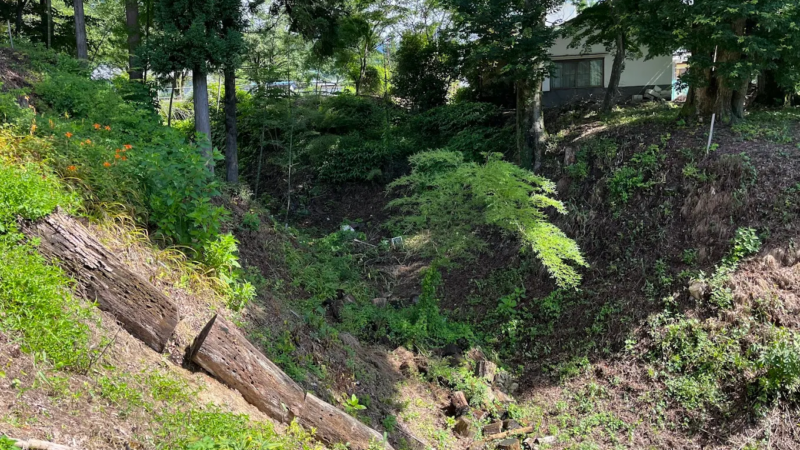
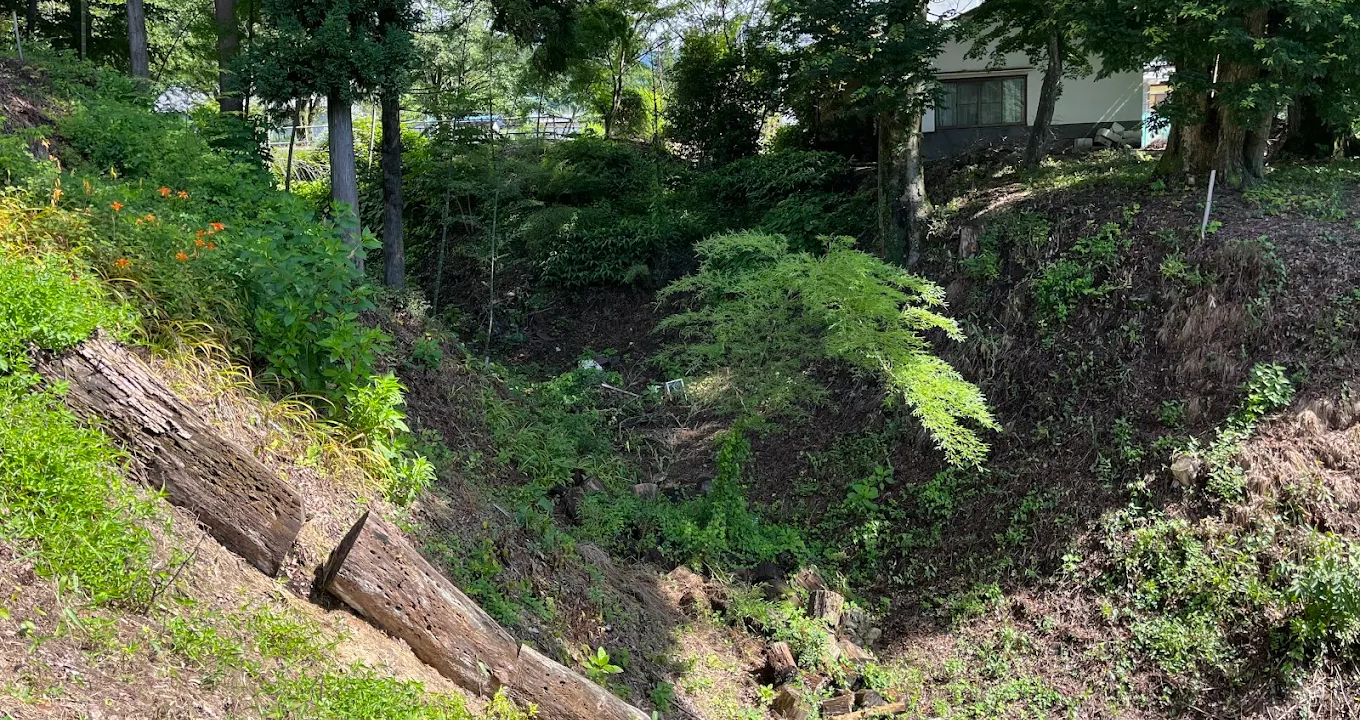
Dry Moats: Multiple dry moats demarcating the enclosures can be observed. Approximately 2-3 meters deep, they served as an important defensive line to prevent enemy intrusion.
Dry Moats: Dry moats cutting across the ridges were constructed, a structure designed to defend against attacks from the rear.
Enclosures: Multiple enclosures, including the main enclosure, are arranged in a stepped pattern, suggesting a division of roles among them.
Information boards are installed on the grounds of Hotel Kojokaku, explaining the locations of the remains and the history of the castle. However, visits may be restricted depending on the hotel’s operating status, so prior confirmation is recommended.
Highlights of Sarugakyo Castle
Remains of Earthworks and Dry Moats
The greatest highlight of Sarugakyo Castle is the well-preserved earthworks and dry moats. The earthworks around the main enclosure are particularly clear, allowing visitors to directly experience the castle-building techniques of the Sengoku period. The dry moats are also deep, providing valuable information for understanding the defensive structure of the time.
For photography, the spot on top of the earthworks overlooking the entire castle grounds is recommended. Combined with the view of Akatani Lake, you can experience the atmosphere of a Sengoku period mountain castle.
Value as a Site Associated with Uesugi Kenshin
Sarugakyo Castle is a site of extremely high historical value as a castle where Uesugi Kenshin stayed many times. As it was an important base during Kenshin’s invasion of the Kanto region, it is a must-see spot for Sengoku period history enthusiasts.
Many place names and legends related to Kenshin remain around the castle ruins, allowing visitors to enjoy a historical walk. The name of Sarugakyo Onsen (hot spring) is also related to Kenshin, so the entire hot spring town is enveloped in a historical atmosphere.
Collecting Castle Stamps
The Minakami Town Tourism Association sells castle stamps for Sarugakyo Castle. Two types are available: washi paper and cypress wood, making them popular collector’s items for castle enthusiasts.
Furthermore, a special edition castle stamp featuring an illustration of Uesugi Kenshin by Hiroyuki Suwahara has been issued in a limited run of 500 copies, attracting attention as a premium item.
Where to obtain:
- Minakami Town Tourism Association (1744-1 Tsukiyono, Minakami-machi, Tone-gun, Gunma Prefecture)
- Designated facilities within Sarugakyo Onsen (Business hours: 10:00-21:30, Closed: Tuesdays)
Access Information
Access by Car
Using the Kan-Etsu Expressway:
- Approximately 20 minutes from Tsukiyono IC via National Route 17
- Parking: Use the parking lot of Hotel Kojokaku (It is recommended to check with the hotel in advance before visiting)
Setting your car navigation system:
- Search for “Hotel Kojokaku” or “Sarugakyo Onsen, Minakami-machi, Tone-gun, Gunma Prefecture”
Access by Public Transportation
Using JR:
- Get off at “Gokan Station” on the JR Joetsu Line
- Take the Kan-Etsu Kotsu bus bound for “Sarugakyo Onsen” (approximately 30 minutes)
- Get off at the “Sarugakyo” bus stop and walk for approximately 5 minutes
Bus Timetable:
- Kanetsu Kotsu bus timetables vary seasonally, so advance confirmation is necessary.
- Due to limited service, it is recommended to plan your round trip in advance.
Points to Note When Visiting
- The castle ruins are located within the grounds of Hotel Kojokaku, so it is recommended to inform the hotel front desk before visiting.
- Some of the remains are on private property, so please be careful not to enter restricted areas.
- As it is a mountain castle, please wear comfortable shoes and clothing.
- While information boards are installed, their number is limited, so researching materials beforehand will deepen your understanding.
Nearby Tourist Attractions
Sarugakyo Checkpoint Ruins (Museum)
Located within walking distance of Sarugakyo Castle, the Sarugakyo Checkpoint Ruins were a checkpoint directly controlled by the shogunate, established as a key point on the Mikuni Kaido road during the Edo period. Established by the third shogun, Tokugawa Iemitsu, it is a valuable surviving example of checkpoint architecture.
Exhibition Contents:
- Checkpoint Pass
- Domain Notebook
- Traveler’s Notebook
- Pass from Ryokan’s Visit (Valuable Document)
Business Information:
- Opening hours and closing days vary by season; advance confirmation is necessary.
- Admission Fee: Approximately 200 yen for adults (subject to change)
Sarugakyo Onsen
After visiting the castle ruins, we recommend relaxing and unwinding at Sarugakyo Onsen. The hot spring town overlooking Lake Akatani has several day-trip bathing facilities.
Hot Spring Characteristics:
- Spring Water Quality: Calcium-Sodium Sulfate Spring
- Efficacy: Neuralgia, muscle pain, joint pain, etc.
- Many facilities have open-air baths offering spectacular views of Lake Akatani.
Lake Akatani (Aimata Dam)
This artificial lake, formed by the Aimata Dam, offers beautiful scenery throughout the seasons. It is particularly known as a scenic spot during the autumn foliage season.
Highlights:
- Selected as one of Japan’s Top 100 Dam Lakes
- Particularly beautiful in spring with its fresh greenery and in autumn with its vibrant foliage
- A well-maintained promenade along the lakeside makes it ideal for a stroll.
Numata Castle Ruins
Numata Castle, located about 30 minutes by car from Sarugakyo Castle, is known as a castle associated with the Sanada clan. It has deep historical ties to Sarugakyo Castle, and visiting both together will give you a deeper understanding of the history of Kozuke Province during the Sengoku period.
Features:
- A castle where Sanada Nobuyuki served as lord
- Currently developed as Numata Park
- Remains such as stone walls and moats remain
- A popular cherry blossom viewing spot in spring.
Sarugakyo Castle and the Mikuni Kaido Road of the Sengoku Period
Military Importance
The Mikuni Kaido Road was an important transportation route connecting Echigo and Kanto, and was an extremely important military route during the Sengoku period. Many Sengoku-era daimyo utilized this road, including Uesugi Kenshin’s invasion of Kanto, Takeda Shingen’s conquest of northern Shinano, and the Hojo clan’s northward advance.
Sarugakyo Castle was strategically located to monitor and control this Mikuni Kaido road, and controlling it meant advancing into Kanto. Kenshin’s repeated use of this castle indicates that he recognized its value not merely as a campsite, but as a strategic stronghold.
Function as a Supply Route
When advancing a large army from Echigo to Kanto, logistics (supply) was of paramount importance. Sarugakyo Castle was the terminus of the supply route from Echigo, and it is believed to have functioned as a base for distributing supplies to various parts of Kanto.
It is presumed that there were facilities for storing provisions and resting horses around the castle, suggesting that it possessed a complex function beyond a simple military structure.
Preservation Status and Future Challenges of Sarugakyo Castle
Current Preservation Status
The Sarugakyo Castle ruins are located within the grounds of Hotel Kojokaku and are therefore under private management. Fortunately, thanks to the hotel’s understanding, the remains are preserved in relatively good condition, and visitors can see the earthworks and dry moats.
However, there is always a risk of damage to the remains due to development and natural disasters, making a long-term preservation plan a challenge.
Value as a Cultural Property
Sarugakyo Castle has high historical value as a castle associated with Uesugi Kenshin, and is also an important site for understanding the structure of mountain castles during the Sengoku period. It is featured in castle research literature, including “The Complete Guide to Japanese Castles, Vol. 4,” and its academic evaluation is well-established.
In the future, formal designation as a cultural property and the formulation of a more systematic preservation and utilization plan are expected.
Recommended Itinerary for Visiting Sarugakyo Castle
Half-Day Course (3-4 hours)
- Visit Sarugakyo Castle Ruins (60 minutes)
- Park at Hotel Kojokaku parking lot
- Check the overall layout using the information board
- View the remains such as earthworks and dry moats
- Take photos
- Sarugakyo Checkpoint Ruins (40 minutes)
- Travel on foot
- Visit the museum
- View the checkpoint architecture
- Lunch and Bath at Sarugakyo Onsen (90 minutes)
- Enjoy dishes made with local ingredients
- Relax and unwind at the hot springs
Full-Day Course (6-7 hours)
In addition to the half-day course:
- Stroll around Akatani Lake (60 minutes)
- Stroll along the lakeside promenade
- Enjoy the seasonal nature
- Take photos
- Travel to and Visit Numata Castle Ruins (90 minutes)
- Approximately 30 minutes by car
- Visit castle ruins associated with the Sanada clan
- Stroll through Numata Park
History Enthusiast’s Tour (2 days)
Day 1:
- Sarugakyo Castle Ruins
- Sarugakyo Checkpoint Ruins
- Overnight stay at Sarugakyo Onsen
Day 2:
- Numata Castle Ruins
- Nagurumi Castle Ruins (related to the Sanada clan)
- Iwagutsu Castle Ruins (related to the Sanada clan)
This course allows you to comprehensively visit castles in northern Kozuke Province during the Sengoku period and experience the three-way battles between the Uesugi, Hojo, and Sanada clans.
Summary: The Charm of Sarugakyo Castle
Located in Minakami Town, Gunma Prefecture, Sarugakyo Castle (Miyano Castle) is an important mountain castle that has made its mark in history as a base for Uesugi Kenshin’s crossing of the mountains. Currently, remnants such as earthworks and dry moats remain on the grounds of Hotel Kojokaku, allowing you to feel the spirit of the Sengoku period.
Main Attractions of Sarugakyo Castle:
- Historical Value Associated with Uesugi Kenshin – A base for Kenshin’s invasions of the Kanto region, where he stayed many times.
- Excellent Preservation of Remains – Earthworks, dry moats, and trenches remain clearly visible.
- Strategic Point on the Mikuni Kaido Road – A crucial military and transportation hub connecting Echigo and Kanto.
- Combine with Nearby Sightseeing – Sarugakyo Onsen, the site of the checkpoint, Akatani Lake, etc.
- Easy Access – Approximately 20 minutes from the Kan-Etsu Expressway.
For those interested in the history of the Sengoku period, castle enthusiasts, and those who want to combine a hot spring trip with historical exploration, Sarugakyo Castle is an ideal destination. Why not experience the history of Kozuke Province during the Sengoku period, along with the beautiful scenery of Akatani Lake?
There are many ways to enjoy your visit, such as collecting castle stamps or touring nearby castles related to the Sanada clan. As part of your trip to enjoy the rich nature and historical culture of Minakami Town, be sure to visit Sarugakyo Castle.