Complete Guide to Mirokujiyama Castle (Wakayama Prefecture): The Battlefield of the Saika-shu and Oda Nobunaga’s Conquest of Kishu
Basic Information on Mirokujiyama Castle
Mirokujiyama Castle is a Sengoku period mountain castle built on Akibayama (also known as Goboyama or Mirokujiyama), a 73-meter-high mountain located in Akiba-cho, Wakayama City, Wakayama Prefecture. Currently, it is maintained as “Akibayama Park” and is affectionately known as “Citizens’ Hill” by local residents.
Castle Data
- Location: 14 Akiba-cho, Wakayama City, Wakayama Prefecture
- Year of Construction: Tensho 5 (1577)
- Builder: Saika-shu (led by Saika Magoichi)
- Lord: Saika Magoichi (Suzuki Magoichi)
- Castle Type: Mountain Castle
- Elevation: 73 meters
- Current Status: Developed as Akibayama Park
- Remains: A raised area believed to be the site of a watchtower (few clear remains)
- Designated Cultural Property: None
Access Information
Public Transportation
- From JR Wakayama Station, take the Wakayama Bus and get off at the “Akibayama” bus stop; it’s a short walk.
- Wakayama Bus is available from Nankai Wakayamashi Station.
By Car
- Approximately 15 minutes from the Hanwa Expressway Wakayama IC
- Parking: Akibayama Park parking available (free, approximately 30 spaces)
Visiting Hours: Open 24 hours (maintained as a park)
Estimated Time Required: Approximately 30 minutes to 1 hour
History and Background of Mirokujiyama Castle
Mirokuji Temple as a Sacred Site of the Ikkō-shū Sect
The existence of “Mirokuji Temple,” which stood on this site, is indispensable when discussing the history of Mirokujiyama Castle. Before the Sengoku period, Mirokuji Temple, an Ikkō-shū (Jōdo Shinshū) temple, was built on the summit of Akibayama Mountain.
Mirokuji Temple was the central base of the Ikkō-shū sect in Kii Province until the Washimori Dojo (later Honganji Sagimori Betsuin) was built. At this temple, Ikkō-shū followers of Kii Province gathered and formed a strong religious community.
It is believed that the 11th head priest of Honganji Temple, Kennyo Shonin, also stayed in this area, and a stone monument inscribed with “Kennyo Shonin’s Residence” still stands on the eastern side of the mountaintop. This monument is a valuable historical site that tells the story of how important Miroku-ji Temple was as a religious center.
The Saika-shu and the Ishiyama War
During the Tensho era (1573-1592), the Ishiyama War broke out between Oda Nobunaga and Ishiyama Honganji Temple. The Saika-shu of Kishu Province were an armed group with a strong faith base in the Ikkō-shū sect, and they took a stance against Oda Nobunaga at the request of Honganji Temple.
The Saika-shu were a confederation composed of powerful local clans such as the Suzuki, Tsuchihashi, Miyago, and Negoro clans, and among them, Saika Magoichi (also known as Suzuki Magoichi or Suzuki Shigehide), the head of the Suzuki clan, is known as the leader. The Saika-shu were also famous as a group of masters of firearms, and their fighting power was known throughout the country.
Oda Nobunaga’s Conquest of Kii Province in 1577
In March 1577 (Tensho 5), Oda Nobunaga launched an invasion of Kii Province to suppress the Saika clan, who supported Ishiyama Honganji Temple. The Oda army, with tens of thousands of troops, invaded Kii Province, capturing Nakano Castle, located at the entrance to Kii, and establishing their camp there.
The commander-in-chief of the Oda army was Oda Nobutaka, the third son of Oda Nobunaga, and included prominent generals such as Akechi Mitsuhide, Niwa Nagahide, and Takigawa Kazumasu. Against this massive army, Saika Magoichi designated Mirokuji Mountain as the site of the decisive battle, fortifying the entire mountain and preparing to confront the Oda army.
Construction of Mirokuji Mountain Castle and the Battle of Saika
Saika Magoichi utilized the site of Mirokuji Temple, originally a religious facility, and fortified the entire Akiba Mountain. With Mirokuji-yama Castle as its main base, the Saika clan established a multi-layered defensive network by strategically placing numerous subsidiary castles and forts in the surrounding area.
The main surrounding fortresses included the following:
- Saika Castle: One of the Saika clan’s main strongholds
- Nakatsu Castle: Captured by the Oda army
- Ota Castle: An important stronghold of the Saika clan
A fierce battle raged at Mirokuji-yama Castle, but the Saika clan gradually fell prey to the overwhelming forces of the Oda army. As Nakatsu Castle fell and other surrounding subsidiary castles successively, Saika Magoichi ultimately decided to surrender to the Oda army.
This Battle of Saika (Akibayama Ancient Battlefield) is recorded in Sengoku period history as an important battle in Oda Nobunaga’s unification of Japan.
Mirokuji-yama after the battle
After surrendering to the Oda army, Mirokuji-yama Castle is believed to have been abandoned. Subsequently, this area was again used as a religious site and as a living space for local residents.
During the Edo period, it came under the rule of the Kishu Tokugawa family, and Akibayama became a mountain of local faith. From the Meiji era onward, it was developed as a park, transforming into the Akibayama Park we see today.
Layout and Structure of Mirokujiyama Castle
Characteristics as a Mountain Castle
Mirokujiyama Castle is a mountain castle with characteristics of a flatland castle, built on a relatively low mountain with an elevation of 73 meters. While the entire mountain is believed to have been fortified, it is thought to have been a temporary fortress built in a short period, resulting in few permanent structures such as stone walls.
Structure of the Main Area
Summit Area (Main Enclosure Site)
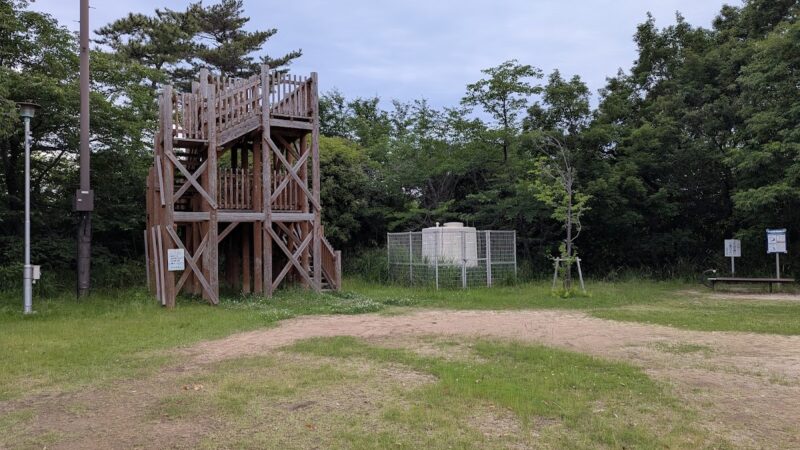
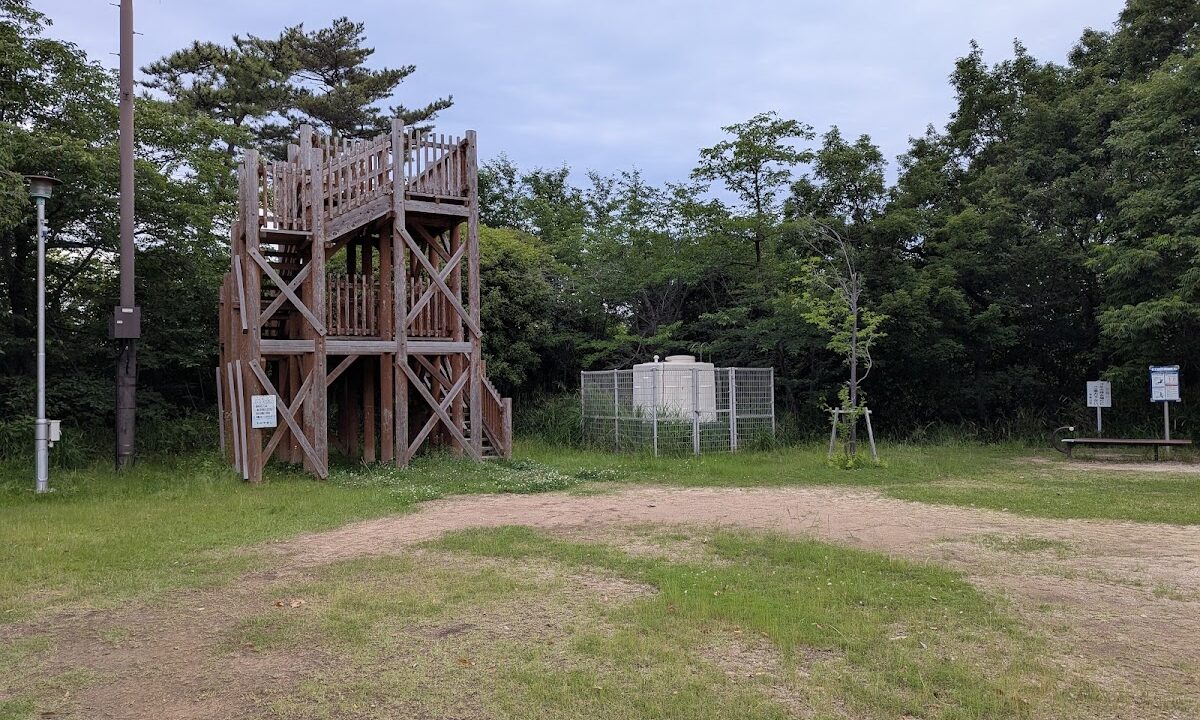
The flat area at the summit is presumed to be the site of the main enclosure. Currently, an observation deck and playground equipment are installed, making it the central facility of the park. The area measures approximately 50 meters east-west and 80 meters north-south, and is believed to be the site of Saika Magoichi’s main camp.
Watchtower Base Site
On the eastern side of the mountaintop, there is a rise approximately 20 meters east-west and 50 meters north-south, which is presumed to be the site of a watchtower base. A stone monument inscribed “Kennyo Shonin’s Standing Place” stands in the center of this rise. From this watchtower base, one can see a panoramic view of Wakayama city and the Kinokawa River area, suggesting its important position as a military observation post.
Enclosure Groups
Several elevation changes can be seen from the mountaintop to the mountainside, but it is unclear whether these are remnants of the original enclosures or later constructions. Due to significant topographical changes caused by park development, identifying the remains is difficult.
Defensive Structures
Because it was a temporary fortress built in a short period, there are currently very few clear traces of defensive structures such as stone walls or earthworks. It is presumed that the defenses mainly consisted of simple structures such as earthworks, fences, and barricades.
Current Akibayama Park and its Highlights
Park Development Status
The site of Mirokujiyama Castle has now been developed as “Akibayama Park,” serving as a place of relaxation for local residents. As its nickname, “Citizens’ Hill,” suggests, it is a park beloved by citizens, with various facilities installed.
Main Park Facilities
- Observation Deck: Located at the summit, offering panoramic views of Wakayama City.
- Playground Equipment: Multiple playground equipment for children.
- Gazebo: Rest area.
- Walking Paths: Walking paths are maintained throughout the mountain.
- Parking: Free parking (approximately 30 spaces).
- Toilets: Located within the park.
Historical Sites
Stone Monument of Abbot Kennyo’s Residence
This stone monument stands on a raised area on the east side of the summit, presumably the site of a watchtower. It was erected to commemorate the stay of Abbot Kennyo, the 11th head of Honganji Temple, in this location. It is a valuable historical site indicating that Miroku-ji Temple was an important base for the Ikkō-shū sect.
Explanatory Board for the Battle of Akibayama
An explanatory board about the Battle of Saika (Akibayama Battlefield) is installed within the park, allowing visitors to learn about the history of the fierce battle that took place here. The information board details Oda Nobunaga’s conquest of Kishu, Saika Magoichi’s resistance, and the course of the battle.
View from the Observation Deck
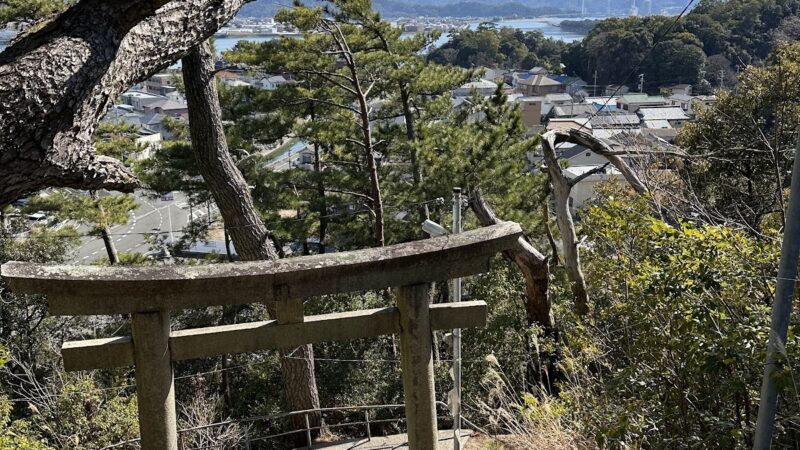
From the observation deck at the summit, you can enjoy a panoramic view of Wakayama city. On a clear day, you can see the Kinokawa River, Wakayama Castle, and even the Kii Channel, giving you a real sense of the strategic importance of this location.
Saika Magoichi likely monitored the movements of the Oda army and planned his strategies from this high vantage point. This is a valuable spot where you can experience the perspective of a warlord of that time.
About Saika Magoichi and the Saika-shu
Who was Saika Magoichi (Suzuki Magoichi)?
Saika Magoichi is a figure known as the leader of the Saika-shu of Kishu during the Sengoku period. His real name is said to be Suzuki Shigehide, and he is also called Suzuki Magoichi. However, it is possible that multiple people used the name “Saika Magoichi,” and there are various theories about his historical identity. Saika Magoichi was known as a master marksman, and his marksmanship was renowned throughout Japan. He was also an excellent commander of the Saika-shu, a courageous warrior who fearlessly challenged even Oda Nobunaga, the unifier of Japan.
Characteristics of the Saika-shu
The Saika-shu were an armed group based in Saika-sho (present-day Wakayama City area) in northwestern Kii Province. Their characteristics are as follows:
A Group of Master Marksmen
The Saika-shu were early adopters of firearms, the latest weapon at the time, and possessed superior operational skills. After firearms were introduced to Tanegashima, Kii Province became a major production center for firearms, and the Saika-shu were feared as one of Japan’s leading marksman groups.
A Maritime Power
Based on the coast of Kii Province, the Saika-shu also possessed a naval aspect. They controlled maritime traffic and excelled in the transport of supplies and naval battles.
Ikkō-shū Faith
Many of the Saika-shū were devout followers of the Ikkō-shū (Jōdo Shinshū) sect, and had strong ties to Hongan-ji Temple. This religious unity was the source of the Saika-shū’s cohesion.
A Federation of Local Samurai
The Saika-shū were not a military force serving a single warlord, but rather a federation of powerful local clans such as the Suzuki, Tsuchihashi, Miyago, and Negoro clans. While they operated independently in peacetime, they united to fight against external enemies.
Related Historical Sites in the Surrounding Area
Wakayama Castle
Located approximately 3 kilometers northeast of Mirokuji-yama Castle, Wakayama Castle was built in 1585 by Toyotomi Hidenaga, the younger brother of Toyotomi Hideyoshi. During the Edo period, it flourished as the residence of the Kishu Tokugawa family, and is now designated a national historical site.
The castle tower was rebuilt in reinforced concrete in 1958, and the interior is open to the public as a museum. It is an essential spot for learning about Wakayama’s history.
Saika Castle Ruins
Saika Castle, considered one of Saika Magoichi’s main bases, is believed to have been located in the Saikazaki district in western Wakayama City. While no clear remains exist today, its name is preserved in place names and legends.
Ota Castle Ruins
Ota Castle, located in Ota, Wakayama City, was the residence of the Ota clan, a powerful local family of the Saika clan. It is known as the castle that fell to a water siege during Toyotomi Hideyoshi’s conquest of Kishu in 1585. Currently, the “Ota Castle Water Siege Embankment Ruins” are designated as a national historic site.
Honganji Sagimori Branch Temple
Located in Sagimori, Wakayama City, Honganji Sagimori Branch Temple became the central temple of Jodo Shinshu Buddhism in Kishu, succeeding Mirokuji Temple. It is an important historical site for understanding the relationship between the Saika clan and the Ikkō-shū sect.
Points to Note When Visiting Mirokujiyama Castle
Tips for Visiting
Engage Your Historical Imagination
Mirokujiyama Castle has been developed into a park, so very few clear castle remains are left. However, the view from the mountaintop, the topography, and the information on the explanatory signs allow you to imagine the battles of that time.
Stand on the observation deck, gaze in the direction from which the Oda army attacked, and reflect on what Saika Magoichi must have felt as he tried to defend this land.
Combining with Nearby Historical Sites
Since visiting Mirokuji-yama Castle alone only takes about 30 minutes, we recommend combining it with other nearby historical sites such as Wakayama Castle and Ota Castle Ruins. This will allow you to gain a deeper understanding of the history of the Saika-shu and Oda Nobunaga’s conquest of Kishu.
Season and Time of Day
The park is open 24 hours a day, but for the best views, we recommend visiting on a sunny day during the daytime. It’s also a popular spot for cherry blossom viewing during the cherry blossom season (late March to early April).
Photo Spots
- Panoramic view of Wakayama city from the mountaintop observation deck
- Stone monument marking the seat of Abbot Kennyo
- Explanation board for the Akibayama battlefield
- Elevated area believed to be the site of a watchtower
Historical Significance of Mirokujiyama Castle
Conflict between the Ikkō-ikki and Sengoku Daimyo
The battle at Mirokujiyama Castle symbolizes the conflict between the Ikkō-ikki forces and the Sengoku daimyo during the Sengoku period. It holds significant historical importance in Japan because it represents a confrontation between the power of a people united by religious beliefs and Oda Nobunaga, the powerful ruler of the time.
Saika-shū’s Firearms Tactics
The Saika-shū were a pioneering group that effectively utilized firearms, a new weapon. It is believed that tactics utilizing firearms were employed in the battle at Mirokujiyama Castle, making it a valuable example for considering the history of military technology in the Sengoku period.
Importance in Local History
In the history of Kishu (Wakayama Prefecture), the Saika clan played a significant role in establishing a unique culture and tradition. Mirokuji-yama Castle is a valuable historical site that conveys the history of the Saika clan to the present day, and is an important element in forming Wakayama’s regional identity.
Geographical Environment of Mirokuji-yama Castle
Natural Environment
Akiba-yama is an isolated hill located southwest of Wakayama City. Although a low mountain at 73 meters above sea level, the surrounding plains provide excellent views from the summit.
The mountain is mainly covered with evergreen broad-leaved forests, and as a valuable green space close to the urban area, it plays an important role from the perspective of ecosystem conservation.
Topographical Characteristics
Located near the mouth of the Kinokawa River, it has long been a transportation hub. This area, situated at the point where sea and land meet, has been considered important as a center for the collection and distribution of goods, and as a strategically important military location.
The terrain clearly shows that securing this area was strategically essential for the Oda army’s invasion of Kishu.
References and Research Materials
Main references and materials for learning about Mirokujiyama Castle:
- *Wakayama City History* (Wakayama City History Compilation Committee)
- *Research on the Saika-shu* (Related academic papers)
- *The Battles Between Oda Nobunaga and Honganji* (Sengoku period history research book)
- *Castles of Kii Province* (Castle research book)
- Cultural property survey report by the Wakayama City Board of Education
- Research reports from various castle research websites
Summary: The Charm of Mirokujiyama Castle
Mirokujiyama Castle may be somewhat disappointing to castle enthusiasts due to the lack of clear castle remains. However, this place bears the mark of the spirit of the Saika-shu, who fought with conviction against Oda Nobunaga, the unifier of Japan.
The history of Akibayama, which has transformed from a sacred site of the Ikkō-shū sect to a battlefield and then to a park for citizens to relax in, tells the story of the multifaceted nature of Japanese history. Why not reflect on the turbulent history of the Sengoku period while gazing at Wakayama city from the observation deck?
With its easy access and compatibility with other historical sites such as Wakayama Castle, Mirokujiyama Castle is a must-visit spot for history buffs visiting Wakayama.