Egami-yakata (Tainai City, Niigata Prefecture) – The Residence of the Nakajo Clan and the Complete Picture of the Okuyama-no-Sho Castle Ruins
What is Egami-yakata?
Egami-yakata is a medieval flatland castle located in Hongō-machi, Tainai City, Niigata Prefecture. It is known as the residence built by the Nakajo clan, the head family of the Miura-Wada clan, local lords of Echigo Province. Currently, it is preserved and maintained as a core component of the national historic site, “Okuyama-no-Sho Castle Ruins.”
Located in the northern part of Echigo, at the head of a fan-shaped plain formed from a former lagoon, this castle site is a flatland castle with a multi-enclosure structure centered around a square main enclosure surrounded by high earthen ramparts, preserving the typical appearance of a medieval castle site.
Positioning as part of the Okuyama-no-Sho Castle Ruins
Egami-yakata is the central site of several ruins designated as a national historic site, the Okuyama-no-Sho Castle Ruins. The Okuyama-sho Castle Ruins include the following historical sites:
- Egami-kan Ruins: The residence that served as the base of the Nakajo clan
- Torisaka Castle Ruins: A fortified castle that functioned as a mountain castle
- Kurata-kan Ruins: The site of a related residence
- Other Related Ruins: The remains of various facilities that constituted Okuyama-sho
These ruins are valuable historical materials that show how the administrative centers of samurai were structured under the medieval manorial system.
History of Egami-kan
The Miura-Wada Clan and Echigo Okuyama-sho
The history of Egami-kan dates back to the Genpei War. Following his achievements in pursuing Kiso Yoshinaka, Miura-Wada Yoshishige was granted the position of jitō (land steward) of Echigo Okuyama-sho, marking the beginning of the Miura-Wada clan’s rule in this region.
In 1277 (Kenji 3), when Miura Wada Tokishige divided his territory among his three grandsons, the family of his eldest grandson, Shigetsura, inherited the Nakajo area and adopted the name Nakajo. This Nakajo clan established Egami Castle as their residence, and it subsequently became the central power base in the region.
Development and Rule of the Nakajo Clan
As the main branch of the Miura Wada clan, the Nakajo clan established a strong base in northern Echigo Province. From the Kamakura period to the Muromachi period, they established regional control as the jitō (land steward) of Okuyama Manor, making Egami Castle their political and military center.
Throughout the Middle Ages, the Nakajo clan played the following roles:
- Collection of land tax and land management as a manor lord
- Maintaining local security and mediating disputes
- Maintaining relations with the shogunate and shugo (provincial governors)
- Maintaining leadership of the family and retainers and maintaining military strength
Changes in the Sengoku Period
With the arrival of the Sengoku period, the Nakajo clan sought to survive amidst the complex political situation in Echigo. They strived to maintain their sphere of influence while maintaining relationships with powerful daimyo in Echigo, including the Uesugi clan.
During this period, in addition to their residence, Egami Castle, they are thought to have used Torisaka Castle, a mountain castle, as a fortified stronghold, establishing a system to utilize different bases in peacetime and wartime. Egami Castle, a flatland castle, served as a place for daily administrative affairs and residence, while Torisaka Castle, a mountain castle, functioned as a well-defended wartime refuge.
Structure and Characteristics of Egami Castle
Overall Size and Layout
Egami Castle is a flatland castle measuring approximately 100 meters east-west and 180 meters north-south. The castle complex consists of a multi-enclosure structure, with the main building at the center and the outer enclosure consisting of sections on the north and south sides.
Located in the northern plains of Echigo, on the fan-shaped edge of a region formed from a former lagoon, it boasted excellent water resources and transportation access, making it an ideal location for a manorial base.
Structure of the Main Enclosure
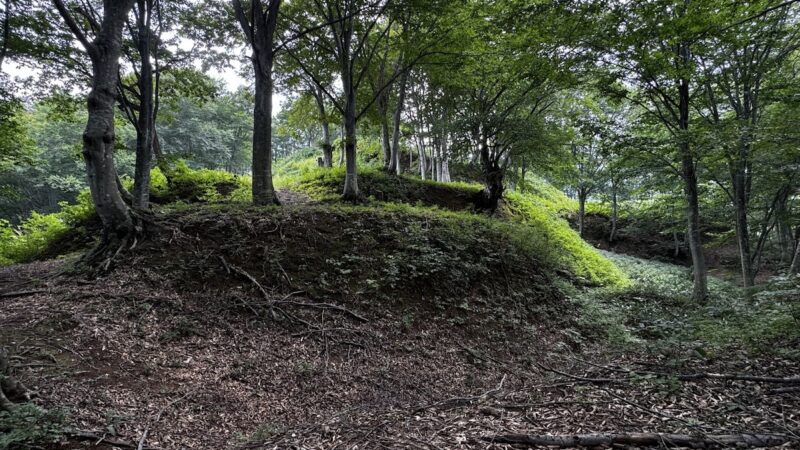
The main enclosure, the heart of the Egami Castle, is a rectangular section surrounded by high earthen ramparts. The height and thickness of the ramparts are remarkable for a flatland castle, serving both defensive functions and as a symbol of authority.
Features of the Main Enclosure:
- Rectangular Plan: A neatly arranged rectangular section
- High Earthen Ramparts: High earthen ramparts surrounding the perimeter
- Moat (Waterway): Waterways surround the east and west sides, serving both defensive and drainage purposes
- Tiger’s Moat (Entrance): Reinforced defense through limited entrances
Arrangement of Earthen Ramparts and Moats
A notable feature of the Egami Castle’s defensive facilities is the combination of earthen ramparts and water moats (waterways). Surrounded on the east and west by waterways, and with earthen ramparts built along them, the castle, though on a flatland, formed a strong defensive line.
These earthen ramparts were not merely defensive structures; they also clearly defined the boundaries of the castle and enhanced the authority of its inhabitants. In medieval castles, the height and size of the earthen ramparts were important indicators of the lord’s status.
Arrangement of the Enclosures
The enclosures located north and south of the main enclosure are presumed to have had different functions.
- North Enclosure: Facilities such as residences and stables for retainers
- South Enclosure: Economic facilities such as warehouses and workshops
- Main Enclosure: The lord’s residence and administrative functions
This functional differentiation is a common characteristic of medieval castle sites, and it is clear that the Egami Castle also had a typical structure.
Current Egami Castle Site
Development as a Historic Site
The Egami Castle site is a nationally designated historic site, and restoration and development based on archaeological excavations are underway. The following remains can be seen at the site:
- Restored Earthworks: A portion of the earthworks surrounding the main enclosure has been restored.
- Moat Markings: The location of the former moat can be seen as a topographical feature.
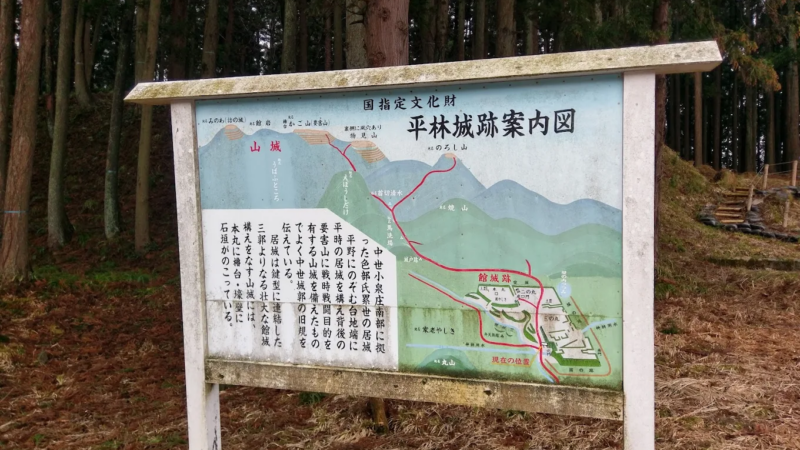
- Information Boards: Explanation panels are installed at various locations.
- Remains Markings: Markings indicating the locations of building remains, etc.
The well-maintained castle site is open to the public as a park and can be freely visited. A major attraction is the opportunity to experience the scale of the defensive facilities at the time by walking along the earthworks.
Okuyama-so Historical Museum
Adjacent to the Egami Castle Site is the “Okuyama-so Historical Museum,” which displays the history of Okuyama-so and many artifacts excavated from the castle ruins, including the Egami Castle Site.
Exhibition Contents:
- Historical panels explaining Okuyama Manor
- Excavation results from the Egami Manor site, Torisaka Castle site, etc.
- Excavated artifacts (ceramics, iron products, wooden products, etc.)
- Genealogy of the Nakajo clan and the Miura-Wada family
- Materials on the medieval Echigo manor system
- Reconstruction models and illustrations
With its easy-to-understand exhibits using numerous photographs and illustrations, you can gain a deep understanding of the history of Egami Manor and Okuyama Manor.
Facility Information:
- Operating Period: April to November (Closed during winter)
- Opening Hours: 9:00 AM to 5:00 PM
- Closed Days: Mondays (If Monday is a public holiday, closed the following day)
- Admission Fee: 200 yen for adults, 100 yen for elementary and junior high school students (group discounts available)
Access Information
Location
Hongo-cho, Tainai City, Niigata Prefecture (formerly Nakajo-machi)
Access by Car
- Nihonkai Tohoku Expressway: Approximately 10 minutes from Nakajo IC
- National Route 7: Approximately 15 minutes from Tainai city center via prefectural roads
- Parking: Free parking available at Okuyama-so Historical Museum (approximately 20 spaces for regular cars)
Access by Public Transportation
- JR Uetsu Main Line: Approximately 10 minutes by taxi from Nakajo Station
- Local Buses: Due to limited service, prior confirmation is necessary.
It’s a considerable distance from Nakajo Station, so taking a taxi is recommended.
Highlights of Egami Castle
The Impressive High Earthworks
The greatest highlight of Egami Castle is its restored high earthworks. It’s rare to find a castle site with earthworks of this scale, especially for a flatland castle, demonstrating the power and technical prowess of the Nakajo clan.
Climbing to the top of the earthworks allows you to survey the entire castle grounds and appreciate how the defensive lines functioned at the time. You can also see the surrounding plains, understanding the strategic importance of this location on an alluvial fan.
Topography of the Moat Remains
The remains of the moat (water channel) that surrounded the castle on the east and west sides are still clearly visible as topography. Walking while imagining how it functioned as a water moat provides a more three-dimensional understanding of the flatland castle’s defensive system.
The Space Inside the Main Enclosure
The interior of the main enclosure, surrounded by earthworks, is a spacious, rectangular area. It is believed that the lord’s residence and government offices once stood here, and archaeological excavations have confirmed postholes and other building remains.
A diagram of the building layout is shown on the site’s information board, allowing visitors to imagine what the residence looked like at the time.
Seasonal Scenery
The Egami Manor site has been developed into a park, allowing visitors to enjoy the changing seasons. The fresh greenery of spring, the lush vegetation of summer, the vibrant autumn leaves, and the snowy winter landscape all offer distinct views.
Related Historical Sites in the Surrounding Area
Torisaka Castle Ruins
Torisaka Castle is a mountain castle that complements Egami Manor. Built on a mountaintop approximately 220 meters above sea level, it was used as a fortified stronghold by the Nakajo clan during the Sengoku period.
Located about 15 minutes by car from Egami Manor, visiting both together allows for an understanding of the medieval castle system that utilized both flatland and mountain castles. From Torisaka Castle, one can enjoy a panoramic view of the Tainai Plain, clearly demonstrating its strategic military location.
Kurata Castle Site
This is another castle site that makes up the Okuyama-sho Castle Ruins. It is thought to have been a subsidiary castle of the Egami Castle and may have functioned as a residence for the Nakajo clan.
Other Historical Sites in Tainai City
Tainai City has many medieval historical sites besides Egami-kan:
- Otoboji Temple: An ancient temple founded in the Nara period, which received protection from the Nakajo clan during the medieval period.
- Kurokawa Castle Ruins: The ruins of a medieval mountain castle.
- Various Manor Sites: Scattered ruins of small manor sites that made up Okuyama-sho.
Points to Note When Visiting Egami-kan
Estimated Visit Time
- Manor Site Only: 30 minutes to 1 hour
- Including History Museum: 1 hour 30 minutes to 2 hours
- Including Surrounding Historical Sites: Half a day to a full day
Clothing and Equipment
- Comfortable Walking Shoes: Essential for walking on the earthworks.
- Seasonal Clothing: Sun protection in summer, warm clothing in winter.
- Rain Gear: Pay attention to the weather as it is an outdoor site.
Photography Tips
- Panoramic View of the Earthwork: Capturing the scale of the earthwork from a distance
- View from the Top of the Earthwork: Landscape including the surrounding plains
- Topography of the Moat Remains: Emphasizing the depth of the moat from a low position
- Information Board and Remains: For documentation purposes
Best Seasons for Visiting
- Spring (April-May): Beautiful fresh greenery, and the history museum is open
- Autumn (September-November): Autumn foliage and pleasant weather
- Summer (June-August): Abundant greenery, but heat protection is essential
- Winter (December-March): History museum is closed, and visiting in snow is difficult
Historical Significance of Egami Castle
Value in Medieval Manor Research
Egami Castle is an extremely important site for studying the medieval manor system and the samurai’s governing system. It is a valuable example that concretely shows what kind of residence a samurai who ruled a manor as a jitō (land steward) had and how they governed the region. ### Contribution to the Study of Flatland Castles
Among the many medieval castles that were mountain castles, the well-preserved remains of a flatland castle like Egami Castle are invaluable. In particular, as a typical example of a square-shaped castle with high earthen ramparts, it occupies an important position in castle research.
Center for the Study of the Miura-Wada Clan
As physical evidence showing how the Miura-Wada clan, based in Sagami Province, expanded into Echigo Province and established their power, Egami Castle is an indispensable historical site in the study of the Miura-Wada clan.
Summary
Egami Castle, a medieval flatland castle remaining in Tainai City, Niigata Prefecture, is a valuable historical site with a clear historical background as the residence of the Nakajo clan, the head family of the Miura-Wada clan. Its multi-enclosure structure, centered on a square main enclosure surrounded by high earthen ramparts, is typical of medieval castle sites and is preserved and maintained as a national historical site.
Visiting it in conjunction with the Okuyama-so Historical Museum allows for a deeper understanding of the medieval manor system, samurai residences, and the history of Echigo Province. Visiting Egami Castle along with other nearby historical sites such as Torisaka Castle will provide a comprehensive understanding of the castle system in northern Echigo during the medieval period.
Egami Castle is a must-see historical site for history enthusiasts, castle fans, anyone interested in medieval history, or anyone wanting to learn about the history of Niigata Prefecture. With its well-maintained remains and comprehensive exhibition facilities, it is a historical park that can be enjoyed by many people, even without specialized knowledge.