Kabasawa Castle (Minamiuonuma City, Niigata Prefecture) Complete Guide: Birthplace of Uesugi Kagekatsu and Site of the Fierce Battle of the Otate Rebellion
Located in Minamiuonuma City, Niigata Prefecture, Kabasawa Castle is known as an important mountain castle in Echigo Province during the Sengoku period, a base for Uesugi Kenshin’s expansion into the Kanto region, and the birthplace of Uesugi Kagekatsu. It was the site of a fierce battle between the Hojo and Uesugi clans during the Otate Rebellion, and valuable remains still exist today as a prefectural historical site. This article provides a detailed explanation of Kabasawa Castle, from its history and the characteristics of its remains to access information and nearby attractions.
Basic Information on Kabasawa Castle
Location and Situated Area
Location: 30 Kabanosawa, Minamiuonuma City, Niigata Prefecture
Former Province: Echigo Province
Elevation: 304 meters (Main Keep Site)
Relative Height: Approximately 100 meters
Kabasawa Castle is located about a 5-minute walk from Jōetsu Kokusai Ski Resort Station on the JR Jōetsu Line, and is also close to Ōsawa Station. With the Tochikubo Pass and Ōsawa Pass, which lead to Echigo Fuchū (Kasugayama), behind it, and controlling the junction of the Mikuni Kaido and Shimizu Kaido roads, the gateways to the Kanto region, it is a mountain castle built at a strategic transportation hub.
Common Names and Alternate Names
Kabasawa Castle is known by several names.
- Kabanosawa Castle
- Mariko Castle
- Kabagata Castle
These alternative names reflect changes in the pronunciation of the place name and variations in its designation over time.
Classification and Structure
Classification: Mountain Castle
Builder: Tanaka Uemon-no-jo (legend)
Construction Period: Nanboku-cho period
Major Renovators: Uesugi Kenshin, Kuribayashi clan
Main Lords: Nagao clan, Kuribayashi clan, Uesugi clan
Keep Structure: None (No keep exists as it is a mountain castle)
Remains: Enclosures, earthworks, dry moats, ridged vertical moats, placenta mound
Designated Cultural Property: Niigata Prefecture Designated Historic Site
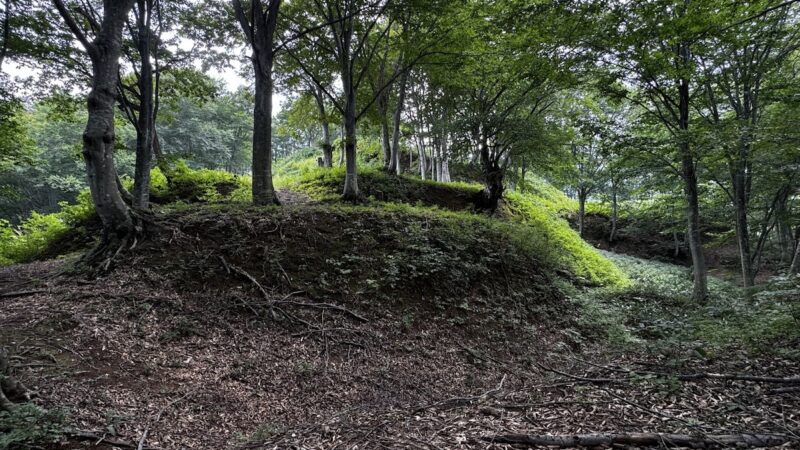
The most distinctive feature of Kabasawa Castle is its unique construction technique called “Inyo-bori” (encircling moat), where dry moats and earthworks surround the lower half of the mountain in a triple or quadruple ring-like fashion. This structure is unique in the prefecture and forms an extremely robust defensive system.
History of Kabasawa Castle
From Construction to the Era of Uesugi Kenshin
Kabasawa Castle is believed to have been built during the Nanboku-cho period (Northern and Southern Courts period), and initially functioned as a branch castle of the Nagao clan, whose main base was Sakado Castle. Sakado Castle was a key base for controlling the Uonuma region, and Kabasawa Castle is thought to have played a part in its defensive line.
After Uesugi Kenshin’s conquest of Echigo Province, Kabasawa Castle became a branch castle of Kasugayama Castle, and its role changed significantly. Kenshin actively expanded into the Kanto region, repeatedly conducting military operations in northern Kanto and Kozuke Province, and Kabasawa Castle served as a “shukujiro” (a post castle) at the gateway to Kanto. A shukujiro is a castle used as a relay point or supply base during expeditions, and it was an important strategic base in Kenshin’s Kanto campaigns.
During this period, the castle was also renovated, and the Kuribayashi clan was appointed as the castle lord. The Kuribayashi clan were important retainers of the Uesugi clan and were entrusted with the governance and defense of this region.
The Birthplace of Uesugi Kagekatsu
At Kabasawa Castle, the “Enazuka” (placenta mound) of Uesugi Kagekatsu remains. The placenta refers to the umbilical cord and other tissues that surrounded the fetus; at the time, it was customary to bury them as a memento of birth.
While Sakado Castle is generally considered to be Uesugi Kagekatsu’s birthplace, the existence of this Enazuka has led to strong support for the theory that he was born at Kabasawa Castle. Kagekatsu was born the son of Nagao Masakage and Sentoin (Uesugi Kenshin’s sister), and later became Kenshin’s adopted son, inheriting the Uesugi family.
The Enazuka still remains within the castle grounds and is a popular historical site for history buffs, attracting many visitors interested in Kagekatsu’s connection to the area.
The Otate Rebellion and the Fierce Battle of Kabasawa Castle
The most important event in the history of Kabasawa Castle is the “Otate Rebellion,” which began in 1578 (Tensho 6).
Background of the Otate Rebellion
Following the sudden death of Uesugi Kenshin, a fierce succession struggle erupted between Uesugi Kagekatsu and Uesugi Kagetora (the seventh son of Hojo Ujiyasu and Kenshin’s adopted son) over his succession. Kagetora received support from the Odawara Hojo clan, while Kagekatsu garnered support from the Takeda clan and powerful local lords within Echigo Province.
Hojo Invasion
During the Otate Rebellion, the Odawara Hojo clan, in order to support Kagetora, led a large army to invade Echigo Province. The Hojo forces crossed the Mikuni Pass and entered Ueda-sho (present-day Minami-Uonuma region), targeting Kabasawa Castle and Arato Castle.
Kabasawa Castle was a frontline stronghold controlling the invasion route from Kanto, and a crucial bridgehead for the Hojo army’s invasion of Echigo. The large army led by Hojo Ujimasa besieged Kabasawa Castle and Arato Castle, engaging in a fierce siege.
The Fall and Recapture of Kabasawa Castle
Kabasawa Castle boasted a strong defense with a surrounding moat, but it ultimately fell to the large Hojo army. The Hojo army occupied Kabasawa Castle and used it as a base for invading Echigo Province.
However, as winter approached, Hojo Ujimasa, in order to escape the harsh Echigo winter, sent his main force back to the Kanto region, leaving only a small number of defenders behind. Seizing this opportunity, Uesugi Kagekatsu’s forces launched a counterattack.
Kagekatsu’s army attacked Kabasawa Castle, which was now lightly defended, and successfully recaptured it. This recapture of Kabasawa Castle was one of Kagekatsu’s important victories in the Otate Rebellion and ultimately contributed to Kagekatsu’s succession to the family headship.
Until the Castle’s Abandonment
After the Otate Rebellion, Kabasawa Castle once again came under the control of the Uesugi clan and continued to play a part in the defense of Echigo Province. However, in 1598, when Uesugi Kagekatsu was transferred to Aizu with a 1.2 million koku domain by order of Toyotomi Hideyoshi, Kabasawa Castle also ceased to serve its purpose and was abandoned.
With the transfer to Aizu, Echigo Province came under the control of clans such as the Hori and Mizoguchi, and mountain castles like Kabasawa Castle lost their strategic value. From then on, Kabasawa Castle quietly withdrew from the stage of history, and its remains have survived to the present day.
Remains and Highlights of Kabasawa Castle
Main Enclosure Site and View
Located at an altitude of 304 meters, the main enclosure site is the highest point of Kabasawa Castle and the central area where the former lord resided. Currently, it is a flat enclosure, offering a spectacular view of the former Ueda-sho and the surrounding mountains.
The views can be enjoyed throughout the seasons, and the autumn foliage season, in particular, offers a beautiful view of the colorful mountains and the Uonuma Plain, making it well worth a visit. On a clear day, you can see famous peaks such as the Tanigawa mountain range and Mount Hakkai in the distance.
Encircling Moat
The most distinctive feature of Kabasawa Castle is the “encircling moat,” a system of dry moats and earthworks that surrounds the lower half of the mountain in three or four layers. This defensive system encircles the entire mountain in multiple layers like a headband, providing multiple layers of protection against enemy intrusion.
This is a unique castle construction technique, unparalleled in Niigata Prefecture, and is believed to have been implemented during renovations by the Uesugi clan. The dry moats and earthworks that remain clearly visible today attest to the high level of castle construction technology at the time.
The way the main keep is surrounded by two layers of outer baileys, and further surrounded by multiple layers of dry moats and earthworks, allows you to truly appreciate the high level of its defensive capabilities when you actually climb the castle and walk around.
Ridge-Shaped Vertical Moat
Behind the main keep, there are distinctive remains called ridge-shaped vertical moats. A ridged trench is a series of trenches dug in a ridge-like pattern on a mountain slope, serving as a defensive structure to prevent enemy flank attacks and flanking maneuvers.
The ridged trenches at Kabasawa Castle are well-preserved and are valuable historical remains for learning about the defensive techniques of mountain castles during the Sengoku period. In recent years, the area behind the main keep has also been improved, making it easier to visit.
Enclosures and Earthworks
Several enclosures (flat areas) are arranged in a stepped pattern around the main keep. Each enclosure is separated by earthworks, and each functioned as an independent defensive unit.
The main enclosures, such as the second and third enclosures, are thought to have been used as garrisons for soldiers and storage areas for supplies. Many of the earthworks are about 2-3 meters high and remain well-preserved today.
Placenta Mound (Enazuka)
The Placenta Mound, believed to contain the placenta of Uesugi Kagekatsu, is an important historical site within the castle ruins. A stone monument stands there, commemorating the legend of Kagekatsu’s birthplace.
The area around the Placenta Mound is well-maintained, making it a must-see spot for history buffs. Considering that Kagekatsu later became one of the Five Elders under the Toyotomi regime and a daimyo of Aizu with a 1.2 million koku domain, it’s deeply moving to think that this place was the starting point of his life.
Access and Castle Visit Information
Access by Public Transportation
JR Joetsu Line
- Approximately 5 minutes on foot from Joetsu Kokusai Ski Resort Station
- Approximately 10 minutes on foot from Osawa Station
Joetsu Kokusai Ski Resort Station is the nearest station, and the castle ruins entrance is very close, making access easy. Following the signs from the station will lead you there without getting lost.
Access by Car
Kan-Etsu Expressway
- Approximately 15 minutes from Muikamachi IC
- Approximately 10 minutes from Shiozawa-Ishiuchi IC
There is parking space near the castle ruins entrance, but the number of spaces is limited, so early arrival is recommended on holidays and during the autumn foliage season.
Precautions When Visiting the Castle
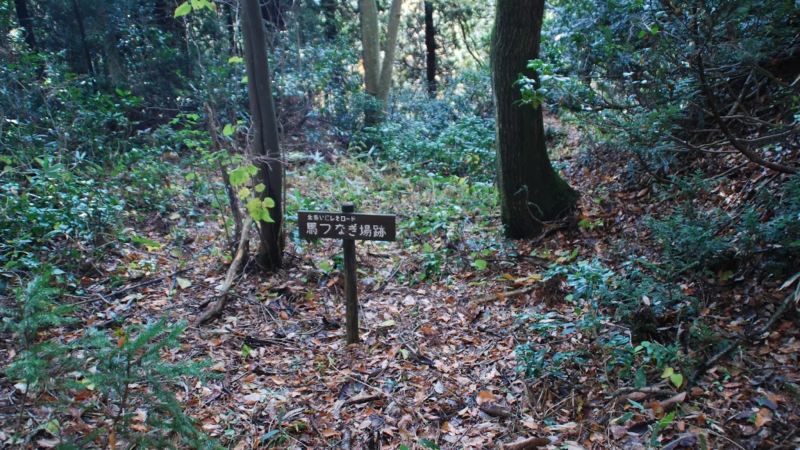
- Estimated Time: Approximately 20-30 minutes on foot to the main keep
- Difficulty: Intermediate (Mountain trails, some physical fitness required)
- Clothing: Hiking boots or trekking shoes recommended
- Season: Spring to autumn is suitable for visiting the castle. Winter is dangerous due to snow.
- Items to Bring: Drinking water, insect repellent (summer), bear bell (just in case)
The climbing path is well-maintained, but it is a mountain trail and can become slippery during and after rain. Also, in summer, the vegetation is dense, so wearing long sleeves and long pants is recommended.
Tourist Attractions Around Kabasawa Castle
Sakado Castle Ruins
Sakado Castle, considered the main castle of Kabasawa Castle, is a large mountain castle known as the residence of the Nagao and Uesugi clans. It is also famous as the castle where Uesugi Kagekatsu spent his childhood. Visiting both Kabasawa Castle and Sakado Castle together will give you a deeper understanding of the Sengoku period history of this region.
Sakado Castle Ruins are also a nationally designated historical site, and its magnificent layout and remains are still preserved.
Unto-an Temple
An ancient temple of the Soto Zen sect, known as the temple where Uesugi Kagekatsu and Naoe Kanetsugu studied in their childhood. It has been revered as a famous temple in Echigo, to the point that there is a saying, “Have you set foot on the soil of Unto-an?”
The temple grounds feature beautiful gardens and historical buildings, allowing you to reflect on history in a tranquil atmosphere. It is approximately a 15-minute drive from Kabasawa Castle.
Hakkaisan
One of Japan’s 200 Famous Mountains, this renowned peak has been revered as a sacred mountain since ancient times. You can take a ropeway halfway up the mountain and enjoy magnificent views. The sake “Hakkaisan,” brewed with the mountain’s spring water, is also nationally famous.
Uonuma no Sato
A complex facility operated by Hakkai Brewery, offering sake tasting and purchase, meals, and a cafe. There are also exhibits showcasing the food culture and sake brewing history of the Uonuma region, making it an ideal rest stop for tourists.
Joetsu Kokusai Ski Resort
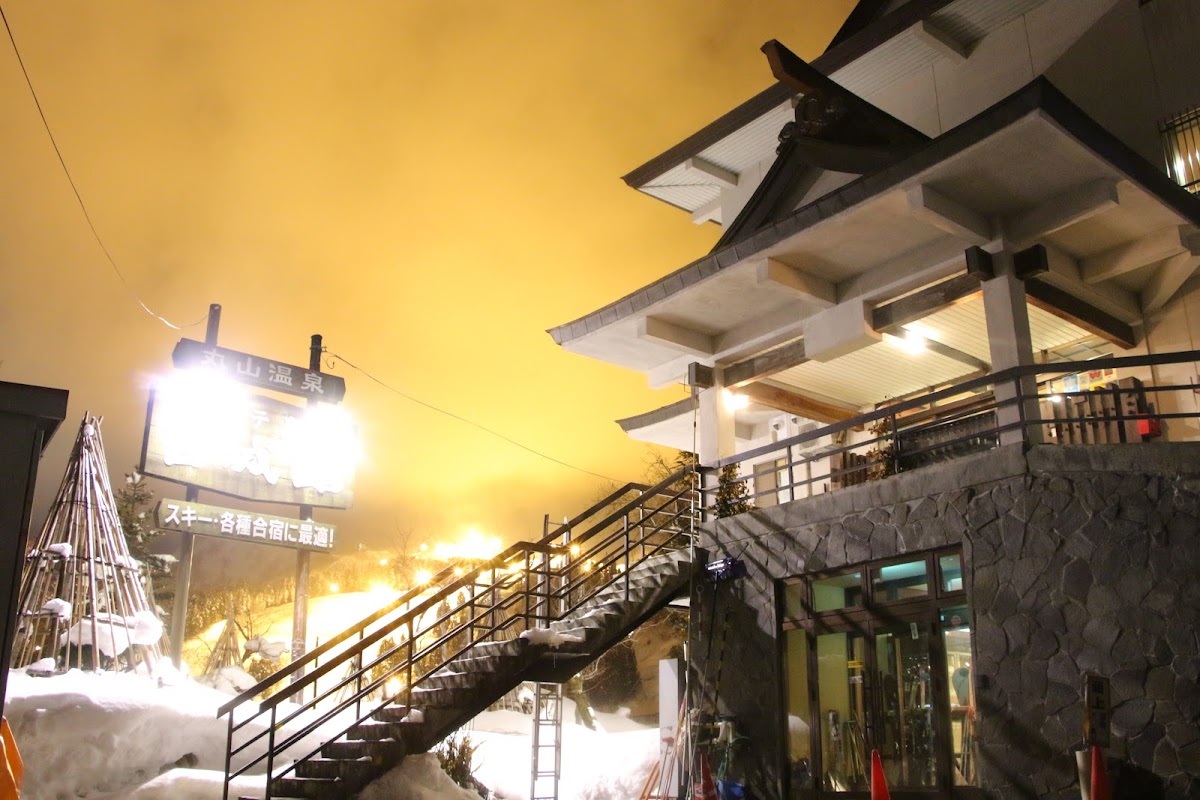
In winter, you can enjoy winter sports at Joetsu Kokusai Ski Resort, which is also the name of the nearest station to Kabasawa Castle. With its vast slopes and excellent facilities, it’s a ski resort enjoyable for beginners to advanced skiers.
Historical Significance of Kabasawa Castle
Kabasawa Castle was not merely a local mountain castle, but an important strategic base connecting Echigo Province and the Kanto region during the Sengoku period. Kabazawa Castle played a crucial role in history as a forward base during Uesugi Kenshin’s expansion into the Kanto region and as the site of a fierce battle during the Otate Rebellion.
In particular, its unique construction technique of surrounding moats demonstrates the high level of military skill of the Uesugi clan and is a valuable example from the perspective of castle research. Furthermore, the tradition that it is the birthplace of Uesugi Kagekatsu evokes a sense of historical romance, as it reveals the roots of a daimyo who played an important role under the Toyotomi regime.
Currently, the Kabazawa Castle ruins are designated as a historical site of Niigata Prefecture and are maintained by a local preservation society. The remains are well-preserved, and it is a valuable cultural asset that conveys the appearance of a Sengoku period mountain castle, attracting many castle enthusiasts and history lovers.
Summary
Kabazawa Castle is a mountain castle that played an important role in the history of Echigo Province as a base for Uesugi Kenshin’s expansion into the Kanto region and as the birthplace of Uesugi Kagekatsu. With its fierce battles during the Otate Rebellion, its unique defensive system of surrounding moats, and its well-preserved remains, it is a castle site rich in points of interest.
The view from the main keep, situated at an altitude of 304 meters, is magnificent, allowing visitors to enjoy the changing seasons while reflecting on the history of the Sengoku period. Access is relatively easy, and there are numerous historical sites associated with the Uesugi clan nearby, such as Sakado Castle and Undo-an Temple.
When visiting Niigata Prefecture, be sure to stop by Kabasawa Castle Ruins and experience the spirit of the Sengoku period. It’s a recommended spot not only for history buffs but also for those who enjoy hiking and nature walks.