Ashina Castle (Yokosuka City, Kanagawa Prefecture) Complete Guide | A Thorough Explanation of the Birthplace of the Miura Clan and the Aizu Ashina Clan
Ashina Castle was a flatland castle located in Ashina, Yokosuka City, Kanagawa Prefecture, and functioned as an important branch castle of the Miura clan. Known as the birthplace of the Ashina clan, a powerful daimyo family that ruled Aizu during the Sengoku period, the castle is now the site of Okusu Elementary School, but valuable historical remains still exist in the surrounding area. This article comprehensively explains everything from the history of Ashina Castle to its current attractions and access methods, providing useful information for castle enthusiasts and history buffs.
Basic Information on Ashina Castle
Location: 1-chome, Ashina, Yokosuka City, Kanagawa Prefecture (around Okusu Elementary School)
Alternate Name: Ashina-kan
Castle Structure: Flatland Castle (Residence + Fortified Castle)
Construction Period: Late Heian Period to Early Kamakura Period
Builder: Ashina Tamekiyo
Main Lord: Ashina Clan (Miura Family)
Elevation: Approximately 13m (Residence Area)
Remains: Koshin Tower, Topography (Rocky Hill at the Fortified Castle Site)
Cultural Property Designation: None
Ashina Castle was built on a gentle slope at an elevation of approximately 13m, inland from Ashina Fishing Port, near the Ashina River which flows into Sagami Bay. The site of the residence, formerly known as “Mitachi,” is now occupied by Okusu Elementary School and a kindergarten.
History and Lords of Ashina Castle
Construction History and Ashina Tamekiyo
Ashina Castle is said to have been built during the late Heian period to the early Kamakura period by Ashina Tamekiyo, the younger brother of Miura Yoshiaki (Miura Daisuke Yoshiaki). Miura Tamekiyo ruled the Ashina area of Sagami Province and adopted the name Ashina from the place name. This marked the beginning of the Ashina clan.
Miura Yoshiaki was the leader of the Miura clan, a prominent samurai group in Sagami Province, and played a crucial role in Minamoto no Yoritomo’s uprising. Ashina Tamekiyo, along with his brother, followed Minamoto no Yoritomo’s uprising and contributed to the expansion of the Miura clan’s power.
Role as a Branch Castle of Kinugasa Castle
Ashina Castle functioned as a branch castle protecting Kinugasa Castle, the main castle of the Miura clan. Kinugasa Castle was the base of the Miura clan, located in Kinugasa-cho, Yokosuka City. Ashina Castle was built approximately 5 km southwest of Kinugasa Castle and is thought to have been responsible for defense from the Sagami Bay side.
The castle’s structure consisted of two parts: a residence and a fortified outpost. In peacetime, the lords lived in the residence, and in times of emergency, they would take refuge in the fortified outpost on the adjacent rocky hill to the east. This structure is a common form of castle and fortification in the medieval period, demonstrating a defensive system that utilized the topography of the Miura Peninsula.
Relationship with the Aizu Ashina Clan
Ashina Castle is particularly important as the birthplace of the Aizu Ashina clan. The Aizu Ashina clan was a family founded by Sahara Yoshitsura, the seventh son of Miura Yoshiaki. They served Minamoto no Yoritomo, distinguished themselves in the Oshu War, and acquired territory in the Aizu region.
The Ashina surname was adopted from the time of Mitsumori, the grandson of Sahara Yoshitsura. Mitsumori adopted the Ashina surname, which originated in the Ashina region of Sagami Province, and settled in Aizu, expanding his power. During the Sengoku period, the Aizu Ashina clan flourished as a powerful daimyo in the Tohoku region, controlling a vast territory including Aizu, Iwashiro, and Iwaki at its peak.
Thus, the fact that a small castle in Yokosuka City, Kanagawa Prefecture, is the origin of a distant Sengoku daimyo family in Aizu is an interesting example in Japanese medieval history.
The Aftermath of Ashina Castle
While much of the detailed history of Ashina Castle after the Kamakura period remains unknown, it is believed to have maintained its function as a branch castle as long as the Miura clan’s power continued. The Miura clan prospered as a powerful retainer of the Kamakura shogunate, but declined after being defeated by the Hojo clan in the Hoji War (1247).
Afterward, Sagami Province came under the control of the Hojo clan, and it is presumed that Ashina Castle was either abandoned or passed into the hands of another lord. During the Sengoku period, it became part of the territory of the Later Hojo clan, and it is believed that the castle lost its function.
Structure and Layout of Ashina Castle
Residence Area (Around Okusu Elementary School)
The residence area of Ashina Castle was located around the present-day Yokosuka Municipal Okusu Elementary School. Built on a gentle plateau approximately 13 meters above sea level, it overlooked Sagami Bay. The remaining place name “Mitachi” (御邸) confirms that this was the lord’s residence.
Although no clear remains can be confirmed because the residence site is now a school facility, the surrounding topography allows us to infer what it was like at the time. The south side, facing the Ashina River, was a steep slope, functioning as a natural defensive line.
Fortified Castle (Eastern Rocky Hill)
To the east of the residence was a rocky hill, where a fortified castle was built. The final stronghold was a defensive base for taking refuge in times of emergency, and it is believed to have been constructed to take advantage of the rugged terrain of the rocky mountain.
Currently, this rocky mountain can be accessed by climbing stairs from behind Okusu Elementary School. Following a narrow path behind the apartment building will lead you to the entrance to the mountain. From near the summit, you can see Sagami Bay and the Ashina settlement, truly appreciating the castle’s excellent location.
Castle Defense System
Although Ashina Castle was a flatland castle, it possessed the following defensive elements:
- Steep southern slope: A natural cliff sloping down towards the Ashina River served as a defensive line.
- Rocky mountain fortifications: A final defensive stronghold utilizing the rugged terrain.
- Proximity to Sagami Bay: Allowing for monitoring of maritime traffic and utilization of water transport.
- Coordination with Kinugasa Castle: Mutual support was possible due to the approximately 5km distance between the two castles.
This structure was not designed for large-scale battles, but rather for maintaining daily security and providing evacuation in emergencies, representing a typical castle design of local powerful families during the Kamakura period.
Ashina Castle Highlights and Current Status
Ashina Castle Site Koshin Tower
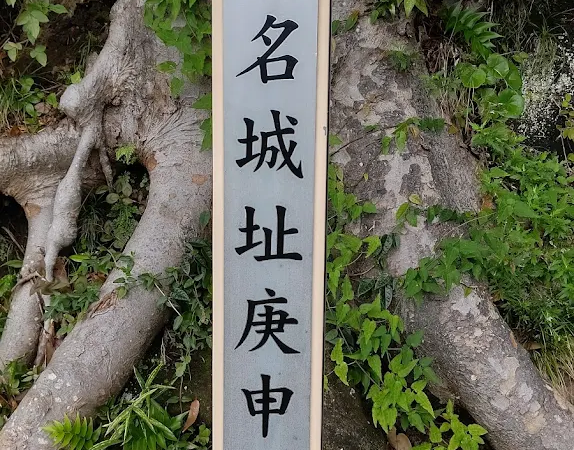
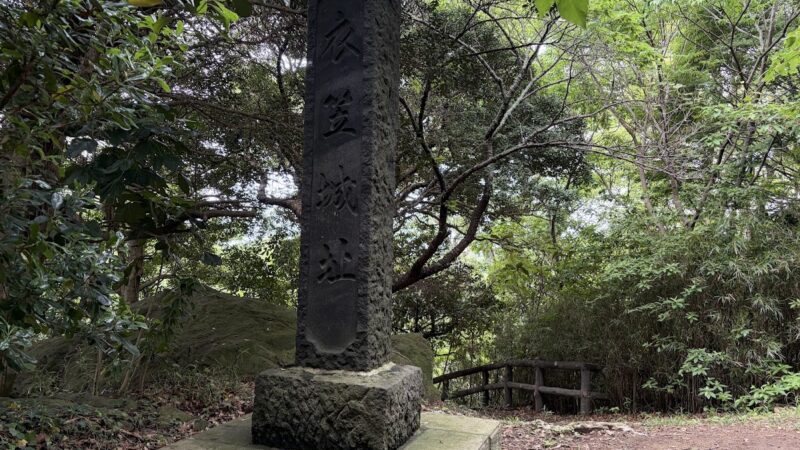
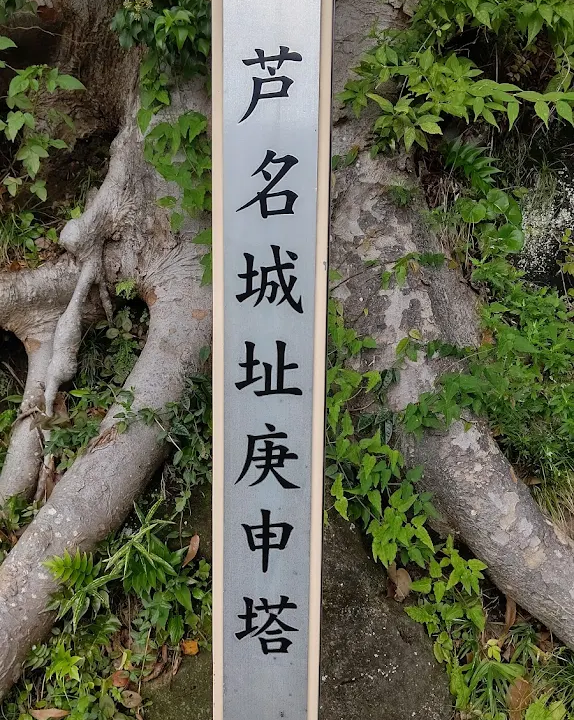
The most important remains of Ashina Castle are the Ashin Castle Site Koshin Tower. This Koshin Tower is located a short distance from Okusu Elementary School and is a valuable historical site indicating the castle ruins. The Koshin Tower bears the inscription “Ashina Castle Ruins,” indicating that local people have carefully preserved the history of this area.
The location of the Koshin Tower may indicate the boundary of the castle grounds, making it a valuable historical site for castle research. Visitors can use this Koshin Tower as a landmark to imagine the former extent of the castle.
Rocky Hill at the Site of the Fortified Castle
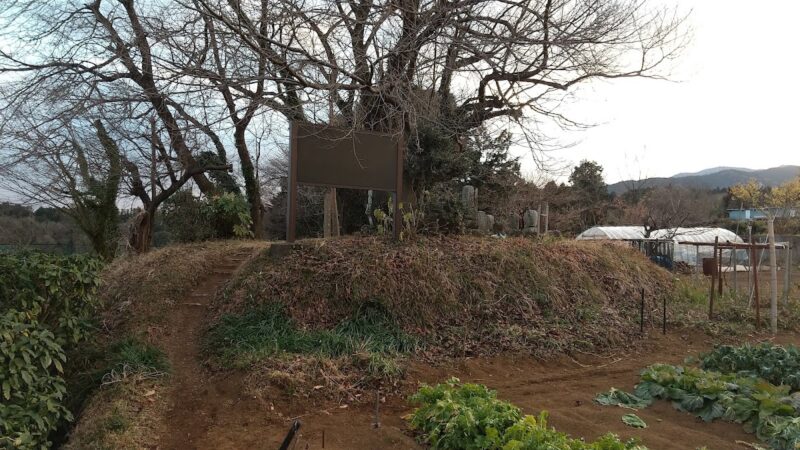
The rocky hill east of Okusu Elementary School is the site of the former fortified castle. You can climb the stairs from behind the apartment building, and near the summit, you can still feel the original topography.
The view from the rocky hill is magnificent, offering a panoramic view of Sagami Bay, Ashina Fishing Port, and the Ashina settlement. This excellent view was clearly important for the castle’s surveillance function. However, the stairs are steep and some sections have uneven footing, so caution is necessary when visiting.
Topography Around Okusu Elementary School
The grounds of Okusu Elementary School are the site of a former residence, but access to the interior is restricted due to it being a school facility. However, walking around the school grounds allows us to understand the topography and location of the castle at that time.
In particular, the steep slope sloping down towards the Ashina River on the south side clearly functions as a natural defensive line. From a distance, the shape of the hills retains the landscape characteristic of a castle site, allowing us to feel the remnants of its former glory.
Ashina River and Ashina Fishing Port
The Ashina River, which flows south of the castle, is a small river that empties into Sagami Bay. The valley created by this river served as a natural moat. Furthermore, Ashina Fishing Port, located at the river mouth, still functions as a fishing base today and is thought to have been an important point for maritime traffic in the Middle Ages.
The name Ashina is said to originate from “a place where reeds grow,” and the area was characterized by a topography with many wetlands. This topography may also have been utilized for the castle’s defense.
Relationship with Joraku-ji Temple
Near Ashina Castle is an ancient temple called Joraku-ji. This temple is associated with the Miura clan and houses a Buddhist statue designated as a National Important Cultural Property. Jōraku-ji Temple also serves as the family temple of the Miura clan. Visiting it in conjunction with Ashina Castle will allow for a deeper understanding of the Miura clan’s history.
Jōraku-ji Temple houses statues such as the Amida Triad and Fudo Myoo, said to be the work of Unkei, preserving the Buddhist culture of the Kamakura period.
Access to Ashina Castle
Access by Public Transportation
Train + Bus:
- Get off at JR Yokosuka Line “Zushi Station” or Keikyu Line “Zushi-Hayama Station”
- Take a Keikyu Bus bound for “Nagai,” “Arasaki,” or “Shimin Byoin” (Citizen’s Hospital)
- Get off at the “Ashina” bus stop and walk approximately 5 minutes to the area around Ōkusu Elementary School (site of the residence)
- It’s approximately a 10-minute walk to the Ashina Castle Ruins Kōshin-tō (Kōshin Tower)
Buses run approximately 2-3 times per hour. Checking the timetable in advance is recommended.
Access by Car
Yokohama-Yokosuka Expressway:
- Approximately 15 minutes from “Kinugasa IC”
- Head south on National Route 134 (Shonan Road) towards Ashina
Parking: There is no public parking at Okusu Elementary School. There are paid parking lots around Ashina Fishing Port; please use these and access the school on foot.
Walking Route
Recommended route for visiting Ashina Castle:
- Ashina Fishing Port (Starting point)
- Walk north along the Ashina River for about 5 minutes
- Explore the area around Okusu Elementary School (site of the former residence)
- Move to the back (east side) of the elementary school
- Climb the rocky hill of the castle from the stairs behind the apartment building (about 10 minutes)
- Descend from the rocky hill to Ashina Castle Ruins Koshin Tower (about 5 minutes)
- If time permits, visit Joraku-ji Temple (about 15 minutes)
This entire walking course takes about 1-2 hours.
Nearby Tourist Spots
Kinugasa Castle Ruins
Kinugasa Castle, the main castle of the Miura clan, is located about 5 km northeast of Ashina Castle. This site is known as the tragic location where Miura Daisuke Yoshiaki was attacked by the Hojo clan after the Battle of Ishibashiyama and died fighting to allow his family to escape. It has been developed into Kinugasa Castle Park, where visitors can see Miura Yoshiaki’s grave and the remains of the castle.
Other Castle Sites on the Miura Peninsula
The Miura Peninsula has numerous castle sites associated with the Miura clan:
- Nuta Castle: The castle of Tsukui Yoshiyuki, the younger brother of Miura Yoshiaki
- Uraga Castle: One of the Miura clan’s branch castles
- Misaki Castle: An important stronghold at the southern tip of the Miura Peninsula
Visiting these sites will help you understand the Miura clan’s sphere of influence and strategies.
Mt. Okusuyama
North of Ashina Castle lies Mt. Okusuyama (242m above sea level), the highest peak on the Miura Peninsula. From the summit, you can enjoy a spectacular view of Sagami Bay, Tokyo Bay, and Mt. Fuji, making it a popular hiking destination. Combining a visit to Ashina Castle with a hike up Mt. Okusu is highly recommended.
Tateishi Park
Heading south along the coast from Ashina, you’ll find Tateishi Park. This scenic spot is famous for the uniquely shaped rock formation “Tateishi” jutting out into Sagami Bay, and is known as a spectacular viewpoint for Mt. Fuji and sunsets.
Points to Note and Manners When Visiting
Consideration for School Facilities
Okusu Elementary School is an active educational facility. Please note the following points when visiting:
- Do not enter school grounds without permission.
- Observe quietly during class hours.
- Take photographs carefully, taking into consideration the safety of the children.
- Avoid visiting on days when school events are being held.
Climbing to the final castle
Please note the following points regarding the stairs to the rocky mountain:
- The stairs are steep and have uneven footing in some places.
- Avoid climbing in rainy weather as it can be slippery.
- Wear comfortable clothing and non-slip shoes.
- Avoid going alone; visiting in a group is recommended.
Photography Etiquette
- Do not photograph private homes, as this is a residential area.
- Treat historical sites such as Koshin-to (stone monuments) with care.
- Do not trespass on private property.
Resources for a deeper understanding of Ashina Castle
Related Books
- “Research on the Miura Clan” (Yoshikawa Kobunkan): A detailed explanation of the history of the Miura clan.
- “Medieval Castles and Fortifications in Kanagawa Prefecture” (Kanagawa Prefectural Board of Education): A survey report of castle ruins in the prefecture.
- * The Ashina Clan of Aizu (Rekishi Shunju-sha): Genealogy and history of the Ashina clan of Aizu
- Research on the Kamakura Shogunate’s Retainers: Activities of the Miura clan during the Kamakura period
Useful Websites
- Kojodan: A community site for castle enthusiasts, rich in visit records and photographs
- Shirobito: Detailed information on the history and highlights of castles
- Yokosuka City Official Website: Local history and cultural property information
Cultural Property Facilities in Yokosuka City
The Yokosuka City Museum of Nature and Humanities exhibits the history and archaeological materials of the Miura Peninsula. It also houses materials related to Ashina Castle and the Miura clan, and visiting before your visit will provide a deeper understanding.
Historical Significance of Ashina Castle
The Power Base of the Miura Clan
Ashina Castle is an important historical site that shows the power base of the Miura clan, a representative samurai group of Sagami Province. The Miura clan, based in Miura County, Sagami Province, played a significant role in the establishment of the Kamakura Shogunate as a powerful vassal family that supported Minamoto no Yoritomo’s uprising.
The network of branch castles on the Miura Peninsula, including Ashina Castle, was a strategic arrangement for the Miura clan to efficiently control their vast territory. Centered around their main castle, Kinugasa Castle, Ashina Castle, Nuta Castle, Uraga Castle, and others cooperated to form a comprehensive defense system for the entire Miura Peninsula.
The Origin of the Aizu Ashina Clan
Another important significance of Ashina Castle is that it is the origin of the Aizu Ashina clan. The history of the Ashina clan, which began as a small castle in Sagami Province, moved to Aizu after the Oshu War, and grew into a powerful daimyo in the Tohoku region during the Sengoku period, symbolizes the movement and development of samurai in medieval Japanese history.
At its peak, the Aizu Ashina clan became a major force in Tohoku, comparable to the Date clan, and prospered with Kurokawa Castle (later Aizu-Wakamatsu Castle) as its base. The fact that its origins lie in Ashina, Yokosuka City, Kanagawa Prefecture, evokes a sense of historical romance.
Resources for Medieval Castle Research
Ashina Castle is a valuable example of a castle built by a local powerful family during the Kamakura period, making it significant in castle research. Its structure, combining a residence and a fortified outpost, and its defensive system utilizing the natural terrain, are important examples for understanding the castle-building techniques and defensive philosophies of the time.
Summary: The Charm of Visiting Ashina Castle
Unlike castles with large stone walls and keeps, Ashina Castle is a castle ruin that quietly tells its history. Although it is now a school and residential area, with little of its former appearance remaining, the Koshin-to stone monument, the topography, and above all, the place name “Ashina” itself, convey that a castle certainly stood here and that samurai lived here.
Tracing the history of the Miura clan and visiting the origins of the Aizu Ashina clan is a valuable experience for gaining a three-dimensional understanding of Japanese medieval history. Amidst the tranquil scenery overlooking Sagami Bay, you can feel the spirit of the samurai of the Kamakura period. When visiting Ashina Castle, exploring the surrounding areas such as Joraku-ji Temple, Kinugasa Castle, and Ashina Fishing Port will provide a richer historical experience. This historical site is recommended not only for castle enthusiasts but also for anyone who enjoys a historical walk.
Ashina, Yokosuka City, Kanagawa Prefecture—this small place name has connections to the distant Aizu region and influenced Tohoku during the Sengoku period. Experience the weight of history firsthand.