
城跡(旧蠣崎小学校)-765x720.png)
Complete Guide to Kakizaki Castle (Aomori Prefecture): A Thorough Explanation of the History, Remains, and Highlights of Kintai Castle
What is Kakizaki Castle?
Kakizaki Castle (Kakizaki-jo) is a medieval Japanese castle located in Kakizaki, Kawauchi-cho, Mutsu City, Aomori Prefecture. Also known as Kintai Castle (Kintai-jo), it was built at a strategic point controlling the entrance to Mutsu Bay. It is located on the right bank of the Otogawa River estuary, north of Tonosaki, and is characterized by its location on a small hill to the north, away from the waterfront where port facilities, residences, and temples are situated.
It is believed to have originated in 1334 (Kenmu 1) when Takeda Shuri-dayu (Takeda Nobuyoshi), appointed as the Kakizaki magistrate under Nanbu Moriyuki, established his residence there. For the next 120 years, across five generations, the Takeda clan resided at the castle. This castle played an important role as the Nanbu clan’s base of operations in the Shimokita Peninsula, becoming the political and military center of the region.
The castle measures approximately 590 meters east-west and 235 meters north-south. As a medieval castle with a plateau-style layout, it is considered one of the most important historical sites in Aomori Prefecture.
History of Kakizaki Castle
Kenmu Period: The Takeda Clan’s Arrival and the Establishment of the Castle
In 1334 (Kenmu 1), as Nanbu Moriyuki expanded his power into Mutsu Province, he dispatched Takeda Shuri-dayu (Takeda Nobuyoshi) to Kakizaki as a deputy. The Takeda clan was a prestigious family descended from the Kai Genji clan, and it is believed they followed the Nanbu clan to Oshu.
Takeda Nobuyoshi established his residence in Kakizaki and functioned as a deputy for the Nanbu clan throughout the Shimokita Peninsula. At this time, Kakizaki Castle is thought to have been more of a residence serving as a base for territorial control than a full-fledged castle.
The Five Generations of the Takeda Clan’s Reign
Kakizaki Castle was ruled by five generations of the Takeda clan for approximately 120 years. The successive lords of the castle are as follows:
- First Lord: Takeda Nobuyoshi (Shuri-dayu) – Entered the castle in Kenmu 1 (1334)
- Second Lord: Takeda Nobunaga (Nobuaki)
- Third Lord: Takeda Nobuyoshi
- Fourth Lord: Takeda Nobumichi
- Fifth Lord: Takeda Nobuzumi (Kakizaki Kurōdo)
The Takeda clan consistently used the character “Nobu” (信) as a common character in their names, maintaining loyalty to the Nanbu clan while solidifying their control over the Shimokita Peninsula. They are believed to have played an important role in port management, trade, and even exchanges with the northern Ezo region, particularly in the area centered around Tanabu.
Expansion Work in the Third Year of Hōtoku
In the third year of Hōtoku (1451), a large-scale expansion project was carried out by the fifth head of the family, Kakizaki Kurōdo Nobuzumi. This renovation gave Kakizaki Castle the functionality of a full-fledged military base. It was during this period that the layout of the baileys and the construction of the moats were completed, giving it the appearance of a Sengoku period castle.
It is thought that the elegant name “Kintai Castle” came into use around this time, indicating that the castle’s imposing appearance had been completed.
The Kakizaki Kurōdo Rebellion (Tanabe Rebellion)
The most important event in the history of Kakizaki Castle is the “Kakizaki Kurōdo Rebellion” (also known as the Tanabe Rebellion), which broke out in the third year of Kōshō (1457).
Background of the Rebellion
The fifth head of the family, Kakizaki Kurōdo Nobuzumi, gradually built his own power base while governing the Shimokita Peninsula for many years. It is believed that he grew to feel a strong sense of self-respect as the de facto ruler of the region, going beyond his position as a deputy of the Nanbu clan. Furthermore, Nobuzumi had expanded his power by destroying the northern royal family (possibly a branch of the Kitabatake clan) that resided in this region. These actions heightened military tensions with his lord, the Nanbu clan.
Course of the Rebellion
In 1457 (Kōshō 3), Kakizaki Kurōdo Nobuzumi, allied with the Andō clan and the Emishi, rebelled against his lord, the Nanbu clan. Nobuzumi raised an army from Kakizaki Castle, and Nanbu Masatsune, the head of the Nanbu clan, obtained permission from the imperial court to dispatch a punitive force.
The punitive force led by Nanbu Masatsune besieged Kakizaki Castle, and a fierce battle ensued. However, Kakizaki Kurōdo Nobuzumi’s rebellion was ultimately suppressed, and Nobuzumi was killed. This rebellion marked the end of the Takeda clan’s rule over Kakizaki.
Kakizaki Castle After the Rebellion
After the suppression of the Kakizaki Kurōdo Rebellion, Kakizaki Castle is believed to have come under the direct control of the Nanbu clan. While detailed historical records of the castle are scarce, it is presumed to have maintained its function as a northern base for the Nanbu clan throughout the Sengoku period.
The final year of its abandonment is unclear, but it is thought to have gradually fallen into disrepair after losing its military role as a fortress in the early modern period.
Structure and Layout of Kakizaki Castle
Location and Topography
Kakizaki Castle was built on a small hill approximately 60 meters above sea level. Its location on the right bank of the Otogawa River estuary was extremely important for monitoring and controlling access to Mutsu Bay. Controlling a key point in maritime traffic gave it high strategic value, allowing control over the distribution of goods and military movements.
The north side of the castle was a steep cliff, functioning as a natural defensive line. The south side had a relatively gentle slope, and it is presumed that the main approach road was located there.
Characteristics of the Castle Layout
Kakizaki Castle’s layout measured approximately 590 meters east-west and 235 meters north-south, and is based on the plateau castle style. Multiple baileys were arranged and demarcated by moats and earthworks.
Major Remains:
- Main Bailey (Honmaru): Located in the center of the castle, it is believed to have been the residence of the castle lord. Currently, a memorial tower for Kakizaki Kurōdo stands here.
- Western Bailey: Located west of the former Kakizaki Elementary School, it was an important defensive stronghold.
- Moats: Multiple moats were constructed as defensive structures separating each bailey.
- Earthworks: Earthworks surrounded the baileys, enhancing their defensive capabilities.
While possessing a typical medieval castle layout, it is characterized by a unique structure that takes advantage of its location facing the sea.
Relationship with Port Facilities
Port facilities, residences, and temples and shrines were located at the foot of the castle. It is believed that the castle fortifications were located on high ground suitable for defense, while the actual administrative functions and economic activities were centered on the flat land near the water. This dual structure was a clever design to balance peacetime governance with wartime defense.
Remains and Current State of Kakizaki Castle
Developed as Kintaijo Park
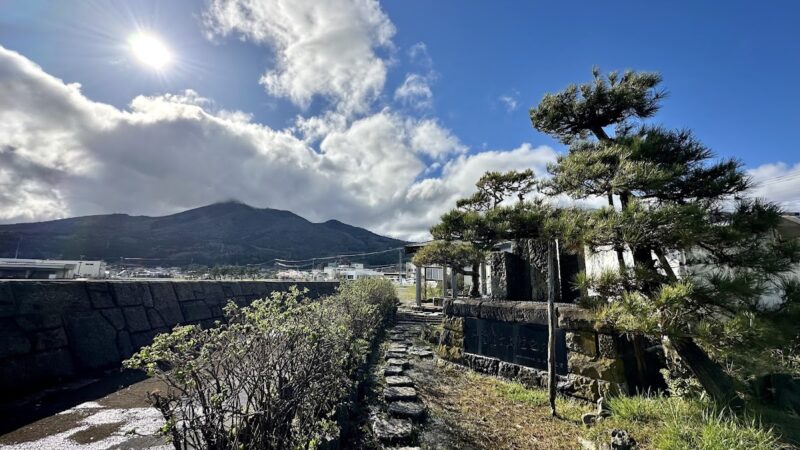
Currently, the Kakizaki Castle ruins have been developed as “Kintaijo Park,” with hiking trails. The castle hill, towering behind the former Kakizaki Elementary School to the north, can be climbed relatively easily from the park entrance.
At the park entrance, there is a map and a stone monument explaining the history of Kintaijo Castle to visitors. The hiking trails are well-maintained, allowing visitors to experience the atmosphere of the Middle Ages while exploring the castle remains.
Existing Remains
Main Remains that Can Be Confirmed:
- Kuruwa Remains: Multiple flat areas remain as the remains of kuruwa (enclosures). A group of kuruwa arranged in a terraced pattern around the main enclosure can be observed.
- Moat: The moats separating the baileys remain in good condition, making them valuable for understanding the defensive system of medieval castles.
- Earthwork: Traces of earthworks can be seen around some baileys. Although some parts are weathered, they allow us to estimate the scale of the defensive facilities in their heyday.
- Cut Slope: Artificial steep slopes (cut slopes) built along the edges of the baileys remain in various places, demonstrating ingenuity in preventing enemy intrusion.
Memorial Tower for Kakizaki Kurōdo
A stone tower commemorating Kakizaki Kurōdo Nobuzumi stands in the main bailey. Although he was killed after leading a rebellion, it expresses respect for him as the last head of the Takeda clan, who ruled this area for 120 years, leaving a significant mark on the region’s history.
Highlights of Kakizaki Castle
The Main Enclosure: A Place of Historical Romance
The main enclosure is located at the highest point of the castle, offering a superb viewpoint overlooking the surrounding area. Standing here, one can reflect on the thoughts of Kakizaki Kurōdo, who ruled this land for 120 years under the Takeda clan and ultimately rebelled against his lord. Stand before the memorial tower and imagine the lives of the people who lived during the turbulent times of the Middle Ages.
Well-Preserved Moat
The moat of Kakizaki Castle is relatively well-preserved, making it a valuable relic that allows one to appreciate the defensive techniques of medieval castles. Seeing the deeply excavated moat, one is amazed by the ingenuity used to prevent enemy incursions and the high level of civil engineering that constructed it.
View of Mutsu Bay
From the castle ruins, one can enjoy a panoramic view of Mutsu Bay. You will realize how important this castle was as a key point for maritime traffic and as a base for monitoring movements to the north. On a clear day, you can enjoy the beautiful scenery of the Shimokita Peninsula.
Nature at Kintaijo Park
The castle ruins, now developed as a park, are a spot where you can enjoy nature throughout the seasons. From the fresh greenery of spring, the deep green of summer, the vibrant autumn foliage, to the snowy winter landscape, each season offers a different view. Its charm lies in the fact that you can enjoy both historical and nature walks.
Access and Visiting Information
Location
Address: Aino, Kakizaki, Kawauchi-cho, Mutsu City, Aomori Prefecture (Kintaijo Park)
Access Methods
Access by Car:
- Approximately 2 hours from Aomori City via National Route 279
- Approximately 30 minutes from the center of Mutsu City
- Parking: Parking spaces are available near the entrance to Kintaijo Park
Public Transportation:
- Take a bus from Shimokita Station on the JR Ominato Line, bound for Kawauchi, and get off at “Kakizaki”
- Approximately 10 minutes on foot from the bus stop to the park entrance
Points to Note During Your Visit
- Estimated Time Required: Allow approximately 1 to 1.5 hours for exploring the castle ruins
- Clothing: Comfortable walking shoes and clothing are recommended as you will be walking on mountain trails
- Items to Bring: Drinks, insect repellent (summer), camera
- Best Season: While spring to autumn is the ideal time to visit, exploring the castle ruins amidst the snowy landscape is also possible in winter.
Nearby Attractions
The area around Kakizaki Castle is dotted with other historical sites and natural landscapes:
- Kawauchi Town Historical Museum: A facility where you can learn about the region’s history
- Mutsu Bay Coast: Beautiful coastline and fishing port scenery
- Other Castle Ruins on the Shimokita Peninsula: Multiple strongholds of the Nanbu clan
Medieval History of Kakizaki Castle and the Shimokita Peninsula
The Nanbu Clan’s Northern Expansion
The history of Kakizaki Castle is also the history of the Nanbu clan’s expansion into the Shimokita Peninsula. From the Kamakura period to the Muromachi period, the Nanbu clan expanded their power in northern Mutsu Province, consolidating their control by appointing local governors.
Kakizaki was one of their northernmost strongholds, playing an important role in trade with Ezo (Hokkaido) to the north and in communication with Hokkaido via the Tsugaru Strait.
A Hub for Northern Trade
In the Middle Ages, Kakizaki served not only as a military base but also as a transit point for northern trade. Trade took place there for northern products such as kelp, herring, and furs, and for rice and handicrafts from Honshu, making it an economically important port town.
The Takeda clan also managed the profits from this trade, and it has been suggested that this formed their own economic base, ultimately leading to their rebellion against their lord.
Relations with the Emishi
The description of Nobuzumi “allying with the Emishi” during the Kakizaki Kurōdo Rebellion is intriguing. At that time, Ainu people inhabited the Shimokita Peninsula and the area around the Tsugaru Strait, and there were repeated interactions and conflicts with the Japanese.
The Takeda clan, based at Kakizaki Castle, played an important role in building relationships with these northern peoples, and it is thought that this led to the alliance during the rebellion.
The Cultural Value of Kakizaki Castle
Importance in the Study of Medieval Castles in Aomori Prefecture
Kakizaki Castle is an important historical site for the study of medieval castles in Aomori Prefecture. Remains showing the castle structure from the Kenmu to Muromachi periods are preserved, making it a valuable resource for understanding the process of castle development in the northern Tohoku region.
Position in Local History
The existence of Kakizaki Castle and the Takeda clan is indispensable in the history of the Shimokita Peninsula. Their 120 years of rule had a significant impact on the formation of the local community, and the Kakizaki Kurōdo Rebellion marked a historical turning point for the region.
For local residents, Kakizaki Castle is still carefully preserved as a symbol of their local history.
How to Enjoy Visiting Kakizaki Castle
Historical Walking Course
By walking along the designated route from the entrance of Kintaijo Castle Park to the main enclosure, you can systematically understand the castle’s structure. Observe each enclosure and moat to experience how medieval castles functioned defensively.
Photo Spots
- View from the Main Enclosure: A spectacular view with Mutsu Bay in the background.
- Cross-section of the Moat: The impressive defensive structure of a medieval castle.
- Kakizaki Kurōdo Memorial Tower: A stone tower that evokes a sense of history.
- Stone Monument at the Park Entrance: Perfect for commemorative photos.
As a Place for Historical Learning
Kakizaki Castle is an excellent resource for learning about Japanese medieval history, particularly the history of the Nanbu clan and the local governance system of the Muromachi period. It offers opportunities for deepening on-site learning, making it ideal for school local history studies and for history enthusiasts to explore.
Summary
Kakizaki Castle (Kintai Castle) is a valuable medieval castle site remaining in Mutsu City, Aomori Prefecture. Since Takeda Shuri-dayū took control in 1334, it served as the residence of the Takeda clan for 120 years across five generations, and was the political, military, and economic center of the Shimokita Peninsula.
The Kakizaki Kurōdo Rebellion of 1457 was a significant historical event that illustrates one aspect of medieval society: the independence of local powerful families and the tension between lords and vassals. This castle was the stage for that rebellion.
Currently, the site is maintained as Kintaijo Castle Park, where visitors can explore the remains of the baileys and moats. With its panoramic views of Mutsu Bay and its atmosphere steeped in medieval history, Kakizaki Castle is a must-see spot for history enthusiasts visiting Aomori Prefecture.
Please visit the Kakizaki Castle ruins to experience the rich nature and historical culture of the Shimokita Peninsula. You’ll have a valuable opportunity to reflect on the five generations of the Takeda clan’s rule, the ambitions of Kakizaki Kurōdo, and the lives of people in the medieval era.
城跡(旧蠣崎小学校)-765x450.png)