Takasakiyama Castle (Oita Prefecture) Complete Guide | A Thorough Explanation of the History and Highlights of the Otomo Clan’s Fortified Castle
Overview
Takasakiyama Castle (Takasaki-sanjo) is a Japanese castle built on the summit of Mount Takasaki (628m above sea level) in Oita City, Oita Prefecture. It is also known by other names such as Takasaki Castle, Takezaki Castle, and Takasaki Goyōgai. Located near the border with Beppu City, it was built on the summit of Mount Takasaki, now home to the famous Takasakiyama Natural Zoological Park (known as “Monkey Mountain”), as a fortified castle for the Otomo clan, who were the governors of Bungo Province.
Built on the summit of Mount Takasaki, which rises from the sea, this mountain castle was known as an impregnable fortress and played an important role in Kyushu history from the Nanboku-chō period to the Sengoku period. It functioned as a stronghold protecting the rear of the Otomo-kan (Funai), where the Otomo clan resided in peacetime, and served as the last stronghold for the family during times of conflict.
Even today, the remains of the castle, including baileys, stone walls, and gate structures, are well-preserved near the summit and are protected as important cultural properties of Oita City. Using the hiking trail, which has been developed as the Takasakiyama Therapy Road, even beginners can reach the summit in about an hour, enjoying both the spectacular panoramic view of Beppu Bay and the romance of history.
History
Construction and Early History
There are various theories regarding the construction period of Takasakiyama Castle, but the most widely accepted theory is that it was built as an auxiliary castle for the Otomo residence during the time of Otomo Yoshiakira, the second head of the Otomo clan. A beacon (tobuhi, signal fire station) was already located in this area during the Nara period, suggesting that it was recognized as a strategically important location from ancient times.
The location of Takasakiyama was strategically crucial, overlooking Beppu Bay and the Bungo Provincial Capital (present-day Oita City center). This location was ideal for monitoring enemy movements from the sea and preparing for inland invasions, making it a natural choice for the Otomo clan to establish their fortress here.
Battles during the Nanboku-cho Period
Takasakiyama Castle first appears on the historical stage during the Nanboku-cho period. In 1355, the Southern Court’s Prince Kaneyoshi army attacked the Otomo clan’s 8th head, Otomo Ujitoki, who was loyal to the Northern Court under Ashikaga Takauji. The Southern Court army invaded from Hita, passing through Kusu, Yufu, and Hazama before attacking Kokufu (Oita).
In 1357, Kikuchi Takemitsu, a Southern Court supporter, allied with Kyushu Tandai Isshiki Norifuji and attacked Otomo Ujitoki. Ujitoki resisted by barricading himself in Takasakiyama Castle, but was ultimately forced to retreat. However, this battle demonstrated the castle’s formidable strength and established its reputation as an impregnable fortress. In 1358 (Enbun 3), Otomo Ujitoki, along with Kutamichikamitsu and others, launched a counterattack from Takasakiyama Castle, aiming to regain power. During this period, Takasakiyama Castle functioned as the Otomo clan’s last stronghold, playing a decisive role in maintaining their control over Bungo Province.
The Sengoku Period and Otomo Sorin
With the arrival of the Sengoku period (Warring States period), Takasakiyama Castle continued to function as an important military base for the Otomo clan. Especially during the time of the 21st head of the clan, Otomo Yoshishige (later Sorin), its strategic importance increased further as the Otomo clan expanded its power in Kyushu.
Otomo Sorin, known as a Christian daimyo, controlled a vast territory in northern Kyushu, centered on Bungo Province. The existence of Takasakiyama Castle, protecting his base in Funai (Oita City), was a crucial foundation supporting Sorin’s ambitious territorial expansion policies.
The Shimazu Invasion and the Battle of Hetsugigawa
In December of Tensho 14 (1586), the Otomo clan faced its greatest crisis: the Shimazu invasion of Bungo Province. The Shimazu army advanced into Bungo with overwhelming force, and Funai (Oita) was on the verge of falling. At this time, Otomo Sorin escaped Funai and fled to Niujima Castle (Usuki Castle).
In January of the following year, Tensho 15 (1587), the Shikoku forces, sent as reinforcements by Toyotomi Hideyoshi, suffered a crushing defeat at the hands of the Shimazu army in the Battle of Hetsugigawa, forcing the Otomo clan to abandon their residence. At this time, Sorin’s son, the 22nd head of the clan, Otomo Yoshimune, fled to Takasakiyama Castle.
The formidable strength of Takasakiyama Castle served as the last line of defense for the Otomo clan even in this critical situation. The impregnable castle built on the mountaintop withstood attacks from the Shimazu army, and was eventually saved by Toyotomi Hideyoshi’s conquest of Kyushu.
The Castle’s Demise and Present Day
In 1593 (Bunroku 2), the Otomo clan was dispossessed of their domain due to the failures of Otomo Yoshimune during the Bunroku War. Consequently, Takasakiyama Castle was also abandoned. Having functioned as the Otomo clan’s stronghold for approximately 240 years, Takasakiyama Castle thus ended its historical mission.
After the Edo period, Takasakiyama Castle was largely forgotten, but the remains of the castle were well preserved on the mountaintop. Currently, it is protected as an important cultural property of Oita City and attracts visitors from castle enthusiasts and history buffs.
Castle Structure and Remains
Layout and Scale
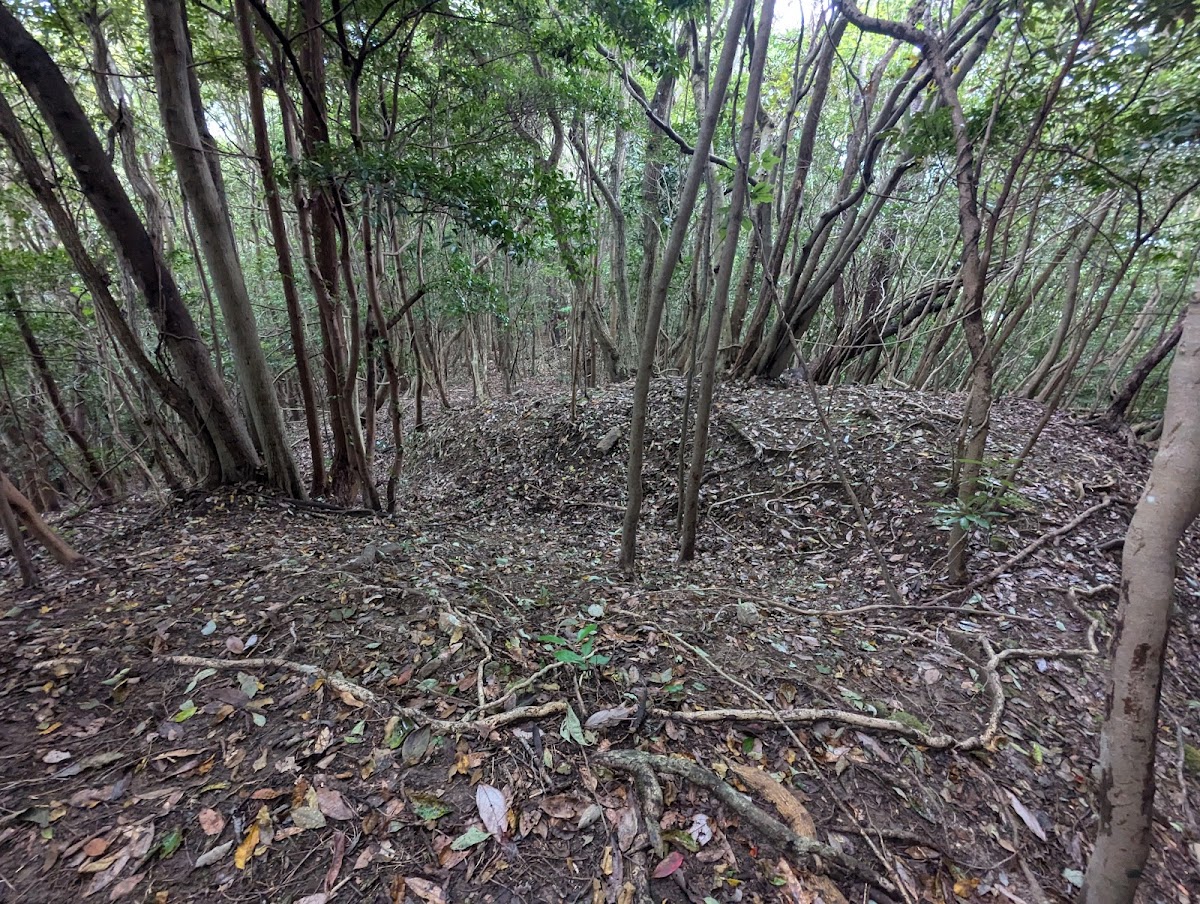
Takasakiyama Castle is a mountain castle with a series of enclosures, centered around the main enclosure at the summit of Mount Takasaki (628m above sea level), with a group of enclosures arranged along the ridge extending southeast. The castle grounds extend approximately 600m from east to west, and its distinctive feature is the series of terraced enclosures.
The main enclosure is located at the highest point of the mountaintop, offering a spectacular view of Beppu Bay. On a clear day, one can even see as far as Shikoku, giving a real sense of the castle’s function as a monitoring base for maritime traffic.
Enclosures and Passageways
A distinctive feature of Takasakiyama Castle is the passageway located on the south side of the enclosures. A passageway runs from what is believed to be the main gate, passing through the side of the enclosures, creating a clever defensive system to prevent enemy intrusion.
Each enclosure is clearly demarcated by a cliff face, and there are elevation differences between the upper and lower enclosures. This structure makes it easier to counterattack from the upper levels even if the lower bailey is breached.
Stone Walls and Earthworks
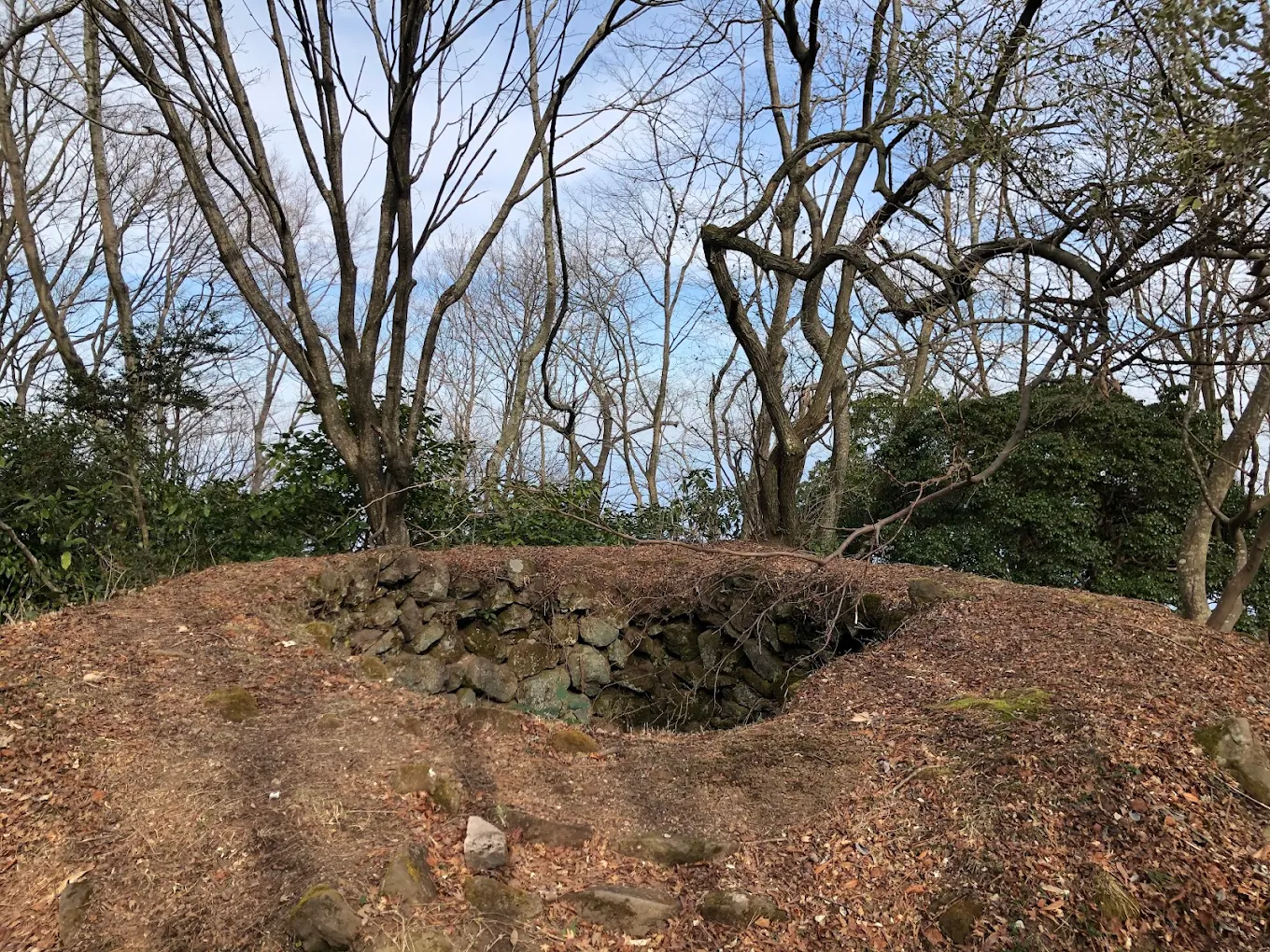
Some remnants of stone walls remain at Takasakiyama Castle. These stone walls, demonstrating the castle-building techniques of the late Sengoku period, were constructed using the nozurazumi technique (stacking natural stones) and are valuable resources for understanding the level of castle-building technology at the time.
Earthworks also remain in various places. These earthworks surrounding the baileys enhanced defensive capabilities and clearly defined the boundaries within the castle.
Gate Entrances and Gate Remains
The gate entrances to the castle were particularly strongly constructed as key defensive points. As mentioned above, the main gate entrance is structured to pass through the side of the bailey, allowing for attacks on intruders from the flank.
Stone materials believed to be the foundation stones of a gate remain around the gate entrance, suggesting the possibility that a turret gate once stood here.
Ascent Route and Access
Takasakiyama Therapy Road
Currently, you can reach Takasakiyama Castle via the Takasakiyama Therapy Road. This course is beginner-friendly and a popular choice among the therapy roads in Oita City.
The course from the southern trailhead to the summit takes approximately one hour on foot. While walking along the well-maintained trail, you may even encounter wild Japanese macaques along the way. The trail is relatively gentle, making it an attractive route for exploring history while enjoying moderate exercise and forest bathing.
Points of Interest
Upon reaching the summit area, you can see the remains of Takasakiyama Castle. From the main enclosure, a spectacular view of Beppu Bay unfolds, allowing you to imagine the scene where the warriors of the Otomo clan once strategized while gazing at this scenery.
The remains of the enclosures are relatively clearly preserved, allowing you to confirm the layout and scale of each enclosure. With careful observation, you can also discover the remains of stone walls and earthworks, providing an excellent opportunity to learn about the structure of a mountain castle from the Sengoku period.
Access Information
The most convenient way to access Mt. Takasaki is by bus from JR Beppu Station or Oita Station. Buses run to Takasakiyama Natural Zoological Park, from where you can access the southern trailhead.
If traveling by car, you can use the parking lot at Takasakiyama Natural Zoological Park. It’s approximately 10 minutes from the Beppu Interchange on the Higashi-Kyushu Expressway.
When hiking, it is recommended to prepare appropriate clothing and shoes, and drinking water. Also, it is important to follow precautions such as not showing food to wild Japanese macaques and avoiding eye contact, in case of an encounter.
Nearby Attractions
Takasakiyama Natural Zoological Park
At the foot of Mt. Takasaki lies Takasakiyama Natural Zoological Park, known as one of Japan’s leading habitats for wild Japanese macaques. Approximately 1,500 macaques live there, and you can observe them being fed up close. It’s a spot you can enjoy all day long, especially if you combine a visit to the castle ruins with a visit to the zoo.
Otomo Clan Ruins
Numerous ruins of the Otomo clan, closely associated with Takasakiyama Castle, remain in Oita City. The Otomo Clan Residence Site (National Historic Site) is the site of the residence where the Otomo clan lived during peacetime, and is an important historical site for understanding its role as a fortified outpost of Takasakiyama Castle.
Tanoura Coastline
The Tanoura coastline, stretching east of Takasakiyama, is a popular driving route offering beautiful views of Beppu Bay. Viewing Beppu Bay from the coastline, after having viewed it from Takasakiyama Castle, allows one to reaffirm the castle’s excellent location.
Isshinji Temple
Isshinji Temple, located in Beppu City, is known for its Fudo Myoo (Acala) and is situated close to Takasakiyama. It offers beautiful scenery throughout the seasons, with cherry blossoms in spring and hydrangeas in early summer.
Cultural Value of Takasakiyama Castle
Important Resource for Medieval Mountain Castle Research
Takasakiyama Castle occupies an important position in castle research as a typical example of a medieval mountain castle in Kyushu. The remains of Takasakiyama Castle showcase the evolution of castle construction techniques from the Nanboku-cho period to the Sengoku period, making it a valuable resource for understanding the development of mountain castles, particularly in Bungo Province.
Center for Otomo Clan Research
The Otomo clan, who ruled Bungo Province, played a crucial role in the history of the Sengoku period in Kyushu. Takasakiyama Castle is an indispensable historical site for understanding the Otomo clan’s military strategy and is a significant historical legacy that tells the story of their rise and fall.
Value as a Landscape
The view from the Takasakiyama Castle ruins offers a spectacular panoramic view of Bungo, centered around Beppu Bay. This landscape remains largely unchanged from the view seen by past warlords, and its historical value is highly regarded.
Efforts for Preservation and Utilization
The Cultural Properties Office of the Oita City Board of Education is actively working on the preservation and utilization of the Takasakiyama Castle ruins. Surveying and archaeological excavations of the remains are continuously being conducted, progressing towards a complete understanding of the castle’s structure.
Value as a Landscape
The view from the Takasakiyama Castle ruins offers a magnificent panorama of the Bungo landscape, centered around Beppu Bay. This landscape remains largely unchanged from the view seen by past warlords, and its value as a historical landscape is highly regarded. Furthermore, the development of the Takasakiyama Therapy Road has created an environment where citizens and tourists can easily visit the castle ruins. This effort to balance the preservation of historical heritage with its utilization as a tourist resource is attracting attention as a model example of regional cultural property protection.
In recent years, efforts have been made to create an environment where visitors can easily understand the history and structure of the castle through the installation of information boards and the improvement of explanatory signs. Guided tours by local volunteer guides are also sometimes organized, allowing visitors to learn more about the charm of Takasakiyama Castle.
Summary
Takasakiyama Castle (Oita City, Oita Prefecture) is an impregnable mountain castle that functioned for approximately 240 years as the stronghold of the Otomo clan, the shugo (military governor) of Bungo Province. Built on the summit of Mount Takasakiyama at an altitude of 628m, this castle played an important role in Kyushu history, including battles with the Kikuchi clan during the Nanboku-cho period and invasions by the Shimazu clan during the Sengoku period.
Even today, the remains of the castle, including baileys, stone walls, and gates, are well-preserved on the mountaintop. It takes about an hour to reach the castle via the Takasakiyama Therapy Road. Takasakiyama Castle, offering breathtaking panoramic views of Beppu Bay and the atmosphere of a Sengoku period mountain castle, is a recommended spot not only for history buffs but also for those who enjoy mountain climbing and hiking.
Takasakiyama Castle, which conveys the history of the Otomo clan’s glory and hardships, stands majestically, teaching us the weight of history and the wisdom of our ancestors, transcending more than 600 years. When you visit Oita, be sure to visit this historically romantic mountain castle.
References
Research on Takasakiyama Castle is conducted through survey reports by the Oita City Board of Education and papers by castle researchers. Main references include “Cultural Properties of Oita City” (Oita City Board of Education Cultural Properties Office), various castle research books, and historical research books on the Otomo clan.
Furthermore, Edo period geographical records such as the “Bungo no Kuni Shi” and military chronicles such as the “Otomo Kōhaiki” are also important historical sources for understanding the history of Takasakiyama Castle. By comprehensively examining these documents, the true nature of Takasakiyama Castle is gradually becoming clearer.
When visiting the site, pamphlets and guidebooks published by the Oita City Tourism Association and the Oita City Board of Education are also useful. The latest information on archaeological excavations and research findings can be found on the official Oita City website and in cultural property-related publications.