Complete Guide to Ogo Castle (Gunma Prefecture): A Thorough Explanation of the History, Structure, and Highlights of this Famous Castle at the Foot of Mt. Akagi
Overview
Ogo Castle is a flatland castle located in Kawarahama-cho, Maebashi City, Gunma Prefecture, that existed from the medieval period to the early modern period. Built on a plateau at an altitude of approximately 180 meters on the southern foot of Mt. Akagi, this castle originated as the residence of the Ogo clan, who were active from the late Heian period to the Kamakura period. It is also known that during the Sengoku period, Kamiizumi Ise-no-kami Nobutsuna, a renowned swordsman and founder of the Shinkage-ryu school, served as its lord.
Currently, it is preserved as a Gunma Prefecture designated historical site, with well-preserved remains such as earthworks and dry moats, centered around the main keep. The castle site measures approximately 670 meters north-south and 310 meters east-west, and possesses high historical value as a typical example of a medieval castle that skillfully utilizes the natural terrain.
It is believed that the castle was fully constructed during the Tenbun era (1532-1555), and it functioned as an important military base in Kōzuke Province (present-day Gunma Prefecture) until its abandonment in 1616 (Genna 2) during the early Edo period.
History and Background
The Era of the Ōgo Clan and the Origin of the Castle
The history of Ōgo Castle dates back to the late Heian period and early Kamakura period. The Ōgo clan, who became the lords of the castle, are said to be descendants of Fujiwara no Hidesato, a famous general of the Heian period, and they served as retainers of the Kamakura Shogunate. The Ōgo clan expanded their power as local lords in Kōzuke Province, and it is believed that the establishment of their residence in this area marked the beginning of Ōgo Castle.
From the Kamakura period to the Muromachi period, the Ōgo clan continued to develop as a powerful samurai group in the region. However, with the arrival of the Sengoku period, they became embroiled in the power struggles of surrounding daimyo.
The Battle Against the Koga Shogun and the Yokose Clan
During the mid-Sengoku period, the Ogo clan was forced to fight for survival amidst a harsh political climate. Around 1541, the Ogo clan faced strong pressure due to the expansion of the Yokose clan (Yura clan), based at Kanayama Castle (present-day Ota City).
The Yokose clan was expanding its power through complex relationships with the Koga Shogun and the Kanto Kanrei Uesugi clan, aiming to control eastern Kozuke Province. Unable to withstand this pressure any longer, Ogo Katsuyuki sought refuge with the Later Hojo clan, based in Odawara, and moved to Ushigome in Edo, Musashi Province, changing his name to Ushigome in 1555. The descendants of this Ushigome clan would later continue as hatamoto (direct retainers) of the Edo Shogunate.
The Rule of the Kamiizumi Clan and the Birthplace of the Shinkage-ryu School of Swordsmanship
After the Ogo clan’s departure, Ogo Castle became the domain of the Kamiizumi clan, a branch of the Ogo clan. Among the Kamiizumi clan, the most famous is Kamiizumi Ise-no-kami Nobutsuna, renowned as a master swordsman.
Born around 1508, Kamiizumi Nobutsuna devoted himself to swordsmanship training from a young age. He studied various schools, including Kage-ryu, Shinto-ryu, and Nen-ryu, and integrated them to create his own unique school of swordsmanship, “Shinkage-ryu.” Shinkage-ryu was later inherited by the Yagyu clan and developed into one of the most important schools in the history of Japanese swordsmanship, serving as the sword instructor to the Shogun of the Edo shogunate.
Kamiizumi Nobutsuna operated from Ogo Castle and trained many disciples. His swordsmanship was both practical and theoretically sound, and he is known for his philosophy of “Katsujinken” (sword that gives life). Ogo Castle was thus an important stage in the history of Japanese martial arts.
The Echigo Uesugi Clan’s Campaigns to Kanto
During the late Sengoku period, the Kanto region was subjected to military intervention by Uesugi Kenshin, a Sengoku daimyo of Echigo Province (present-day Niigata Prefecture), who served as the “Kanto Kanrei” (Governor of Kanto). At the request of Kanto Kanrei Uesugi Norimasa, Uesugi Kenshin frequently dispatched troops to Kanto to counter the Later Hojo clan’s control of the region. This is known as “Echigo.”
While there are various theories regarding the relationship between Kamiizumi Nobutsuna and Uesugi Kenshin, records indicate that Kamiizumi acted on the Uesugi side. Kozuke Province was a strategically important point connecting Echigo and Kanto, and Ogo Castle played a crucial role within this strategic location.
It is believed that Kamiizumi Nobutsuna joined Kenshin’s forces during his campaign to Kanto in 1560. However, Nobutsuna then embarked on a journey of martial arts training, leaving Ōgo Castle around 1566 and traveling throughout the country, teaching swordsmanship in various locations.
The Otate Rebellion and the Honnō-ji Incident
After the death of Uesugi Kenshin, the Otate Rebellion broke out in Echigo Province in 1578. This was a civil war over the succession to Uesugi Kenshin, with his adopted son Uesugi Kagekatsu and Uesugi Kagetora (from the Later Hōjō clan) fiercely competing. This rebellion became a large-scale conflict involving not only Echigo Province but also various forces in the Kantō and Shinano regions.
In Kōzuke Province, the balance of power also shifted significantly due to this rebellion. Ultimately, Uesugi Kagekatsu emerged victorious, but in the process, the Later Hōjō clan’s influence expanded into Kōzuke Province.
Furthermore, in 1582, the Honnō-ji Incident occurred, in which Oda Nobunaga was killed by Akechi Mitsuhide. This political upheaval plunged the Kanto and Kōshin regions, which had been under the Oda clan’s control, into chaos once again, leading to territorial disputes between the Later Hōjō clan, Tokugawa Ieyasu, and Uesugi Kagekatsu. During this period, Ōgo Castle is believed to have been within the sphere of influence of the Later Hōjō clan.
The Makino Clan’s Entry into the Castle and its Aftermath
In 1590, following Toyotomi Hideyoshi’s siege of Odawara, the Later Hōjō clan was destroyed, and the Kanto region came under the control of Tokugawa Ieyasu. Upon entering the Kanto region, Ieyasu deployed his retainers throughout.
Makino Yasunari, a senior retainer of Tokugawa Ieyasu, became the lord of Ōgo Castle. Makino Yasunari was a samurai from Mikawa Province (present-day eastern Aichi Prefecture) and a long-serving hereditary retainer of the Tokugawa family. Upon entering Ōgo Castle, he renovated and improved the medieval castle, transforming it into a modern fortress.
Makino Yasunari served as the first lord of the Ōgo Domain, ruling over a 20,000 koku territory, and resided at Ōgo Castle until 1598. Afterward, the Makino clan was transferred to Nagamine in Echigo Province (present-day Nagaoka City, Niigata Prefecture), and Ōgo Castle temporarily functioned as a branch castle of Maebashi Castle.
After the Makino clan, the Sakai clan took control of Ōgo Castle, and a castle governor was appointed. However, in 1616, due to the Edo Shogunate’s “One Castle Per Province” decree, Ōgo Castle was officially abandoned. Subsequently, the castle buildings were demolished, and the castle site gradually transformed into farmland and residential areas.
The Sakai clan continued to rule the Ōgo region, but when they were transferred to Himeji in Harima Province (present-day Himeji City, Hyogo Prefecture) in 1749, the Ōgo region remained under the control of the shogunate and hatamoto (direct retainers of the shogun) until the end of the Edo period.
Successive Lords of Ōgo Castle
The successive lords of Ōgo Castle are as follows:
Medieval Period (Up to the Sengoku Period)
- Ogo Clan (Late Heian Period – Muromachi Period)
- The Ogo clan is said to be descended from Fujiwara no Hidesato and served as retainers of the Kamakura Shogunate.
- During the time of Ogo Katsuyuki, they moved to Musashi Province under pressure from the Yokose clan of Kanayama Castle.
- Kamiizumi Clan (Mid-Sengoku Period)
- Kamiizumi Ise-no-kami Nobutsuna: A renowned swordsman and founder of the Shinkage-ryu school of swordsmanship.
- The Kamiizumi clan is said to be a branch of the Ogo clan.
- Under the Influence of the Later Hojo Clan (Late Sengoku Period)
- During the Tensho era, they came under the control of the Later Hojo clan.
Early Modern Period (Early Edo Period)
- Makino Yasunari (1590 – 1598)
- A retainer of Tokugawa Ieyasu and the first lord of the Ogo Domain (20,000 koku).
- Developed Ogo Castle as an early modern castle.
- Transferred to Nagamine, Echigo Province in 1598 (Keicho 3)
- Sakai Clan (Early Edo Period – Abandoned Castle in 1616)
- A castle lord was appointed
- Abandoned Castle in 1616 (Genna 2) due to the One Castle Per Province Decree
Structure
Ogo Castle is a flatland castle built on a plateau at the southern foot of Mount Akagi, located at an altitude of approximately 180 meters and a relative height of approximately 10 meters. The castle is built skillfully utilizing the long, narrow hilly terrain, and its layout is characterized by making maximum use of the natural topography.
Overall Structure
The castle area measures approximately 670 meters from north to south and 310 meters from east to west, with the following baileys arranged from north to south.
- Chikado Kuruwa: The northernmost enclosure
- Kitajo (Etchu Yashiki): The northern defensive stronghold
- Honmaru: The central part of the castle
- Ninokuruwa: South of Honmaru
- Sannomaru: Further south enclosure
- Yonomaru: The southernmost point (currently the location of the Maebashi City Ogo Branch Office)
These enclosures are separated by deep dry moats, a structure designed to prevent enemy intrusion.
Structure of Honmaru
The Honmaru is the core enclosure of Ogo Castle, and its remains are still well-preserved. Earthen ramparts 3-4 meters high surround the Honmaru, and their scale is overwhelming to visitors. The earthen ramparts on the west and south sides are particularly well-preserved, conveying the castle-building techniques of the Sengoku period.
The remains of a masugata gate have been confirmed at the entrance to the main enclosure, indicating that a masugata was used as a defensive structure for the entrance. A masugata is a defensive structure designed to make enemy intrusion difficult; it consists of a double gate trapping intruders within the masugata space, allowing for attacks from all sides.
The interior of the main enclosure is leveled and is presumed to have once housed the lord’s residence or other important buildings. Currently, a shrine stands there, serving as a place of worship for the local community.
Dry Moats and Earthworks
The greatest highlight of Ogo Castle is the dry moats and earthworks that separate each enclosure. A particularly deep and wide dry moat is dug between the main enclosure and the second enclosure, reaching a depth of approximately 7-8 meters and a width of approximately 15-20 meters. This dry moat has a V-shaped cross-section called a yagenbori, making it extremely difficult for attackers to cross.
High earthen ramparts were built on both sides of the dry moat, further increasing the elevation difference from the bottom of the moat. From the top of the ramparts, it was possible to effectively attack enemies attempting to cross the moat.
A dry moat was also constructed between the western group of baileys and the main keep, adding another layer to the castle’s defenses. These dry moats remain intact to this day, providing valuable historical remains that allow us to experience the defensive system of a medieval castle.
Utilization of the Eastern Topography
The Aratogawa River flows to the east of Ogo Castle, and this natural river acts as a natural moat. The elevation difference between the river and the plateau is approximately 20 meters, making attacks from the east extremely difficult.
It is believed that there was a residential area for retainers called “Negoya” along the Aratogawa River. Negoya was a prototype of a castle town, where retainers lived during peacetime and took refuge in the castle during wartime.
West Enclosure and Outer Fortifications
To the west of the main enclosure lies a flat area known as the West Enclosure. This area is thought to be an extension of the castle and may have been developed during renovations by the Makino clan in the early Edo period.
It is presumed that warehouses, stables, and other rear support facilities were located in the West Enclosure. Furthermore, traces of earthworks and moats remain partially along the western outer edge of the castle, suggesting that they formed a defensive line for the entire castle area.
Renovations as a Modern Castle
In the early Edo period, when Makino Yasunari became the lord of the castle, elements of a modern castle were added to the medieval Ogo Castle. It is believed that the castle underwent improvements such as the construction of a masugata gate, strengthening of earthworks, and expansion of the enclosures.
However, with the castle’s abandonment in 1616, the renovation into a full-fledged modern castle using stone walls was never completed. Therefore, the current Ogo Castle ruins retain many characteristics of medieval castles, making it a valuable historical site for studying the castle structure of the Sengoku period.
Branch Castles
Several branch castles existed within the sphere of influence of the Ogo clan, centered around Ogo Castle. These branch castles formed a defensive network for Ogo Castle and functioned as bases for governing the territory.
Zen Castle
Located approximately 3 kilometers northeast of Ogo Castle, this branch castle is believed to have been ruled by a member of the Ogo clan. Zen Castle was built on a hill at the southern foot of Mount Akagi and served as a defensive base against invasions from the north.
Kamiizumi Castle
This castle is considered the base of the Kamiizumi clan and was located approximately 5 kilometers west of Ogo Castle. It is said to be the birthplace of Kamiizumi Ise-no-kami Nobutsuna and is also known as the birthplace of the Shinkage-ryu school of swordsmanship. Currently, a monument marking the castle site stands, and only a few remains are preserved.
Other Fortifications
Several small fortifications and watchtower remains, whose names are unknown, have been identified around Ogo Castle. These are thought to have functioned as road monitoring points and emergency communication centers.
Highlights of Ogo Castle
Earthen Embankment of the Main Enclosure
The most impressive feature of Ogo Castle is the massive earthen embankment surrounding the main enclosure. Reaching a height of 3-4 meters and a width of over 10 meters at its base, this embankment demonstrates the advanced civil engineering techniques of the Sengoku period. The western and southern embankments, in particular, are well-preserved and retain much of their original appearance.
Climbing onto the embankment offers a panoramic view of the entire castle grounds, making it ideal for understanding the castle’s layout. Furthermore, the depth of the dry moat viewed from the embankment is breathtaking, giving a real sense of the castle’s formidable defenses.
Dry Moat
The dry moat separating the main keep and the second bailey is approximately 7-8 meters deep and 15-20 meters wide, and remains clearly visible today. There are places where you can descend to the bottom of the moat, allowing you to experience its depth.
The V-shaped V-shaped moat is a structure that made it extremely difficult for attackers to cross, and is an important relic for understanding the defensive philosophy of medieval castles. The height of the earthen ramparts viewed from both sides of the moat is impressive, giving a real sense of the castle’s strength.
Masugata Gate Remains
The remains of the Masugata gate at the entrance to the main keep are an important relic demonstrating the defensive techniques of castle architecture. Although the stonework is no longer present, the structure of the Masugata can be deciphered from the topography.
The Masugata is a system where a double gate lures intruders into a narrow space, allowing for attacks from all sides. This structure represents a defensive technique that developed from the late Sengoku period to the early Edo period, and is relevant when considering the construction date of Ogo Castle.
Chikato Kuruwa
Located at the northernmost point of the castle, Chikato Kuruwa was the frontline defensive stronghold against enemies from the north. Although part of it is now privately owned, traces of earthworks and moats can still be seen.
From this enclosure, one can enjoy a magnificent view of Mount Akagi, and truly appreciate how the castle was built by skillfully utilizing the terrain at the foot of Mount Akagi.
Shrine and Stone Monument
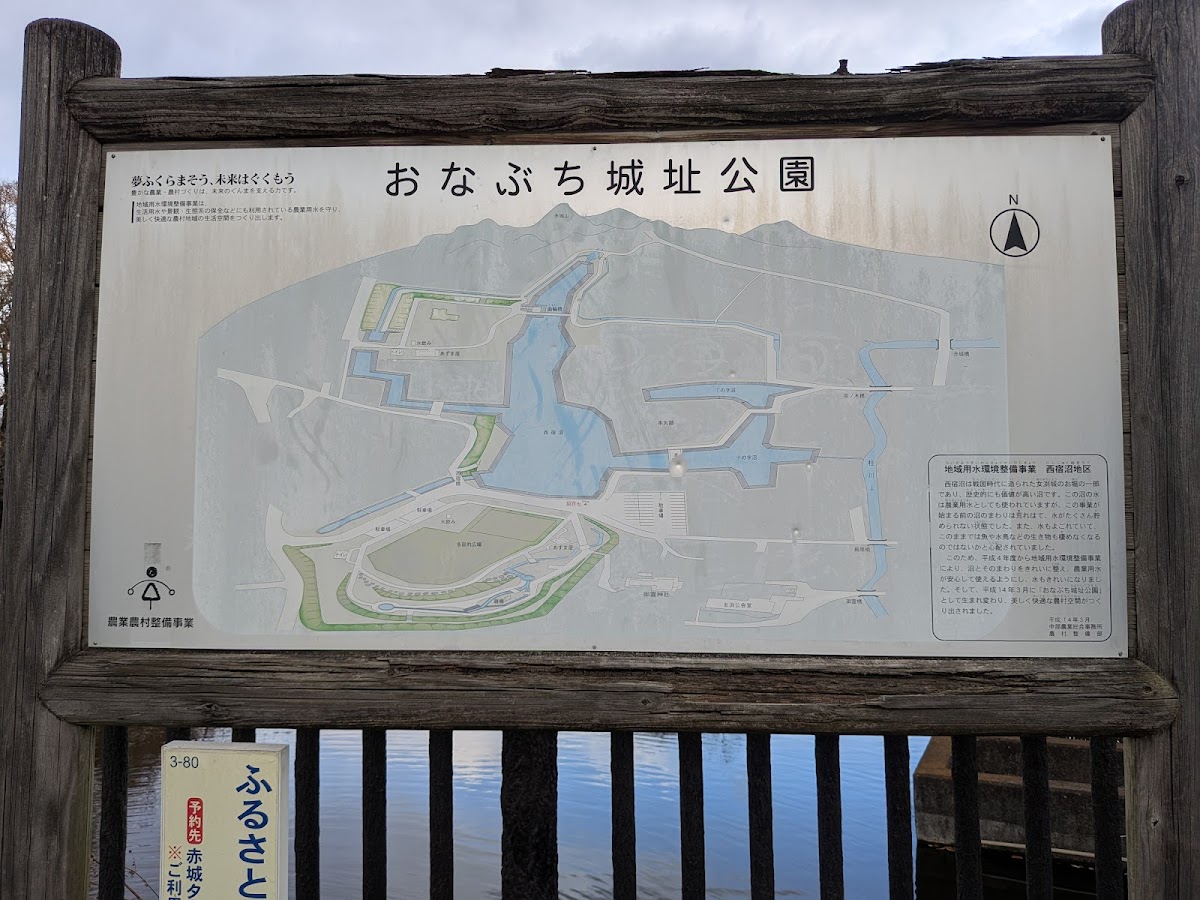
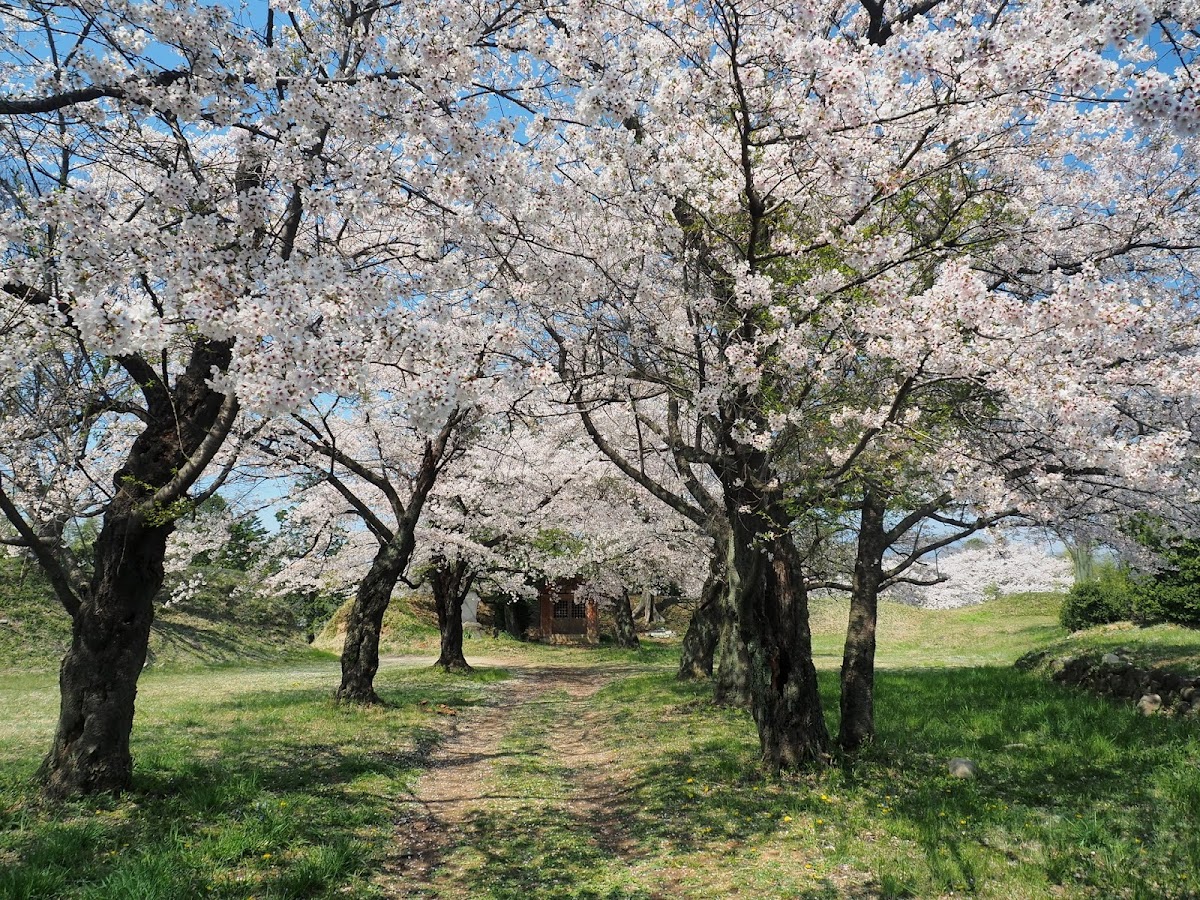
A shrine stands on the site of the main keep, serving as a place of worship for the local community. Within the shrine grounds, there are explanatory signs and stone monuments related to Ogo Castle, allowing visitors to learn about the castle’s history.
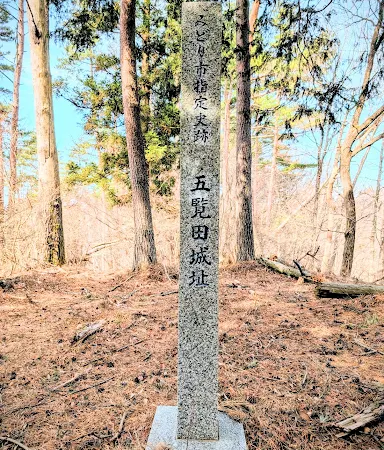
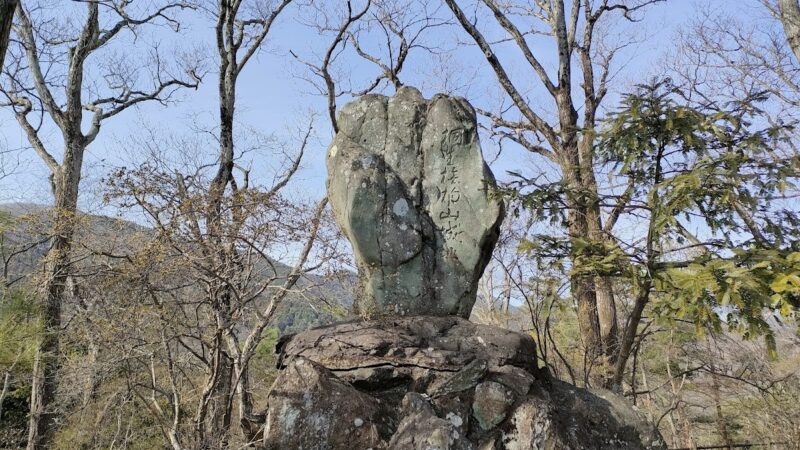
In particular, the stone monument designated as a Gunma Prefecture historical site is an important marker indicating the historical value of Ogo Castle. Furthermore, a monument commemorating Kamiizumi Ise-no-kami Nobutsuna has been erected nearby, highlighting the area’s connection to a renowned swordsman.
Yon-no-maru (Ogo Branch Office)
Located at the southernmost point of the castle, the Yon-no-maru is currently occupied by the Ogo Branch Office of Maebashi City. A parking lot is available around the branch office, making it a convenient starting point for visiting the castle ruins.
Partial traces of earthworks and moats remain around the Yon-no-maru, allowing visitors to appreciate the vastness of the castle grounds.
Access
The following are ways to access Ogo Castle:
Using Public Transportation
Train
- Get off at Ogo Station on the Jomo Electric Railway Jomo Line, approximately 15 minutes on foot.
- Transfer to the Jomo Electric Railway from JR Maebashi Station, approximately 30 minutes to Ogo Station.
From Ogo Station to the castle ruins, walk north. Follow the signs in front of the station to reach the castle ruins. The route passes through a residential area, but guide signs are placed at key points.
Bus
- Take the Kanetsu Kotsu bus “Ogo Line” from JR Maebashi Station and get off at “Ogo Shisho-mae” bus stop.
- Travel time: Approximately 40 minutes
By Car
From the Kanetsu Expressway
- Approximately 20 minutes from the Kanetsu Expressway “Maebashi IC”
- Proceed along National Route 17 towards Maebashi city center, then take Prefectural Route 114 towards Ogo.
From the Kita-Kanto Expressway
- Approximately 30 minutes from the Kita-Kanto Expressway “Isesaki IC”
- Proceed along National Route 17 towards Maebashi, then take Prefectural Route 114 towards Ogo.
Parking
- Parking is available at the Maebashi City Ogo Branch Office parking lot (free of charge).
- Address: 1115-4 Horikoshi-cho, Maebashi City, Gunma Prefecture
- Parking capacity: Approximately 30 cars
Visiting Hours and Precautions
- Visiting Hours: Open all day (The main keep site is maintained as a park)
- Admission Fee: Free
- Estimated Time Required: Approximately 1-2 hours for a thorough visit
Notes
- The earthworks and dry moats can be slippery, so comfortable walking shoes are recommended.
- In summer, vegetation can be overgrown, making the remains difficult to see.
- Some areas are private property; please do not enter restricted areas.
- Please be quiet and observe proper etiquette while visiting the shrine grounds.
Location
Address: Kawarahama-cho, Maebashi City, Gunma Prefecture
Main Facilities
- Main Keep Site: Kawarahama-cho, Maebashi City, Gunma Prefecture (Shrine location)
- Fourth Bailey (Ogo Branch Office): 1115-4 Horikoshi-cho, Maebashi City, Gunma Prefecture
Distance from Major Surrounding Cities
- Approximately 10 kilometers from the center of Maebashi City
- Approximately 20 kilometers from Takasaki City
- Approximately 15 kilometers from Isesaki City
Nearby Tourist Attractions
Kamiizumi Castle Ruins
These are the ruins of a castle believed to be the birthplace of Kamiizumi Ise-no-kami Nobutsuna, the founder of the Shinkage-ryu school of swordsmanship. Located approximately 5 kilometers west of Ogo Castle, a castle ruins monument and explanatory sign are installed. Those interested in swordsmanship are recommended to visit both Ogo Castle and Maebashi Castle.
Maebashi Castle (Maebashi Park)
Located approximately 10 kilometers southwest of Ogo Castle, Maebashi Castle was the residence of the Sakai and Matsudaira clans during the Edo period. Currently, it is maintained as Maebashi Park, with some earthworks and moats remaining. From the observation deck of the Gunma Prefectural Government Building, you can see Mount Akagi and the Ogo area.
Mount Akagi
Mount Akagi, towering north of Ogo Castle, is a stratovolcano with an elevation of 1,828 meters. With many attractions such as Lake Onuma, a caldera lake at the summit, and Akagi Shrine, it is ideal for hiking and driving. It can be accessed in approximately 40 minutes by car from Ogo Castle. ### Ogo Onsen (hot spring)
Near the castle ruins, there is a day-trip hot spring facility where you can relax and soothe your fatigue after visiting the castle ruins. You can also enjoy dishes made with local ingredients.
Gunma Prefectural Museum of History
Located in Maebashi City, this history museum exhibits the history of Gunma Prefecture from ancient times to the modern era. It also houses materials related to castles in the prefecture, including Ogo Castle, making it recommended for those who want to learn more about history.
Ogo Castle and the Swordsman Kamiizumi Nobutsuna
When discussing Ogo Castle, its relationship with Kamiizumi Ise-no-kami Nobutsuna, the founder of the Shinkage-ryu school of swordsmanship, is indispensable. Kamiizumi Nobutsuna is said to have been born at Kamiizumi Castle around 1508 (Eisho 5), and as the head of the Kamiizumi clan, a branch of the Ogo clan, he also served as the lord of Ogo Castle.
Nobutsuna devoted himself to swordsmanship training from a young age, receiving instruction from Aisu Ikosai of the Kage-ryu school and Matsumoto Masanobu of the Shinto-ryu school, among others. He studied these schools of swordsmanship and, by adding his own theories and techniques, founded the “Shinkage-ryu” school.
The defining characteristic of Shinkage-ryu lies in its philosophy of “Katsujinken” (sword that gives life). This philosophy posits that “the sword is not for killing, but for giving life,” positioning swordsmanship not merely as a technique for killing, but as a means of character development and spiritual discipline. This philosophy later became the spiritual foundation of Japanese martial arts.
Among Kamiizumi Nobutsuna’s disciples were Yagyu Sekishusai Munenori, Hikida Kagekane, and Kango Muneharu, and through them, Shinkage-ryu spread throughout Japan. The Yagyu family, in particular, became instructors to the Shogun of the Edo Shogunate, and Shinkage-ryu was established as the legitimate swordsmanship of the samurai class.
Around 1566, Kamiizumi Nobutsuna left Ogo Castle on a journey of martial arts training. He traveled through Kyoto, Nara, Ise, and other places, teaching swordsmanship in various locations. He is believed to have died around 1577 (Tensho 5), but the details are unknown.
Ogo Castle holds special significance for swordsmanship enthusiasts and history buffs due to its connection to such an important figure in the history of Japanese martial arts.
Cultural Property Designation and Preservation Activities of Ogo Castle
Ogo Castle ruins were designated a Gunma Prefecture Historic Site in 1970 (Showa 45). This led to efforts to preserve and maintain the castle ruins.
The Maebashi City Board of Education regularly mows the grass and maintains the information boards at the castle ruins, maintaining an environment where visitors can safely explore. Local history enthusiasts and community associations also cooperate in preservation activities, such as cleaning the castle ruins and holding guided tours.
In recent years, detailed surveys and archaeological excavations have been conducted at the castle ruins, advancing research into the castle’s structure and history. These research results have been published as academic papers and reports, contributing to the development of castle research.
Ogo Castle is a valuable historical site that preserves the structure of a medieval castle in excellent condition, and its appropriate preservation and utilization are expected to continue in the future.
Summary
Ogo Castle is a flatland castle from the medieval to early modern period located in Maebashi City, Gunma Prefecture. It was the residence of historically important warlords such as the Ogo, Kamiizumi, and Makino clans. In particular, it holds special significance in the history of Japanese martial arts as it is associated with Kamiizumi Ise-no-kami Nobutsuna, the founder of the Shinkage-ryu school of swordsmanship.
Even today, the remains of the main keep, such as the earthworks and dry moats, are well-preserved, making it a valuable historical site where visitors can experience the structure of a Sengoku period castle. Protected as a Gunma Prefecture designated historical site, Ogo Castle is a must-see spot for history buffs and castle enthusiasts.
Why not visit the ruins of Ogo Castle, nestled in the beautiful natural environment at the foot of Mount Akagi, and reflect on the historical stage where warlords of the Sengoku period once fought? It is easily accessible by the Jomo Electric Railway and bus, and admission is free, making it a convenient place to visit. Visiting the surrounding Kamiizumi Castle ruins, Maebashi Castle, and Mount Akagi together will allow you to gain a deeper understanding of Gunma Prefecture’s rich history and culture.
References
The following documents and materials were consulted in writing this article:
- “Gunma Prefecture History,” Gunma Prefecture History Compilation Committee
- “Maebashi City History,” Maebashi City History Compilation Committee
- “Comprehensive Survey of Japanese Castles,” Vol. 4, Shin Jinbutsu Oraisha
- “Medieval Castles and Residences of Kozuke Province,” Gunma Prefecture Board of Education
- “Studies on Shinkage-ryu,” Budo History Research Association
- Materials from the Cultural Properties Protection Division, Maebashi City Board of Education
- Materials held at the Gunma Prefectural Archives
- Various castle research papers and survey reports
Based on these materials, we have strived to provide accurate and detailed information.