Complete Guide to Fukazawa Castle (Kiryu City, Gunma Prefecture) | A Thorough Explanation of the History and Highlights of the Akuzawa Clan
What is Fukazawa Castle?
Fukazawa Castle is a medieval mountain castle located in Shukumawari, Kurohone-cho, Kiryu City, Gunma Prefecture. Also known as Kanbai Castle and Akuzawa Castle, it is known as a cliffside castle built on a cliff overlooking the Fukazawa River, a tributary of the Watarase River.
The elevation is approximately 362m, with a relative height of approximately 60-110m, situated on a strategically important plateau on the west bank of the Watarase River. Currently, Shoenji Temple stands on the castle site, and the remains of the main keep are located at a lower elevation facing the cliff southwest of the temple.
Fukazawa Castle was the base of the Akuzawa clan, who ruled Kurokawa-go (the Watarase River valley area) during the Sengoku period. It was an important fortress that maintained its independent power amidst the rivalry of powerful daimyo such as the Uesugi, Yura, and Hojo clans.
History of Fukazawa Castle
Origins of the Akuzawa Clan and the Construction of Fukazawa Castle
The ancestors of the Akuzawa clan can be traced back to the Former Nine Years’ War (1051-1062) in the late Heian period. It is believed that a family serving the Abe clan, who were leaders of the Emishi people of Oshu, accompanied Abe Muneto, who was captured and escorted to the capital after the defeat of the imperial army, to this area.
Afterward, the Akuzawa clan made a living as intermediaries between the central government and Oshu, handling documents and other correspondence, and settled in the Kurohone area. The Akutsu family received a permanent land grant for Kurohone Village, and the Matsushita family received one for Higashi Village (present-day Higashi district of Kiryu City), thus establishing their position in the region.
There are various theories regarding the construction date of Fukazawa Castle, but the most likely are the Kenmu era (1334-1336) and the Eiroku era (1558-1570). In any case, it is certain that the Akutsu clan built the castle as a base to control the upper reaches of the Watarase River and its mountainous areas.
Control of the Nerimichi Road and its Strategic Importance
The strategic value of Fukazawa Castle lay in its control of the Nerimichi Road. The Nerimichi Road was an important transportation route connecting Numata, passing through the eastern foothills of Mount Akagi, and leading to the Kanto Plain, making it a crucial point between Joshu (present-day Gunma Prefecture) and Kanto.
By controlling the Neri Road, the Akuzawa clan secured a strategically important position both economically and militarily. Surrounded by powerful Sengoku daimyo such as the Uesugi, Yura, and Hojo clans, they maintained their independence by shifting their allegiance. This flexible diplomatic strategy is one of the reasons the Akuzawa clan was able to maintain their power for such a long period.
Relationship with the Kiryu and Yura Clans
Initially, the Kurokawa clan, based at Fukazawa Castle, was subservient to the Kiryu clan, a powerful local family in the Kiryu region. The Kurokawa clan was a collective term for a group of local lords in the Watarase River valley area, led by the Akuzawa clan, and Fukazawa Castle also served as their base of operations.
When the Kiryu clan declined, the Akuzawa clan became subservient to the Yura clan. The Yura clan was a powerful daimyo based at Kanayama Castle (Ota City), and they exerted influence in eastern Joshu Province. While under the Yura clan’s control, the Akuzawa clan maintained a degree of independence.
Attack and Surrender by Uesugi Kenshin
In Tensho 2 (1574), when Uesugi Kenshin of Echigo invaded the Kanto region, Fukazawa Castle came under attack from the Uesugi army. At this time, the castle lord, Akuzawa Samanosuke, surrendered to Uesugi Kenshin, and the Echigo forces were retained at Fukazawa Castle.
This event demonstrates that Fukazawa Castle was a crucial strategic point in the Kanto region during the Sengoku period, a target of fierce competition among major daimyo. As part of his strategy to control Kanto, Uesugi Kenshin employed a strategy of controlling key transportation hubs, and the capture of Fukazawa Castle was part of this strategy.
Subordination to the Hojo Clan and the Capture of Goran-da Castle
After the death of Uesugi Kenshin, the balance of power in Kanto shifted again. In Tensho 12 (1584), the Hojo clan of Sagami Province won over the Akuzawa clan through diplomatic negotiations, and the Akuzawa clan became subservient to the Hojo clan.
At this time, Akuzawa, acting on orders from the Hojo clan, captured the nearby Goranda Castle (Goranda-jo, formerly Ogihara, Higashimura, Kiryu City). Goranda Castle was also a fortress located in a corner of Kurokawa-go, and this capture earned Akuzawa the trust of the Hojo clan, further solidifying his control over Kurokawa-go.
The Siege of Odawara and the Abandonment of the Castle
In Tensho 18 (1590), when Toyotomi Hideyoshi began his siege of Odawara, Akuzawa Notonokami Naotaka, lord of Fukazawa Castle, decided to remain loyal to the Hojo clan.
Akuzawa Michitomo (believed to be another name for Notonokami Naotaka) led approximately 40 to 41 retainers into Odawara Castle. These men, known as the Fukazawa samurai, entered Odawara Castle prepared to share the fate of the Hojo clan.
However, the Hojo clan surrendered to Toyotomi Hideyoshi’s overwhelming forces, and Odawara Castle was opened. After the Hojo’s surrender, the Akuzawa clan’s territory was confiscated by the Toyotomi, and Fukazawa Castle was abandoned. Akuzawa Notonokami Naotaka and the other Fukazawa samurai returned to farming in the Kanbai area, bringing an end to the Akuzawa clan’s history as samurai.
Even after returning to farming, the Akuzawa clan continued to exist as prominent figures in the region, and their descendants are said to still reside in the Kiryu City area today.
Structure and Layout of Fukazawa Castle
Location and Topography
Fukazawa Castle is a cliffside castle built on a cliff overlooking the Fukazawa River, a tributary of the Watarase River. A cliffside castle is a type of castle built on the edge of a cliff facing a river or valley, characterized by a defensive structure that makes maximum use of the natural terrain.
The plateau on which the castle stands has a relative elevation of approximately 60 to 110 meters, and the north and east sides are bordered by steep cliffs formed by the Fukazawa River and Watarase River. This natural fortification made attacks from the north and east virtually impossible.
Main Enclosure and Major Enclosures
The current location of Shōenji Temple is believed to be the central part of the castle. A stone monument marking the main enclosure stands at a low position facing the cliff southwest of the temple. Looking down from the Shōenji Temple parking lot with the temple behind you, you can see the location of the main enclosure considerably below.
The main enclosure was positioned on the edge of the cliff, providing an excellent lookout point overlooking the Fukazawa River. While not particularly large, its layout cleverly utilizes the terrain.
It is presumed that several enclosures (kuruwa, sections of the castle) were located around the main enclosure, but due to changes in the terrain and the construction of the temple, it is difficult to accurately determine its original form.
Current Status of the Remains
The following remains have been identified at Fukasawa Castle:
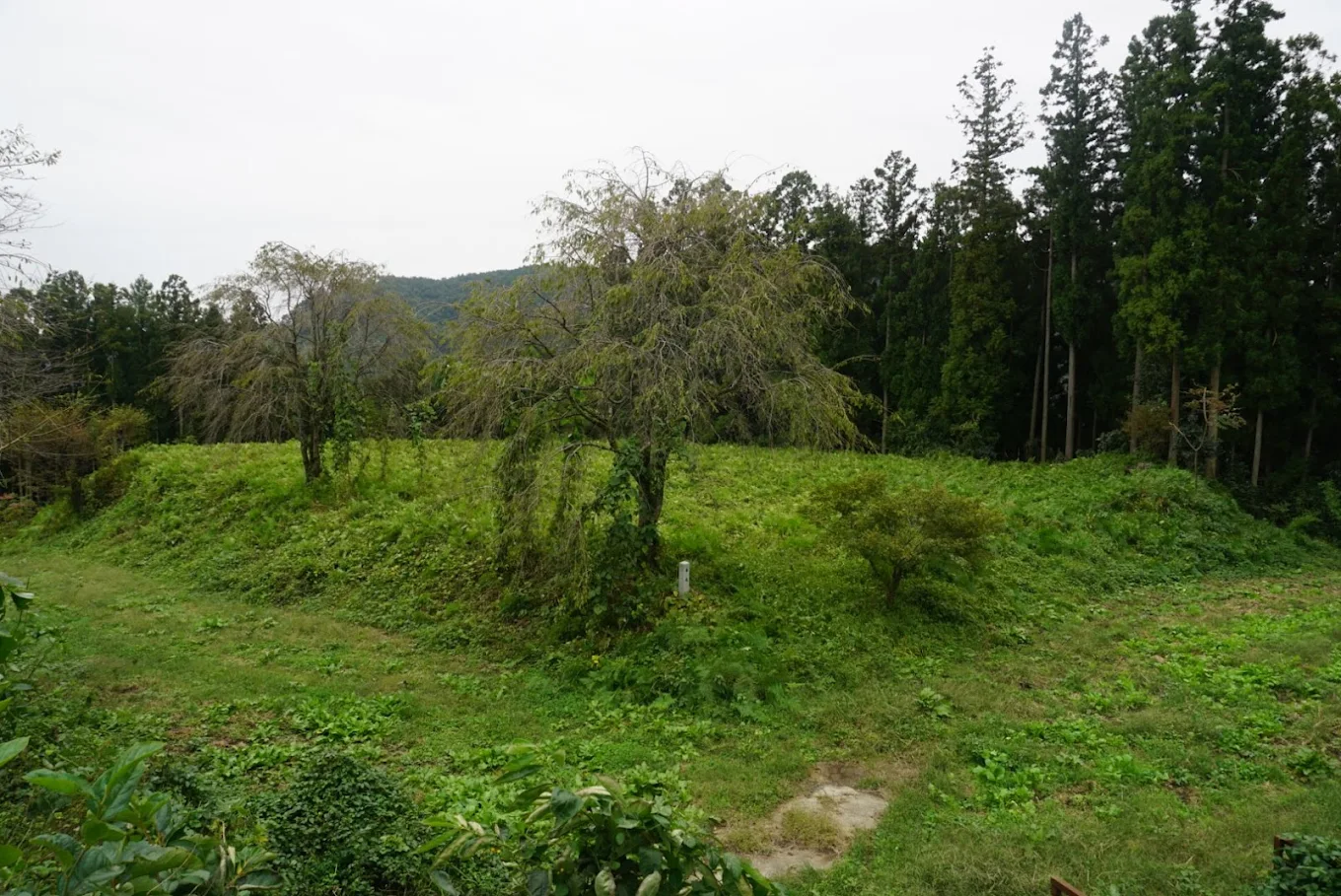
Earthworks: Traces of earthworks, which were defensive structures of the castle, remain in part. Earthworks are embankment-like structures built by piling up earth, which prevented enemy intrusion and served as a foundation for fences and walls.
Dry Moats: Traces of dry moats (moats without water) that separated the baileys are also visible. Dry moats were important defensive structures in mountain castles, obstructing enemy routes and clearly defining the boundaries between baileys.
Bailey Sites: Several flat areas have been identified as bailey sites, but their appearance has changed significantly as they are now used as temple grounds and cemeteries.
Cut Slopes: Parts of artificially carved steep slopes (cut slopes) remain, providing clues to understanding the castle’s defensive structure.
The current Fukasawa Castle site is maintained as the grounds of Shōenji Temple, and the state of preservation as castle remains is not necessarily good. However, the unique characteristics of its location on the edge of a cliff, along with the remaining earthworks and dry moats, allow us to understand the structure of this medieval mountain castle.
Information Boards and Stone Monuments
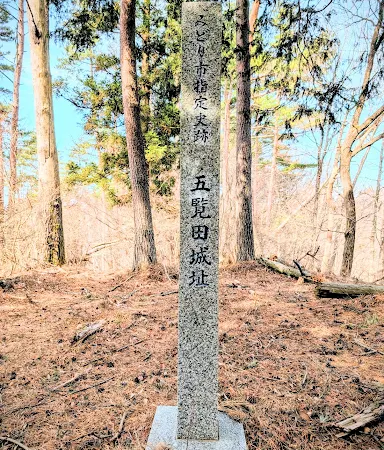
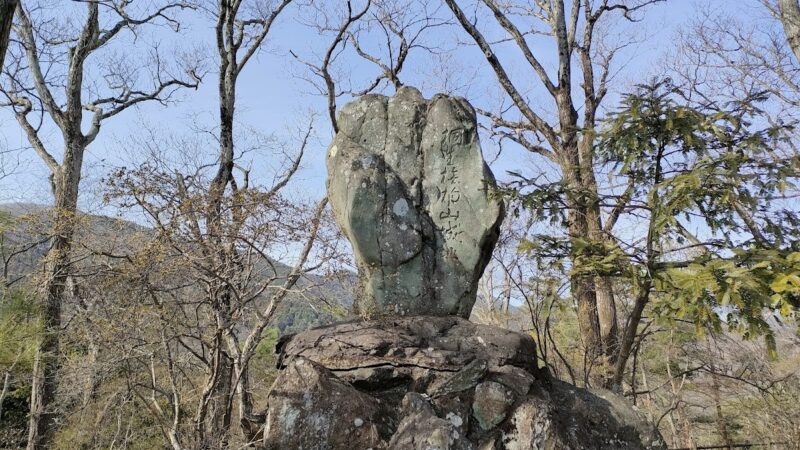
Information boards, labeled “Fukazawa Castle” or “Kamibai Castle,” are installed at the castle site, providing basic information about the castle’s history and structure. A stone monument stands at the site of the main keep, indicating that this was the residence of the Akuzawa clan.
The content of the information boards may vary depending on the installation date and the administrator; the names “Fukazawa Castle” and “Kamibai Castle” may be used interchangeably, but these refer to the same castle.
Highlights of Fukazawa Castle
Shōenji Temple and the Site of the Main Keep
The main highlights when visiting Fukazawa Castle are the grounds of Shōenji Temple and the site of the main keep. Shōenji Temple was built after Fukazawa Castle was abandoned and is located in the center of the castle grounds.
Entering the temple grounds from the parking lot and heading towards the cliff edge on the southwest side, you can see the stone monument marking the site of the main keep. The stone monument is located at a considerably low elevation, allowing one to appreciate the unique location of Fukasawa Castle on the edge of a cliff.
From the site of the main keep, one can look down upon the Fukasawa River valley, experiencing firsthand the strategic importance of this location. The height and steepness of the cliff, in particular, provide valuable insight into the defensive design of medieval mountain castles that utilized natural terrain.
Traces of Earthworks and Dry Moats
Partial traces of earthworks and dry moats remain within the grounds and surrounding area of Shōenji Temple. These are valuable castle remains and provide clues to understanding the defensive structure of medieval mountain castles.
In particular, relatively clear remains of earthworks and dry moats can be seen in the area called Ōma on the southwest side. By observing these remains, one can imagine how Fukasawa Castle was defended.
View of the Watarase River
From the Fukasawa Castle site, one can enjoy a panoramic view of the Watarase River and the surrounding mountains. This view is crucial for understanding how the Akuzawa clan monitored and controlled transportation routes, including the Neri-michi road.
In particular, its location overlooking both the upper and lower reaches of the Watarase River reveals its strategic position for monitoring the flow of people and goods along the road.
Historical Atmosphere
Because the Fukasawa Castle ruins have not been heavily commercialized for tourism, one can reflect on medieval history in a quiet and peaceful atmosphere. The unique space, where the religious space of Shōenji Temple and the castle ruins are fused, conveys the historical layers of Fukasawa Castle.
Considering the history of the Akuzawa clan, who were besieged in Odawara Castle and later settled in this area after returning to farming, the Fukasawa Castle ruins are not merely castle ruins, but a place where the history of the region and the lives of its people are etched into the landscape.
Access and Visiting Information
Location
Address: Near 564 Shukumawari, Kurohone-cho, Kiryu City, Gunma Prefecture (Shōenji Temple)
Access by Car
The most convenient way to access Fukazawa Castle Ruins is by car.
- From Ōta-Kiryu IC on the Kita-Kantō Expressway: Approximately 40 minutes
- From Numata IC on the Kan-Etsu Expressway: Approximately 50 minutes
Head north on National Route 122 towards Kurohone-cho. Upon entering the Shukumawari area, you will see signs for Shōenji Temple.
Parking
Shōenji Temple has a parking lot for visitors, with space for several cars. However, as it is a temple parking lot, please observe proper etiquette and avoid long-term parking.
Access by Public Transportation
Access by public transportation is difficult. The nearest stations, Kiryu Station on the JR Ryomo Line and Honjuku Station on the Watarase Keikoku Railway, are quite far away, and bus service is limited. We recommend visiting by car.
Points to Note During Your Visit
- Shōenji Temple is an active temple, so please observe proper etiquette as a visitor.
- The main keep site is located on the edge of a cliff, so please watch your step.
- Many of the remains are located within the temple grounds and cemetery, so please observe quietly.
- Photography of information boards and stone monuments is permitted, but please refrain from photographing the cemetery.
- Due to the lush vegetation in summer, visiting in spring or autumn is recommended.
Estimated Visiting Time
Allow approximately 30 minutes to 1 hour to visit the Fukasawa Castle Ruins. This is ample time to stroll through the Shōenji Temple grounds, examine the main keep site and other remains, and enjoy the surrounding scenery.
Related Historical Sites in the Surrounding Area
When visiting Fukazawa Castle, exploring the related historical sites in the surrounding area will allow you to gain a deeper understanding of the region’s history.
Goranda Castle
Goranda Castle, located in Ogihara, Higashi district (formerly Higashi Village), Kiryu City, was a castle captured by the Akuzawa clan under orders from the Hojo clan. It is a castle site occupying a corner of Kurokawa-go and is an important historical site for understanding its relationship with Fukazawa Castle.
Kiryu Castle (Hishakuyama Castle)
Kiryu Castle (Hishakuyama Castle), the base of the Kiryu clan, is located on a mountain overlooking Kiryu city. Visiting the castle of the Kiryu clan, who initially served the Akuzawa clan, will provide a more comprehensive understanding of the medieval history of this region.
Umehara Manor and Hikobe Residence
In Kurokawa-go, there are scattered remains of manors belonging to local lords who served the Akuzawa clan, such as Umehara Manor and Hikobe Residence. Visiting these historical sites will allow you to gain insight into the reality of the Kurokawa people.
Watarase Keikoku Railway
The Watarase Keikoku Railway is a scenic railway running along the Watarase River. Passengers can enjoy the scenery around the Neri-do Road, which was controlled by Fukasawa Castle, from the train windows, and appreciate the importance of the transportation route controlled by the Akusawa clan.
Historical Significance of Fukasawa Castle
Survival Strategies of Small and Medium-Sized Local Lords
The history of Fukasawa Castle is a prime example of the survival strategies of small and medium-sized local lords during the Sengoku period. The Akusawa clan, surrounded by powerful Sengoku daimyo such as the Uesugi, Yura, and Hojo clans, maintained their independence by flexibly changing their allegiances.
This diplomatic strategy was not mere opportunism, but a calculated choice based on the strategic value gained from controlling the Neri-do Road, a crucial transportation hub. The history of Fukasawa Castle conveys the complex power relations of the Sengoku period and the wisdom of local forces that survived within it.
The Importance of Controlling Transportation Routes
The reason Fukazawa Castle was considered important for a long period of time was its control over the Neri Road. From the medieval to the early modern period, control of transportation routes brought not only economic benefits but also military and political advantages.
Through this control of transportation routes, the Akuzawa clan was able to maintain their existence as a force that could not be ignored, even though they were not of daimyo class. The history of Fukazawa Castle is a valuable case study for considering the relationship between transportation and castles.
The Siege of Odawara and Local Society
The history of the Akuzawa clan’s siege of Odawara Castle and subsequent return to farming demonstrates the impact of Toyotomi Hideyoshi’s Siege of Odawara on local society. The end of the Sengoku period was a turning point for many small and medium-sized local lords, who lost their status as samurai.
However, examples like the Akuzawa clan, who remained prominent figures in the community even after returning to farming, are important for understanding the role of the former samurai class in local society during the Edo period. The history of Fukazawa Castle tells the story of the transformation of local society during the transition from the Sengoku period to the early modern period.
Summary
Fukazawa Castle (also known as Kamibai Castle) is a medieval mountain castle located in Kiryu City, Gunma Prefecture. It was the base of the Akuzawa clan, who ruled Kurokawa-go during the Sengoku period. Built on a cliff overlooking the Fukazawa River, a tributary of the Watarase River, it was a strategically important base controlling the Neriri Road, a vital transportation route.
The Akuzawa clan maintained their independence by flexibly changing their allegiances amidst the powerful Sengoku daimyo clans of Uesugi, Yura, and Hojo. However, after the Hojo clan’s downfall in Toyotomi Hideyoshi’s Odawara campaign in 1590, the Akuzawa clan, after being besieged in Odawara Castle, were forced to return to farming, and Fukazawa Castle was abandoned.
Currently, Shōenji Temple stands on the castle site, and remnants such as the main keep, earthworks, and dry moats remain partially preserved. While not a flashy tourist destination, it is a valuable historical site where you can reflect on medieval history in a quiet atmosphere.
The history of Fukazawa Castle is historically significant, conveying the survival strategies of small and medium-sized local lords during the Sengoku period, the importance of controlling transportation routes, and the transformation of local communities during the transition from the Sengoku period to the early modern period. This castle is a must-visit for anyone interested in the medieval history of Gunma Prefecture or a fan of mountain castles.