Meitokuji Castle (Gunma Prefecture) Complete Guide: A Strategic Point in the Sengoku Period that Served as a Bridgehead for Sanada Masayuki’s Conquest of Numata
Located in Gokan, Minakami-machi, Tone-gun, Gunma Prefecture, Meitokuji Castle is a mountain castle that played a crucial role as a base for Sanada Masayuki’s conquest of Numata Castle during the Sengoku period. Also known as Tenjin-yama Castle, it still retains impressive remains, including massive dry moats and high earthen ramparts. This article provides a detailed explanation of Meitokuji Castle’s history, structure, highlights, and access methods.
History of Meitokuji Castle: A Strategic Point Fighted Between Uesugi, Hojo, and Sanada
Construction and Early History
The exact construction date of Meitokuji Castle is unclear, but it is believed to have originated from Tenjin-yama Fort, built by the Numata clan (or possibly the Gokan clan) during the Tenbun era (1532-1555). Taking advantage of its location on a hill extending southward, it functioned as a strategic point for monitoring the Tone River basin.
Initially, it served as a branch castle of the Numata clan, a local powerful family, and was part of the defensive network of Numata Castle. During this period, Kōzuke Province was the front line of the power struggle between the Uesugi clan, the Kanto Kanrei (governor of the Kanto region), and the rising Hojo clan, and Myōtokuji Castle was caught in the middle of this conflict.
Uesugi Kenshin’s Southward Expansion and Uesugi Territory
In 1560, when Uesugi Kenshin of Echigo Province began his full-scale expansion into the Kanto region, the Numata clan came under the control of the Uesugi clan. This effectively made Myōtokuji Castle one of the important bases for the Echigo Uesugi clan’s expansion into Kanto.
Kenshin inherited the position of Kanto Kanrei and was in fierce conflict with the Hojo clan. Myōtokuji Castle served as a front-line base for the Uesugi forces in the Tone-Numata region, playing a role in protecting the border with the Hojo clan’s sphere of influence. It is believed that during this period, the castle’s defensive functions were strengthened, and the foundations of the remains seen today were formed.
Hojo Clan Rule and Sanada Masayuki’s Invasion
In 1578, when Uesugi Kenshin died suddenly, a succession dispute (the Otate Rebellion) erupted, and the Uesugi clan’s power declined significantly. Taking advantage of this chaos, the Odawara Hojo clan advanced into the Tone-Numata region, and Myotokuji Castle also came under Hojo control.
However, from 1579 to 1580, Sanada Masayuki, a vassal of Takeda Katsuyori, began his invasion of the Tone-Numata region. Even after the fall of the Takeda clan, Masayuki continued to operate as an independent force, aiming to control the northern part of Kozuke Province.
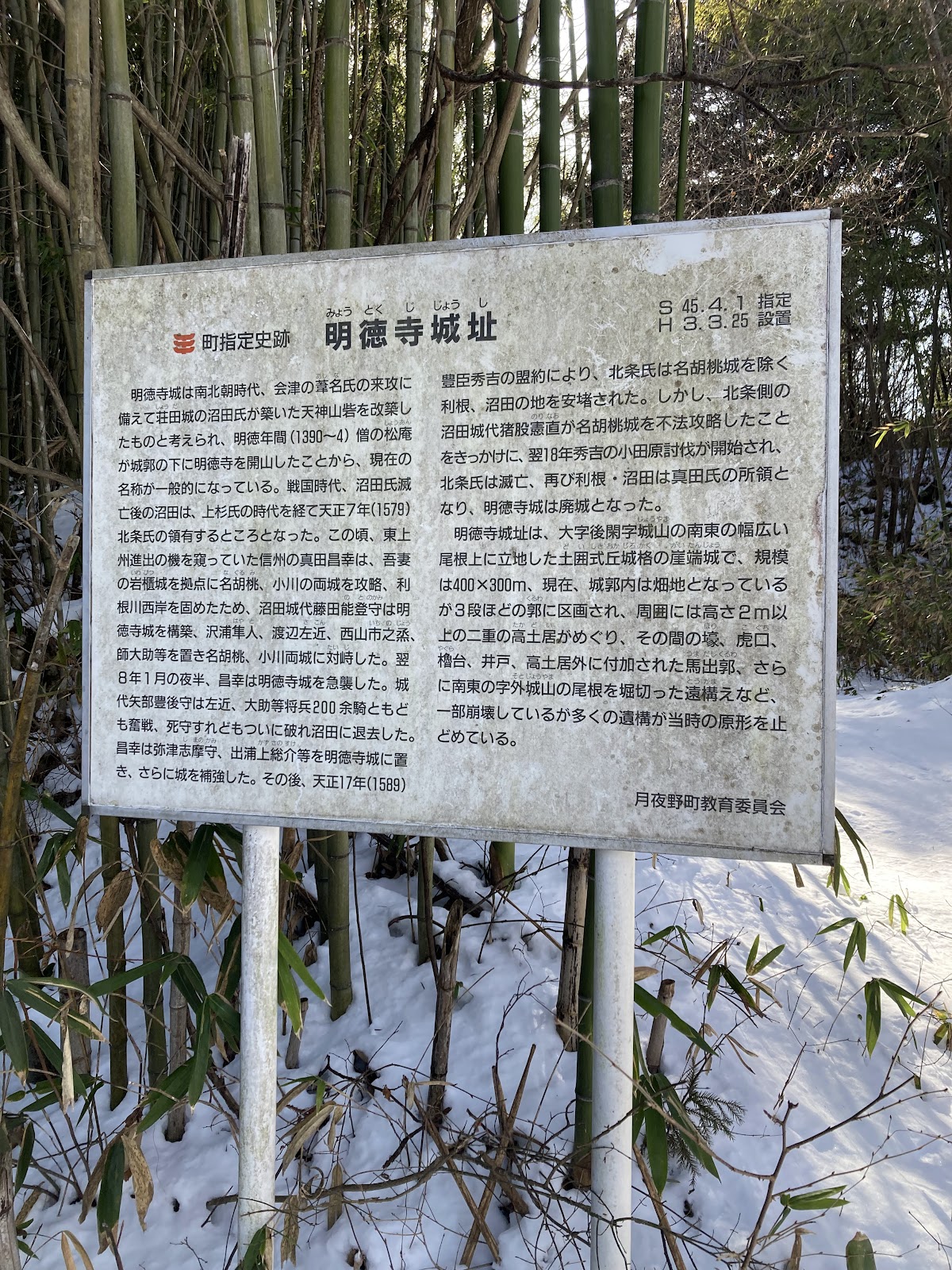
In January 1580, Sanada Masayuki launched a night attack on Myotokuji Castle. According to one account, Masayuki himself fought valiantly with a naginata (long-handled sword) and succeeded in capturing the castle. This audacious night attack resulted in Meitokuji Castle falling into the hands of the Sanada clan, making it an important base for them thereafter.
As a Bridgehead for the Capture of Numata Castle
After acquiring Meitokuji Castle, Sanada Masayuki utilized it as a bridgehead for the capture of Numata Castle. He used Meitokuji Castle and Nagurumi Castle as forward bases, forming a siege network against Numata Castle.
At the time, Numata Castle was occupied by a Hojo-aligned castle lord, but Masayuki employed a strategy combining military pressure and skillful stratagem. Through continuous pressure from Meitokuji Castle, he ultimately succeeded in persuading Fujita Nobuyoshi, the castle lord of Numata, to surrender Numata Castle without bloodshed.
This capture of Numata Castle established Sanada Masayuki’s control over the Tone-Numata region. Meitokuji Castle continued to serve as an important branch castle of the Sanada clan, playing a vital role in the defense of the Numata territory.
After the Edo Period
It is believed that Meitokuji Castle ceased to serve its military purpose and was abandoned during the Edo period. However, its remains are well-preserved and remain a valuable historical site for understanding the structure of castles during the Sengoku period.
Structure and Layout of Meitokuji Castle
Location and Topography
Meitokuji Castle is located approximately 1.5 km northeast of Gokan Station on the JR Joetsu Line, built on a hill extending southward. At an elevation of approximately 400m, it occupies a strategic location overlooking the Tone River basin. This topographical advantage is one of the reasons it functioned as a historically important base.
The castle grounds are long and narrow from north to south, and its layout skillfully utilizes the natural terrain. By utilizing the ridge of the hill, a structure was created that allowed for efficient defense even with a small number of troops.
Characteristics of the Main Enclosure (Honmaru)
The main enclosure, the heart of Meitokuji Castle, is a vast enclosure extending approximately 200m from north to south. The area is currently used as farmland, and the flat terrain is well-preserved. This size indicates that it was not merely a fortified outpost, but designed to accommodate a certain number of troops.
The most distinctive feature of the main enclosure is the high earthen rampart surrounding it. This rampart remains clearly visible even today, reaching heights of 2-3 meters in some places. The rampart served to prevent enemy intrusion and protect against arrow and gunfire.
The Massive Dry Moat on the East Side
The most impressive remains of Meitokuji Castle are the massive dry moat on the east side. This moat extends continuously from the northern moat to the south, and its scale is truly impressive. With a width of approximately 10-15 meters and depths of 5-7 meters in some places, it speaks to the advanced civil engineering techniques of the Sengoku period.
It has been suggested that this dry moat may not have been merely a defensive structure, but also functioned as a belt-shaped enclosure with an earthen rampart. In other words, it is thought to have been designed as a multi-purpose military facility, utilizing the bottom of the moat as a movement route or positioning troops along its sides for flanking attacks.
Double Moats on the Northern Ridge
The ridge to the north and behind the castle is blocked by two moats. A moat is a defensive structure that cuts vertically through a ridge to prevent enemy intrusion; it’s a typical defensive technique for mountain castles.
The moats at Meitokuji Castle are double-layered, demonstrating a multi-layered defense strategy where even if the first moat is breached, the second provides respite. Each moat is approximately 3-5 meters deep and is still clearly visible today.
Other Remains
Besides the main enclosure, several other enclosure remains have been identified. These are thought to have functioned as defensive enclosures protecting the main enclosure or as troop garrison spaces. Furthermore, topographical features believed to be the remains of a castle gate (koguchi) remain, providing clues to how the castle’s entrances and exits were designed.
Based on the arrangement of earthworks and dry moats, it is presumed that Meitokuji Castle was significantly strengthened during renovations by Sanada Masayuki. In particular, the large dry moat on the east side is highly likely to have been excavated when the castle was used as a base for the attack on Numata Castle.
Highlights of Meitokuji Castle
Well-Preserved Dry Moats
The biggest reason to visit Meitokuji Castle is undoubtedly its well-preserved dry moats. The massive dry moat on the east side, in particular, is a valuable relic that allows you to truly appreciate the scale of civil engineering during the Sengoku period. Looking up from the bottom of the moat, you’ll be amazed by its depth and the steepness of the cliffs.
Because the dry moats pass through a grove of trees, they are overgrown with vegetation in the summer, but visibility is better in winter, making it easier to grasp the overall structure of the remains. For those planning to take photographs, visiting during the leafless season is recommended.
High Earthen Embankments Surrounding the Main Enclosure
The high earthen embankments surrounding the main enclosure are also a must-see. The embankments on the north and east sides are particularly high, allowing you to experience the defensive structure of the time. Walking along the top of the embankments allows you to imagine the view the castle’s defenders had.
There is a difference in elevation between the inside (main enclosure side) and outside of the earthwork, indicating a structure advantageous against attacks from the outside. This three-dimensional defensive design demonstrates the sophistication of castle-building techniques during the Sengoku period.
Moat on the North Ridge
The double moat on the north ridge is also impressive. As you proceed along the ridge path, a deep indentation suddenly appears, and beyond that, another moat awaits—a truly practical defensive structure.
Descending to the bottom of the moat and looking up at the cliffs on both sides, one can contemplate the labor involved in such extensive civil engineering work performed by hand. The moat was not simply dug; the excavated soil was piled up to form an earthwork, demonstrating an efficient design.
Value as a Site Associated with Sanada Masayuki
Meitokuji Castle has a legend that Sanada Masayuki personally led a night attack to capture it, making it a castle of special significance for fans of the Sanada clan. This site symbolizes Masayuki’s strategic vision and execution skills, and is also positioned as part of the Sanada Road.
Walking through the castle grounds, imagining the situation when Masayuki used this as a base to advance his siege of Numata Castle is one way to enjoy the romance of history.
Access and Visiting Guide
Access by Public Transportation
Approximately 25-30 minutes on foot from JR Joetsu Line “Gokan Station”. Head northeast from the station, cross National Route 291, and head towards the hilly area. Along the way, you’ll see residential areas and rural landscapes, offering a peaceful atmosphere.
If using a taxi, it takes about 5 minutes from Gokan Station to near the castle ruins. It’s recommended to book a taxi in advance for your return trip.
Access by Car
Approximately 10 minutes from Kanetsu Expressway “Tsukiyono IC”. From National Route 17, take the prefectural road to the Gokan area.
There is a gravel-covered parking area behind “Mine no Yu Tsukiyo no Yakata” (a day-trip hot spring facility), and it is available for visitors to the castle ruins. However, facility operating hours and usage rules may change, so it is recommended to check before visiting.
Points to Note When Visiting
Meitokuji Castle Ruins are not a particularly well-maintained tourist facility, and parts of the area are used as forest and farmland. Please keep the following points in mind when visiting:
- Clothing and Equipment: Comfortable walking shoes and long-sleeved shirts and long pants are recommended. Insect repellent is especially essential during the summer.
- Season: The best time to observe the ruins is during the leafless period from late autumn to early spring. In summer, vegetation is dense and visibility is limited.
- Time: The visit takes about 30 minutes to 1 hour. If you want to observe the ruins carefully, allow 1 hour or more.
- Consideration for Private Property: Some areas are used as fields, so please be careful not to damage the crops. – Safety Management: The dry moats and trenches are deep, so please be careful where you step. They become slippery during and after rain.
Nearby Attractions
Nearby spots to visit in conjunction with your visit to Meitokuji Castle:
- Numata Castle Ruins: The main keep that Sanada Masayuki used as a base to conquer Numata Castle. It is now maintained as Numata Park. Approximately 15 minutes by car.
- Nagurumi Castle Ruins: A castle that served as a base for the conquest of Numata Castle, along with Meitokuji Castle. A historically important castle that triggered the Siege of Odawara. Approximately 10 minutes by car.
- Gokan Residence Ruins: The site of the residence of the Gokan clan, which is related to the predecessor of Meitokuji Castle. Within walking distance.
- Mine-no-Yu Tsukiyo-no-Yakata: A day-trip hot spring facility. Perfect for relaxing after visiting the castle ruins.
Historical Significance of Meitokuji Castle
Position in Sanada Masayuki’s Strategic Role
Meitokuji Castle was a strategically important point in Sanada Masayuki’s establishment of control over the Numata territory. After the fall of the Takeda clan, Masayuki determined that control of the Tone-Numata region was essential for his survival as an independent force. He gradually expanded his power using Meitokuji Castle and Nagurumi Castle as bases.
This strategy was remarkably successful, and the acquisition of Numata Castle established a firm position for the Sanada clan in northern Kozuke Province. The foundation for the Sanada clan’s subsequent achievements, including the Siege of Odawara, the Battle of Sekigahara, and the Siege of Osaka, can be said to lie in their control of the Numata territory during this period.
A Castle Reflecting the Shifting Powers of the Sengoku Period
The rulers of Meitokuji Castle changed hands from the Numata clan to the Uesugi clan, then to the Hojo clan, and finally to the Sanada clan. This shift clearly reflects the changing power dynamics in the Kanto region during the Sengoku period.
This castle can be said to symbolize the turbulent late 16th century, a period marked by events such as Uesugi Kenshin’s expansion into the Kanto region, the rise of the Hojo clan after Kenshin’s death, and the independence of the Sanada clan after the fall of the Takeda clan. Tracing the history of a single castle allows us to understand the major trends of the Sengoku period.
Value in Castle History
Meitokuji Castle is important for castle history research because it well preserves the typical structure of a Sengoku period mountain castle. In particular, the large dry moats and earthworks are valuable resources demonstrating the castle-building techniques of the late 16th century.
There are also remains that are thought to be traces of renovations by Sanada Masayuki, making it valuable for understanding the Sanada clan’s castle-building techniques. Masayuki later built larger castles such as Ueda Castle and Matsushiro Castle, but we may be able to glean some of the foundational techniques and philosophies of his later work from Meitokuji Castle.
Things to Know Before Visiting Meitokuji Castle
Basic Knowledge of Castle Terminology
To gain a deeper understanding of the remains of Meitokuji Castle, it is helpful to know some basic castle terminology:
- Kuruwa: A flat area within a castle. Used for garrisoning troops and constructing buildings.
- Dorui: A defensive wall made by piling up earth. It protects against attacks from arrows and guns.
- Karabori: A moat that does not contain water. Dry moats are common in mountain castles because securing water is difficult.
- Horikiri: A defensive structure dug vertically into a ridge. It blocks enemy incursions.
- Kirigishi: A steep slope artificially carved out. It makes climbing difficult.
- Koshikuruwa: A long, narrow enclosure built around the main enclosure or on a slope.
Best Season for Visiting
The best time to visit Meitokuji Castle is as follows:
- November to March (Late Autumn to Winter to Early Spring): The overall layout of the ruins is easily visible due to the fallen leaves, making it ideal for photography. However, it is best to avoid the snowy season.
- April to May (Spring): The fresh greenery is beautiful, and the weather is mild, making it a pleasant time for walking.
- June to September (Summer): While the view is limited by the dense vegetation, you can enjoy the lush green atmosphere. Insect repellent is essential.
Photography Tips
Tips for taking impressive photos at Meitokuji Castle:
- Large Dry Moat on the East Side: An angle looking up from the bottom of the moat emphasizes the height of the cliff face.
- Earthworks of the Main Enclosure: A shot looking down into the main enclosure from the top of the earthworks can convey its vastness.
- Moat on the North Ridge: Viewing the moat from the side allows for a visualization of its depth and defensive function.
- Panoramic View: If possible, it’s also good to view the entire castle from a nearby hilltop.
Summary: The Charm of Meitokuji Castle
Meitokuji Castle in Minakami Town, Gunma Prefecture, is not large in scale, but it is a valuable historical site where you can experience the history and castle-building techniques of the Sengoku period. The historical background—that Sanada Masayuki personally led a night attack to capture it and used it as a bridgehead in the siege of Numata Castle—gives the castle ruins special significance.
The well-preserved dry moats and earthworks speak to the advanced defensive thinking and civil engineering techniques of the time, making them impressive remains for castle enthusiasts. Because it’s not a well-maintained tourist spot, some preparation and caution are necessary for a visit, but that’s precisely why you can truly feel the atmosphere of the Sengoku period.
By visiting Numata Castle, Nagurumi Castle, and other castle ruins associated with the Sanada clan in the surrounding area, you can gain a comprehensive understanding of Sanada Masayuki’s rule over the Numata territory. When you visit the Tone-Numata region, be sure to stop by Meitokuji Castle as well. It will be a valuable experience that allows you to feel the spirit of the Sengoku period.