Maebashi Castle (Gunma Prefecture) Complete Guide | A Thorough Explanation of the History, Remains, and Highlights of the Seven Famous Castles of the Kanto Region
Overview of Maebashi Castle
Maebashi Castle (Maebashi-jo) was a Japanese castle located in Otemachi, Maebashi City, Gunma Prefecture. It was formerly known as Mayabashi Castle. Built on the northeastern edge of the Maebashi Plateau, it was a strong fortress that utilized the Tone River and Hirose River as natural moats.
It is known for being praised by Tokugawa Ieyasu as the Flower of Kanto and is counted as one of the Seven Famous Castles of Kanto. Currently, the Gunma Prefectural Government building and Maebashi Park stand on the castle site, and parts of the earthworks and stone walls convey the atmosphere of its former glory.
Basic Information
- Alternate Name: Umayabashi Castle
- Castle Structure: Flatland Castle
- Construction Period: Late 15th Century (Muromachi Period)
- Builder: Nagano Clan
- Main Lords: Nagano Clan, Hojo Clan, Sakai Clan, Matsudaira Clan
- Year of Abandonment: 1769 (Meiwa 6), 1872 (Meiji 5)
- Year of Reconstruction: 1867 (Keio 3)
- Remains: Earthworks, stone walls, part of the moat
- Location: Otemachi, Maebashi City, Gunma Prefecture (around the current Gunma Prefectural Government building)
History and Development of Maebashi Castle
Construction and Development during the Muromachi and Azuchi-Momoyama Periods
The history of Maebashi Castle dates back to the late 15th century during the Muromachi period. Initially, it was built as Maebashi Castle by the Nagano clan, a powerful local family in Kōzuke Province. The Nagano clan’s main base was Minowa Castle, but they are believed to have used Maebashi Castle as a subsidiary castle.
In the 16th century, Nagano Narimasa, a senior retainer of the Yamanouchi Uesugi clan (the Kanto Kanrei), expanded his power, and Maebashi Castle became increasingly important as a strategic point. However, in the 1560s, it was invaded by Takeda Shingen and fell into the hands of the Takeda clan in 1566.
After the fall of the Takeda clan in 1582, it came under the control of the Hojo clan, but with Toyotomi Hideyoshi’s siege of Odawara in 1590, the Kanto region became the territory of Tokugawa Ieyasu.
Prosperity in the Edo Period and the “Flower of Kanto”
In 1590, when Tokugawa Ieyasu entered the Kanto region, Hiraiwa Chikayoshi, a senior retainer of Ieyasu, became the lord of Maebashi Castle. Chikayoshi undertook a large-scale renovation of the castle, constructing a three-story keep and developing it into a modern castle. It is said that during this period, Ieyasu inspected Maebashi Castle and, upon seeing its magnificent appearance, praised it as “the flower of Kanto.”
In 1601, when Hiraiwa Chikayoshi was transferred to the Kofu Domain, Sakai Shigetada, a hereditary retainer of the Tokugawa family, took up residence in the castle. As the lord of the Maebashi Domain (then known as the Maebashi Domain), the Sakai clan further developed the castle and its surrounding town, and Maebashi flourished as the political and economic center of Kozuke Province.
However, Maebashi Castle faced a major problem: the flooding of the Tone River, also known as “Bando Taro.” While the Tone River provided natural protection for the castle, repeated floods caused immense damage to the fortress.
Tone River Flooding and Castle Abandonment
The flooding of the Tone River was a serious problem for Maebashi Castle. Since Tokugawa Ieyasu’s entry into the Kanto region, flood control of the Tone River was one of the shogunate’s important policies, but it was not possible to completely prevent flood damage.
In particular, the great flood of 1742 (Kanpo 2) caused significant damage to the castle, and subsequent repairs and damage continued. Maintaining the castle required enormous expenses, increasing the burden on the local people.
In 1767, the then-lord of the domain, Sakai Tadayuki, requested permission from the shogunate to relocate the castle, citing the damage caused by the Tone River’s floods and the increasing cost of repairs. The shogunate granted this request, and in 1769 (Meiwa 6), Maebashi Castle was officially abandoned, and the domain’s administrative center was moved to Kawagoe in Isesaki (later renamed from Maebashi Domain to Kawagoe Domain).
Reconstruction and the Last Permission to Build a Castle at the End of the Edo Period
Approximately 100 years after its abandonment, in 1867 (Keio 3), Maebashi Castle reappeared on the stage of history. Matsudaira Naokatsu, the lord of the Kawagoe Domain at the time, petitioned the shogunate for permission to rebuild Maebashi Castle, in response to strong requests from his people.
Surprisingly, this was the year of the Taisei Hokan (restoration of imperial rule), just before the collapse of the Edo Shogunate. Nevertheless, the shogunate granted permission for the reconstruction of Maebashi Castle. This is considered to be the last castle construction permission issued by the Edo Shogunate.
Matsudaira Naokatsu moved the domain’s administrative center back to Maebashi and began the reconstruction of Maebashi Castle. However, the Meiji Restoration occurred before the full-scale restoration was completed.
Changes in Modern and Contemporary Times
In 1871 (Meiji 4), the Maebashi Domain was abolished with the abolition of the feudal domains and the establishment of prefectures, and Maebashi Castle ceased to function as the domain’s administrative center. In 1872 (Meiji 5), it was officially abandoned, and much of the castle was demolished.
In 1881 (Meiji 14), the Gunma Prefectural Office was constructed on part of the Maebashi Castle site. The current Gunma Prefectural Government building is located precisely on the site where the main keep of Maebashi Castle once stood. Furthermore, part of the castle site has been developed into Maebashi Park, a place of relaxation for citizens.
Structure and Layout of Maebashi Castle
Maebashi Castle was a flatland castle that utilized the Tone River and Hirose River as natural moats. Cleverly taking advantage of its location on the northeastern edge of the Maebashi Plateau, it possessed a robust structure protected by rivers on the north and east sides.
Main Enclosure Structure
The castle consisted of the main keep (Honmaru), the second enclosure (Ninmaru), the third enclosure (Sanmaru), and the outer enclosure (Sotomaru). A three-story keep (Tenshu) stood in the main keep, boasting an imposing presence befitting one of the seven most famous castles in the Kanto region.
The second enclosure (Ninmaru) housed the lord’s residence and administrative buildings, while the third enclosure (Sanmaru) contained the residences of retainers and armory buildings. The outer enclosure included the Kanai Enclosure, which played a role in protecting the connection point with the castle town.
Castle Gates and Main Entrance
Maebashi Castle had several gates, but the Kurumabashi Gate was particularly important. Located on the main entrance connecting the outer bailey (Kanai Kuruwa) to the castle grounds, it served as the castle’s main gate.
In addition, several other gates were strategically placed throughout the castle, forming key points in its defense.
Existing Remains and Points of Interest
While the remains of Maebashi Castle are limited, several important historical sites can still be visited today.
Earthworks Around the Gunma Prefectural Government Building
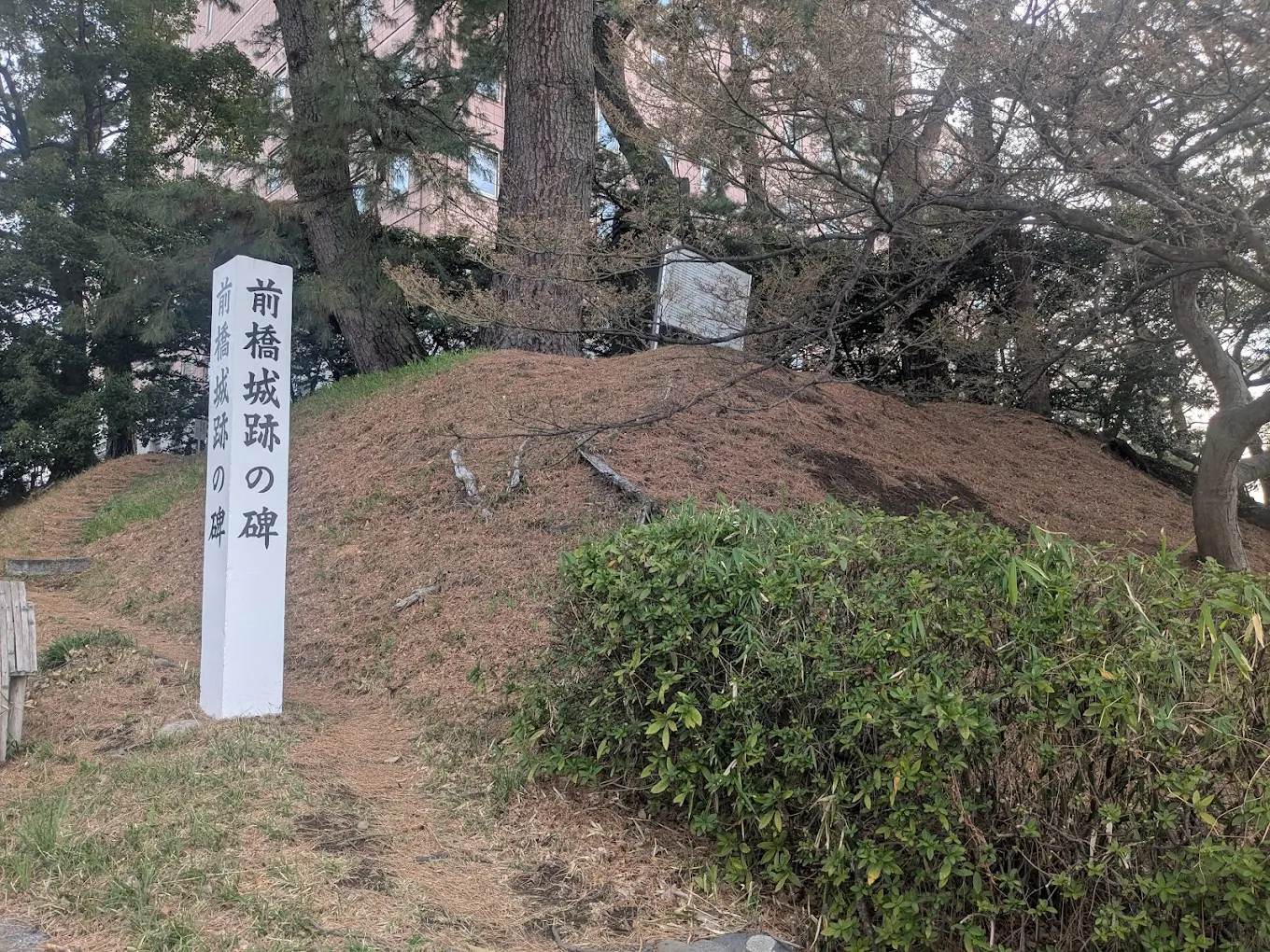
The best-preserved remains are the earthworks remaining north of the Gunma Prefectural Government Building. These earthworks are part of Maebashi Castle’s defensive facilities and are valuable relics that convey its appearance at the time. The earthworks, several meters high, offer a glimpse into the scale of the former castle.
Gunma Prefectural Government Building Observation Deck
The 32nd floor of the Gunma Prefectural Government Building has a free observation deck offering panoramic views of the site where Maebashi Castle once stood. From the observation deck, you can see the Tone River and Mount Akagi, giving you an understanding of how Maebashi Castle made excellent use of the terrain.
Kurumabashi Gate Site
To the east of the Gunma Prefectural Government building stands a monument marking the Kurumabashi Gate Site. This monument, indicating the location of the former main gate, is an important clue to understanding where the castle’s front was located. Information boards are also installed in the surrounding area, providing detailed information about the castle’s appearance at the time.
Maebashi Park and Rinkokaku
Part of the Maebashi Castle site has been developed into Maebashi Park. Within the park is Rinkokaku, a valuable Meiji-era building. Built in 1884 (Meiji 17) as a guesthouse, Rinkokaku is designated as a National Important Cultural Property.
A stone monument marking the “Maebashi Castle Site” also stands in Maebashi Park, indicating its historical significance. The park is also known as a cherry blossom viewing spot, attracting many visitors in spring.
Remains of Stone Walls and Moats
Traces of stone walls and moats can be found around the prefectural office and in parts of Maebashi Park. While these are only partial remains, they are important for understanding the structure of Maebashi Castle.
Successive Castle Lords and the Changes in the Maebashi Domain
Various daimyo (feudal lords) served as lords of Maebashi Castle. The main castle lords are introduced in chronological order.
Castle Lords during the Sengoku Period
- Nagano Clan (late 15th century – 1566): Builder of the castle, a powerful local lord of Kozuke Province
- Takeda Clan (1566 – 1582): During the time of Takeda Shingen and Katsuyori
- Hojo Clan (1582 – 1590): Under the rule of the Odawara Hojo clan
Castle Lords during the Edo Period
- Hiraiwa Chikayoshi (1590 – 1601): First lord of Maebashi Domain, 33,000 koku
- Sakai Shigetada (1601 – 1618): Tokugawa retainer, 33,000 koku
- Sakai Tadayo (1618 – 1634): Shigetada’s son
- Sakai Tadayuki (1634-1636): Son of Tadayoshi
Afterward, the Sakai clan was transferred to the Himeji Domain in Harima Province, and the following daimyo successively ruled Maebashi:
- Matsudaira Naomoto (from Himeji, 1749-1766)
- Sakai Tadayoshi (1767-1769): Moved to Kawagoe, Maebashi Castle was abandoned
After Reconstruction in the Late Edo Period
- Matsudaira Naokatsu (1867-1871): Rebuilt Maebashi Castle, last lord of the Maebashi Domain
Legends and Traditions Related to Maebashi Castle
Origin of “The Flower of Kanto”
The anecdote that Tokugawa Ieyasu praised Maebashi Castle as “The Flower of Kanto” is famous. This phrase indicates that Maebashi Castle was one of the most beautiful and magnificent castles in the Kanto region.
It is said that when Ieyasu actually visited Maebashi Castle, he uttered these words upon seeing the castle surrounded by the Tone River and Hirose River, the imposing three-story keep, and the well-maintained castle town. This anecdote is a source of pride for the people of Maebashi and is still used as an alternative name for Maebashi Castle today.
The Legend of Otora
Maebashi Castle has an intriguing legend called the “Legend of Otora.” This is a story about a woman named Otora who served at Maebashi Castle during the Edo period.
According to the legend, Otora was a beautiful woman who served the lord of the castle, but she was involved in an incident and met a tragic end. After that, strange phenomena began to occur within the castle, and rumors spread that Otora’s spirit was appearing.
This legend has been passed down as a folk tale in Maebashi and conveys a mystical side to Maebashi Castle.
The Legend of Osakabehime
Maebashi Castle also has a legend about a yokai (supernatural creature) called Osakabehime. Osakabehime is said to be either the guardian deity of the castle or a yokai (supernatural creature) residing within it, and is sometimes depicted as a woman in the form of a snake.
Osakabehime is said to have saved the castle from danger or, conversely, warned the lord of the castle, and her legend is deeply intertwined with the history of Maebashi Castle.
Access and Visiting Guide
Access by Train
- Approximately 15 minutes on foot or 5 minutes by bus from JR Maebashi Station
- Approximately 10 minutes by bus from JR Shin-Maebashi Station
Access by Car
- Approximately 15 minutes from the Kan-Etsu Expressway “Maebashi IC”
- Approximately 20 minutes from the Kita-Kanto Expressway “Maebashi Minami IC”
Gunma Prefectural Government has a parking lot for visitors (paid). Maebashi Park also has a parking lot.
Using Shared Bicycles
Maebashi City has a shared bicycle system called “Maechari,” with numerous cycle ports around Maebashi Station and Shin-Maebashi Station. Exploring the castle ruins by bicycle is a pleasant and efficient way to visit multiple historical sites.
Points of Interest
- Gunma Prefectural Government Building: Northern earthen rampart, 32nd-floor observation deck (open weekdays, weekends, and holidays, free of charge)
- Kurumabashi Gate Ruins: East side of the prefectural government building, information board available
- Maebashi Park: Castle ruins monument, Rinkokaku (Important Cultural Property)
- Nearby Town Names: Place names such as Otemachi retain traces of the castle town.
Estimated Time Required for Visiting
If visiting the main historical sites, approximately 1-2 hours on foot is a guideline. If you plan to visit the interior of Rinkokaku or enjoy the view from the prefectural government building’s observation deck, it’s advisable to allocate more time.
Nearby Tourist Spots
Rinkokaku
A wooden building from the Meiji era located within Maebashi Park, and a nationally designated Important Cultural Property. Built in 1884 as a guesthouse, it still preserves the pinnacle of architectural technology from that era, along with its beautiful Japanese garden.
Maebashi Toshogu Shrine
This shrine, built to ward off evil spirits from Maebashi Castle, enshrines Tokugawa Ieyasu. It has deep historical ties to Maebashi Castle.
Lunapark (Maebashi Central Children’s Park)
A small amusement park known as Japan’s most nostalgic amusement park. Located next to Maebashi Park, it’s a popular spot for families.
Promenade along the Hirose River
A beautiful promenade has been built along the Hirose River, which served as the outer moat of Maebashi Castle. Cherry trees line the path, offering particularly beautiful scenery in spring.
Maebashi Castle and the History of Gunma Prefecture
Maebashi Castle is not merely a castle; it is deeply intertwined with the history of Gunma Prefecture itself. The fact that the Gunma Prefectural Government is located on the castle site symbolizes Maebashi’s continued status as the center of Kozuke Province.
Maebashi City, currently the capital of Gunma Prefecture, plays a central role in politics and administration. The history of Maebashi Castle tells the story of its long history as an important center.
Cultural Value of Maebashi Castle
Although few structures remain of Maebashi Castle, it possesses significant cultural value in the following respects:
- One of the Seven Famous Castles of the Kanto Region: As a representative castle of the Kanto region, it holds an important position in the history of castles.
- The Last Castle Construction Permit Granted by the Edo Shogunate: The stage for a symbolic event in the history of the late Edo period.
- History of Tone River Flood Control: A valuable example illustrating the relationship between rivers and castles.
- Impact on Urban Development: It had a significant impact on the current urban structure of Maebashi City.
Summary
Maebashi Castle is a famous castle with a history spanning approximately 400 years, from its construction in the Muromachi period to its demolition in the Meiji era. Praised as the “Flower of Kanto,” this beautiful castle continued to play an important role as the center of Kozuke Province, while battling the natural threat of flooding from the Tone River.
Although many of the castle’s structures have been lost, remnants that evoke its former glory remain, such as the earthworks around the Gunma Prefectural Government building, the remains of the Kurumabashi Gate, and the castle site monument in Maebashi Park. Visiting these historical sites will allow you to gain a deeper understanding of the history of Maebashi Castle and the origins of Maebashi City in Gunma Prefecture.
As one of the seven most famous castles in the Kanto region, and as the last castle whose construction was permitted by the Edo Shogunate, Maebashi Castle holds a special place in the history of Japanese castles. When you visit Gunma Prefecture, be sure to visit the Maebashi Castle ruins and experience the rich history etched into this land.