Complete Guide to Chokoji Castle (Shiga Prefecture): Exploring the Legend of Binwari Shibata and Sengoku Period History
What is Chokoji Castle?
Chokoji Castle is a Sengoku period mountain castle located in Chofukuji-cho, Omihachiman City, Shiga Prefecture. Also known as “Binwariyama Castle,” it was built on the summit of Mt. Binwari, approximately 330 meters above sea level. This castle was an important branch castle of the Rokkaku clan, a powerful daimyo of Omi Province during the Sengoku period, and functioned as a key base in the defense network of Kannonji Castle.
The current Chokoji Castle ruins straddle Omihachiman City and Higashiomi City, and still retain the typical structure of a medieval mountain castle that skillfully utilizes the natural terrain. Hiking trails are maintained to the castle ruins, making it popular not only with history enthusiasts and castle fans, but also with hikers who enjoy nature.
History of Nagamitsu-ji Castle
The Ōnin War and the Castle’s Construction
The construction of Nagamitsu-ji Castle dates back to 1468 (Ōnin 2). It is believed to have been built by Sasaki Shiro Masataka, who was in conflict with Sasaki Rokkaku Takayori, the governor of Ōmi Province, during the Ōnin War.
At that time, the Sasaki clan was divided into the Eastern and Western armies, and fierce battles ensued between Nagamitsu-ji Castle and Kannon-ji Castle, each using them as their base. This internal conflict destabilized the political situation within Ōmi Province and would later affect the power base of the Rokkaku clan.
Role as a Branch Castle of the Rokkaku Clan
Nagamitsu-ji Castle functioned as an important branch castle of the Rokkaku clan, whose main base was Kannon-ji Castle. Kannonji Castle was one of the largest mountain castles in Omi Province, built on the summit of Mt. Kinugasa, and Nagamitsuji Castle was positioned as a defensive stronghold protecting its southern territory.
The Rokkaku clan was a powerful daimyo (feudal lord) that ruled southern Omi Province from the Muromachi period to the Sengoku period, and Nagamitsuji Castle was part of a network of castles used to maintain their vast territory. Several subsidiary castles, such as Kowakiyama Castle and Minotsukuriyama Castle, were also located nearby, forming a coordinated defensive system.
Oda Nobunaga’s Invasion and the Placement of Shibata Katsuie
In 1570, Oda Nobunaga invaded southern Omi Province and attacked Nagamitsuji Castle to eliminate the Rokkaku clan’s influence. Nagamitsuji Castle fell in this siege, and Nobunaga appointed his senior retainer, Shibata Katsuie, as its lord.
During this period, Nobunaga was strengthening his control over Omi Province by placing trusted generals at strategic locations throughout the region. The deployment of Shibata Katsuie to Nagamitsu-ji Castle was also a strategic move aimed at securing the area around Kannon-ji Castle and laying the groundwork for the construction of Azuchi Castle.
The Legend of “Bottle-Breaking Shibata”
The reason Nagamitsu-ji Castle came to be called “Bottle-Breaking Mountain Castle” is due to a famous anecdote involving Shibata Katsuie.
When Shibata Katsuie was the lord of Nagamitsu-ji Castle, it was besieged by the forces of the Sasaki clan, the former shugo (provincial governor) of Omi Province. As the siege dragged on and the castle’s water supply nearly ran out, Katsuie is said to have given all his soldiers the remaining water, then personally smashed the water jar to cut off their retreat, before sallying forth in a desperate attempt to win.
This act of desperate resolve boosted the morale of his soldiers, and as a result, they achieved victory. This heroic tale led to Nagamitsu-ji Castle being called “Bottle-Breaking Castle.” This anecdote has been passed down through generations as an episode demonstrating Shibata Katsuie’s qualities as a military commander.
Construction and Abandonment of Azuchi Castle
In 1576 (Tensho 4), Oda Nobunaga began construction of the magnificent Azuchi Castle on Mount Azuchi, located south of Nagamitsu-ji Castle. Upon its completion in 1579 (Tensho 7), the center of Omi Province’s control completely shifted to Azuchi Castle.
Consequently, Nagamitsu-ji Castle lost its strategic importance and is believed to have been naturally abandoned. Shibata Katsuie also moved to Echizen Province as the commander-in-chief of the Hokuriku army, and Nagamitsu-ji Castle ceased to serve its purpose.
Structure and Layout of Nagamitsu-ji Castle
Design of a Mountain Castle Utilizing the Topography
Nagamitsu-ji Castle is a mountain castle that makes maximum use of the steep terrain of Mount Kamewari. The main enclosure is located on the mountaintop at an altitude of approximately 330 meters, and a series of enclosures (kuruwa) are arranged along the ridge, employing a linear layout.
A key feature of this castle is its skillful use of natural terrain, minimizing artificial construction while achieving high defensive capabilities. The steep slopes themselves act as natural barriers, making it difficult for attackers to approach.
Major Remains
Main Enclosure (Honmaru)
Located at the mountaintop, the main enclosure is the central facility of Nagamitsu-ji Castle. A relatively flat space is provided, suggesting that the lord’s residence and command post were located here. From the main enclosure, one can enjoy a panoramic view of the Omi Plain, and excellent views of Kannonji Castle and Mount Azuchi.
Stone Walls
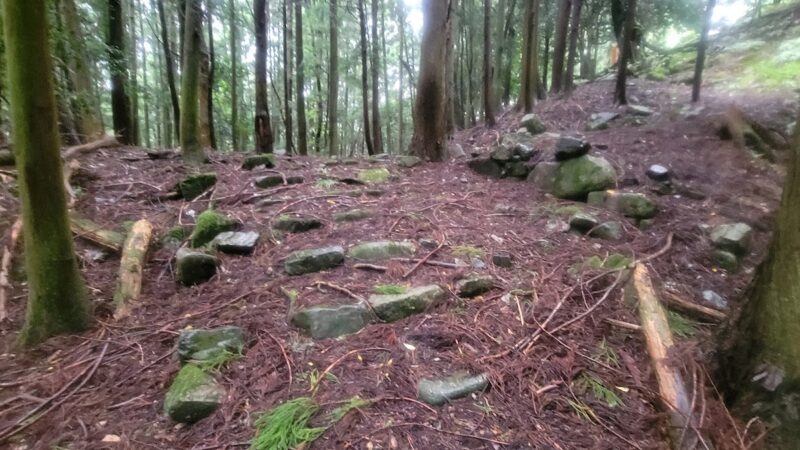
Some stone walls remain at Nagamitsu-ji Castle. It has been suggested that these stone walls were renovated when Shibata Katsuie, a subordinate of Oda Nobunaga, became the castle lord. It is believed that the structure was improved from a primarily earthen rampart structure during the Rokkaku clan era to a stronger defensive facility utilizing stone walls.
The stone walls are constructed using the nozura-zumi method, a simple structure where natural stones are piled up as they are. However, it is a valuable historical site that represents the early stages of stone wall construction in medieval mountain castles.
Moats
Multiple moats blocking the ridgeline can be seen. Moats are important defensive structures that prevent enemy intrusion and make movement along the ridge difficult. Some of the moats at Nagamitsu-ji Castle reach a depth of several meters, demonstrating the advanced castle-building techniques of the time.
Enclosures
Various large and small enclosures are arranged around the main enclosure. These are thought to have been used as garrisons for soldiers and storage areas for supplies. The enclosures are separated by earthworks and steep slopes, forming a tiered defensive line.
Layout Characteristics
The layout of Nagamitsu-ji Castle is designed with coordination with Kannon-ji Castle in mind. It offered good visibility from Kannon-ji Castle, and communication via signal fires was possible. Furthermore, its strategic location overlooking the transportation routes of southern Omi Province made it a crucial military stronghold.
Highlights of Nagamitsu-ji Castle
The Charm of Exploring the Castle Ruins
Nagamitsu-ji Castle ruins are a valuable historical site that strongly retains the atmosphere of a mountain castle from the Sengoku period. Walking along the well-maintained hiking trails, you can experience the castle’s structure from that era.
The view from the main enclosure is magnificent; on a clear day, you can see Lake Biwa, the Omi Plain, and even Mount Hiei. This view truly demonstrates why Nagamitsu-ji Castle was considered such an important military base.
Points to Observe the Ruins
When visiting the castle ruins, paying attention to the following ruins will help you understand the history of Nagamitsu-ji Castle more deeply:
- Remaining Stone Walls: The stone walls remaining around the main enclosure are important remains that show traces of renovations during the time of Oda Nobunaga.
- Depth and Shape of the Moat: The scale of the moat that cuts off the ridge reveals the castle construction techniques of the time.
- Arrangement of Enclosures: You can observe how the multiple enclosures were arranged and formed a defensive line.
- Traces of Earthworks: Traces of earthworks remaining on the edges of the enclosures allow you to infer the structure of the defensive facilities.
Information Boards and Explanations
Information boards are installed at the entrance to the castle and key points, where you can learn about the history and structure of Nagamitsu-ji Castle. These information boards clearly convey the charm of the castle ruins, even to first-time visitors.
Access and Visiting Information
Location
Address: Chofukuji-cho, Omihachiman City, Shiga Prefecture (and extending into Higashiomi City)
Access to the Castle Entrance
Public Transportation
- Approximately 20 minutes by car from JR Biwako Line “Omihachiman Station”
- Taxis are convenient, but bus routes are limited, so please check in advance.
By Car
- Approximately 15 minutes from Meishin Expressway “Yokaichi IC”
- Approximately 20 minutes from Meishin Expressway “Ryuo IC”
Parking
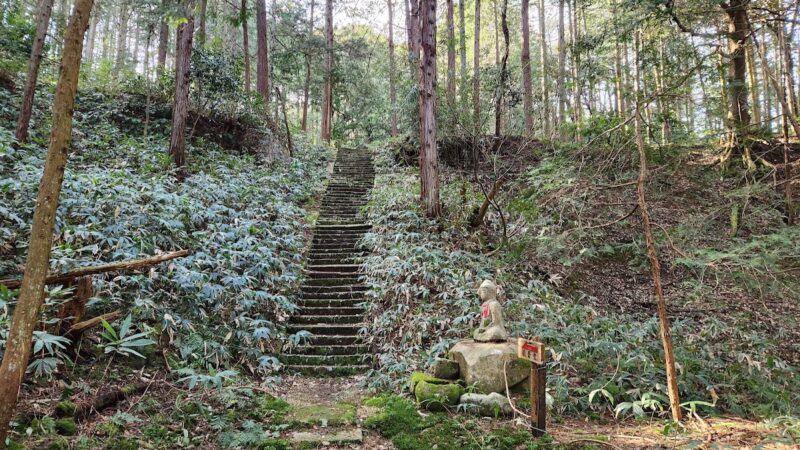
Hiyoshi Shrine Parking is the closest parking lot to the castle entrance. Hiyoshi Shrine is located at the entrance to Chokoji Castle, and the hiking trail to the summit begins from here. Parking space is limited, so caution is advised during busy times.
Castle Ascent Time and Difficulty
- From the entrance to the main enclosure: Approximately 30-40 minutes on foot
- Difficulty: Intermediate (Suitable for those familiar with mountain trails)
- Estimated Time: Approximately 1 hour 30 minutes to 2 hours round trip (including time spent viewing the castle ruins)
Clothing and Equipment
The following equipment is recommended for visiting the mountain castle:
- Hiking boots or trekking shoes: Shoes with non-slip soles are safer
- Long-sleeved shirt and long pants: To protect yourself from bushes and insects
- Drinking water: Sufficient hydration is especially necessary in summer
- Hat: To protect your head from the sun and branches
- Rain gear: To prepare for changing weather conditions
- Map or GPS: To prevent getting lost
Precautions for Visiting
- Winter (December to March): Due to the possibility of snow and ice, it is recommended that only experienced hikers avoid visiting during this time.
- Summer: Bringing insect repellent spray will make your visit more comfortable.
- Avoid visiting alone; it is recommended to travel in groups.
- Cell phone reception may be poor in some areas, so inform family members or others of your destination in advance.
Nearby Tourist Attractions
Kannonji Castle Ruins
Kannonji Castle, the main castle of Nagamitsu-ji Castle, is one of the largest mountain castles in Omi Province, built on the summit of Mt. Suzuka. It flourished as the base of the Rokkaku clan, and its stone walls and vast baileys remain. It is also selected as one of Japan’s Top 100 Castles, and visiting it together with Nagamitsu-ji Castle will give you a deeper understanding of the Rokkaku clan’s castle network.
Azuchi Castle Ruins
The magnificent Azuchi Castle ruins, built by Oda Nobunaga, are located about 5 kilometers south of Nagamitsu-ji Castle. The view from the castle tower ruins is spectacular, and it is a historical site where you can feel Nobunaga’s dream of unifying Japan. It is designated as a Special Historic Site, and there are many points of interest, such as the stone walls and the main approach road.
Omihachiman City
Omihachiman, a castle town built by Toyotomi Hidetsugu, preserves its Edo-period streetscape. The white-walled storehouses along the Hachiman Canal are picturesque and famous as a filming location for historical dramas. Known as the birthplace of Omi merchants, it boasts numerous historical townhouses and museums.
Chokoji Temple (Chofukuji Temple)
Chokoji Temple, the origin of the castle’s name, still exists today as Chofukuji Temple. Located near the castle ruins, it is a temple that conveys the history of the Sengoku period.
Castle Stamp and Castle Tour Information
Obtaining Castle Stamps
Castle stamps for Chokoji Castle may be available at tourist information centers and some facilities in Omihachiman City. Castle stamps are popular collectible items among castle enthusiasts, and more and more people are purchasing them as souvenirs of their visits.
Availability and prices may change, so it is recommended to check with the Omihachiman City Tourism and Products Association before visiting.
Integration with Castle Touring Apps
Castle touring apps such as “Kojodan” and “Nippon Castle Tour” allow you to record your visits to Nagamitsu-ji Castle. Using these apps allows you to manage your visit records and exchange information with other castle enthusiasts.
These apps also offer features such as GPS-based visit verification and photo sharing, making your castle tours even more enjoyable.
Nagamitsu-ji Castle and the Sengoku Period History of Omi Province
The Rise and Fall of the Rokkaku Clan
The history of Nagamitsu-ji Castle is closely intertwined with the rise and fall of the Rokkaku clan. The Rokkaku clan was a prestigious family that ruled southern Omi Province from the Muromachi period, and at its peak, wielded influence over Kyoto’s politics.
However, with the advent of the Sengoku period, they lost power due to the rise of the Asai clan and the invasion of Oda Nobunaga, and in 1570, their base, Kannonji Castle, fell. The fall of Nagamitsu-ji Castle symbolized the decline of the Rokkaku clan.
Oda Nobunaga’s Control of Omi
After capturing Nagamitsu-ji Castle, Oda Nobunaga positioned Omi as a crucial strategic base. Complete control of Omi was essential to securing a route to Kyoto and expanding his influence in eastern Japan.
Placing Shibata Katsuie at Nagamitsu-ji Castle was a measure to monitor the former Rokkaku clan forces around Kannon-ji Castle and establish a new system of control. The subsequent construction of Azuchi Castle solidified Nobunaga’s control over Omi.
The Later Life of Shibata Katsuie
Shibata Katsuie, who served as the lord of Nagamitsu-ji Castle, later became the commander-in-chief of the Hokuriku army, based in Echizen. He distinguished himself in suppressing the Ikkō-ikki rebellions and fighting against the Uesugi clan, becoming a leading figure among the Oda retainers.
After the Honnō-ji Incident, he clashed with Toyotomi Hideyoshi and committed suicide after being defeated at the Battle of Shizugatake. The anecdote of the “bottle-breaking” incident at Nagamitsu-ji Castle has been passed down through generations as an episode demonstrating Katsuie’s spirit as a warrior.
Historical Value of Nagamitsu-ji Castle
Significance in Medieval Mountain Castle Research
Nagamitsu-ji Castle is an important historical site that shows the development process of mountain castles from the medieval period to the Sengoku period. From the earthen rampart-centered structure of the Rokkaku clan era to the renovations using stone walls after it came under the command of Oda Nobunaga, we can discern the changes in castle construction technology.
While many mountain castles remain in Omi Province, Nagamitsu-ji Castle is relatively well-preserved and suitable for observing its remains. It is also a valuable research subject for castle researchers.
Position in Local History
Nagamitsu-ji Castle is an indispensable historical site when discussing the history of Omihachiman City. Along with Kannonji Castle and Azuchi Castle, it indicates that this region was a political and military center during the Sengoku period.
Important for local history education and as a tourist resource, the development of hiking trails provides more people with the opportunity to experience the history of the Sengoku period.
A Recommendation to Visit Nagamitsu-ji Castle
Nagamitsu-ji Castle is a valuable historical site that conveys the appearance of a mountain castle from the Sengoku period. By actually visiting the historical site where the legend of “Shibata the Bottle-Breaker” remains, you can experience a sense of realism that cannot be obtained from history books.
The view from the mountaintop is magnificent, allowing you to relive the scenery seen by the former castle lords. Visiting it together with Kannonji Castle and Azuchi Castle will give you a more comprehensive understanding of the Sengoku history of Omi.
Enjoying a hike on the nature-rich Mt. Binwari while contemplating the historical romance of the Sengoku period—Nagamitsu-ji Castle offers such a fascinating experience. It is a recommended historical site not only for history buffs but also for those who want to enjoy nature walks.
When you visit Omihachiman, be sure to extend your trip to the ruins of Nagamitsu-ji Castle. You are sure to spend a valuable time feeling the spirit of the Sengoku period.