Complete Guide to Wada Castle (Koka City, Shiga Prefecture): The Residence of the Koga Samurai Who Sheltered Ashikaga Yoshiaki
What is Wada Castle?
Wada Castle is a medieval mountain castle located in Wada, Koka-cho, Koka City, Shiga Prefecture. It is known as the residence of the Wada clan, a family of Koga samurai. Built at the end of the Heian period, it is a representative castle of the Koga Castle Group, which underwent extensive renovations during the Sengoku period. Its most notable feature is that it was the historical site where Ashikaga Yoshiaki, who would later become the 15th Shogun, hid for a time.
Currently, it is protected as a Koka City designated historical site, and the remains such as the earthworks and moats surrounding the main enclosure are well-preserved. Wada Castle was not a single castle, but rather the central element of a complex defensive system consisting of seven castles and residences known as the Wada Castle Group.
Basic Information on Wada Castle
Location and Access Information
Location: Wada, Koka-cho, Koka City, Shiga Prefecture (Kadota no Tonoyama)
Other Names/Common Names: Tonoyama Castle, Wada Clan Residence
Construction Period: Late Heian Period (Late 12th Century)
Builder: Wada Clan
Renovator: Wada Koremasa (Sengoku Period)
Main Lords: Wada Clan, Wada Iga-no-kami Koremasa
Year of Abandonment: Tensho Era (Around 1573-1592)
Castle Structure: Hilltop Castle, Residence-type Castle
Remains: Earthworks, Dry Moats, Trenches, Enclosures, Gate Remains
Designated Cultural Property: Koka City Designated Historic Site
Map and Location
Wada Castle is located in the southern part of the Koka Basin, on the western edge of the hills along the Wada River. The surrounding area is dotted with castles such as Mizuguchi Castle and other castles of the Koga castle complex, and it is a strategic point on the road connecting Omi Province and Ise Province. This location later played a crucial role in Ashikaga Yoshiaki’s escape.
History of Wada Castle
Late Heian Period to Muromachi Period
The history of Wada Castle dates back to the late Heian period. It is believed to have begun when the Wada clan, who rose to prominence as Koga samurai, established their residence in this area. The Wada clan was a powerful local family, counted among the 53 families of Koga, and served as vassals of the Rokkaku clan.
During the Onin era (1467-1469), its function as a castle was strengthened in the wake of the Onin War. During this period, various local clans in the Koga region actively developed castles for self-defense, and the Wada clan also remodeled their residence into a full-fledged castle.
Sengoku Period: Connection with Ashikaga Yoshiaki
Wada Castle first appears on the historical stage during the Sengoku period (Warring States period). In May 1565 (Eiroku 8), the “Eiroku Incident” occurred, in which the 13th Shogun Ashikaga Yoshiteru was assassinated at Nijo Castle by Matsunaga Hisahide and the Miyoshi Three. At this time, Yoshiteru’s younger brother, Ichijoin Kakkei (later Ashikaga Yoshiaki), was imprisoned at Kofuku-ji Temple, but he managed to escape.
Wada Koremasa supported Kakkei’s escape. Wada Koremasa sheltered Kakkei at Wada Castle in Koga, ensuring his safety. The Wada clan played a role in ensuring the safety of travel through the Koga region (roadside security) and providing lodging. During this period, a facility called the “Kubō Yashiki” (Shogun’s Residence) was also established at Wada Castle, and preparations were made to welcome members of the Shogun’s family.
After staying at Wada Castle, Kakkei traveled from place to place, gaining the support of Oda Nobunaga, and in 1568 entered Kyoto as the 15th Shogun, Ashikaga Yoshiaki. Due to this achievement, Wada Koremasa rose to become the lord of Akutagawa Castle, and later Takatsuki Castle.
Connections with Christianity
Wada Iga-no-kami Koremasa is also known for protecting Francis Xavier, who introduced Christianity to Japan in 1549, and for mediating a meeting between him and Oda Nobunaga. This fact indicates that the Wada clan was not merely a local powerful family, but an enlightened family interested in central politics and international affairs.
The Road to the Castle’s Abandonment
With the advent of the Tensho era, the political situation in the Koga region changed dramatically as Oda Nobunaga’s unification of Japan progressed. Wada Koremasa was killed in the Battle of Shirai-gawara in 1571 (Genki 2), and the power of the Wada clan declined. It is believed that Wada Castle was abandoned after the era of Toyotomi Hideyoshi.
Remains and Highlights of Wada Castle
Earthworks of the Main Enclosure
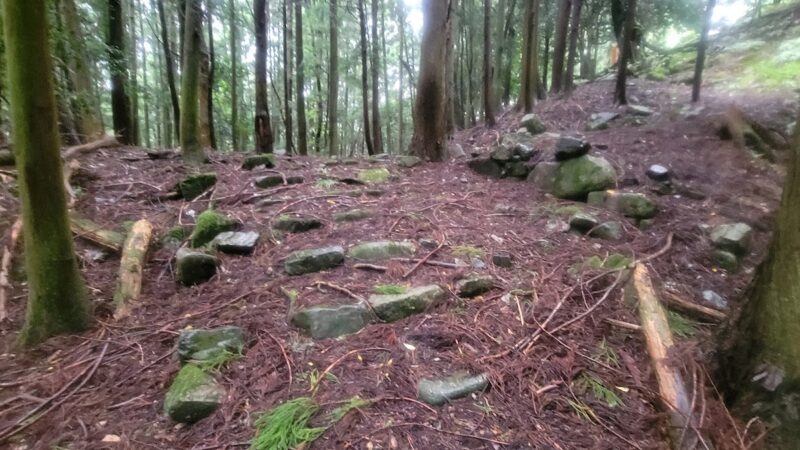
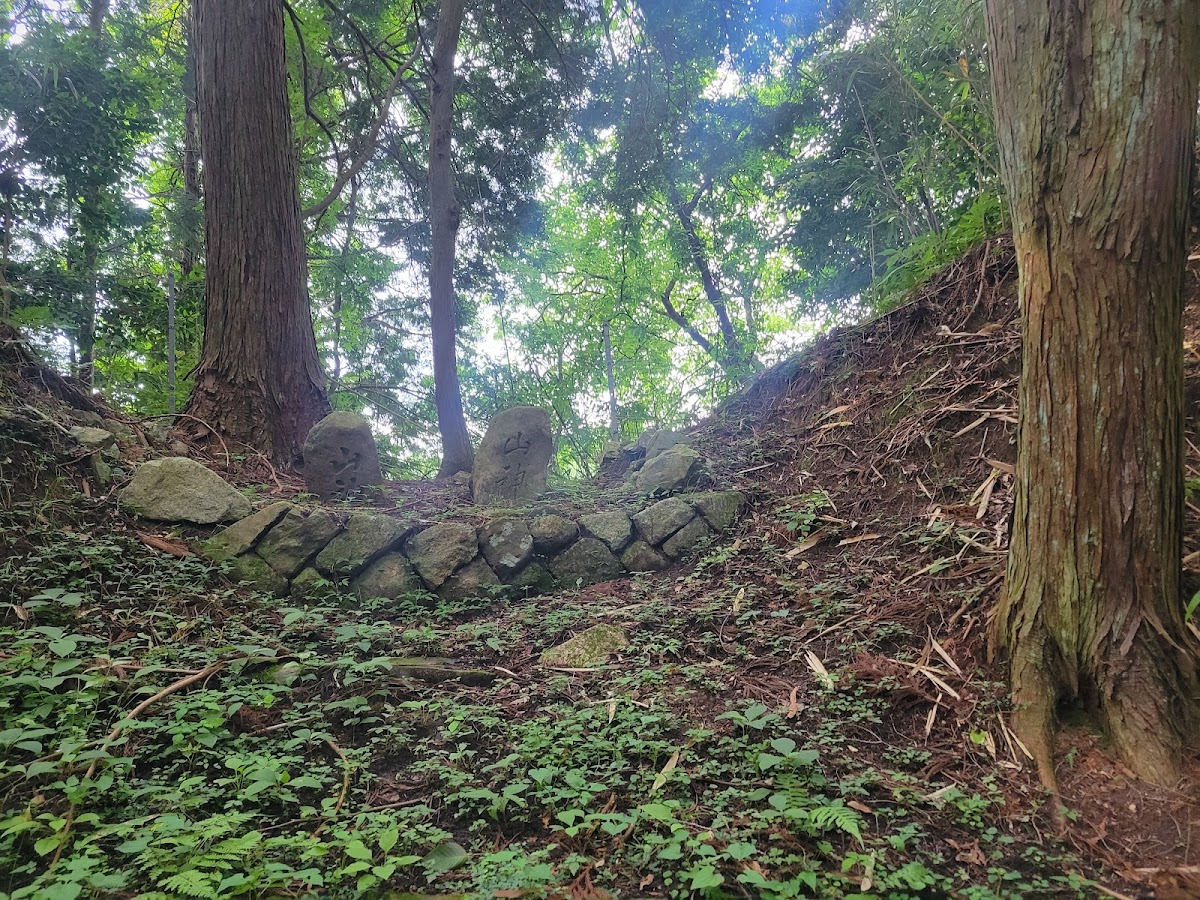
The greatest highlight of Wada Castle is the square earthworks surrounding the main enclosure. While these earthworks share similar characteristics with other castles in Koga, they exhibit a unique structure. They are wide, relatively low on the north side, and gradually rise towards the south. This difference in elevation is thought to be a defensive feature, suggesting a design that anticipated enemy incursions.
The earthworks reach a maximum height of approximately 3 meters, with a base width of 5 to 7 meters. The top of the earthworks is flattened, suggesting the possibility of fences or walls being installed there. Even today, the shape of the earthworks is clearly visible, making them valuable remains for understanding the castle’s structure at the time.
Moats and Dry Ditches
Moats and dry ditches that demarcated the castle grounds are also well-preserved. The moat separating the main enclosure and the second enclosure is approximately 2-3 meters deep and 4-5 meters wide, forming a clear defensive line. These moats served to prevent enemy intrusion and clearly demarcate the various sections within the castle.
The dry moats are mainly located on the south and east sides of the castle, cleverly utilizing the natural terrain. The moat bottoms are not flat, but sloped to facilitate drainage, demonstrating the high level of technical skill in medieval castle construction.
Remains of the Entrance Gate
The remains of the entrance gate to the main enclosure can also be seen. The gate is not a simple opening, but employs a “staggered entrance gate” design, where the earthwork curves to prevent a direct enemy advance. This structure was designed to allow for flanking fire against invading enemies.
Arrangement of Enclosures
Wada Castle has a layout where multiple enclosures are arranged in a stepped pattern around the main enclosure. The main enclosure is located at the highest point, surrounded by the second and third enclosures. There were clear elevation changes between each enclosure, indicating a layered defensive structure.
The main enclosure measured approximately 40 meters east-west and 30 meters north-south, a sufficient size for a residence. The second and third enclosures were somewhat smaller and are thought to have been used for troop garrisoning or storage of supplies.
Site of the Shogun’s Residence
The location of the “Shogun’s Residence,” where Ashikaga Yoshiaki stayed, is also estimated to be within the castle grounds. While the exact location is unclear, a flat area adjacent to the main enclosure is considered a possible site. The existence of a special facility for receiving members of the Shogun’s family demonstrates the strength of the Wada clan’s influence and their ties to the central government.
Wada Castle Group: A Complex Defensive System
Wada Castle did not exist in isolation; it was part of a complex defensive system consisting of seven castles known as the “Wada Castle Group.” These castles were each managed by members of the Wada clan, who cooperated with each other to defend the region.
Composition of the Wada Castle Group
The Wada Castle Group includes the following castles:
- Wada Castle (Main Castle): The base of the Wada clan
- Tonoyama Castle: Also said to be another name for Wada Castle
- Other Branch Castles: Multiple castles managed by the Wada clan
These castles were positioned in locations where visual communication was possible, and it is believed that a communication network using signal fires and other means was established. A system was in place to send reinforcements from other castles if one castle was under attack.
Characteristics of the Koga Castle Group
Wada Castle, as a representative castle of the Koga Castle Group, exhibits a castle structure unique to this region. Koga castles share the following common characteristics:
- Square Earthworks: A structure where the main enclosure is surrounded by square earthworks.
- Residential Function: A military facility that also served as a daily living space.
- Complex Arrangement: A defensive system in which multiple castles cooperate.
- Utilization of Natural Terrain: A layout that skillfully utilizes hills and rivers.
These characteristics are related to the fact that the Koga samurai formed a community organization called “So,” which maintained autonomy while cooperating with each other.
About the Wada Clan
Origins and Genealogy of the Wada Clan
The Wada clan was a powerful local lord, counted among the 53 families of Koga. While there are various theories about their origins, they are believed to have been one of the samurai groups that had settled in the Koga region since the Heian period. During the Kamakura period, they obtained the position of jitō (land steward), establishing their power base in the region.
During the Muromachi period, they served as vassals of the Rokkaku clan, playing an important role in supporting the Rokkaku clan’s rule in southern Omi Province. As the Sengoku period began, the Wada clan produced figures like Wada Koremasa who had connections to the central government, transcending the status of a mere local powerful family.
Achievements of Wada Koremasa
Wada Iga-no-kami Koremasa is the most famous figure within the Wada clan. His service in sheltering Ashikaga Yoshiaki led to his promotion to lord of Akutagawa Castle (present-day Takatsuki City, Osaka Prefecture), and later to lord of Takatsuki Castle. During his time as lord of Takatsuki Castle, he was also known as a Christian daimyo, implementing progressive policies such as allowing Christian missionary work within his territory.
Koremasa died in the Battle of Shirai-gawara in 1571 (Genki 2), but his descendants continued as hatamoto (direct retainers of the shogun) during the Edo period, and the Wada bloodline continued into modern times.
Transportation Access and Visiting Information
Access by Public Transportation
Nearest Station: JR Kusatsu Line “Aburahi Station”
From Aburahi Station to Wada Castle Ruins is approximately a 25-minute walk, about 2 kilometers. There is a bicycle rental facility in front of the station, and you can reach the site in about 10 minutes by bicycle. Using a rental bicycle is convenient for visiting multiple castles in the Koka region.
Access by Car
Nearest Interchange: Approximately 15 minutes from Shin-Meishin Expressway “Koka-Tsuchiyama IC”
Take Prefectural Road 51 and proceed along the Wada River. Turn left before Yabuuchi Bridge and proceed about 260 meters; you will see an explanatory sign for the castle ruins entrance. There is parking space on the roadside, but it is not very large, so please be careful.
Points to Note When Visiting
Visiting Hours: Flexible (However, daytime hours are recommended)
Admission Fee: Free
Estimated Time Required: Approximately 30 minutes to 1 hour
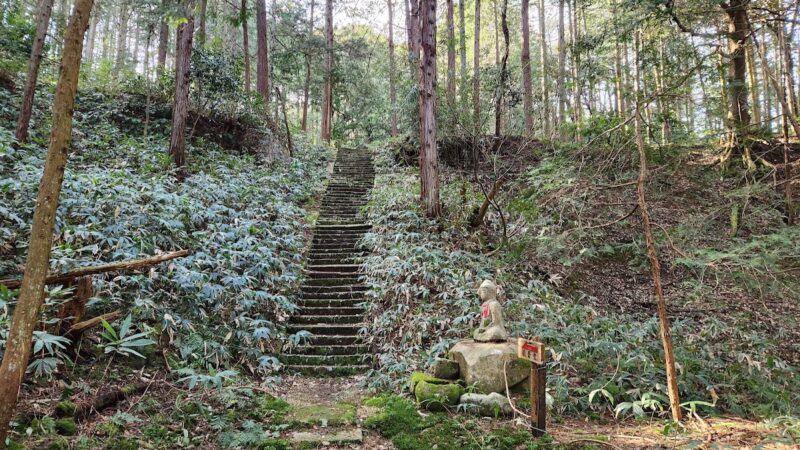
A detailed information board is installed at the entrance to the castle ruins, where you can learn about the history and structure of Wada Castle. From the entrance, you will proceed to the main enclosure via a path through the rice paddies. The path is well-maintained, but it can be slippery in rainy weather, so comfortable walking shoes are recommended.
Around the main enclosure, you can observe remains such as earthworks and moats up close. Comparing your observations with the information on the information board will deepen your understanding. Since vegetation grows thick from spring to autumn, winter is the best time to visit to observe the remains.
Information on Nearby Spots
Other Castles in Koka
When visiting Wada Castle, we recommend also visiting the surrounding Koka castle complex.
Minakuchi Castle: An Edo period castle located in Minakuchi-cho, Koka City. This castle was built when Tokugawa Iemitsu visited Kyoto, and is now open to the public as the Minakuchi Castle Museum. It is about a 20-minute drive from Wada Castle.
Masugi Kita Castle: Located in Kami-Masugi, Konan-cho, Koka City, this castle belonged to the Masugi clan, a Koka samurai family. Similar to Wada Castle, it was the residence of the Masugi clan, vassals of the Rokkaku clan, and its connection to the Wada Castle complex has been noted.
Koka Historical and Cultural Facilities
Koka City Minakuchi Historical and Folk Museum: A facility where you can learn about the history and culture of the Koka region. It also has exhibits on Koka samurai and castles, which helps deepen your understanding of Wada Castle.
Koka-ryu Ninja Residence: A facility that opens to the public the actual residence of a Koka ninja. You can learn about the relationship between Koka samurai and ninjas.
Natural and Scenic Spots
Aburahi Shrine: An ancient shrine near Aburahi Station, which was revered by Koka samurai. The main hall and gate tower are designated as Important Cultural Properties, making it a historically valuable spot.
Scenery along the Yasugawa River: The area around Wada Castle is rich in nature, and beautiful scenery can be enjoyed especially during the cherry blossom season in spring and the autumn foliage season.
Cultural Value of Wada Castle
Protection as a Koka City Designated Historic Site
Wada Castle ruins are protected as a Koka City designated historic site. This designation ensures the preservation and proper management of the remains, and efforts to pass on this valuable historical heritage to future generations continue.
Academic Value
Wada Castle holds an important position in the study of medieval castles. It is particularly highly valued academically for the following reasons:
- A typical example of the Koga castle complex: It well preserves the unique castle structure of the Koga region.
- Relationship with Ashikaga Yoshiaki: An important stage in the political history of the late Muromachi period.
- An example of a residential castle: It exhibits the characteristics of a medieval castle where combat facilities and residential facilities are integrated.
- A complex defense system: It demonstrates the actual regional defense that functioned as part of the Wada castle complex.
Due to these values, Wada Castle has attracted attention from castle researchers and history enthusiasts.
Points to Note When Visiting Wada Castle
Clothing and Equipment
Since the castle ruins are located in a mountainous forest, the following equipment is recommended:
- Comfortable walking shoes: Sneakers or hiking boots are suitable.
- Long-sleeved shirt and long pants: To protect yourself from vegetation and insects.
- Hat: To protect your head from the sun and branches.
- Drinking water: Especially in summer, essential to prevent heatstroke.
Differences in Visiting Depending on the Season
- Spring (March-May): The fresh greenery is beautiful, and the weather is mild, making it suitable for visiting.
- Summer (June-August): Vegetation grows thick, making it difficult to see the ruins. Caution is needed due to the abundance of insects.
- Autumn (September-November): The autumn leaves are beautiful, and the grass is cut, making it easier to observe the ruins.
- Winter (December-February): This is the best time to observe the ruins. However, cold weather gear is necessary.
Manners and Safety
- As this is a historical site, please be careful not to damage the remains or climb on the earthworks.
- Please take all your trash with you.
- Avoid visiting alone; it is recommended to visit with multiple people if possible.
- The ground can be slippery during or immediately after rain, so please refrain from visiting or exercise extreme caution.
Summary
Wada Castle (Koka City, Shiga Prefecture) is a medieval castle of significant historical value as the base of the Koka samurai Wada clan and as the site where Ashikaga Yoshiaki was sheltered. Built at the end of the Heian period and renovated during the Sengoku period, it is now protected as a Koka City designated historical site.
The remains, such as the square earthworks surrounding the main enclosure, moats, and gate sites, are well-preserved, making it a valuable example for understanding the characteristics of the Koka castle group. The fact that multiple castles formed a coordinated defense system as the Wada Castle Group also reflects the characteristics of the samurai groups in this region.
The historical event of Wada Koremasa’s protection of Ashikaga Yoshiaki is indispensable for understanding the political history of the late Muromachi period, as it represents a local powerful family’s deep involvement in central politics. Furthermore, the Wada clan was characterized by their enlightened nature and international perspective, including their connection with Francis Xavier.
Currently, Wada Castle ruins are a historical site open to the public and popular with history enthusiasts and castle fans. It’s relatively easy to access from Aburahi Station on the JR Kusatsu Line, and visiting it along with the surrounding Koka castle complex and historical and cultural facilities allows visitors to experience the rich history and culture of the Koka region.
Wada Castle offers insights into the lives and strategies of Koka samurai, the turmoil of the late Muromachi period, and the structure of medieval castles. Within its tranquil setting, one can feel the spirit of the people who lived through that turbulent era—a truly valuable historical site.