Usayama Castle (Otsu City, Shiga Prefecture) Complete Guide | History and Highlights of Omi’s First Stone-Walled Castle Built by Oda Nobunaga
What is Usayama Castle?
Usayama Castle is a Sengoku period mountain castle built on the summit of Mt. Usayama, approximately 336 meters above sea level, located in Minami-Shiga-cho, Otsu City, Shiga Prefecture. Also known as Shiga Castle or Shiga Fortress, it was situated at a strategic transportation hub on the southwestern end of Lake Biwa.
This castle was built in 1570 (Genki 1) by Mori Yoshinari, a retainer of Oda Nobunaga, under Nobunaga’s orders. As a valuable castle that was the first to be built with stone walls in Omi before Nobunaga built Azuchi Castle, it holds an important position in the history of castles.
Located at the junction of the Lake Biwa West Route (leading from the western shore of Lake Biwa to Kyoto) and the Yamanaka Pass, Usayama Castle served three strategic functions: monitoring water transport on Lake Biwa, controlling the Hokkoku Kaido road, and keeping Enryaku-ji Temple in check. Currently, parts of the stone walls remain as castle ruins, and the mountaintop is known as a scenic spot offering panoramic views of Lake Biwa.
History and Background of Usayama Castle
Background and Purpose of Construction
In May 1570 (Genki 1), Oda Nobunaga was attacking Asakura Yoshikage of Echizen Province, but his ally, Asai Nagamasa, suddenly betrayed him, putting Nobunaga in danger of being attacked from both sides. Having narrowly escaped this critical situation known as the “Retreat from Kanegasaki,” securing a route connecting Kyoto and Gifu Castle became an urgent priority for Nobunaga.
In preparation for the southward advance of the Asai-Asakura allied forces, Nobunaga decided to build a castle on Usayama Mountain, recognizing the need to control the western shore route of Lake Biwa and the Hokkoku Kaido road. This location was strategically important, as it was unavoidable when traveling to Kyoto via the western shore of Lake Biwa.
Nobunaga entrusted the defense of this important stronghold to Mori Yoshinari, one of his most trusted retainers, who completed Usayama Castle in a remarkably short period of approximately three months.
Mori Yoshinari and the Battle of Usayama Castle
As the lord of Usayama Castle, Mori Yoshinari not only defended the castle but also dedicated himself to improving transportation routes. He constructed a new mountain pass connecting Sakamoto and Kyoto to the north of the castle and closed the Osaka Pass and Koseki Pass to the south, thereby strengthening surveillance of traffic.
In September 1570 (Genki 1), the allied forces of Asai Nagamasa and Asakura Yoshikage, joined by warrior monks from Enryaku-ji Temple on Mount Hiei, advanced on Sakamoto with a massive army of approximately 30,000 men. Mori Yoshinari, along with Oda Nobuharu (Nobunaga’s younger brother) and Aochi Shigetsuna, marched to Sakamoto with only 3,000 soldiers to confront the Allied forces.
Despite the overwhelming numerical disadvantage, Yoshinari fought bravely but was killed in action on September 20th at the age of 48. Oda Nobuharu, Aochi Shigetsuna, and Ikeda Tomomasa were also killed in this battle, resulting in heavy losses for the Oda army.
However, Mori Yoshinari’s valiant efforts bought time, allowing the remaining defenders to hold out in Usayama Castle and withstand the Allied attacks. The Allied forces set fire to the castle but were unable to capture it.
Nobunaga, who hurried back to Kyoto from Settsu, entered Usayama Castle and confronted the Allied forces. However, a stalemate ensued, and ultimately, a peace agreement was reached. This battle is known as the “Battle of Usayama Castle” or the “Siege of Shiga,” and Mori Yoshinari’s loyalty and bravery will be recounted for generations to come.
Akechi Mitsuhide’s Appointment as Castle Lord
After Mori Yoshinari’s death in battle, Akechi Mitsuhide was appointed as the lord of Usayama Castle. It is believed that Mitsuhide resided at Usayama Castle from around 1571 (Genki 2) to 1573 (Tensho 1).
During this period, Mitsuhide was involved in important military actions, such as participating in the burning of Enryaku-ji Temple on Mount Hiei at Nobunaga’s command. Usayama Castle also served as a frontline base for monitoring Enryaku-ji Temple.
In 1573 (Tensho 1), Nobunaga decided to build a new castle in Sakamoto on the shores of Lake Biwa, and ordered Mitsuhide to construct it and become its lord. This later became Sakamoto Castle. With the completion of Sakamoto Castle, Usayama Castle is believed to have completed its role and been abandoned.
Although it was a short-lived castle, lasting only a little over three years, it played an extremely important role in the early stages of Oda Nobunaga’s rule over Omi Province.
Letters from Rokkaku Yoshikata and Usayama Castle
A letter from Rokkaku Yoshikata (Jōtei), a Sengoku period daimyo of Omi Province, remains as historical material concerning Usayama Castle. This letter is a valuable primary source that conveys contemporary information about the construction of Usayama Castle and the battle situation.
The Rokkaku clan were daimyo of southern Omi Province, based at Kannonji Castle, but they fell into decline after being defeated by Oda Nobunaga’s army on its way to Kyoto in 1568. However, when the Asai-Asakura allied forces advanced southward, they were in a position to check the Oda forces.
These letters suggest that Usayama Castle was not merely a military base, but an important political and strategic base that attracted the attention of various forces in Omi Province.
The Castle Structure of Usayama Castle
Layout and Arrangement
Usayama Castle is a typical mountain castle with its main keep located on the summit of Mt. Usayama, approximately 336 meters above sea level, and its baileys arranged along the ridge. With a relative height of approximately 200 meters, it boasts a highly defensible structure that takes advantage of the steep terrain.
Currently, the site of the main keep on the mountaintop is occupied by an NHK antenna facility, so some of the remains have been altered. However, traces of the bailey’s steps and earthworks remain in the surrounding area, allowing us to imagine the castle’s structure in its heyday.
The castle’s layout is long and narrow, extending north and south along the ridge, with multiple baileys arranged in a stepped pattern. Each bailey is clearly demarcated by steep slopes, demonstrating ingenuity in preventing enemy intrusion.
Characteristics and Importance of Stone Walls
The most significant feature of Usayama Castle is that it was the first castle in Omi Province to utilize stone walls, even before Oda Nobunaga built Azuchi Castle. This holds significant importance in the history of Japanese castles.
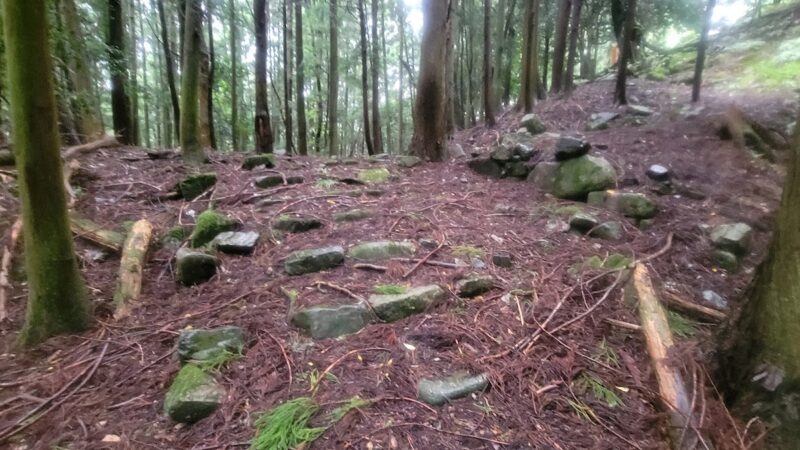
Even today, parts of the stone walls remain around the mountaintop, allowing us to see the stonework constructed using the nozurazumi technique. While not as grand as the walls of Azuchi Castle, it is a rare and valuable example of a mountain castle where stone walls have survived to the present day.
These stone walls are believed to have been adopted by Mori Yoshinari to enhance the castle’s defenses during its rapid construction. It is possible that Nobunaga utilized his experience in building the stone walls at Usayama Castle in the later construction of Azuchi Castle.
Although small in scale, the stone walls possess technical elements that connect to later Oda-style castles, making them an important historical site for understanding the development of Oda Nobunaga’s castle-building philosophy.
Enclosures and Defensive Structures
Usayama Castle had multiple enclosures, but the enclosures around the main keep, in particular, functioned as important defensive strongholds. The enclosures were separated by steep slopes, forming defensive lines utilizing the differences in elevation.
The castle features multiple trenches, a characteristic of mountain castles, demonstrating a defensive strategy against enemy incursions from the ridge. Traces of vertical trenches have also been confirmed, indicating thorough defense against attacks from the slopes.
Regarding the structure of the entrance (koguchi), while details are unclear due to current alterations, the possibility of a square-shaped entrance using stone walls has been suggested.
Highlights and Current Status of Usayama Castle
Main Enclosure Site and Antenna Facility
The main enclosure site at the summit of Usayama Castle is currently occupied by an NHK broadcasting antenna facility. Therefore, some of the remains at the main enclosure site have been altered, but remnants of the castle’s former appearance are scattered throughout the surrounding area.
The flat area around the antenna facility is thought to be the main enclosure site, offering a panoramic view of Lake Biwa. It is likely that Mori Yoshinari and Akechi Mitsuhide also surveyed Lake Biwa and the Kyoto area from this location, formulating their strategies.
Remaining Stone Walls
Unusually for a mountain castle, parts of the stone walls of Usayama Castle still remain. These were constructed using the nozurazumi technique (rough-stone masonry) and are attracting attention from castle researchers as a valuable example of Oda-style stone walls predating Azuchi Castle.
The stone walls are scattered around the main keep, and although some are buried in the earth, it is possible to observe the construction methods and stone selection. The use of relatively large stones for a mountain castle suggests that, despite its short construction period, it was intended to be a strong defense.
Spectacular Views of Lake Biwa
The greatest attraction of the Usayama Castle ruins is the spectacular view of Lake Biwa from the mountaintop. From the 336-meter-high summit, you can see the southern part of Lake Biwa, as well as the Seta and Ishiyama areas on the opposite shore, and even Mount Hiei and Kyoto.
On a clear day, you can enjoy the beautiful scenery created by the blue surface of Lake Biwa and the surrounding mountains. This view makes you realize the strategic importance of why Nobunaga built his castle here.
Currently, it is a popular destination for mountain climbing and hiking, attracting not only history buffs but also nature lovers.
Remains of Enclosures and Cut Embankments
Several remains of enclosures can be seen around the main keep, where elevation changes and cut embankments can be observed. These remains demonstrate the ingenuity of the castle’s layout, which made use of the unique terrain of a mountain castle.
In particular, the enclosure one level below the main keep is relatively well-preserved, allowing us to imagine the castle’s structure at the time. It is thought that buildings stood on the flat areas of the enclosures, and it is estimated that the residences of Mori Yoshinari and Akechi Mitsuhide were located in this area.
Access and Visiting Guide to Usayama Castle
Location and Basic Information
Location: Minami-Shiga-cho, Otsu City, Shiga Prefecture
Castle Classification: Mountain Castle
Year of Construction: 1570 (Genki 1)
Builder: Mori Yoshinari (by order of Oda Nobunaga)
Main Lords: Mori Yoshinari, Akechi Mitsuhide
Year of Abandonment: Around 1573 (Tensho 1)
Elevation: Approximately 336 meters
Relative Height: Approximately 200 meters
Access by Car
The nearest expressway interchange is the Kyoto-Higashi IC on the Meishin Expressway. It takes approximately 15 minutes by car from the IC to reach the area around Omi Jingu Shrine.
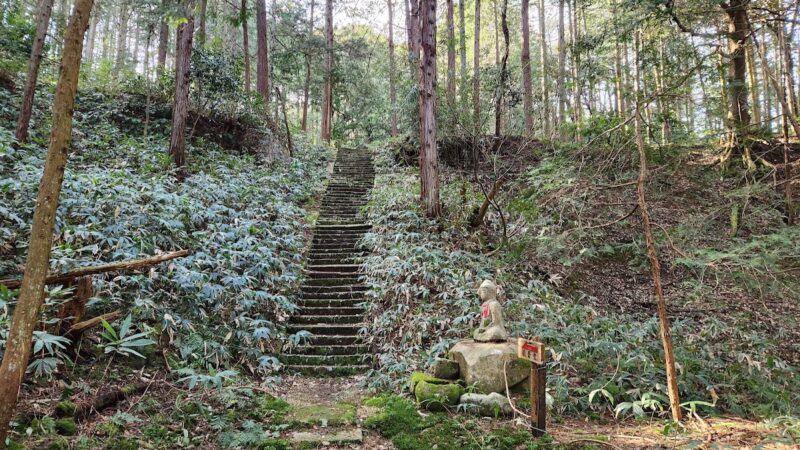
The trailhead is located behind Omi Jingu Shrine or near Usa Hachimangu Shrine. You can use the Omi Jingu Shrine parking lot, but it is recommended to check in advance regarding long-term parking for hiking purposes.
Access by Public Transportation
The nearest stations are JR Kosei Line “Otsukyo Station” or Keihan Electric Railway Ishiyama-Sakamoto Line “Omi-Jingu-mae Station”.
- From JR Otsukyo Station: Approximately 15 minutes on foot to Omi Jingu Shrine, then proceed to the trailhead.
- From Keihan Omi Jingu-mae Station: Approximately 10 minutes on foot to Omi Jingu Shrine, then proceed to the trailhead.
Climbing Routes and Estimated Time
The main climbing routes to Usayama Castle are as follows:
Omi Jingu Route (Recommended):
- A hiking trail is maintained from behind Omi Jingu Shrine.
- Approximately 40-50 minutes from the trailhead to the summit.
- A relatively well-maintained path, making it easy even for beginners.
Usa Hachimangu Route:
- A route starting from near Usa Hachimangu Shrine.
- Approximately 45-60 minutes from the trailhead to the summit.
- While there are some slightly steep sections, this route offers a historical atmosphere.
Allow approximately 2-3 hours for the round trip. Including time for exploring and enjoying the scenery at the summit, we recommend planning for 3-4 hours.
Points to Note When Visiting
- Clothing: As this is a mountain climb to a castle, comfortable walking shoes and clothing are essential.
- Season: Spring to autumn is recommended, but don’t forget insect repellent in the summer.
- Hydration: Bring plenty of water, especially in the summer.
- Weather: The ground can become slippery in rainy weather, so choose a sunny day.
- Time: Allow ample time to climb the mountain so you can descend before sunset.
- Protection of Remains: Please be careful not to touch the remains such as stone walls.
Nearby Tourist Attractions
Omi Jingu Shrine
Omi Jingu Shrine, located at the trailhead of Usayama Castle, is a shrine dedicated to Emperor Tenji and is also known as the setting for the anime “Chihayafuru.” It attracts visitors from all over Japan as a sacred site for competitive karuta (a Japanese card game).
Usa Hachimangu Shrine
This shrine is located on the mountainside of Usayama and is the origin of the name of Usayama Castle. In a tranquil atmosphere, you can feel the weight of history.
Sakamoto Castle Ruins
The ruins of Sakamoto Castle, built by Akechi Mitsuhide after Usayama Castle, are located about 10 minutes by car from Usayama Castle. Parts of the stone walls remain on the shore of Lake Biwa, and visiting both allows you to trace Mitsuhide’s footsteps.
Enryaku-ji Temple
Enryaku-ji Temple on Mount Hiei has a historical relationship with Usayama Castle, having faced it directly. Located about 30 minutes by car, it is a renowned temple registered as a World Heritage Site.
Historical Significance of Usayama Castle
Base of Oda Nobunaga’s Rule of Omi Province
Usayama Castle was the first full-fledged castle built by Oda Nobunaga to rule Omi Province. Built with the strategic purpose of preventing the southward advance of the Asai-Asakura allied forces and securing access to Kyoto, this castle played a crucial role in Nobunaga’s path to unifying Japan.
Although it was a short-lived castle, lasting only a little over three years, Mori Yoshinari’s valiant efforts prevented the Allied forces from invading Kyoto, giving Nobunaga time to counterattack, which greatly contributed to the subsequent development of the Oda regime.
Pioneer of Stone Wall Castles
Usayama Castle holds an important place in the history of Japanese castles as the first castle in Omi Province to use stone walls, even before Oda Nobunaga built Azuchi Castle.
While previous mountain castles were mainly defended with earthen ramparts and steep slopes, Usayama Castle adopted stone walls. This demonstrates the castle-building philosophy of Mori Yoshinari and Oda Nobunaga, who sought to achieve stronger defenses within the constraints of building the castle in a short period of time.
The experience of building stone walls at Usayama Castle is considered to have laid the foundation for the development of stone wall castles, which later led to Azuchi Castle, and then to Toyotomi Hideyoshi’s Osaka Castle and Fushimi Castle.
Mori Yoshinari’s Loyalty and Valor
Mori Yoshinari’s presence is indispensable when discussing the history of Usayama Castle. Despite the overwhelming difference in troop numbers, Yoshinari’s loyalty and bravery in fighting for his lord Nobunaga, risking his life, have been passed down through generations as a model of a Sengoku period warlord.
Yoshinari’s sons, Mori Nagayoshi and Mori Ranmaru, also served the Oda family, and Ranmaru, in particular, died alongside Nobunaga in the Honnoji Incident. The Mori family is known as a prestigious family that remained loyal to the Oda family for three generations.
Connection with Akechi Mitsuhide
Usayama Castle is also important as a castle where Akechi Mitsuhide served as lord. Mitsuhide used this as his base to participate in the burning of Mount Hiei, and later built Sakamoto Castle, becoming a central figure in the control of Omi Province.
Usayama Castle, which served as a stepping stone for Mitsuhide’s rise to power, also occupies an important position in Mitsuhide’s life leading up to the Honnoji Incident.
Summary
Usayama Castle was a mountain castle built in 1570 by Mori Yoshinari at the command of Oda Nobunaga. It was located at a strategic point connecting Lake Biwa and Kyoto. As the first castle in Omi Province to utilize stone walls, even before Azuchi Castle, it holds significant importance in the history of Japanese castles.
The Battle of Usayama Castle, where Mori Yoshinari was killed in battle against the Asai-Asakura allied forces, was a crucial battle on Oda Nobunaga’s path to unifying Japan. Afterward, Akechi Mitsuhide became the castle lord, and its role ended with the construction of Sakamoto Castle. However, it is a castle that left a rich history in just over three years.
Even today, parts of the stone walls remain on the mountaintop, making it a popular spot for history buffs and hiking enthusiasts to enjoy panoramic views of Lake Biwa. With easy access from Omi Jingu Shrine, it is an ideal place for a historical walk tracing the footsteps of Oda Nobunaga, Mori Yoshinari, and Akechi Mitsuhide.
When you visit Shiga Prefecture, be sure to climb to the ruins of Usayama Castle and experience the atmosphere of the Sengoku period and the beautiful scenery of Lake Biwa.