Ebara Castle (Ehime Prefecture) Complete Guide | The History of a Sengoku Period Flatland Castle and the Hiraoka Clan, a Senior Retainer of the Kono Clan
Ebara Castle, located in Ebara-cho, Matsuyama City, Ehime Prefecture, is a valuable historical site that preserves a rare example of a medieval flatland castle in excellent condition. Designated as a prefectural historical site, it features a square, single-enclosure structure surrounded by high earthen ramparts and a moat, characteristic of a Sengoku period castle. This article provides a detailed explanation of Ebara Castle’s history, structure, highlights, and access methods.
Basic Information on Ebara Castle
Location and Designation Status
Ebara Castle ruins are located south of Matsuyama City, in the former Ebara Village (present-day Ebara-cho, Matsuyama City). It is protected as an Ehime Prefecture designated historical site and is considered an extremely important site in the study of medieval castles.
Basic Data
- Location: Ebara-cho, Matsuyama City, Ehime Prefecture
- Other Names: Ebara Castle, Aihara Castle, Sakui Castle, Hiraoka Castle
- Castle Type: Flatland Castle (Marsh Castle)
- Size: Approximately 130m east-west, approximately 120m north-south (one theory says 125.4m x 105m)
- Cultural Property Designation: Ehime Prefecture Designated Historic Site
- Main Remains: Earthworks, moats, baileys, earthen bridges, stone walls
About the Other Names of Ebara Castle
Ebara Castle has been known by several other names. “Aihara Castle” is the oldest name appearing in ancient documents, recorded in the “Kutsuna Ichizoku Gunchu Shidai” from Kenmu 2 (1335). “Hiraoka Castle” is a name derived from the Hiraoka clan, who were the lords of the castle. The term “Sakui Castle” also appears in historical documents, which is thought to describe the characteristics of the castle’s defensive structures.
History of Ebara Castle
Construction and the Nanboku-cho Period
The exact construction date of Ebara Castle is unknown, but it has been confirmed to have existed by Kenmu 2 (1335). The “Kutsuna Ichizoku Gunchu Shidai” (Records of the Kutsuna Clan’s Military Service) records that in this year, the Omori clan, who supported the Northern Court, fought against the Kutsuna clan, who supported the Southern Court, at “Aihara Castle.”
The place name “Ebara” has been used as a village name since the Heian period and is listed as one of the four villages of Ukena District in the “Wamyō Ruijushō” (a Japanese dictionary compiled in the Heian period). It is thought that the regional importance of this area led to the early construction of a castle.
In the battle of Kenmu 2, the Kutsuna clan attacked Ebara Castle, and the fighting continued until the following year. This battle during the Nanboku-cho period indicates that Ebara Castle was an important military base in Iyo Province.
The Muromachi Period and the Kono Clan
In the late Muromachi period, Ebara Castle became the residence of the Hiraoka clan, important retainers of the Kono clan, a powerful daimyo family in Iyo Province. The Hiraoka clan held a particularly important position within the Kono clan’s retainer group, and Ebara Castle functioned as a crucial southern stronghold within the Kono clan’s sphere of influence.
Successive heads of the Hiraoka clan, including Hiraoka Fusazane, Hiraoka Michisuke, Hiraoka Michiyuki, and Hiraoka Michifusa, used this castle as their base. Especially during the Sengoku period, the strategic importance of Ebara Castle increased as a check against the Chosokabe clan of Tosa Province, who were expanding their power with the aim of unifying Shikoku.
The Fall of Ebara Castle in 1585
The fate of Ebara Castle was sealed by Toyotomi Hideyoshi’s conquest of Shikoku in 1585. At this time, the lord of Ebara Castle was Hiraoka Michiyuki, but the castle fell to the overwhelmingly superior forces of the Toyotomi army.
The Shikoku Campaign was a crucial military operation undertaken by Toyotomi Hideyoshi in his process of unifying Japan, with the aim of conquering the entire Shikoku region, which had been under the control of Chosokabe Motochika. The Kono clan and their retainers also suffered a major blow in this battle.
Attempts to Restore the Kono Clan and the Castle’s Demolition in 1600
The history of Ebara Castle continued even after its fall in 1585. In September 1600, during the time of the Battle of Sekigahara, a significant event occurred.
Taking advantage of the fact that Kato Yoshiaki, the lord of Matsumae Castle at the time, was away serving Tokugawa Ieyasu, Hiraoka Zenbei Naofusa, the younger brother of Hiraoka Michiyuki, attempted to restore the Kono clan at Ebara Castle. This was an attempt to restore the power of the Kono clan, which had declined since Toyotomi Hideyoshi’s conquest of Shikoku.
However, this uprising ended in failure, and Ebara Castle remained in ruins. This incident marked the complete end of Ebara Castle’s role as a military base.
Structure and Characteristics of Ebara Castle
A Square, Single-Enclosure Flatland Castle
Ebara Castle is a typical square, single-enclosure flatland castle. Built on flat land, it measures approximately 130m east-west and 120m north-south. In the Sengoku period, when mountain castles were common, the well-preserved remains of such a flatland castle are rare nationwide, making it an extremely valuable example in the study of medieval castles.
Structure of Earthworks
The most striking feature of Ebara Castle is the earthworks surrounding it on all four sides, approximately 5m high. These earthworks remain clearly visible today, allowing us to appreciate the scale of the defensive facilities at the time.
The earthen ramparts are not merely mounds of earth, but possess a carefully calculated structure. They not only prevented enemy intrusion but also served to maintain visibility from within the castle and acted as footholds during defensive battles. Traces of stonework have been found in the southwestern section, indicating a more robust defense.
In recent years, a portion of the earthen ramparts suffered damage due to a disaster, and restoration work has been carried out. This work has yielded new insights into the internal structure of the ramparts.
Moat Arrangement
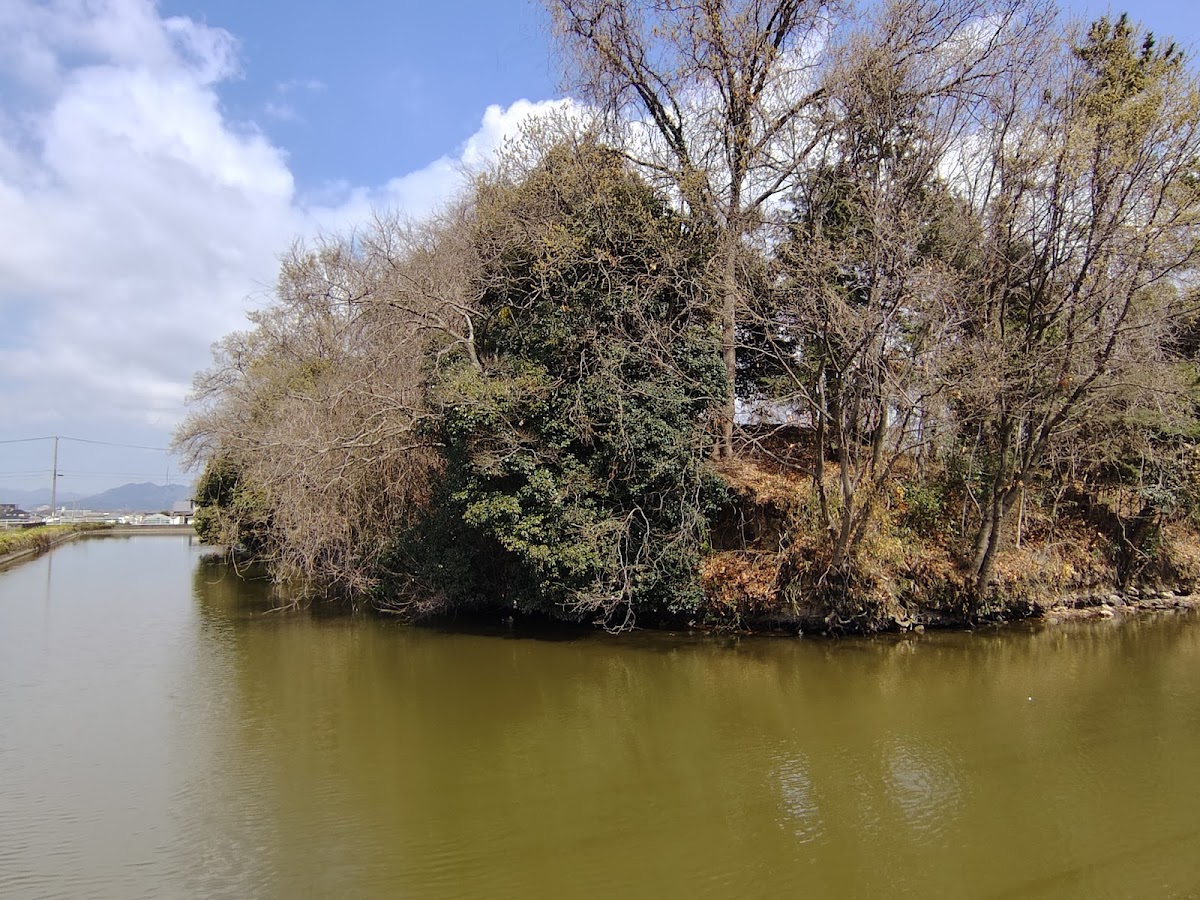
Ebara Castle is surrounded by a moat. Because the castle was built on flat land, this moat played an extremely important role in its defense. The water in the moat was drawn from the surrounding water system, and the castle’s alternative name, “Numajo” (Swamp Castle), is thought to derive from this characteristic of the moat.
The moat not only physically hindered enemy approach but, together with the earthen ramparts, formed a double line of defense. It may also have functioned as a water supply source for the castle.
Earthen Bridge and Entrance
An earthen bridge was located on the south side of the castle, serving as the main communication route to the outside world. Earthen bridges are a method of securing passageways without filling in moats, and their structure allows for destruction in emergencies to prevent enemy intrusion.
The location of this earthen bridge indicates that the castle’s main entrance was on the south side, providing an important clue in considering its relationship with the castle town and the main road.
Layout of Enclosures
Ebara Castle is basically a single-enclosure structure, but subtle topographical changes are observed within the main enclosure, suggesting a building layout and functional differentiation. Details are unclear due to limited archaeological excavations, but it is believed that living spaces, warehouses, and wells were systematically arranged.
Highlights of Ebara Castle
Well-Preserved Remains
The greatest highlight of Ebara Castle is undoubtedly the well-preserved remains of this medieval flatland castle. Major defensive structures such as earthworks, moats, and earthen bridges remain clearly visible, making it a valuable place to experience the castle structure of the Sengoku period.
In particular, the earthworks maintain a height of approximately 5 meters, and their scale and shape demonstrate the high level of castle-building technology of the time. Walking along the earthen ramparts allows you to survey the surroundings from the perspective of the castle’s defenders, helping you understand its function as a defensive stronghold.
The Moat Landscape
The moat surrounding the castle still holds water in some sections today, evoking its former appearance. The combination of the moat and earthen ramparts represents a typical medieval castle landscape and is a popular spot for photography.
The changing water levels in the moat and the surrounding vegetation throughout the seasons create different scenes, adding to its charm. Especially during the fresh greenery of spring and the vibrant autumn foliage, you can enjoy a beautiful landscape where historical scenery and natural beauty harmonize.
View from the Earthen Bridge
The earthen bridge on the south side is an important point for understanding the castle’s structure. Looking into the castle from the bridge, you can see the rectangular enclosure, the surrounding earthen ramparts, and the arrangement of the moat, allowing you to grasp the overall layout of Ebara Castle.
Furthermore, the structure of the earthen bridge itself is interesting, allowing you to observe both its function as a passage across the moat and its defensive features simultaneously.
Traces of Stone Masonry
The traces of stone masonry remaining in the southwestern part are important remains indicating that the defensive facilities of Ebara Castle were more complex. Examples of stone masonry being used in medieval flatland castles are limited, demonstrating the high economic power and technical skill of the Hiraoka clan.
The stone masonry is thought to have been used to reinforce the earthworks and strengthen the defenses of important entrances. Although weathered, careful observation allows us to discern the stonework techniques of the time.
Ebara Castle and the Kono and Hiraoka Clans
The Kono Clan’s Rule of Iyo Province
The Kono clan was a powerful samurai family that ruled Iyo Province (present-day Ehime Prefecture) for a long period. From the late Heian period to the Sengoku period, they reigned as the largest power in Iyo Province.
The Kono clan controlled maritime traffic in the Seto Inland Sea and organized pirate groups (naval forces), wielding considerable power. By combining this maritime power with land-based territorial control, they maintained their dominance in Iyo Province. ### The Role of the Hiraoka Clan
The Hiraoka clan served as important retainers of the Kono clan, particularly in charge of land-based military affairs and administration. Based at Ebara Castle, they governed the southern region of the Kono territory and were responsible for defending against external enemies.
The Hiraoka clan was not merely a military commander; they also served as local administrators. It is believed they governed the villages around Ebara, collecting taxes, maintaining public order, and developing infrastructure.
The Shikoku Campaign and the Decline of the Kono Clan
Toyotomi Hideyoshi’s Shikoku campaign drastically altered the fates of both the Kono and Hiraoka clans. Faced with overwhelming military superiority, the Kono clan was forced to surrender, and their long-established system of control in Iyo Province collapsed.
Hiraoka Michiyuki also resisted at Ebara Castle, but it ultimately fell. Afterward, the Kono clan was allowed to survive as a minor daimyo, but they were unable to regain their former power.
The Shikoku Campaign and the Decline of the Kono Clan
Toyotomi Hideyoshi’s Shikoku campaign drastically altered the fate of both the Kono and Hiraoka clans. Faced with an overwhelming difference in military strength, the Kono clan was forced to surrender, and their long-standing rule in Iyo Province collapsed.
Hiraoka Michiyuki also resisted at Ebara Castle, but it ultimately fell. Although the Kono clan was allowed to survive as a minor daimyo afterward, they were unable to regain their former power. ### Attempts and Failures to Restore the Kono Clan
In 1600, Hiraoka Zenbei Naofusa attempted to restore the Kono clan, which was the last resistance of the former Kono clan retainers. The uprising took place amidst the chaos of the Battle of Sekigahara, a pivotal battle for control of Japan, but was quickly suppressed by Kato Yoshiaki.
This failure completely crushed the dream of restoring the Kono clan, and the Hiraoka clan disappeared from the historical stage. The ruin of Ebara Castle symbolized the end of an era.
Current Status and Preservation of Ebara Castle Ruins
Protection as a Prefectural Designated Historic Site
Ebara Castle Ruins are legally protected as an Ehime Prefecture designated historic site. This designation restricts the destruction and alteration of the remains, ensuring the preservation of the historical landscape.
The Matsuyama City Board of Education is responsible for management, and regular mowing and inspections of the remains are carried out. Furthermore, information boards and explanatory signs have been installed to help visitors understand the history and structure of the castle ruins.
Disaster Restoration Work on the Earthworks
In recent years, parts of the earthworks have been damaged by natural disasters such as heavy rains. To protect this valuable cultural property, disaster restoration work was carried out under the guidance of experts.
This work not only repaired the earthworks but also considered the use of traditional construction methods and materials to avoid compromising their value as a cultural property. In addition, archaeological excavations conducted in conjunction with the work have yielded new insights into the structure of the earthworks.
Engagement with the Local Community
Ebara Castle Ruins are recognized as an important historical heritage site by local residents. Regular tours and cleaning activities are held by local history enthusiasts, demonstrating community-wide preservation efforts.
It is also used as a site for local history studies in elementary and junior high schools, playing a role in passing on history to future generations. Children’s actual visits to the earthworks and moats have the effect of increasing their interest in local history.
Access and Visiting Information
Transportation Access
Using Public Transportation
- Take an Iyo Railway bus from JR Matsuyama Station or Iyo Railway Matsuyama City Station.
- Get off at the “Ebara-cho” bus stop and walk for approximately 5 minutes.
Using a Car
- Approximately 15 minutes from Matsuyama IC on the Matsuyama Expressway.
- Approximately 20 minutes from central Matsuyama City via National Route 33.
- Parking: There is no dedicated parking lot, so please park on the surrounding roadside with consideration.
Visiting Precautions
- Free admission
- Open at all times, but it is advisable to avoid visiting at night.
- To protect the remains, entry to the earthworks and moats is restricted to designated areas only.
- Be careful as the ground can be slippery during and after rain.
- In summer, the grass grows thick, so wearing long sleeves and long pants is recommended.
- Carrying insect repellent is recommended.
Nearby Tourist Attractions
Tourist attractions in southern Matsuyama City that you should visit in conjunction with a visit to Ebara Castle Ruins:
- Matsuyama Castle: A famous castle representing Matsuyama City, and one of the 12 remaining original castle keeps.
- Dogo Onsen: Famous as one of Japan’s oldest hot springs.
- Ishite-ji Temple: The 51st temple of the Shikoku 88 Temple Pilgrimage.
- Saka no Ue no Kumo Museum: A facility where you can learn about Matsuyama’s modern history.
Points to Note When Visiting Ebara Castle
Points for History Enthusiasts
For those interested in medieval castles, Ebara Castle is a must-see historical site. We recommend paying attention to the following points during your visit:
- Structure of the Earthworks: Observe the earthworks, approximately 5m high, from various angles to understand the castle construction techniques.
- Arrangement of the Moats: Confirm how the surrounding moats are arranged and form a defensive system.
- Location of the Earthen Bridge: Consider why it was placed on the south side and its relationship to the surrounding terrain.
- Traces of Stonework: Observe the stonework in the southwest and learn about medieval stonework techniques.
- Overall Layout: Understand the meaning of the square single-enclosure structure in relation to the tactics of the Sengoku period.
Photography Tips
Ebara Castle Ruins is also a photography spot where you can enjoy the beautiful scenery of each season:
- Spring: The contrast between the fresh greenery and the earthworks is beautiful.
- Summer: The scenery of the lush green moats.
- Autumn: The harmony of autumn leaves and historical remains.
- Winter: Photograph the entire structure of the ruins with a clear view.
Photographing in the soft light of early morning or evening is recommended. The view of the entire castle complex from the earthen bridge is particularly popular as a representative landscape of Ebara Castle.
Family-Friendly Points
Enjoyable for families:
- The flat terrain makes it easy for small children to walk.
- You can climb the earthen ramparts and experience the feeling of “castle exploration.”
- You can observe aquatic life in the moat (depending on the season).
- You can learn about history in a picnic-like atmosphere.
However, it is important to keep an eye on children and not get too close to the moat.
Historical Significance of Ebara Castle
Value in Medieval Castle Research
Ebara Castle occupies an extremely important position in the research of medieval castles, especially flatland castles. In the Sengoku period, when mountain castles were the mainstream, flatland castles with such clearly preserved remains are rare nationwide.
It possesses typical elements of medieval flatland castles, such as its basic structure of a square single enclosure, a defensive system of earthen ramparts and moats, and the management of entrances by earthen bridges, giving it textbook value.
Importance in Local History
Ebara Castle is an indispensable historical site for understanding the medieval history of Iyo Province. It was the stage for important historical events in the region, including the rule of the Kono clan, the role of the senior retainer Hiraoka clan, the impact of Toyotomi Hideyoshi’s conquest of Shikoku, and the failure of the Kono clan’s restoration movement.
As the core of the historical identity of the southern area of present-day Matsuyama City, the Ebara Castle ruins are cherished and carefully preserved by local residents.
Value as a Cultural Property
As a legally protected prefecturally designated historical site, the Ebara Castle ruins are a valuable cultural asset of Ehime Prefecture. Further research and investigation are likely to yield new insights, and it is hoped that it will eventually be upgraded to a nationally designated historical site.
Due to the excellent state of preservation of the remains, the possibility of restoration, development, and creation of a historical park is being considered, and its use as a tourist resource is also anticipated.
Summary
Ebara Castle (Matsuyama City, Ehime Prefecture) is a historical site that preserves extremely valuable remains of a flatland castle from the Sengoku period to this day. The castle, a square-shaped single enclosure measuring approximately 130m east-west and 120m north-south, surrounded by an earthen rampart and moat approximately 5m high, is highly regarded as a typical example of a medieval castle.
Its existence has been confirmed as early as 1335 (Kenmu 2), and it was the site of battles during the Nanboku-cho period. In the late Muromachi period, it flourished as the residence of the Hiraoka clan, a senior retainer of the Kono clan, but fell during Toyotomi Hideyoshi’s conquest of Shikoku in 1585 (Tensho 13). After the Kono clan’s attempt to restore power in 1600 (Keicho 5) failed, the castle was abandoned.
Currently, it is protected as a designated historical site of Ehime Prefecture, and the remains such as the earthen rampart, moat, earthen bridge, and stone walls are well preserved. As an important historical heritage site in southern Matsuyama City, it is cherished by local residents and history enthusiasts, and is a must-see historical site for anyone studying medieval castles.
When sightseeing in Matsuyama, why not visit Ebara Castle Ruins along with Matsuyama Castle and Dogo Onsen, and experience the atmosphere of the Sengoku period?