Kurose Castle (Ehime Prefecture) Complete Guide: Tracing the History of the Saionji Clan’s Residence and the Sengoku Period
Located in Unomachi, Uwa-cho, Seiyo City, Ehime Prefecture, Kurose Castle is a mountain castle that played an important role as the residence of the Saionji clan, who ruled Iyo Province during the Sengoku period. Built on the summit of Mt. Kurose at an altitude of 350m, this castle was a strategically important location overlooking the Uwa Basin, and even today, remnants such as moats and earthworks remain in good condition.
History of Kurose Castle and the Saionji Clan
Background of Construction and Saionji Sanemitsu
The exact date of construction of Kurose Castle is uncertain, but it is said to have been built around the Tenbun era (1532-1555) or in Tenbun 15 (1548) by Saionji Sanemitsu. The Saionji clan originally used Matsuba Castle as their main base, but to prepare for threats from neighboring forces such as the Otomo clan of Bungo and the Ichijo clan of Tosa, they decided to build the more defensible Kurose Castle.
According to the “Uwa Kyūki” (Old Records of Uwa), Saionji Sanemitsu abandoned Matsuba Castle and began construction of Kurose Castle, but died before its completion. It is said that the castle was completed during the time of his son, Saionji Kōnosuke, and the relocation of their residence was realized. This relocation was a crucial strategic decision for the Saionji clan to maintain their power in southern Iyo Province.
The Saionji Clan’s Rule and the Situation in Iyo Province
The Saionji clan reigned as a powerful samurai family in Iyo Province from the Muromachi period to the Sengoku period. Centered around Kurose Castle, they established a strong network of castles controlling the entire Uwa Basin, including subsidiary castles such as Tobigasu Castle, Gagō Castle, Oka Castle, Gomagamori Castle, and Doi Castle.
Oka Castle, in particular, was an important subsidiary castle adjacent to Kurose Castle, and even today, the relative positions of the two castles can be seen from the area around Uwajima Sports Park. These subsidiary castles were the cornerstone of the defense system centered around Kurose Castle, and formed the foundation of the Saionji clan’s military power.
Saionji Kimihiro and the Turmoil of the Late Sengoku Period
Saionji Kimihiro was the last lord of Kurose Castle. During Kimihiro’s time, Iyo Province was experiencing the turbulent late Sengoku period, surrounded by powerful forces such as the Ichijo clan of Tosa, the Chosokabe clan, and the Otomo clan of Bungo.
In 1584, Kimihiro decided to pledge allegiance to Chosokabe Motochika of Tosa. This was a difficult choice made to maintain the Saionji clan’s independence. However, the following year, 1585, when Toyotomi Hideyoshi’s invasion of Shikoku began, Kimihiro surrendered to Kobayakawa Takakage without a fight.
This surrender marked the end of the Saionji clan’s rule over Kurose Castle. Afterward, Toda Katsutaka is believed to have resided at Kurose Castle, and it is thought that the castle eventually came under the control of Ozu Castle.
Structure and Layout of Kurose Castle
Location and Topographical Features
Kurose Castle is a multi-bailey mountain castle built on the summit of Mount Kurose, at an elevation of 350m (relative height approximately 200m). The mountain directly visible from Unomachi Station is Kurose Castle, and its location offers an excellent viewpoint overlooking the entire Uwa Basin. This topographical advantage was one of the main reasons the Saionji clan relocated their castle.
A climbing route to the castle is maintained from behind the current Uwa Gymnasium, and it is estimated that the entire Uwa Sports Park was part of the former castle grounds. The structure, with defensive facilities arranged in stages from the foot of the mountain to the summit, exhibits typical characteristics of mountain castles from the Sengoku period.
Major Remains
Kurose Castle still retains many remains, preserving the appearance of a mountain castle from the Sengoku period.
Moats: Multiple moats, crucial for the castle’s defense, were constructed in various locations. These were important defensive structures that prevented enemy incursions by cutting off the ridges.
Earthworks: Earthworks, positioned to surround the baileys, enhanced the castle’s defensive capabilities and also served as hiding places for soldiers. The earthworks of Kurose Castle remain in relatively good condition, making them valuable resources for understanding the castle construction techniques of the time.
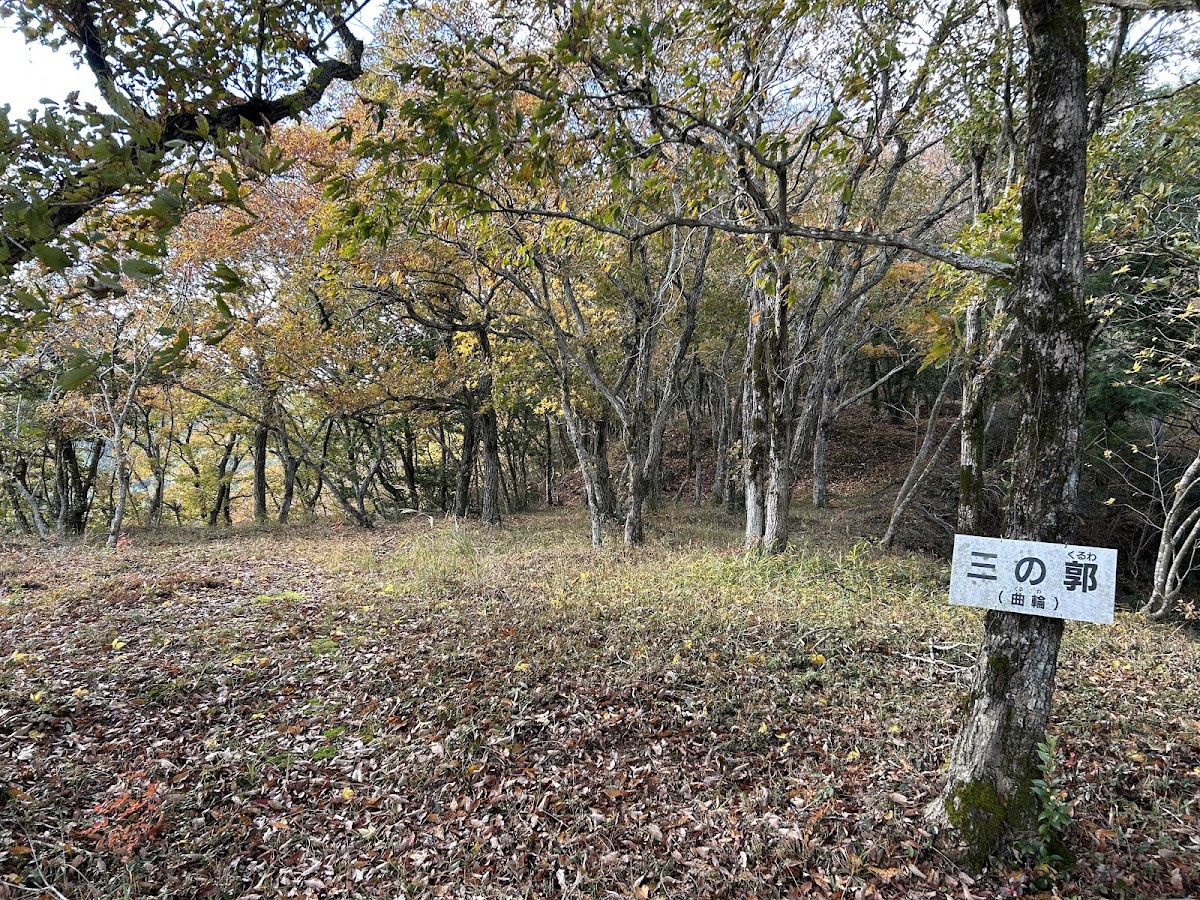
Baileys (Enclosures): Multiple baileys are arranged in a stepped pattern from the mountaintop to the mountainside. The structure, with the main enclosure at the center and the second and third enclosures following, allowed for efficient defense and troop deployment.
Horizontal Moats: Horizontal moats dug horizontally along the mountainside were defensive structures that prevented enemy lateral movement. The horizontal moats of Kurose Castle are cleverly positioned, making full use of the terrain.
Koshiguruwa: Small, flat areas surrounding the main enclosures, serving a supplementary defensive role.
Inubashiri: Narrow passages outside earthworks and stone walls, used for defense and patrols.
Ido: Securing a water source was crucial for mountain castles. Multiple well remains have been confirmed at Kurose Castle, indicating a design intended for long-term sieges. The abundance of wells speaks to the castle’s importance and the high level of construction skill of the Saionji clan.
Characteristics of the Castle Layout
Kurose Castle’s layout is based on a linear enclosure system, with the main enclosure at the mountaintop surrounded by a series of enclosures along the ridge. This structure had the advantage of efficiently deploying a large number of troops while maximizing the limited space on the mountaintop.
Each enclosure was clearly demarcated by moats and earthworks, creating a multi-layered defensive system where even if one enclosure was breached, the next could provide defense. Furthermore, it is believed that the area around Uwajima Sports Park at the foot of the mountain was also included in the castle grounds, indicating the formation of a vast castle space. ## Highlights and Notes on Kurose Castle
View from the Summit
The greatest highlight of Kurose Castle is undoubtedly the view from the summit. From the main enclosure at an altitude of 350m, you can see the entire Uwa Basin. The lords of the Saionji clan likely viewed their territory and monitored the surrounding area from this very spot.
On a clear day, you can see as far as the mountains of Shikoku, making it a valuable place to experience the perspective of a castle lord during the Sengoku period. This excellent view makes it clear why Kurose Castle was chosen as a strategically important location.
Well-Preserved Remains
The remains of Kurose Castle are preserved in relatively good condition, making it a worthwhile historical site for castle enthusiasts. In particular, the moats and earthworks are clearly visible, allowing for close observation of Sengoku period castle construction techniques.
The remains of several wells are also an important point of interest. You can learn about the ingenuity used to secure water sources in mountain castles and imagine the realities of castle life at that time.
Relationship with the subsidiary castle, Oka Castle
When visiting Kurose Castle, we recommend also visiting the adjacent subsidiary castle, Oka Castle. Understanding the relative locations of the two castles will help you understand the reality of the Saionji clan’s castle network. Viewing both castles from around Uwa Sports Park reveals a coordinated defensive line.
Historical Value
Kurose Castle is an important castle site indispensable when discussing the Saionji clan, a Sengoku period daimyo. It is a valuable historical site for understanding the Sengoku history of Iyo Province, especially the rise and fall of the Saionji clan, and occupies an important position in the study of medieval castles in Shikoku.
Access and Visiting Guide
Location
Address: 2 Unomachi, Uwacho, Seiyo City, Ehime Prefecture
Kurose Castle is located on a mountain adjacent to the town of Unomachi, in the center of Seiyo City.
Access
Access by Train:
- Get off at Unomachi Station on the JR Yosan Line
- Approximately 15 minutes on foot from the station to Uwajima Sports Park
- A short walk from Uwajima Sports Park to the trailhead
The mountain visible directly in front of Unomachi Station is Kurose Castle, so you won’t get lost.
Access by Car:
- Approximately 10 minutes from the Seiyo-Uwajima Interchange on the Matsuyama Expressway
- Parking available at Uwajima Sports Park (free)
Using the parking lot at Uwajima Sports Park is the most convenient option. Information boards are also installed within the park.
Climbing Route
The climb to Kurose Castle starts from Uwajima Sports Park. A hiking trail is maintained behind the gymnasium in the sports park, making it a relatively easy route.
Climbing Time: Approximately 30-40 minutes one way
Difficulty: Intermediate (Suitable for those accustomed to mountain trails)
Equipment: Hiking boots or trekking shoes recommended, drinking water essential
The hiking trail is well-maintained, but there are steep slopes typical of mountain castles, so appropriate equipment and physical fitness are necessary. Particular caution is needed during and after rain, as the trails can become slippery.
Points to Note When Visiting
- Season: Spring to autumn is the best time to visit. Take sufficient precautions against heatstroke during the summer.
- Clothing: Long sleeves and long pants recommended (to prevent insect bites and injuries from branches)
- Time: Allow approximately 2-3 hours round trip
- Solo Travel: Visiting with multiple people is preferable if possible
- Mobile Phone: Reception is relatively good even at the summit, but it’s best to contact someone beforehand just in case.
Nearby Tourist Attractions
When visiting Kurose Castle, you can also enjoy nearby tourist attractions.
Unomachi Townscape: A beautiful townscape designated as an Important Preservation District for Groups of Traditional Buildings. Buildings from the Edo period to the early Showa period remain, making it ideal for historical walks.
Kaimei School: A Meiji-era pseudo-Western style school building, designated as an Important Cultural Property.
Uwa Folk Art Museum: A museum exhibiting approximately 6,000 folk art items, offering insights into the local lifestyle and culture.
Preservation Status and Future of Kurose Castle
While the remains of Kurose Castle are relatively well-preserved, some areas show signs of natural erosion and tree growth. Preservation efforts by the local Seiyo City government and history enthusiasts continue, including regular mowing and maintenance of information boards.
In recent years, interest in Kurose Castle has grown among castle fans and history enthusiasts, and the number of visitors is increasing. The Seiyo City Tourism and Products Association is focusing on utilizing Seiyo City’s historical heritage, including Kurose Castle, and further development and information dissemination are expected in the future.
The Saionji Clan and the Sengoku Period History of Iyo Province
The Origins and Development of the Saionji Clan
The Saionji clan is said to have descended from the Saionji family, a noble family of Kyoto, and settled in Iyo Province during the Nanboku-cho period. During the Muromachi period, they grew into a powerful local lord in southern Iyo Province, expanding their influence mainly in Uwa District.
In the Sengoku period, surrounded by powerful forces such as the Kono, Otomo, Ichijo, and Chosokabe clans, they maintained their independence through skillful diplomacy and military strength. The construction of Kurose Castle was a strategic decision to survive this difficult era.
The Shikoku Unification War and the End of Kurose Castle
During the Tensho era, as Chosokabe Motochika’s movement to unify Shikoku intensified, the Saionji clan was also affected. In 1584, Saionji Kimihiro submitted to the Chōsokabe clan, which effectively meant the loss of his independence.
The following year, in 1585, when Toyotomi Hideyoshi’s invasion of Shikoku began, a large army led by Kobayakawa Takakage invaded Iyo Province. Kimihiro surrendered without resistance, and Kurose Castle was opened to the public. While this decision preserved the Saionji bloodline, it marked the end of the Saionji clan’s history as a Sengoku-period daimyo.
Summary: Historical Significance of Kurose Castle
Kurose Castle is a representative mountain castle of Iyo Province during the Sengoku period and an important historical site that tells the history of the Saionji clan. Built on a mountaintop 350 meters above sea level, this sturdy castle showcases the pinnacle of Sengoku-period castle construction technology, and many of its remains are still well-preserved today.
With its panoramic views of the Uwa Basin, clearly preserved moats and earthworks, and numerous well remains, Kurose Castle offers plenty to see and is a must-visit for castle enthusiasts and anyone interested in history.
The view of Mount Kurose from Unomachi Station conveys the glory of the Saionji clan, who once ruled this land, and the turbulent history of the Sengoku period. When you visit Ehime Prefecture, be sure to visit Kurose Castle and experience the spirit of the Sengoku period.
The climbing route from Uwa Sports Park is well-maintained, making it a relatively accessible mountain castle. Visiting the surrounding townscape of Unomachi and Kaimei School in conjunction with your visit will make for a more fulfilling historical exploration. Kurose Castle is the perfect starting point for a journey to experience the rich history and culture of Seiyo City.