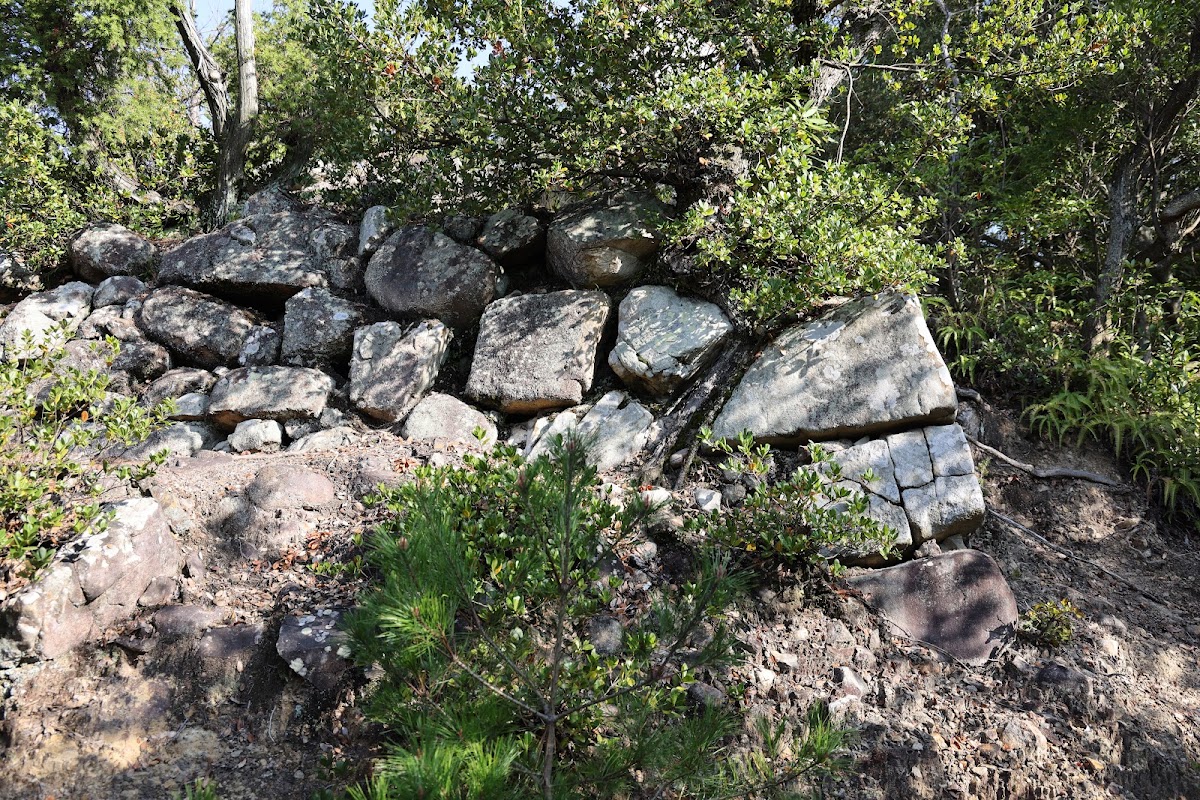
Toramaru Castle (Higashikagawa City, Kagawa Prefecture) Complete Guide | History, Remains, and Access Information
What is Toramaru Castle?
Toramaru Castle is a Sengoku period mountain castle built on Toramaru Mountain (elevation 417m, relative height 395m) in Yodayama, Mizushi, Higashikagawa City, Kagawa Prefecture. Known as the residence of the Kagawa clan, who ruled the eastern Sanuki region, it later became an important base, the stage for fierce battles with the Awa Miyoshi clan and the Tosa Chosokabe clan.
There is a legend that it was named “Toramaru Castle” because it was built in the Year of the Tiger. Its rugged mountain terrain and skillful layout made it a strategic point in eastern Sanuki. Even today, the remains of the main enclosure, moats, and earthworks are well-preserved, conveying the appearance of a Sengoku period mountain castle.
Basic Information on Toramaru Castle
Location and Access
Location: Mizushi, Higashikagawa City, Kagawa Prefecture
Former Province: Sanuki Province
Elevation: 417m
Relative Height: 395m
Map Coordinates: Summit of Toramaru Mountain on Yodayama Mountain
Access Method:
- By Car: Approximately 15 minutes by car from JR Sanuki-Shiratori Station. Use the Toramaru Park or Hiromiji Temple Ruins parking lot.
- Trailhead: A hiking trail is maintained from the Hiromiji Temple Ruins parking lot.
- Climbing Time: Approximately 60-90 minutes from the trailhead to the main enclosure.
Castle Classification and Structure
Classification: Mountain Castle
Structure: Concentric Mountain Castle
Builder: Kangawa Clan (tradition)
Year of Construction: Unknown (tradition says Year of the Tiger)
Main Lords: Kangawa Clan, Yasutomi Clan, Sogawa Masayasu Year of Abandonment: Around 1584 (Tensho 12)
Keep Structure: None (As it was a mountain castle, there was no keep)
Major Remains: Enclosures, moats, earthworks, turret bases, vertical moats
Common Name/Alternate Name
There is no particular alternative name, but it is affectionately known locally as “Toramaruyama Castle.” The name “Toramaru,” derived from the theory that it was built in the Year of the Tiger, is distinctive.
History of Toramaru Castle
Construction and the Rule of the Kagawa Clan
The exact construction date of Toramaru Castle is unclear, but it is believed to have been built by the Kagawa clan, who ruled the eastern part of Sanuki Province. The Kagawa clan were vassals of the Hosokawa clan and ruled Ota County, Kagawa County, and Shodoshima Island, becoming a powerful local family with significant influence in eastern Sanuki.
While there are various theories regarding the construction period, there is a legend that it was named “Toramaru Castle” because it was built in the Year of the Tiger. Utilizing the rugged terrain of Toramaru Mountain, it functioned as a strong mountain castle and one of the strongholds of the Kagawa clan.
Invasion by the Miyoshi Clan and Change of Lord
In 1572 (Genki 3), Miyoshi Nagaharu of Awa Province began his invasion of Sanuki Province. The then-lord of Toramaru Castle, Kagawa Motomasa, was attacked by the Miyoshi forces, and Toramaru Castle fell. The Kagawa clan retreated to Hirune Castle, and Yasutomi Moritada (Yasutomi clan), lord of Amataki Castle and a vassal of the Miyoshi clan, entered Toramaru Castle and became its lord.
This change of lord positioned Toramaru Castle as an important base for the Miyoshi clan’s control of Sanuki. The Yasutomi clan solidified their control over the eastern Sanuki region from Toramaru Castle.
Battle of Nakatomigawa and the Escape of Sogawa Masayasu
In 1582 (Tensho 10), the Battle of Nakatomigawa took place in Sanuki Province. Defeated by the Chosokabe clan of Tosa in this battle, Sogō Masayasu fled to Toramaru Castle and holed up there. Sogō Masayasu was a member of the Miyoshi clan and a central figure in the Miyoshi forces in Sanuki Province.
During this period, Toramaru Castle functioned as an important base for the Miyoshi forces, serving as a stronghold against the Chosokabe invasion of Sanuki. Along with Sogō Castle, it played a crucial role as the last stronghold of the Miyoshi forces.
The Capture and Fall of the Castles by Chōsokabe Motochika
In 1583 (Tenshō 11), Chōsokabe Motochika of Tosa Province, along with the Kagawa clan and others, launched a full-scale invasion of Sanuki Province to capture Sogō Castle and Toramaru Castle, which were Miyoshi strongholds. The Chōsokabe army successively captured Amataki Castle, Ishida Castle, and Tomita Castle, employing a strategy to sever the connection between Sogō Castle and Toramaru Castle.
The isolated Toramaru Castle fell in 1584 (Tensho 12) to an attack by the Chosokabe army, along with Sogō Castle. With this fall, the Miyoshi forces in Sanuki Province completely disappeared, and Toramaru Castle is believed to have ceased to exist and become a ruined fortress.
For Chosokabe Motochika, who aimed to unify Shikoku, the capture of Toramaru Castle was a crucial step in conquering Sanuki, and its fall marked a major turning point in the Sengoku period history of Shikoku.
Toramaru Castle’s Layout and Remains
Characteristics of the Castle Structure
Toramaru Castle is a mountain castle with a series of interconnected enclosures, centered on the summit of Mt. Toramaru (elevation 417m), with small and medium-sized enclosures arranged along the ridges extending east, west, north, and south. Centered around the main enclosure at the highest point, large trenches were constructed, particularly along the ridges extending west and south, creating a defensive structure that skillfully utilizes the rugged terrain of Mt. Toramaru.
The steep location, with a relative elevation of 395m, provided strong defensive capabilities in itself, posing a significant obstacle to attacking forces. The layout, utilizing the ridgeline, is a typical technique of Sengoku period mountain castles, efficiently utilizing limited flat land to construct multiple defensive lines.
Main Enclosure (Honmaru)
Located at the mountaintop, the main enclosure is the most important enclosure and the center of the castle. It has a relatively large, flat area, and it is believed to have housed the lord’s residence and command post. From the main enclosure, one can enjoy a panoramic view of the eastern Sanuki region, overlooking the Harima Sea and the surrounding mountains.
The remains of a watchtower base can also be found within the main enclosure, where the Shingu Shrine now stands. This watchtower base functioned as a lookout tower, an important facility for monitoring enemy movements.
Moats and Vertical Moats
Particularly noteworthy defensive features of Toramaru Castle are the multiple moats that cut off the ridgeline. Large trenches were constructed, particularly on the western and southern ridges, forming a strong defensive line to prevent enemy intrusion.
The trenches are deeply and sharply dug, demonstrating the advanced castle-building techniques of the time. Vertical trenches were also placed on the slopes, ensuring comprehensive protection against attacks from the flanks. These remains are still clearly visible today, making this a valuable historical site that showcases the civil engineering techniques of the Sengoku period.
Enclosures
Several enclosures are arranged along the east-west and north-south ridges, centered around the main enclosure. These enclosures vary in size, each serving a defensive role. The terraced arrangement of the enclosures constituted a multi-layered defensive system designed to progressively hinder the advance of an attacking army.
Traces of earthworks remain in each enclosure, suggesting the presence of fences and walls. Communication routes between the enclosures have also been identified, indicating a well-planned layout within the castle.
Hiking Trail and Points of Interest
Currently, a hiking trail is maintained from the Hiromiji Temple Ruins parking lot to the main enclosure. Signposts are installed along the trail, allowing you to confirm the location of the ruins as you ascend. However, as it is a steep mountain path with a relative elevation of 395m, appropriate physical fitness and equipment are required for the ascent.
The ascent should take approximately 60-90 minutes one way. The route from the trailhead, through the moats and various enclosures to the main enclosure, allows you to enjoy a historical walk while experiencing the defensive structure of a Sengoku period mountain castle.
Highlights of Toramaru Castle
View from the Main Enclosure
The greatest highlight of Toramaru Castle is the magnificent view from the main enclosure. The view of the eastern Sanuki region from the 417m-high summit is breathtaking, offering panoramic views of Harima Nada, the town of Hikita, and the surrounding mountains. On clear days, Shodoshima Island can be seen, and it’s likely that the former lords of the castle also gazed upon this view while watching over their territory.
This view held significant importance not only for its scenic beauty but also for its military surveillance function. Its location overlooking the Harima Sea, a crucial point for maritime traffic, was of great value in terms of information gathering.
Shingu Shrine and Watchtower Base
The Shingu Shrine currently stands on the site of the watchtower base of the main enclosure. This shrine is an object of local worship, reflecting the history of the castle ruins being protected by the community. The stonework and flat surface of the watchtower base retain their original appearance, allowing us to imagine how the watchtower was positioned.
Large-Scale Moats
The large-scale moats remaining on the western and southern ridges are important remains that demonstrate the construction techniques of Toramaru Castle. The moats, several meters deep, give a real sense of the scale of the civil engineering work carried out by hand during the Sengoku period. You can closely observe the defensive features, such as the cross-sectional shape and width of the moat, and the structure that completely blocks the ridge.
Continuous Group of Enclosures
The continuous group of enclosures along the ridgeline demonstrates the ingenious layout unique to mountain castles. The large and small enclosures, arranged to suit the terrain, are the culmination of ingenuity in maximizing the limited flat land. There is enjoyment in deciphering the defensive strategy from the elevation differences and arrangement of the enclosures.
Related Historical Sites in the Surrounding Area
Hirune Castle
Hirune Castle, where the Kagawa clan retreated after being driven out of Toramaru Castle by the Miyoshi clan, is closely related to Toramaru Castle. Understanding its connection to Hirune Castle is a crucial element in tracing the history of the Kagawa clan.
Amataki Castle
Amataki Castle, the base of the Yasutomi clan who became the lords of Toramaru Castle, is also an indispensable related historical site for understanding the history of Toramaru Castle. During the Chosokabe clan’s invasion of Sanuki, Amataki Castle was captured before Toramaru Castle.
Sogō Castle
Sogō Castle, along with Toramaru Castle, was the last stronghold of the Miyoshi forces and the base of Sogō Masayasu. The historical context of the two castles’ cooperation, isolation, and simultaneous fall is crucial for understanding the situation in Sanuki during the Sengoku period.
Hikida Castle
Located in Higashikagawa City, Hikida Castle is known as a coastal castle facing the Seto Inland Sea, and its location and structure are in stark contrast to Toramaru Castle. Visiting both castles allows you to compare the differences between mountain castles and coastal castles.
Toramaru Park
Located at the foot of Toramaru Castle, Toramaru Park is named after the castle. It can be used as a starting point for climbing to the castle and has rest facilities.
Points to Note When Climbing
Equipment and Clothing
Toramaru Castle is a full-fledged mountain castle with a relative elevation of 395m, and appropriate equipment is necessary for climbing it. Prepare trekking shoes, comfortable clothing, drinking water, a towel, and rain gear. In summer, insect repellent is essential, and in winter, warm clothing is a must.
Estimated Time Required
The round trip from the trailhead to the main enclosure should take approximately 2-3 hours. If you plan to carefully observe the ruins, it will take even longer. Plan your itinerary with ample time.
Safety Considerations
The mountain path is steep, so pay close attention to your footing. It becomes especially slippery during and after rain. Climbing in groups is recommended over solo visits. Check your cell phone signal strength beforehand.
Best Time to Visit
Spring (March-May) and autumn (October-November) are the best times to visit. In summer, be aware of the heat and insects, and in winter, the shorter daylight hours require early departure. The seasons of fresh greenery and autumn leaves are particularly beautiful and highly recommended.
Historical Significance of Toramaru Castle
Toramaru Castle can be considered a microcosm of the power struggles in Sanuki Province during the Sengoku period. The transition of rulers from the Kagawa clan to the Miyoshi clan, and then to the Chosokabe clan, symbolizes the rise and fall of Sengoku-era daimyo in Shikoku.
In particular, the capture of Toramaru Castle held significant importance in Chosokabe Motochika’s unification of Shikoku. The fall of Toramaru Castle, the last stronghold of the Miyoshi forces, marked the end of the Sengoku period in Sanuki.
The well-preserved remains today are a valuable historical asset that conveys the castle-building techniques and strategies of the time. Experiencing the structure of this rugged mountain castle allows one to understand the realities of the battles faced by Sengoku warlords.
Summary
Toramaru Castle is a Sengoku-era mountain castle built on Toramaru Mountain in Higashikagawa City, Kagawa Prefecture, boasting a rugged location at an altitude of 417m and a relative height of 395m. It began as the residence of the Kagawa clan and is a historically important fortress that served as the stage for battles against the Miyoshi and Chosokabe clans.
The remains of the main enclosure, moats, and baileys are well-preserved, conveying the appearance of a mountain castle from the Sengoku period. The view from the main enclosure is magnificent, offering a panoramic view of the eastern Sanuki region. While climbing requires a certain level of physical fitness, it’s a castle site where you can fully appreciate the charm of a mountain castle.
This castle site is a must-visit for anyone interested in the Sengoku history of Shikoku or those who want to enjoy a full-fledged mountain castle tour. A hiking trail is maintained from the Hirokaiji Temple Ruins parking lot, so prepare appropriate equipment and experience the romance of Sengoku history.