Ganjaku Castle (Fukuoka Prefecture) Complete Guide | History, Highlights, and Hiking Routes of Buzen’s Strongest Castle
Overview of Ganjaku Castle
Ganjaku Castle was a Japanese mountain castle located at 1788-2 Soeda, Soeda-machi, Tagawa-gun, Fukuoka Prefecture. A typical mountain castle with its main enclosure at the summit of Mt. Ganjaku (454 meters above sea level), its robust structure earned it the reputation of “Buzen’s Strongest Castle,” and it functioned as an important base in the northern Kyushu region from the medieval period to the Sengoku period.
Currently, a replica castle tower has been constructed in Soeda Park at the foot of the mountain, making it a popular tourist spot for history enthusiasts and hikers. The castle ruins hold an important position in the history of Japanese castles, both as a historical heritage site of Fukuoka Prefecture and as a representative mountain castle of the Chikuhō region.
Basic Information
- Location: 1788-2 Soeda, Soeda-machi, Tagawa-gun, Fukuoka Prefecture
- Elevation: 454 meters
- Castle Structure: Mountain castle
- Year of Construction: Hogen 3 (1158)
- Builder: Oba Kagechika (by order of Taira no Kiyomori)
- Year of Abandonment: Genna 1 (1615)
- Main Lords: Oba clan, Kikuchi clan, Otomo clan, Ouchi clan, Akizuki clan
- Remains: Enclosures, stone walls, moats
- Reconstructed Structures: Mock keep (built in 1991)
- Access: Approximately 2 hours on foot from Soeda Station on the JR Hitahikosan Line (to the summit)
A Mountain Castle Known as the Strongest Fortress in Buzen Province
The reason why Iwaishi Castle was called the “strongest fortress in Buzen Province” lies in its location and structure. Built on the summit of the steep Iwaishi Mountain, at an altitude of 454 meters, the castle had a defensive system that made maximum use of the natural terrain.
Centered around the main enclosure at the summit, multiple baileys were arranged in a stepped fashion, each separated by deep moats. The north and east sides, in particular, were sheer cliffs, making it extremely difficult for attackers to approach. Artificial moats and earthworks were constructed on the south and west sides, designed to withstand attacks from all directions.
This formidable strength was proven in actual battles; from the medieval period to the Sengoku period, it was the site of numerous battles, yet it remained an impregnable fortress that did not easily fall. In Buzen Province (present-day eastern Fukuoka Prefecture and northern Oita Prefecture), the strategic value of Iwaishi Castle was highly regarded.
History of Iwaishi Castle
Construction in the Late Heian Period
The history of Iwaishi Castle dates back to the late Heian period, specifically to the third year of the Hogen era (1158). It is said that Taira no Kiyomori, who was serving as the Dazai Daini (Vice-Governor of Dazaifu) in Kyushu at the time, ordered his retainer, Oba Heiza Kagechika, to construct the castle.
Taira no Kiyomori recognized the need to secure a base in Kyushu as he sought to expand the power of the Taira clan. Iwaishi Castle was located near the border of Buzen and Chikuzen provinces, and also controlled the pilgrimage route to Mount Hiko, making it a politically and militarily important location. Oba Kagechika, a powerful retainer of the Taira clan, built a strong mountain castle in this strategic location.
Struggle for Control in the Medieval Period
From the Kamakura period to the Muromachi period, Iwaishi Castle became the target of fierce struggle among powerful local clans in Kyushu. The Kikuchi, Otomo, Ouchi, and Akizuki clans, among others, were among the powerful figures of each era who vied for control of this castle.
Particularly during the Nanboku-cho period (Northern and Southern Courts period), it became a battleground for the conflict between the Southern and Northern Courts, resulting in numerous changes of castle lords. During the Muromachi period, it came under the influence of the Ouchi clan and functioned as an important base for controlling Buzen Province. Later, during the Sengoku period (Warring States period), the Akizuki clan became the castle lords, making it a frontline conflict with the Otomo clan of Bungo Province.
Toyotomi Hideyoshi’s Kyushu Campaign and the Fall of Iwaishi Castle
The most dramatic event in the history of Iwaishi Castle was Toyotomi Hideyoshi’s Kyushu campaign in April of Tensho 15 (1587). Aiming to pacify Kyushu, Hideyoshi designated Iwaishi Castle as a crucial target.
Hideyoshi dispatched powerful generals Maeda Toshinaga and Gamo Ujisato, and besieged Iwaishi Castle with a large army. Iwaishi Castle, known as “the strongest castle in Buzen Province,” fell in just one day due to the overwhelming difference in troop numbers and the skillful siege tactics of Hideyoshi’s army.
This swift capture demonstrated the military power of the Akiyoshi army to the surrounding daimyo and accelerated the subsequent conquest of Kyushu. The fall of Iwaishi Castle was also a symbolic event marking the end of the era of medieval mountain castles.
Abandoned Castles in the Edo Period
After the Kyushu campaign, Iwaishi Castle was temporarily managed by a Toyotomi general, but after the Battle of Sekigahara, it came under the control of the Kokura Domain. However, in 1615, when the Tokugawa Shogunate issued the “One Castle Per Province” decree, Iwaishi Castle was abandoned.
The “One Castle Per Province” decree was a policy that allowed each domain to retain only one castle, and ordered the demolition of other castles. In the Kokura Domain, only Kokura Castle was allowed to survive, and its subsidiary castles, including Iwaishi Castle, were demolished. Thus, the history of Iwaishi Castle, spanning approximately 450 years, came to an end.
Current Iwaishi Castle
Construction of a Replica Castle Tower
Approximately 380 years after the castle’s abandonment, in 1991 (Heisei 3), Soeda Town constructed a replica castle tower in Soeda Park at the foot of the mountain, with the aim of promoting regional development and creating a tourist resource. The construction cost is estimated at approximately 300 million yen.
This replica castle tower was not built based on historical documents, but rather as a structure with an observation deck function as a tourist facility. While its exterior mimics a typical Japanese castle architectural style, there is no evidence that a castle tower ever existed at the actual Iwaishi Castle. Medieval mountain castles typically did not have castle towers, instead consisting mainly of baileys and turrets.
Use as an Observation Deck
Currently, the replica castle tower is open to the public free of charge and can be used as an observation deck. From inside the tower, you can enjoy a panoramic view of Soeda Town, and on clear days, you can even see the mountains of the Chikuhō region and, in the distance, Mount Hikosan.
Inside the building, explanatory panels about the history and structure of Iwaishi Castle are displayed, allowing visitors to learn about the castle’s history while enjoying the scenery. It’s a particularly popular spot, attracting many tourists during the cherry blossom season in spring and the autumn foliage season.
Development of Soeda Park
Soeda Park, where a replica castle tower stands, is developed as a place of relaxation blessed with a natural environment. Walking paths are provided within the park, allowing visitors to enjoy the plants of each season. Rest facilities and parking are also available, making it easily accessible for families.
A hiking trail leading to the main keep ruins at the summit is also maintained from the park, serving as a starting point for those who want to enjoy a full-fledged mountain castle exploration.
About Iwaishi Mountain
Geographical Characteristics
Iwaishi Mountain is a 454-meter-high mountain located on the border of Soeda Town and Aka Village in Tagawa District, Fukuoka Prefecture. It forms part of the Chikuhō Mountains and is located at the northwestern end of the Hikosan mountain range. The mountain’s name is thought to originate from the abundance of exposed rocks on its surface.
From the summit, a 360-degree panoramic view unfolds, offering views of Kitakyushu City to the north, Mt. Hikosan to the south, the mountains bordering Oita Prefecture to the east, and the Chikuhō Plain to the west. This excellent view was one of the factors that enhanced its value as a military base.
Natural Environment
Mt. Iwaishi is blessed with abundant nature and diverse flora. From the foothills to the middle of the mountain, there are plantations of cedar and cypress, while natural forests remain from the middle of the mountain to the summit. In spring, azaleas and mountain cherry blossoms color the mountain; in summer, fresh greenery; and in autumn, vibrant autumn leaves.
Many wild animals inhabit the area, including mammals such as wild boars, deer, and raccoons, as well as a variety of birds. Caution is advised when hiking to avoid encounters with wild animals.
Overview of Hiking Routes
There are mainly two hiking routes to Mt. Iwaishi: one from Soeda Town and the other from Aka Village. Both routes take approximately 1.5 to 2 hours to reach the summit and are suitable for intermediate hikers. The hiking trail is relatively well-maintained, but there are steep sections and rocky areas, so appropriate equipment and preparation are necessary. Especially in summer, temperatures are high, so adequate hydration and heatstroke prevention are crucial.
Hiking Trail from Soeda Town
Access and Starting Point
The hiking trail from Soeda Town starts at Soeda Station on the JR Hitahikosan Line. It’s about a 15-minute walk from the station to Soeda Park, where the main hiking trail begins. There is a parking lot at the park, so access by car is also possible.
After visiting the replica castle tower in Soeda Park, enter the hiking trail that continues from the back of the park. An information board is installed at the trailhead, showing the route and estimated time.
Route Characteristics
The route from Soeda Town is the most common and frequently used course. The initial part is a relatively gentle slope through a wooded area, but from the middle onwards, the slope becomes steeper and rocky areas appear.
Along the way, at an altitude of approximately 200 meters, there is a viewpoint overlooking the town of Soeda. Many hikers take a break here, and beginners can even use this as their turnaround point.
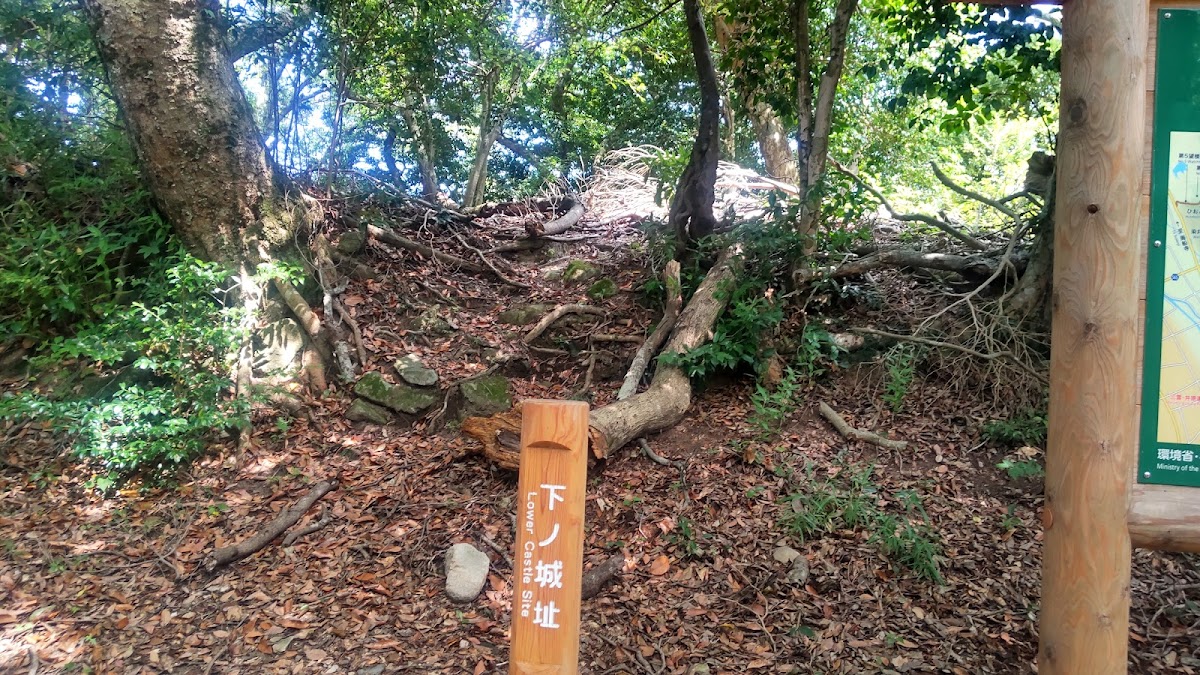
Near the summit, remnants of moats and baileys remain, allowing you to observe the castle’s ruins as you climb. The large moat just before the main bailey is a particularly valuable relic, revealing a part of the defensive system of the time.
Summit Main Bailey Site
The main bailey site at the summit is a flat, leveled open area, retaining the appearance of the former main bailey. Traces of stone walls and earthworks can be seen around, allowing you to truly appreciate the castle’s structure.
A castle site monument stands at the main bailey site, along with an explanatory sign briefly detailing the history of Iwaishi Castle. The view from here is breathtaking, allowing you to understand why this place was called “Buzen’s strongest castle.”
Hiking Trail on the Akamura Side
Route Characteristics
The route from the Akamura side is slightly longer than the route from the Soeda Town side, offering a more tranquil mountain hike. The trail begins in the Uchida area of Akamura and follows the ridge to the summit.
This route is relatively less used, making it suitable for those who want to experience nature more deeply. Along the way, you can see the remains of several subsidiary castles and outposts, making it an interesting route for understanding the entire castle system of Iwaishi Castle.
Remains of Outposts
The Akamura side route contains the remains of outposts (tsukejiro) believed to have been built during Toyotomi Hideyoshi’s Kyushu campaign. Outposts were temporary encampments built around enemy castles during attacks, and these are thought to have been constructed by Hideyoshi’s army during the siege of Iwaishi Castle.
These remains can still be seen today as earthworks and flat areas, making them valuable historical sites that convey the details of siege warfare during the Sengoku period.
The Charm of Iwaishi Castle
Highlights of the Castle Remains
The greatest charm of Iwaishi Castle lies in its well-preserved remains as a medieval mountain castle. Multiple baileys are arranged in a stepped pattern around the main enclosure, and the moats and earthworks separating each bailey are clearly visible.
Particularly noteworthy are the stone walls, which utilize natural bedrock. Unlike the stone walls of early modern castles, which are constructed from processed stones, these walls showcase a unique medieval technique that skillfully utilizes natural rock. Furthermore, the defensive line utilizing the cliffs at the mountaintop demonstrates the high level of castle-building technology.
Historical Value
Iwaishi Castle was a mountain castle that functioned for approximately 450 years, from the late Heian period to the early Edo period. During that time, various forces that colored Japanese medieval history—the Taira clan, the Kamakura Shogunate, the Nanboku-cho period, the Muromachi Shogunate, the Sengoku daimyo, and the Toyotomi regime—fought over this castle.
This long history demonstrates that Iwaishi Castle was not merely a local mountain castle, but a strategically important political and military center in northern Kyushu. Tracing the castle’s history provides a concrete understanding of the flow of Japanese medieval history.
Scenery and Nature
The charm of Iwaishi Castle lies not only in its history. The 360-degree panoramic view from the 454-meter-high mountaintop is breathtaking, offering a sweeping view of the Chikuhō region’s geography. On clear days, you can even see as far as the Kanmon Strait.
The changing seasons are another major attraction. The fresh greenery of spring, the deep green of summer, the vibrant autumn foliage, and the snowy winter landscape all present different faces with each season. It’s truly a spot where you can enjoy both historical exploration and nature observation simultaneously—a win-win situation.
Practical Information for Visitors
Access Methods
Public Transportation
- Get off at Soeda Station on the JR Hitahikosan Line, then walk approximately 15 minutes to Soeda Park (mock castle tower).
- It’s another 1 hour 30 minutes to 2 hours on foot to the main castle ruins at the summit.
By Car
- Approximately 40 minutes from Yahata IC on the Kyushu Expressway via National Route 322.
- Free parking is available at Soeda Park (approximately 50 cars).
Precautions for Visitors
- If climbing to the summit, appropriate clothing and shoes for hiking are required.
- Always bring drinking water (there are no water sources on the mountain).
- In summer, take precautions against heatstroke; in winter, take precautions against the cold.
- It is recommended to carry a bell or similar device as you may encounter wild animals.
- Cell phone reception is unstable in some areas.
- If hiking alone, be sure to inform your family or others of your hiking plan.
Estimated Visiting Time
- Visiting only the replica castle tower at Soeda Park: 30 minutes to 1 hour
- Round trip to the main keep ruins at the summit: 3 to 4 hours
- For a thorough observation of the castle ruins: 4 to 5 hours
Best Season
The best time to visit Iwaishi Castle is spring (April to May) and autumn (October to November). The weather is mild, and you can enjoy cherry blossoms and fresh greenery in spring, and autumn leaves in fall. Summer is hot and carries a risk of heatstroke, and winter has the possibility of snowfall and freezing temperatures, so it is best to avoid these times unless you are an experienced hiker.
Nearby Tourist Attractions
Mount Hikosan
Located about 10 kilometers south of Iwaishi Castle, Mount Hikosan is a sacred mountain with an elevation of 1,199 meters and has long been known as a sacred site for Shugendo (mountain asceticism). It is counted as one of Japan’s three major Shugendo mountains, and is home to Hikosan Shrine and many other temples and shrines.
Historical Spots in Soeda Town
Besides Iwaishi Castle, Soeda Town boasts many other historical sites. Visiting the old streets scattered throughout the town and the museums showcasing local history will provide a deeper understanding of the region’s history.
Castles in the Chikuhō Region
In addition to Iwaishi Castle, many medieval castles remain in the Chikuhō region of Fukuoka Prefecture. Visiting distinctive mountain castles such as Shōjigatake Castle, Takatoriyama Castle, and Iwaya Castle will offer a more comprehensive understanding of the region’s medieval history.
Iwaishi Castle and the History of Japanese Castles
A Typical Example of a Medieval Mountain Castle
Iwaishi Castle is attracting attention in the field of castle research as a castle with a typical structure of a medieval Japanese mountain castle. It retains many characteristics of medieval castles, including a layout that maximizes the use of natural terrain, a multi-layered defensive system using baileys and moats, and stone walls utilizing bedrock.
As a valuable historical site that preserves the image of a mountain castle as a pure military facility, distinct from the flatland castles and hill castles of the early modern period, it is highly valued for its academic significance.
Position in Kyushu’s Castle Culture
A unique castle culture developed in the Kyushu region. Iwaishi Castle is representative of the mountain castle culture of northern Kyushu. Located in Buzen Province, a strategic point connecting Kyushu and Honshu, it functioned as a point of contact between central power and local forces in Kyushu.
This geographical location gave Iwaishi Castle a complex history and simultaneously increased its importance as a fortress. Iwaishi Castle is indispensable for understanding the history of castles in Kyushu.
Summary
Iwaishi Castle is a historically significant mountain castle located in Soeda-machi, Tagawa-gun, Fukuoka Prefecture. From its construction at the end of the Heian period until its abandonment in the early Edo period, it functioned as a strategic point in northern Kyushu for approximately 450 years and was feared as “the strongest castle in Buzen.”
Currently, a replica keep stands at the foot of the mountain, allowing visitors to easily experience its history. On the other hand, if you climb to the main keep ruins at the summit, you can enjoy the well-preserved castle remains and magnificent views. It’s an attractive spot that can be enjoyed by history buffs, hiking enthusiasts, and families alike.
When visiting Fukuoka Prefecture, be sure to visit Iwaishi Castle and experience the atmosphere of the medieval and Sengoku periods. The view of Chikuhō from the 454-meter-high summit will surely be an unforgettable memory.